Skip to content
You may feel your case was handled unfairly. After presenting clear evidence that circumstances have changed and showing why a new arrangement is in your child's best interest, the court's final order may still feel unjust. When a judge denies a necessary modification or issues an order that fails to protect your child, it can be a devastating blow.
However, a trial court's decision is not always the final word. The Texas appellate process exists to correct legal errors and ensure that family law rulings are fair and just. If you believe the court made a mistake in your custody modification case, an appeal may be your path to restoring balance for your family. This process is complex, but with the right guidance, it is a powerful tool for seeking justice.
Understanding When You Can Modify a Custody Order
Life is not static, and a court order that once made sense may no longer serve your child's well-being. The Texas Family Code is designed to adapt to these changes, but it also prioritizes stability for children. Courts will not modify an order for minor inconveniences; you must present a legally sound reason to reopen the case.
The entire modification process is built on a two-part legal test. First, you must prove there has been a "material and substantial change in circumstances" since the last order was signed. Second, and most importantly, you must demonstrate that modifying the order is in the "child's best interest."
Sometimes, even with a strong case, a judge gets it wrong. If a court denies a modification that is clearly needed or issues an order that is not supported by the evidence, that is precisely when understanding your appellate options becomes critical. An appeal isn't a second trial, but it is a vital check on the legal system to correct a significant mistake.
The "Material and Substantial Change" Standard
This legal standard is the key that unlocks the courthouse door. A "material and substantial change" must be a significant shift in the lives of the child or parents that occurred after the current order was signed. A temporary issue or a minor disagreement will not be enough.
So, what does this look like in practice? While every case is unique, Texas courts consistently recognize certain events as meeting this standard:
- A parent is relocating. A planned move, particularly to a new city or out of state, is a classic trigger for modification.
- A major change in a parent's schedule or employment. If a new work schedule, such as overnight shifts or constant travel, makes the existing possession order unworkable, this can be a material change.
- The child's needs have evolved. A toddler's needs are vastly different from a teenager's. A parenting plan may need to be updated to accommodate new medical, educational, or emotional requirements.
- The child is in an unsafe environment. This is an urgent matter. The presence of substance abuse, family violence, or neglect in a parent’s home is an immediate red flag for any judge.
- A parent consistently violates the court order. If one parent willfully and repeatedly ignores the possession schedule or denies access to the child, the court can intervene.
The court’s focus is always on how a change directly affects the child. You must draw a clear line connecting the event to your child's well-being. A parent's new relationship, for example, is not a material change on its own. However, if that new partner has a history of abuse, it becomes a critical issue for the child's safety.
To clarify, let's compare common life events with what the court considers legally significant.
Grounds for Modification vs. Common Life Changes
| Common Life Change (Usually Not Enough) | Material and Substantial Change (Potential Grounds for Modification) |
|---|---|
| A minor increase or decrease in one parent's income. | One parent loses their job and can no longer provide a stable home. |
| One parent gets remarried or starts a new relationship. | A new partner in the home has a criminal history or is abusive to the child. |
| A parent and child have a minor disagreement or argument. | The child expresses a clear and mature desire to live with the other parent (if over 12). |
| The child has a new extracurricular activity that clashes with the schedule. | The child develops a serious medical condition requiring specialized care near one parent. |
| A parent moves to a new apartment in the same school district. | A parent is planning an out-of-state move that would upend the child's life. |
This table illustrates the kind of significant impact a judge is looking for. The change must fundamentally alter the child's circumstances.
Proving the Change Is in the Child’s Best Interest
Establishing a material and substantial change is only the first step. The most critical part of your case is proving that your proposed new arrangement is truly in your child's best interest. This is the guiding principle for every decision a Texas family court makes.
This is where the facts and evidence become everything. You need to present a compelling case showing how your proposed changes will provide your child with a more stable, nurturing, and safe life.
If you present overwhelming evidence demonstrating what is best for your child and the court rules against it, that decision may constitute what is known as an "abuse of discretion." In plain English, this is a specific type of legal error where the judge's decision was arbitrary, unreasonable, or made without proper consideration of the facts or law. It is a strong basis for an appeal, allowing a higher court to review the decision for fairness and legal accuracy.
The Two Paths for Changing Your Custody Agreement
Once you have identified a material and substantial change, you have two potential paths forward: reaching an agreement with the other parent or asking a judge to decide the issue. The path you take will significantly impact the time, cost, and emotional energy required to secure a new order that serves your child's best interests.
Path 1: Modification by Agreement
The simplest and most collaborative way to change a custody order is by reaching an agreement with your co-parent. This involves negotiating the new terms and formalizing them in an Agreed Order that is signed by a judge. This approach keeps you and your co-parent in control, rather than ceding that power to the court.
Even if you disagree on some points, negotiation can be successful. Learning how to prepare for mediation can equip you with the tools to find common ground.
The benefits of an agreed modification include:
- Cost Savings: It avoids the significant legal fees associated with a contested court battle.
- Faster Resolution: An agreed order can often be finalized in weeks, compared to the months or even years litigation can take.
- Reduced Conflict: Working together benefits your long-term co-parenting relationship and, by extension, your child.
CRITICAL NOTE: A verbal agreement is not legally enforceable. All changes must be written into a formal court order, signed by the judge, and filed with the court clerk to become official. Do not skip this crucial step.
Path 2: Filing a Petition to Modify
When an agreement is impossible, you must ask the court to intervene. This formal process begins by filing a Petition to Modify the Parent-Child Relationship. This legal document outlines the changes you are requesting and explains why they are necessary and in the child's best interest.
After filing the petition, you must provide formal notice to the other parent through a procedure called service of process, as required by the Texas Rules of Civil Procedure. This ensures they have a fair opportunity to respond to the lawsuit.
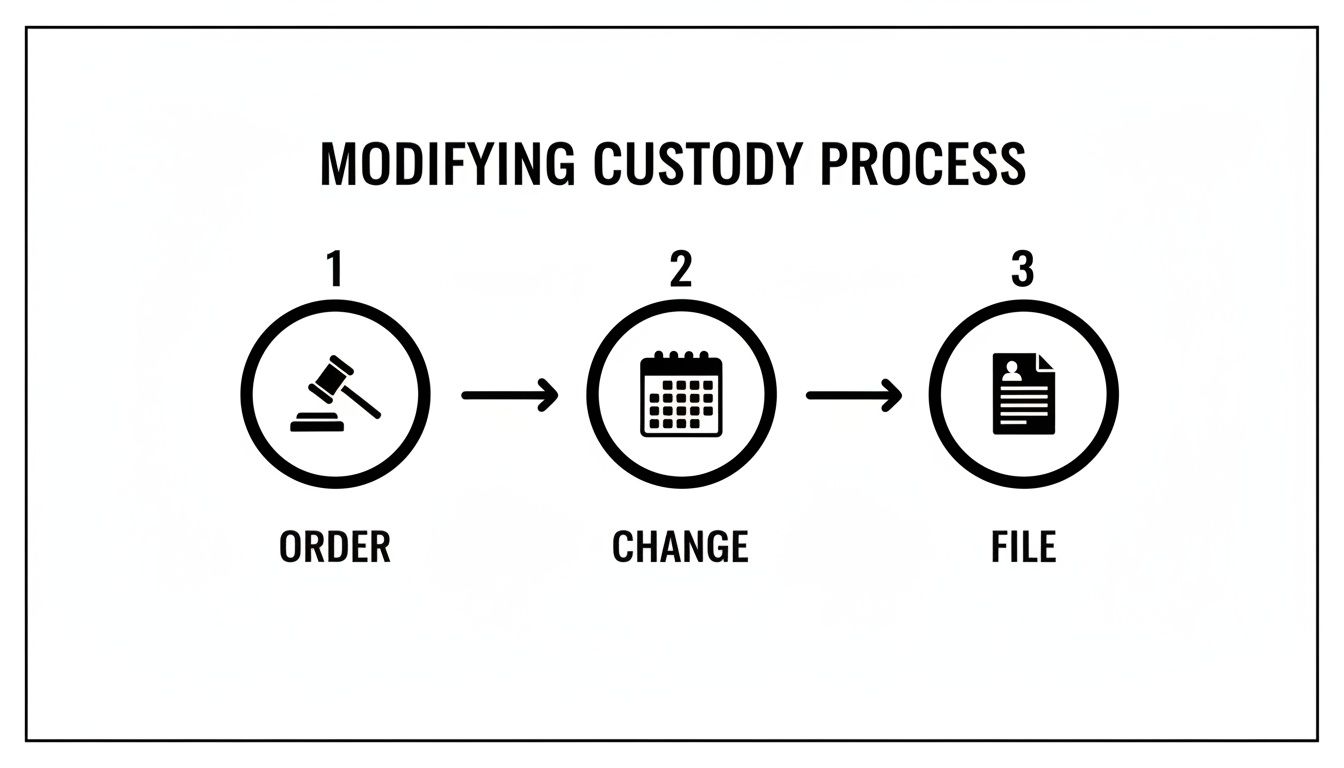
This flowchart shows the basic process: an existing order, a significant change in circumstances, and the formal filing of a petition to start the modification case.
What About Emergencies?
If your child is in immediate physical or emotional danger, you do not have to wait months for a final hearing. Texas law allows you to request Emergency or Temporary Orders for immediate protection. You can file for a Temporary Restraining Order (TRO) along with your modification petition.
A TRO can prevent the other parent from taking the child out of state, using drugs or alcohol around them, or allowing a dangerous individual to have contact with them. These orders are a vital tool for ensuring a child's safety while the case proceeds.
The Modern Shift Toward Shared Parenting
If you are seeking to modify your custody order to achieve a more balanced possession schedule, you should know that the legal landscape supports your goal. The outdated notion of one parent being the "primary" caregiver is fading. Texas law and courts increasingly recognize that children thrive when both parents are actively and meaningfully involved in their lives.
This is not just a social trend; it is a legal one. Judges are now more likely to view shared parenting as the starting point for what is in a child's best interest, provided both parents are fit and capable. This gives you a strong foundation when arguing for a more equitable possession schedule.

Why This Trend Matters for Your Modification Case
This shift toward co-parenting is highly relevant in a modification case. You are asking a judge to evaluate your family's current circumstances and determine what is best for your child now. An older order that heavily favors one parent may no longer align with modern legal standards or your family's reality.
Statistics reflect this evolution. Over the past three decades, shared physical custody has more than doubled, increasing from 13% of divorce cases before 1985 to 34% between 2010 and 2014. This data shows a clear judicial trend that provides important context for your case.
This gives you a powerful angle for your argument. For example, if your work schedule has become more flexible, you can frame your request as a positive change that allows for a co-parenting arrangement that will directly benefit your child.
Connecting Shared Parenting to Texas Law
The Texas Family Code explicitly encourages "frequent and continuing contact" with parents who act in the child's best interest. Your task in a modification case is to prove that you are one of those parents.
You can build a stronger case by demonstrating that you:
- Are stable and reliable. This is foundational. Evidence of steady employment, a safe home, and responsible decision-making is crucial.
- Encourage the child’s relationship with the other parent. Judges look for parents who support the child’s bond with the other parent, not those who undermine it.
- Are actively involved. Show, don't just tell. Document your participation in parent-teacher conferences, medical appointments, and extracurricular activities to prove your deep involvement.
This focus on shared parenting is a key principle in Texas custody law. To learn more about how it works in practice, review our guide on achieving joint custody in Texas.
If a trial court issues a restrictive order that ignores your stability and your efforts to co-parent, that ruling could be considered an "abuse of discretion." An appellate court can review whether the judge failed to properly apply the modern legal presumption that shared parenting is often what is best for a child.
Ultimately, a successful modification comes down to showing the court how a new, more balanced schedule serves your child's current needs. By framing your arguments within this modern legal context, you are advocating for what is essential for your child's well-being.
How to Build a Rock-Solid Case for Your Modification
Winning a custody modification requires more than just telling a judge that things have changed; you must show them with credible evidence. A strong case is built with facts that paint a clear picture of why the old order is no longer working and why your proposed changes are in your child’s best interests.
Think of yourself as an investigator for your own case. Every text message, report card, and calendar entry can become a crucial piece of evidence to present to the court.

Start Gathering Your Essential Documents Now
Your goal is to tell a compelling story—backed by facts—that clearly demonstrates the material and substantial change. Here is what to start collecting:
- Communication Logs: This is a powerful tool. Save every text, email, and message from co-parenting apps. These logs can show patterns of behavior, whether it is the other parent's consistent tardiness, hostility, or lack of cooperation.
- School Records: A child’s academic performance provides a window into their well-being. Report cards, attendance records, and communications from teachers can show whether a child is thriving or struggling under the current schedule.
- Medical and Therapy Records: If your child's health needs have changed or they are seeing a counselor, these professional records offer objective, third-party insights into their emotional state and the impact of their environment.
- Financial Documents: If child support is at issue or a parent's financial instability is the reason for the change, you will need documentation like pay stubs, tax returns, and bank statements.
Sometimes, the "material and substantial change" involves sensitive issues like substance abuse. Understanding topics like how to help an alcoholic spouse can be relevant in demonstrating how a child's environment has become unsafe.
To help you organize, here is a checklist of essential evidence for a custody modification case.
Essential Evidence Checklist for Your Custody Modification Case
| Evidence Category | Specific Examples | Why It's Important |
|---|---|---|
| Communication Records | Text messages, emails, co-parenting app logs (OurFamilyWizard, AppClose). | Shows patterns of communication, cooperation (or lack thereof), and behavior over time. |
| Child's Performance | Report cards, attendance records, teacher communications, awards, disciplinary notices. | Provides a neutral, third-party view of how the child is faring under the current order. |
| Financial Information | Pay stubs, tax returns (last 2 years), bank statements, proof of new employment. | Crucial for any changes to child support or if financial stability is a key issue. |
| Health & Wellness | Doctor's visit summaries, therapy notes (if permissible), prescription records. | Documents the child's physical and mental health and any changing needs. |
| Parental Conduct | Criminal records, photos/videos of unsafe environments, social media posts. | Can demonstrate behavior that directly endangers the child's well-being. |
| Witness Information | Names and contact info for teachers, counselors, neighbors, or family members. | Their testimony can corroborate your claims about the change in circumstances. |
This list provides a foundation for a well-prepared case. The more organized and thorough you are, the more credible your petition will be.
What is the Discovery Process?
After filing your Petition to Modify, evidence-gathering becomes more formal through a process called discovery. Governed by the Texas Rules of Civil Procedure, discovery is a set of legal tools that allow you to request information from the other parent.
The main tools include:
- Interrogatories: Written questions that the other party must answer under oath. For example, you could ask for the names of all adults who have resided in their home while the child was present.
- Requests for Production: Formal requests for documents, such as the other parent's bank statements, employment contract, or text messages related to visitation.
- Depositions: An out-of-court interview where your attorney questions the other parent under oath, with a court reporter transcribing the testimony. It is an effective way to get their story on the record.
Discovery is not a fishing expedition; every request must be relevant to the issues in the case. However, when used strategically, it is one of the best ways to build the factual foundation needed to win.
Ultimately, success in a custody case—at trial or on appeal—depends on the strength of the evidence. For a deeper look at how evidence can shape your case, see our guide on how to win custody battles. A well-documented case not only persuades a trial judge but also creates a strong record that is essential if an appeal becomes necessary.
Challenging an Unfair Ruling Through an Appeal
You’ve poured everything into your case. You clearly showed a material and substantial change in circumstances and laid out exactly why your proposed changes are in your child’s best interest. So what happens when the judge just gets it wrong? When a court denies your request or issues a new custody order that feels completely unjust, it can be a devastating blow.
But that’s not necessarily the end of the road. This is where the appellate process comes into play. It's crucial to understand that an appeal is not a do-over. You don't get to bring in new evidence or rehash your entire case. Think of the appellate court as a review board, carefully scanning the trial court's record for specific legal mistakes.
An appeal is your chance to fight for justice when you believe the law was misapplied or a decision was made that fundamentally failed to protect your child. The process is tough and full of strict rules, but it exists for a reason: to correct errors and ensure a fair outcome.
Understanding the Standard of Review
In most Texas custody modification appeals, the higher court looks for something called an "abuse of discretion." This is a critical legal concept you need to grasp.
- Abuse of Discretion: This legal term means the trial judge's decision was so arbitrary, unreasonable, or unsupported by the evidence that it was completely outside the realm of reasonable disagreement. In plain English, the judge made a call that no other reasonable judge would have made with the same facts and law.
This can happen for a few reasons. For instance, the judge might have:
- Ignored clear, undisputed evidence presented at trial.
- Completely misinterpreted or misapplied the Texas Family Code.
- Made a decision based on personal bias instead of the facts.
Proving this is a high bar to clear, there's no doubt about it. But it’s far from impossible when you have a sharp legal argument that pinpoints exactly where and how the trial court went off track.
Reversible Error and the Path to a New Outcome
The ultimate goal of your appeal is to prove a "reversible error" occurred. This isn't just any minor mistake; it's a legal blunder so significant that it likely led the trial court to the wrong conclusion. It’s an error that, if it hadn't happened, would have probably resulted in a different, more just outcome for your family.
A common reversible error in custody cases is when a judge fails to properly weigh all the "best interest" factors. For example, they might fixate on one single factor while ignoring all the others, leading to a lopsided decision that the evidence just doesn't support.
The entire appeal hinges on a powerfully written legal document called a brief. This is much more than a summary of events. It’s a meticulously researched argument that weaves the facts of your case together with established law and legal precedent. Your appellate attorney uses this brief to convince the higher court that a serious error was made and that the original decision must be corrected. For a broader look at the modification process itself, check out our guide on how to change a custody agreement in Texas.
Sometimes, looking at broader trends can add valuable context to an appeal, especially in a global hub like Texas. For example, joint physical custody (JPC) has seen a massive increase in Europe, with 20.7% of children in separated families now living in some form of JPC. This global shift toward shared parenting is significant, and a Texas court’s failure to properly consider such widely accepted principles could form part of a compelling appellate argument. You can learn more about the rise of joint custody arrangements in Europe to see the data behind this trend.
If you believe the court made a mistake in your family law case, our appellate attorneys can help you seek a fair outcome. Contact The Law Office of Bryan Fagan today for a free consultation.
Common Questions About Texas Custody Modifications
As you start thinking about changing your custody order, a lot of very practical questions are bound to pop up. You’re probably wondering about how long this all takes, whether your child gets a say, or what happens if one of you needs to move away. Let's tackle some of the most common concerns we hear from parents in Texas, head-on.
Getting clear, straightforward answers can make this entire process feel less intimidating. It helps you focus on what really matters: your child's future.
How Long Does It Take to Modify a Custody Order in Texas?
Honestly, the timeline for a custody modification is all over the map. There’s no single answer, but the biggest variable is simple: can you and your co-parent agree?
If you're on the same page, an Agreed Order can be drafted, signed by both of you, and finalized by a judge in just a few weeks. That’s the quickest and least expensive path by a long shot.
But if you can’t agree, you’re looking at a much longer road. A contested case has to move through several stages, each with its own timeline:
- Filing and Service: Kicking things off by filing the petition and having the other parent formally served with the lawsuit.
- Discovery: This is the evidence-gathering phase, and it can easily stretch out for several months as both sides exchange documents and information.
- Mediation: In most Texas counties, you'll be required to try and settle the case with a neutral mediator before you can go to trial.
- Final Hearing: If mediation fails, your case gets put on the court's trial docket, and you'll have to wait for your turn.
When you factor in busy court schedules and the back-and-forth of a contested case, the entire process can take anywhere from several months to well over a year. The level of conflict between the parents is almost always what dictates the pace.
Can My Child Decide Which Parent to Live With?
This is easily one of the most misunderstood parts of Texas family law. While a child’s preference definitely matters, it's not the final word.
Under the Texas Family Code, once a child turns 12, they have the right to speak privately with the judge about their wishes. The judge is actually required to interview the child to hear who they want to live with primarily.
But here’s the crucial part: the child's preference is not legally binding. The judge’s final decision must always be based on the child’s best interest. The court will look at everything—the child’s maturity, their reasons for their choice, and all the other evidence—before making a ruling.
So, while your child gets to have their voice heard, the ultimate decision still rests with the court, which has to take a holistic view of their well-being.
What if My Ex-Spouse Wants to Move Out of State?
Most custody orders in Texas include a geographic restriction. This clause sets a boundary—usually the county you live in and its neighbors—that the child must live within. The whole point is to make sure both parents can stay actively involved in the child's life.
If one parent wants to move with the child outside of that area, they can't just pack the car and go. They have two options: get the other parent's written agreement or file a modification lawsuit to ask the court for permission. To win, they'll have to prove that lifting the restriction and allowing the move is in the child's best interest.
Trying to move without permission is a big mistake and can have serious legal blowback. The other parent could file an enforcement action and an emergency motion to get the child brought back immediately. Plus, it becomes a powerful piece of evidence against the moving parent in the custody case that follows.
Is Mediation Required to Modify a Custody Order?
Yes. In nearly all Texas counties, you can't get a final contested hearing on a custody modification without first going to mediation. Judges are big believers in mediation because it gives parents the power to find solutions themselves.
Mediation is basically a structured negotiation session led by a neutral third-party mediator. The mediator isn't there to make a decision for you; their job is to help facilitate a productive conversation and guide you toward a middle ground.
There are some real advantages to this approach:
- You Control the Outcome: You get to craft a solution that works for your unique family, instead of a judge imposing a generic order.
- It’s Confidential: Anything you say in mediation stays in mediation. It can’t be used against you in court if you don’t reach a deal.
- It Saves Time and Money: A successful mediation lets you skip the massive expense and emotional stress of a courtroom battle.
If you do reach an agreement, it's put into a document called a Mediated Settlement Agreement. Once everyone signs it, it’s irrevocable and legally binding, forming the blueprint for your new custody order.
If you believe the court made a mistake in your family law case, our appellate attorneys can help you seek a fair outcome. Contact The Law Office of Bryan Fagan today for a free consultation.