You may feel like the judge missed something obvious in your custody case. You told the truth. You brought witnesses. You showed the court what mattered to your child. Then the final order came out, and it didn’t reflect what you believe the evidence showed.
That reaction is common, and it’s understandable. But a Texas appeal is not driven by the strength of your frustration. It’s driven by the strength of the trial record and whether that record shows a legal mistake the appellate court can correct.
When parents search for insufficient evidence appeal texas custody, they often assume the next step is proving the judge was wrong. In reality, the harder question is this: Was the evidence in the record so lacking, or the process so flawed, that the trial court abused its discretion under Texas law?
That’s a narrower question than commonly anticipated. It’s also why some appeals succeed and many do not.
A custody appeal can still be a powerful tool. It can correct rulings based on unsupported findings, improper evidence, due process problems, or preserved trial errors. But the appeal will turn on what was admitted, excluded, objected to, and recorded at the trial level. If the foundation wasn’t built there, the appellate court usually can’t build it later.
Introduction When You Believe the Court Got Your Custody Case Wrong
A custody order can affect where your child lives, how decisions get made, and how often you see your child. When that order feels disconnected from what transpired in court, it’s hard to accept.
Most parents come to an appeal with one central thought: the judge didn’t have enough evidence to do this. Sometimes that instinct is legally important. Sometimes it points to a real appellate issue. But sometimes it reflects a different problem, such as evidence that existed but never made it into the record, or arguments that were never properly preserved.
That distinction matters.
An appeal asks a higher court to review whether the trial court made a reversible error. In plain English, that means a mistake serious enough to justify changing the result. In an insufficient evidence appeal, the focus is not whether another judge might have ruled differently. The focus is whether the ruling lacks enough support in the actual record, or whether the trial court misapplied the law in reaching it.
A calm appellate review often starts with a hard truth: your best appeal may depend more on what happened during trial than on what happened after judgment.
If you’re trying to understand whether you have a viable path forward, start there. Look past the feeling that the outcome was unfair and ask a more strategic question. What, exactly, is in the record that shows the court acted without adequate support or without following the right legal rules?
The Critical Difference Between a Trial and an Appeal
You leave the courthouse believing the judge missed what mattered. A teacher’s email never came in. A witness was cut short. An objection was never made. By the time you start asking about an appeal, the case often feels frozen in place.
That is the first hard lesson of a custody appeal in Texas. The appeal is not a new hearing. It works more like a film review after the game has ended. The appellate court does not call new witnesses, weigh your child’s needs from scratch, or consider documents that never became part of the file. It studies the record created in the trial court and asks whether the ruling can legally stand on that record.
This difference decides far more appeals than parents expect.
At trial, the court builds the factual foundation. Testimony comes in. Exhibits are offered. Objections are made or waived. The judge decides what facts were proved and what orders to enter. On appeal, the court reviews that finished foundation. If a key brick was never placed, the appellate judges cannot add it later. If harmful evidence came in without objection, they usually review the case as it exists, not as it should have been.
That is why an insufficient evidence appeal is often won or lost before the notice of appeal is ever filed. The question is rarely just, “How do I appeal?” The better question is, “What made it into the record, what was excluded, and what was preserved clearly enough for an appellate court to use?”
Texas custody appeals also run on deadlines and record rules. New evidence is generally off the table, and the appellate court works from the clerk’s record and reporter’s record. A related discussion of factual sufficiency appeals in Texas family law shows how closely these cases turn on the actual trial record rather than a parent’s understandable sense that the result was unfair.
Plain-English terms you’ll see in an appeal
- Appellant means the party filing the appeal. In a custody case, that is usually the parent challenging the order.
- Appellee means the party defending the judgment on appeal.
- Trial record means the materials the appellate court can review. That usually includes the Clerk’s Record and the Reporter’s Record.
- Briefing means the written arguments filed in the appellate court. A brief points to specific places in the record, identifies the legal error, and explains why that error justifies relief.
Trial vs. Appeal A Fundamentally Different Process
| Aspect | Trial Court | Appellate Court |
|---|---|---|
| Main purpose | Decide disputed facts and enter orders | Review whether the ruling rests on proper legal support |
| Evidence | Witnesses, exhibits, objections, testimony | No new evidence allowed |
| Decision-maker | Trial judge, sometimes jury | Panel of appellate judges |
| Focus | What happened and what order serves the child’s best interest | Whether the trial court followed the law and had adequate support in the record |
| Record used | Live testimony and filed exhibits | Clerk’s Record and Reporter’s Record only |
| Arguments | Testimony and trial advocacy | Written briefs, sometimes oral argument |
| Standard applied | Fact-finding and discretionary decision-making | Standard of review, often abuse of discretion in custody cases |
Practical rule: If a fact was never admitted, never clearly offered, or never preserved by objection or request, the appellate court usually cannot use it to reverse the custody order.
Parents often find this frustrating because real life is always bigger than a transcript. But appellate courts do not decide cases from memory, fairness alone, or information gathered after trial. They decide from the record. In an insufficient evidence appeal, that record is the whole battlefield.
Understanding Insufficient Evidence in Texas Custody Cases
When people say there was “not enough evidence” for a custody ruling, they usually mean one of two things. Either there was no meaningful evidence supporting an essential finding, or the evidence supporting the ruling was so weak that the decision doesn’t hold up under appellate review.

Legal sufficiency and factual sufficiency
Think of a custody finding like a bridge. It has to rest on support beams.
Legal sufficiency is the question of whether a support beam exists at all. If an essential finding has no supporting evidence in the record, that is often described as a “no evidence” problem.
Factual sufficiency asks a different question. A beam may exist, but is it too weak to support the structure? In that kind of challenge, the argument is that the evidence supporting the finding is so weak, or the contrary evidence is so weighty, that the result can’t fairly stand.
This related discussion of a factual sufficiency appeal in Texas family law helps show why these arguments require careful record analysis rather than broad claims of unfairness.
How parents often misunderstand this issue
A parent may say, “I had better witnesses,” or “the other side was less credible.” That may be true, but it doesn’t automatically create an appellate issue.
The appellate court does not usually step in just because the evidence was disputed. It asks whether the ruling had enough evidentiary support under the applicable standard and whether the law was correctly applied. That’s a narrower review than many people expect.
A simple example helps:
- A judge limits one parent’s possession based on an allegation, but the record contains no admitted testimony or exhibit connecting that allegation to any risk to the child. That may raise a legal sufficiency issue.
- A judge makes a major restriction based on thin testimony, while the admitted records and witnesses strongly point the other way. That may raise a factual sufficiency argument, depending on preservation and the standard of review.
Where insufficiency overlaps with abuse of discretion
In custody appeals, these concepts often overlap. A court abuses its discretion when it makes a ruling without adequate support in the record or without following guiding legal rules.
That doesn’t mean every weak record wins on appeal. It means the appellant must connect the evidentiary gap to a specific challenged ruling.
A short explanation can help if you want to hear the idea discussed in practical terms.
If the judge had two competing stories and chose one, that alone usually won’t reverse a custody order. If the judge made a critical finding with no real support in the record, the analysis changes.
The Abuse of Discretion Standard of Review
The most important phrase in a Texas custody appeal is abuse of discretion. If you understand that standard, you’ll understand why some unfair-feeling cases are not strong appeals, and why some narrow record-based issues matter a great deal.
Texas appellate courts apply an abuse of discretion standard in child custody appeals. Under that standard, the trial court’s ruling is presumed correct, and the appellate court will reverse only if the trial court acted “arbitrarily, unreasonably, or without reference to guiding principles or rules,” as explained in this overview of Texas child custody appeals and abuse of discretion review.
What the appellate court does and does not do
The appellate court does not retry the custody case. It does not decide which parent it personally finds more persuasive. It does not substitute its own judgment because it might have ruled differently.
Instead, it asks whether the trial court had sufficient evidence to support its rulings and whether it correctly applied the law.
That’s why the standard feels so demanding. Even evidence that seems weak may still be enough to survive appellate review if it gives the trial judge some basis for the decision.
For a deeper look at how this standard works in family cases, see this explanation of the abuse of discretion standard in Texas family law.
What might qualify and what usually won’t
The question is rarely “Was this the best decision?” The question is “Did the trial court make a decision the law allows on this record?”
A few examples make that easier to apply:
| Scenario | Likely appellate view |
|---|---|
| The judge believed one witness over another on a disputed issue | Usually not enough by itself |
| The judge relied on a key finding with no record support | Potential abuse of discretion |
| The judge excluded critical admissible evidence after a proper offer of proof | Potential reversible error |
| The judge admitted irrelevant or prejudicial evidence that affected the ruling | Potential reversible error |
| A parent simply found better evidence after trial ended | Usually not an appeal issue |
Why this standard changes strategy
This standard pushes appellate lawyers to think narrowly and precisely. The question is not whether the entire custody case feels wrong in a general sense. The question is whether there is a pinpoint legal defect tied to the record.
That’s why successful appeals often sound less emotional than the underlying dispute. They focus on a preserved objection, a missing evidentiary link, an unsupported finding, an excluded witness, or a legal rule the court failed to follow.
Preserving the Record The Foundation of Your Appeal
Most insufficient evidence appeals are won or lost before the notice of appeal is ever filed.
Texas appellate courts decide appeals on the trial court record. The appeal is based on the Clerk’s Record and Reporter’s Record, and the rule is strict: “If it’s not in the record, it doesn’t exist for your appeal.” This explanation of Texas child custody appeals and mandamus practice also notes that parties with new, post-judgment facts should usually consider a modification case instead of an appeal.
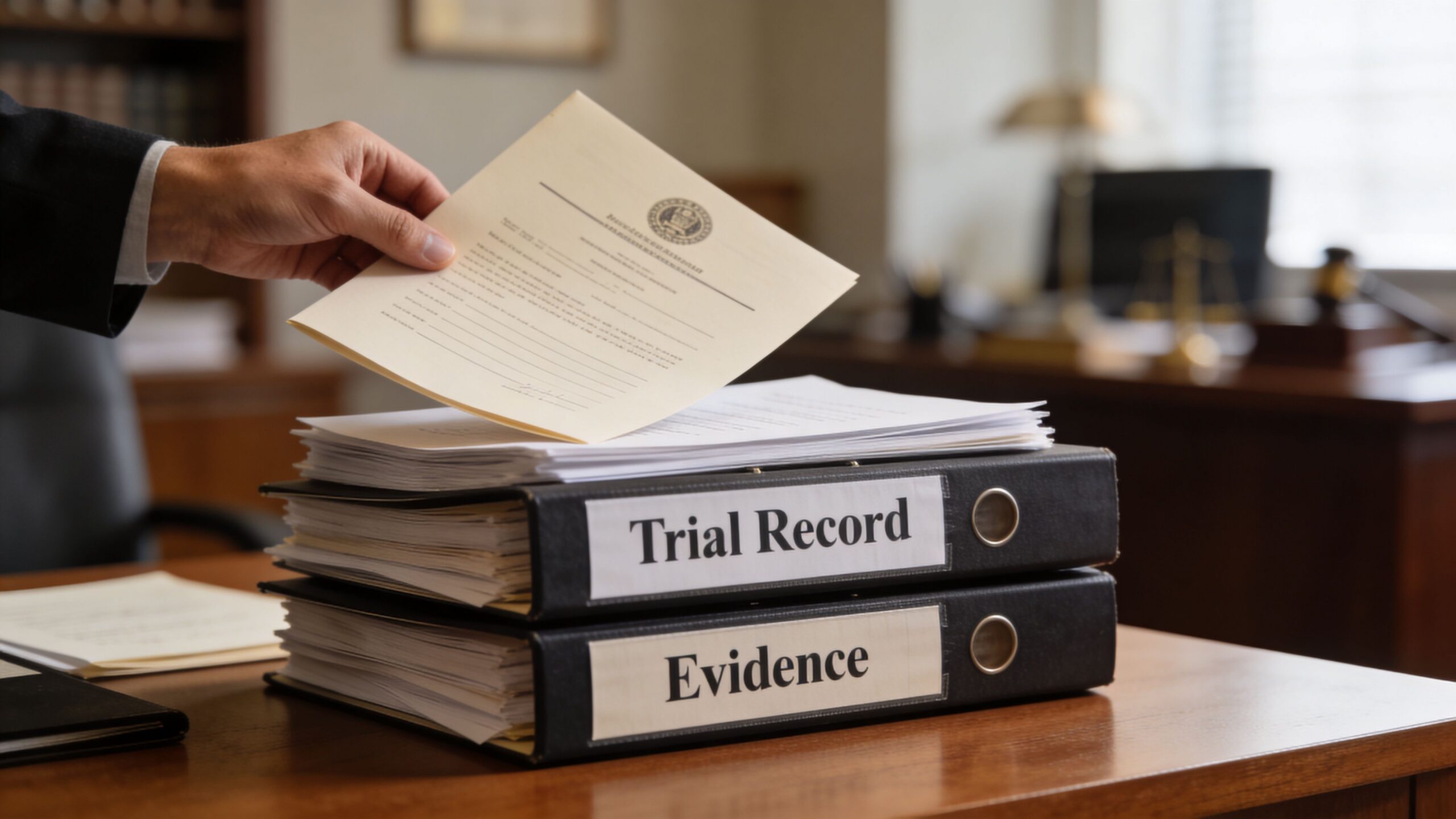
That rule is unforgiving, but it gives you a very clear lens for evaluating a possible appeal. If you’re thinking about an insufficient evidence appeal texas custody case, you should ask less often, “What else could I show now?” and more often, “What exactly was admitted, objected to, excluded, and ruled on then?”
What record preservation looks like in real life
A strong appellate record usually depends on trial counsel doing very specific things in real time.
- Timely objections matter. If improper evidence comes in and no one objects, the appellate court may treat the issue as waived.
- A ruling matters. An objection without a court ruling can leave the issue unpreserved.
- Offers of proof matter. If the judge excludes your witness or exhibit, the appellate court often needs a clear record of what that evidence would have shown.
- Admitted exhibits matter. Marking a document isn’t enough. It must become part of the record.
For a focused discussion of the doctrine itself, see this guide on preserving error for appeal in Texas family court.
A practical checklist for parents and trial counsel
Here is what appellate lawyers often look for when reviewing a custody trial:
Objections to harmful evidence
Was there a timely objection to irrelevant, hearsay, or unfairly prejudicial material?A clear offer of proof
If your side was blocked from presenting testimony, does the record show what that witness would have said?Findings tied to actual proof
Can each important custody restriction be traced to evidence that was admitted?A complete transcript
If key hearings were not recorded or ordered, important issues may be impossible to prove on appeal.Document handling
Were text messages, records, reports, or evaluations properly authenticated and admitted?
For attorneys and clients organizing testimony, deposition transcripts, and hearing records, even outside the formal appellate record, a clean transcript can become a critical legal tool for sworn testimony when checking consistency, preparing offers of proof, or identifying where trial objections should have been made.
A common point of confusion
Parents often say, “The judge ignored my evidence.” Sometimes that means the judge heard it and gave it little weight. That is harder to challenge. Other times it means the evidence was never admitted, or the judge wrongly excluded it despite a proper offer of proof. That can be very different on appeal.
Another common issue involves custody evaluations. The 2017 update to Texas Family Code §107.114(a) raised the bar by requiring expert testimony or stipulation before a child custody evaluation report can be admitted on its own, rather than coming in as standalone hearsay, as noted in the earlier discussion of Texas family law evidence rules.
One practical takeaway is simple. Trial work and appellate work are connected. In some matters, trial counsel handles both. In others, families consult appellate counsel early, and some firms, including The Law Office of Bryan Fagan, PLLC, review developing records, identify preservation risks, and assist with appellate strategy under the Texas Rules of Appellate Procedure and the Texas Family Code.
Common Grounds for an Insufficient Evidence Appeal
A parent leaves trial feeling certain the judge got it wrong. On appeal, the first question is narrower and much less emotional. What in the record supports the ruling, and what is missing?
That shift matters. An insufficient evidence appeal is often decided long before the notice of appeal is filed. It rises or falls on the trial record, much like a house depends on the foundation poured before the walls go up. If the needed testimony, exhibits, objections, and offers of proof are not in that record, an appellate court usually has very little room to help.
A restriction based on concern rather than proof
Start with a familiar custody problem. A parent works nights, weekends, or rotating shifts. The judge limits that parent’s possession based on the schedule.
The question on appeal is not whether a different judge might have ruled differently. The question is whether the record contains admitted evidence showing that the work schedule harmed the child, created instability, or posed a specific risk. If the record shows only assumption, general concern, or argument by counsel, that can become a real sufficiency issue.
Courts have discretion in custody cases. Discretion still has to rest on evidence.
Excluded testimony that never made it into the appellate picture
Another common ground appears when a witness was kept out. A counselor, teacher, doctor, or family member was ready to testify about a central issue, but the court excluded the testimony.
Here is where many appeals are won or lost at trial. If counsel made a proper offer of proof, the appellate court can see what the witness would have said and decide whether the exclusion mattered. If no offer of proof was made, the court often has no way to measure the harm, even if the exclusion felt obviously unfair in the courtroom.
A preserved exclusion issue can be stronger than a broad complaint that the judge failed to listen, because it gives the appellate court something concrete to evaluate.
Findings that do not match the admitted exhibits
Sometimes the problem is simpler. The order says one parent was uninvolved in school, medical care, or day-to-day parenting, but the admitted record shows emails, attendance logs, medical records, and messages proving repeated involvement.
That kind of mismatch gets careful attention on appeal. A single inconsistency may not change the outcome. But if a key finding supporting conservatorship, possession, or restrictions conflicts with the exhibits the court admitted, appellate counsel will examine whether the ruling can stand on the record that was made.
The point is practical. Appeals are not built from what a parent remembers happened. They are built from what the transcript and exhibits can prove.
Improper evidence that filled a gap the other side could not prove
Some insufficiency arguments work together with evidentiary error. A trial court may admit inflammatory, irrelevant, or unfairly prejudicial material over a proper objection. If that evidence appears to supply the main support for a custody restriction, the appeal may argue two related points. The court should not have considered that evidence, and without it, the remaining record does not support the ruling.
That combination can be important in family cases, where emotionally charged evidence may influence how the judge views the parents even when the legal connection to the child’s best interest is weak.
Orders built on broad accusations instead of specific proof
Another recurring problem is the jump from accusation to finding. A parent is labeled unstable, uncooperative, or dangerous, but the record contains few specifics. No witness ties the accusation to actual parenting failures. No documents show missed appointments, school problems, unsafe conditions, or harm to the child.
Appellate courts do not retry the case. They also do not treat vague claims as a substitute for proof. When a serious custody limitation rests on general impressions without concrete record support, that can form part of an insufficient evidence challenge.
A useful comparison from property issues
The same basic principle appears in other family law rulings. If a court assigns a value to a business, home, or account without supporting documents or testimony, the problem is the lack of evidentiary support for a key finding.
Custody appeals work the same way. The winning question is often not, “How do I convince the appellate court my side was better?” It is, “What admissible proof was in the record for this finding, and what proof was missing when the ruling was made?”
If your case also includes overlapping financial issues, you may want to review related material on property division appeals.
Navigating the Texas Custody Appeal Process
The appellate process can feel technical because it is. But the sequence is manageable when you break it into stages and keep the focus on deadlines, records, and briefing.

Step one through step three
The process usually starts quickly after the final order.
Notice of Appeal
This is the formal filing that starts the appeal. In many final custody matters, the notice must typically be filed within 30 days of the appealable order, as discussed earlier.Clerk’s Record
This includes pleadings, orders, admitted exhibits, and other filed documents from the trial court.Reporter’s Record
This is the transcript of hearings and trial testimony. Without it, many insufficiency arguments become much harder to pursue.
Step four through step six
Once the record is assembled, the written arguments begin.
| Stage | What happens |
|---|---|
| Appellant’s Brief | The appealing party explains the legal errors, cites the record, and requests relief |
| Appellee’s Brief | The responding party argues that the judgment should be affirmed |
| Reply Brief | The appellant may respond to points raised in the appellee’s brief |
Briefing is not just storytelling. It is structured legal writing. The brief must identify the issue, tie it to the record, explain the standard of review, and show why the error requires relief.
That requirement trips up many self-represented litigants. A discussion of pro se appellate pitfalls in Texas family cases notes a 2025 Fort Worth Court of Appeals case, In the Interest of J.D., where a mother’s appeal failed because she had not raised child support issues at trial and her briefing was inadequate. The same discussion also notes that over 70% of litigants in Texas family courts are self-represented.
Poor briefing can keep an appellate court from reaching the merits at all. A valid frustration is not enough. The issue must be preserved, presented, and argued under the rules.
Step seven through final review options
After briefing, the court may decide the case on the papers or set oral argument. If oral argument occurs, the lawyers answer judges’ questions about the record, the law, and the requested remedy.
The court then issues a written opinion. After that, a party may consider a motion for rehearing or, in the right case, a petition for review to the Texas Supreme Court.
Why procedural discipline matters
Parents sometimes focus on the final opinion and overlook the middle of the process. But appeals are built in the middle.
Deadlines must be met. The correct records must be requested. The brief must comply with the Texas Rules of Appellate Procedure. The argument must match the preserved issues. A mistake in any of those areas can narrow the case or end it.
If you’re evaluating an appeal, a practical first step is to gather the signed order, hearing dates, transcripts if available, and all admitted exhibits. Those materials provide a complete picture of whether the case is appellate-ready.
Potential Outcomes and Your Next Steps to Seek Justice
A successful appeal does not always mean the appellate court enters the custody order you wanted. That surprises many parents.
Most often, if the appellate court agrees that the trial court made a meaningful error, it will reverse and remand. In plain English, that means the higher court sends the case back to the trial court for further proceedings consistent with the appellate opinion. The trial court must then revisit the matter using the correct legal framework.

Reverse and remand versus reverse and render
A reverse and remand result is common because family law cases often require fact-intensive decisions the trial court must make in the first instance.
A reverse and render result is narrower. That means the appellate court effectively directs the legal result itself rather than sending the issue back for more proceedings. This is usually reserved for situations where the law and record permit only one proper outcome.
What to do if you think your custody ruling lacks support
Use a disciplined review, not a rushed one.
- Collect the final order and all hearing dates. Appellate timing starts with signed orders.
- Secure the record. The transcripts and admitted exhibits often decide whether the appeal is viable.
- List the specific findings you believe lacked support. General unfairness isn’t enough.
- Identify trial objections and exclusions. Preserved evidentiary issues can matter as much as insufficiency itself.
- Consider whether new facts belong in a modification case instead. If major events happened after judgment, appeal may not be the right vehicle.
The strongest custody appeals usually focus on a few precise issues, not every problem that happened during the case.
Parents often come in believing they need to prove the whole trial was wrong. In many appeals, that approach is too broad. The better approach is to identify the exact ruling, the exact part of the record, and the exact legal reason the order cannot stand.
An appeal won’t erase the stress of the trial court process. But it can restore structure, fairness, and accountability when a custody order rests on an unsupported finding or a serious legal mistake.
If you believe the court made a mistake in your family law case, our appellate attorneys can help you seek a fair outcome. Contact The Law Office of Bryan Fagan, PLLC today for a free consultation.