If a Texas family court has ordered you to pay or receive spousal maintenance—what most people call alimony—you may feel the decision was fundamentally unfair. The amount might seem wrong, the duration too long, or you may believe it shouldn't have been awarded at all. An unjust spousal maintenance order can create significant financial strain, but it does not have to be the final word. The Texas appellate process exists to correct legal errors made by a trial court.
This guide explains how Texas courts determine the amount and duration of spousal maintenance and, more importantly, how you can challenge an order that fails to follow the state's strict legal requirements. Understanding these rules is the first step toward seeking a fair and just outcome through the appeals process.
Understanding the Standard of Review for Spousal Maintenance
In Texas, spousal maintenance is strictly controlled by state law. A court simply cannot order payments that exceed the lesser of $5,000 per month or 20% of the paying spouse's average monthly gross income. These are not guidelines; they are hard caps.
When a judge makes a decision on spousal maintenance, an appellate court reviews that decision for an "abuse of discretion."
- Abuse of Discretion: This legal term means a trial court judge made a decision that was arbitrary, unreasonable, or made without reference to guiding legal principles. In the context of spousal maintenance, this could mean ordering payments that exceed the statutory caps, awarding it to a spouse who was not legally eligible, or miscalculating the paying spouse's income.
An appeal is not a second trial or a chance to present new evidence. It is a focused review of the trial record to determine if a "reversible error" occurred—a mistake so significant that it likely caused an improper judgment. Because Texas spousal maintenance laws are so rigid, these errors are often clear and can form the basis of a strong appeal.
It's crucial to understand that these caps are not suggestions. They are absolute legal maximums. A judge who orders spousal maintenance that blows past these limits has made a clear legal error, which is often the central issue in a family law appeal.
To provide a quick reference, here’s a summary of the key requirements and limits for court-ordered spousal maintenance in Texas.
Texas Spousal Maintenance At a Glance
| Requirement/Limit | Explanation (Texas Family Code) | Key Details |
|---|---|---|
| Eligibility Threshold | A spouse must first prove they lack sufficient property to provide for their "minimum reasonable needs." | This includes separate property and their share of the community property. |
| Qualifying Circumstance | Must meet one of several conditions (e.g., married 10+ years, family violence, disability). | The 10-year marriage rule is the most common path to eligibility. |
| Monthly Payment Cap | The lesser of $5,000/month or 20% of the paying spouse's average monthly gross income. | This is a hard ceiling; judges cannot exceed it. Gross income is broadly defined. |
| Duration Limit | The length of payments is tied to the length of the marriage (e.g., 5, 7, or 10 years). | The law presumes maintenance should last for the shortest reasonable period. |
This table highlights just how structured and limited the Texas system is. It’s designed to provide temporary help, not create a permanent financial dependency.
Common Reversible Errors in Spousal Maintenance Orders
From an appellate lawyer’s perspective, these strict rules are everything. An appeal isn’t a do-over or a second chance to argue the facts. It’s a focused review of the trial court record to see if the judge made a legal mistake—what we call a reversible error.
When it comes to spousal maintenance, some of the most common appealable errors are:
- Miscalculating Gross Income: The court might have incorrectly included non-income sources or excluded legitimate earnings when doing the 20% calculation.
- Exceeding the Statutory Caps: Any order for more than $5,000 or 20% of gross income is a direct violation of the law and a clear error.
- Ignoring the Property Division: Before even considering maintenance, a judge must look at the property awarded to the requesting spouse. If they didn't, that's a major problem.
If you look at the maintenance order from your divorce and feel it was calculated incorrectly or is just fundamentally unfair, there's a good chance a legal error is to blame. Our appellate team knows exactly how to spot these issues and build a compelling case to get a just result.
What You Can Appeal in a Texas Spousal Maintenance Case
Before a Texas court ever gets to the how much and how long of alimony, there's a critical first step: eligibility. Spousal maintenance isn't a given in a Texas divorce; it's a specific remedy for a specific set of circumstances. The person asking for support has to prove they qualify, and if they can't, the court's hands are tied.
Think of it this way: if a judge orders spousal maintenance without first confirming the requesting spouse meets the strict legal requirements, that order is built on a shaky foundation. This kind of mistake is a classic reversible error—a legal misstep so significant that an appeals court can, and often will, overturn the entire decision.
The Two-Part Eligibility Test
To get over this first hurdle, the spouse asking for support must prove two things to the court.
First, they have to show that after the divorce and property division, they won't have enough property (including their own separate property) to meet their “minimum reasonable needs.” This is the gatekeeper. If someone has enough assets—cash, investments, real estate—to support themselves, the conversation about maintenance typically stops right there.
If they can prove they lack sufficient property, they then have to prove that at least one of the following is true:
- The marriage lasted 10 years or longer, and they've made a real effort to earn a living or develop skills but still can't earn enough to meet their basic needs.
- The other spouse was convicted of (or received deferred adjudication for) an act of family violence within two years of when the divorce was filed or while the case was ongoing.
- The spouse asking for support has a significant physical or mental disability that keeps them from being able to earn a living.
- The spouse is the main caregiver for a child of the marriage who has a physical or mental disability that requires so much care it prevents that parent from working.
The 10-year marriage rule is the most common path, but it's far from the only one. Any court that grants maintenance without ticking one of these boxes has likely abused its discretion. For a deeper dive into these requirements, see our guide on getting alimony in Texas.
What is an "abuse of discretion"? It happens when a judge makes a ruling that is arbitrary, unreasonable, or completely ignores the guiding legal principles. Ordering alimony for someone who doesn't meet the Texas Family Code's eligibility criteria is a textbook example.
The flowchart below shows how Texas law puts a ceiling on alimony payments based on the paying spouse's income.
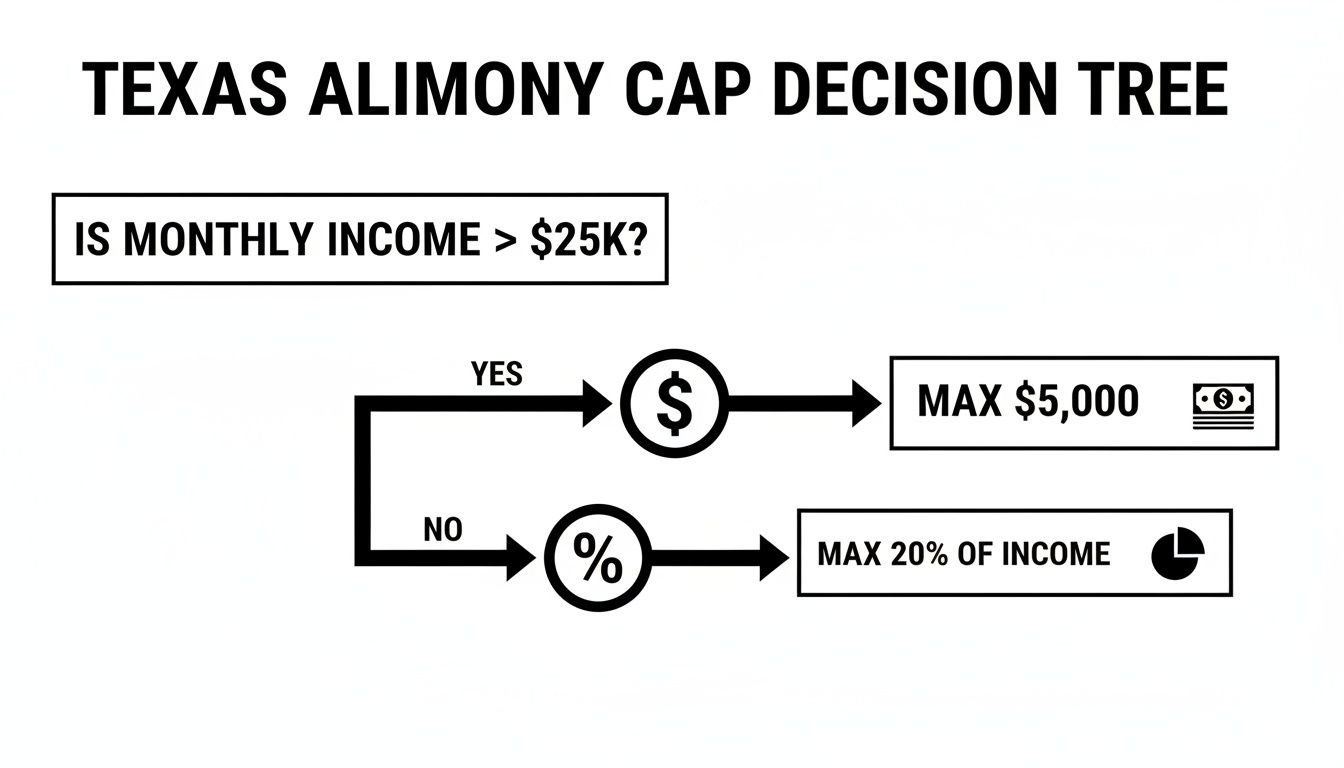
As you can see, the law prevents maintenance awards from getting out of hand. Once the paying spouse's income hits a certain point, the $5,000 per month cap kicks in, regardless of how much higher their earnings go.
If you suspect the judge in your case overlooked these strict eligibility rules, the order may be legally flawed. Our appellate attorneys are experts at combing through court records to pinpoint these exact kinds of errors and build a compelling case for getting the decision corrected on appeal.
How Courts Calculate The Amount and Duration

Once a judge agrees that a spouse qualifies for maintenance, the next big questions are always the same: How much will it be, and for how long? From the outside, the process can feel a bit arbitrary, but in Texas, it’s anything but. The law gives judges a strict formula and a clear set of factors to follow, leaving very little to guesswork.
Think of it this way: just as a contractor relies on systematic estimation methods to quote a project accurately, a Texas court uses specific legal guidelines to determine spousal support. When a judge strays from these rules—maybe by miscalculating income, ignoring the legal caps, or ordering payments for too long—it’s often considered an abuse of discretion. That’s a powerful legal term for a mistake that can be challenged on appeal.
The Two-Part Cap on Payment Amount
The Texas Family Code puts a hard ceiling on how much spousal maintenance can be ordered. The final award can't be more than the lesser of two specific numbers: $5,000 per month or 20% of the paying spouse’s average monthly gross income.
This isn't a suggestion; it's a mandatory legal limit. Let's break down how this works with a couple of real-world examples:
-
Example 1: A spouse earns an average gross income of $10,000 per month. Twenty percent of that is $2,000. Because $2,000 is less than the $5,000 cap, the absolute maximum the court can order is $2,000 per month.
-
Example 2: A high-earning spouse brings in an average of $30,000 per month in gross income. Twenty percent of that is $6,000. In this case, because the statutory cap of $5,000 is less than $6,000, the court is legally forbidden from ordering maintenance payments higher than $5,000 per month.
If a judge orders payments that exceed these caps, it's a clear and significant legal error. If you suspect your maintenance order was calculated incorrectly, an experienced appellate attorney should review the court record for these kinds of mistakes.
How Marriage Length Determines Payment Duration
The "how long" part of the equation is also tightly controlled by law, tied directly to the length of the marriage. The guiding principle here is that maintenance should last for the shortest reasonable time needed for the receiving spouse to get on their feet financially.
A common misconception is that spousal maintenance in Texas can go on forever. That's just not true. The law sets firm deadlines based on how long you were married, reinforcing the state's goal of promoting financial independence after a divorce.
The Texas Family Code lays out a clear timeline for the maximum duration of payments. Below is a table summarizing these legal limits, which are based on the specific circumstances and length of the marriage.
Spousal Maintenance Duration Limits by Marriage Length
| Length of Marriage | Maximum Duration of Maintenance | Relevant Circumstance |
|---|---|---|
| 10 to 20 years | 5 years | Also applies if family violence occurred. |
| 20 to 30 years | 7 years | Standard duration for marriages in this range. |
| 30 years or more | 10 years | The absolute longest duration allowed. |
| Any length (disability) | As long as eligibility persists | Only applies if the spouse has a total disability. |
It's crucial to remember that these are the maximum timeframes. A judge can, and often does, order payments for a shorter period based on the facts of the case. However, a judge who orders maintenance for longer than the law allows has committed a reversible error—a mistake that an appellate court has the power to correct.
If you’re concerned that the maintenance order in your divorce decree is unfair, lasts too long, or was calculated incorrectly, the root of the problem might just be a legal error. The Law Office of Bryan Fagan is here to help you pursue a fair outcome. Reach out to our experienced appellate attorneys today for a free consultation to evaluate your case.
Why Texas Spousal Maintenance Is So Tough
If you've ever felt like getting spousal support in Texas is an uphill battle, you're not wrong. Our state’s approach is deeply rooted in a history of self-reliance and the legal principle that a fair division of community property should be enough to get both spouses back on their feet.
This isn't just an old-fashioned idea; it's the very foundation of our modern laws. For a long time, Texas didn't even have court-ordered alimony. It was the absolute last state in the U.S. to finally enact spousal maintenance laws back in 1995. Before that, the only way to arrange for post-divorce support was through a private, contractual agreement between the two parties. You can read more about the current state of alimony in Texas.
A System Designed for Minimal Support
This history is crucial because it explains why our entire system is built on limitations. The law isn't designed to equalize lifestyles or create a long-term financial safety net. It’s meant to provide temporary, minimal support—just enough to help a spouse bridge the gap to self-sufficiency.
Think of it this way: every rule, from the tough eligibility hurdles to the caps on payment amounts and duration, grows from this core philosophy. The law starts with the assumption that spousal maintenance should be the exception, not the rule.
The strictness of Texas spousal maintenance law serves a very specific purpose: to tie the judge's hands. It deliberately narrows a trial court's discretion, forcing them to stick to the letter of the law instead of making decisions based on broad ideas of fairness.
How This Affects Your Appeal
Once you understand this background, it becomes clear why a judge straying from these statutes is such a big deal. When a court awards maintenance to someone who doesn't legally qualify, gets the payment caps wrong, or orders it for too long, it's not a minor oversight. It’s a fundamental departure from the entire legal framework.
This is exactly where an appeal comes in. An appeal isn't a do-over of your trial; it's a microscope focused on the trial court's decisions, looking for a specific kind of mistake known as a reversible error. This is an error so significant that it likely caused the wrong outcome.
In a system as rigid as ours, these errors are often easier to spot. If the maintenance order in your divorce feels fundamentally unfair, it might be because the judge stepped outside the very limited authority the law gives them. A skilled appellate attorney can dissect the trial record to see if the judge abused their discretion by failing to follow these strict legal guardrails.
Challenging an Unfair Spousal Maintenance Order

Sometimes, despite your best efforts, a judge gets it wrong. You might be looking at a spousal maintenance order and thinking the amount is outrageously high, the payments stretch on for far too long, or there was no legal basis for it in the first place. When that happens, it’s easy to feel powerless, but you’re not.
The Texas appellate process was created for exactly this situation: to correct legal mistakes and ensure court orders actually follow the law.
Don’t mistake an appeal for a do-over. It isn't a second trial where you get to bring in new evidence. Instead, think of it as a focused, methodical review of what already happened in the courtroom. A skilled appellate lawyer becomes a legal detective, poring over trial transcripts, motions, and the final order to pinpoint where the judge misapplied the law.
Understanding Abuse of Discretion and Reversible Error
In the world of family law appeals, two phrases carry a lot of weight: "abuse of discretion" and "reversible error." Knowing what these mean is the first step toward fixing an unjust outcome.
A judge commits an abuse of discretion when they make a decision that's unreasonable, arbitrary, or simply ignores the black-and-white rules set by Texas law. This doesn’t mean the judge had bad intentions—it just means their ruling fell outside the zone of what the law considers a reasonable decision. For instance, if a judge completely ignores the statutory caps on maintenance payments, that’s a clear abuse of discretion.
A reversible error is a mistake so significant that it likely led to the wrong result in your case. Not every little mistake counts. A simple typo in a document probably isn’t a reversible error. But a major legal blunder that saddles you with an unfair financial burden? That’s exactly what this is for. Our job on appeal is to prove to a higher court that this kind of error happened and that it created an unjust outcome that needs to be fixed.
Common Appealable Errors in Maintenance Cases
Because Texas law is so specific about when and how spousal maintenance can be awarded, judges have very little wiggle room. When they step outside those strict legal boundaries, they open the door for a successful appeal.
In our experience, some of the most common reversible errors include:
- Ignoring the Statutory Caps: The court orders payments that are more than $5,000 per month or exceed 20% of the paying spouse's average monthly gross income.
- Exceeding Duration Limits: The judge sets a payment timeline that’s longer than the law allows for the length of the marriage (like ordering seven years of maintenance for a 15-year marriage).
- Granting Maintenance to an Ineligible Spouse: The court awards maintenance even when the requesting spouse never met the strict legal requirements, like the 10-year marriage rule or proof of an incapacitating disability.
- Miscalculating Gross Income: The judge incorrectly includes assets that aren't income or messes up the calculation of the payor’s average earnings, resulting in an unfairly high award.
The fact is, alimony is intentionally rare in Texas. In FY2023, state courts finalized 60,755 divorces without children and another 47,731 with children. Yet, true spousal maintenance awards are uncommon because of the tough legal hurdles. This strictness is exactly why any deviation from the rules is a prime candidate for an appeal based on legal error. You can find more historical context and data on these trends at scholarship.law.duke.edu.
An appeal is a highly technical process focused on legal arguments, not emotional ones. It requires a persuasive written argument, called a "brief," that clearly outlines the trial court’s errors and explains why the appellate court must correct them.
Building a winning appeal is all about a meticulous review of every document and every word spoken in court. We search for those specific moments where the law was misinterpreted or ignored. By presenting a clear and compelling case to the appellate judges, we can work to get that unfair spousal maintenance order reversed or changed.
If you want to dive deeper, you might be interested in our article explaining how much spousal support is in Texas.
How to Seek a Fair Outcome in Your Case
Realizing that the spousal maintenance order in your divorce might be legally wrong is the first step. The next, and most important, is taking action. If you have a gut feeling that the judge's decision was fundamentally unfair, that instinct is absolutely worth exploring with a legal professional who lives and breathes the appellate process.
The key takeaway here is simple: Texas spousal maintenance laws are incredibly complex, and they can be unforgiving. Trial court judges are human, and they can make mistakes—mistakes with long-lasting financial consequences for your family. But an unfair outcome doesn't have to be the final word.
Your Path to a Just Result
The only way to challenge a flawed ruling is to have your case professionally evaluated by attorneys who specialize in Texas family law appeals. An appeal isn't a do-over of your divorce trial; you don't get to re-argue the same facts or emotions. Instead, it’s a meticulous, strategic review of the court record to pinpoint specific legal errors the judge made.
Our appellate team digs into every piece of evidence—every document, transcript, and ruling—to identify critical mistakes, such as:
- Miscalculating the paying spouse's net monthly resources.
- Awarding maintenance that exceeds the legal caps of $5,000 per month or 20% of income.
- Ordering payments for a duration longer than the law allows for the length of your marriage.
- Granting maintenance to a spouse who simply didn't meet the strict eligibility requirements in the first place.
An appeal serves as a vital check on the trial court's power. It's the system's way of ensuring judges follow the Texas Family Code to the letter, which promotes fairness and consistency. If a legal error shaped your outcome, your case deserves a second look from a higher court.
Knowing how to choose a family law attorney with proven appellate experience is non-negotiable. The skills required to win on appeal are worlds away from trial work. It demands deep legal scholarship, sharp and persuasive writing, and a mastery of the unique procedures of the appellate courts.
If you believe a mistake was made in your case, we invite you to contact The Law Office of Bryan Fagan for a confidential consultation. Our appellate team can assess what happened, identify potential reversible errors, and outline a clear strategy to fight for the fair result you deserve.
Your Top Questions About Texas Alimony, Answered
Even after you get a handle on the basic rules, you're bound to have specific questions about how spousal maintenance works in Texas. It's only natural to wonder how the law applies to your unique situation. Let's tackle some of the most common questions we hear from clients to help you get a clearer picture.
Keep in mind, every single maintenance order has to be built on the foundation of the Texas Family Code. If a judge issues an order that ignores or misapplies these rules, that mistake can become a powerful reason for a family law appeal.
Can I Get Alimony If My Marriage Was Short?
In most cases, the answer is no. To even be considered for court-ordered spousal maintenance, the marriage typically needs to have lasted 10 years or longer. The law in Texas is pretty firm on this, operating on the idea that shorter marriages don't usually create the kind of financial dependency that maintenance is meant to solve.
But there are a few critical exceptions. Someone in a marriage of less than 10 years might still get maintenance if they can prove one of the following:
- The other spouse was convicted of an act of family violence.
- The spouse asking for support has a disabling physical or mental condition.
- The requesting spouse is the primary caregiver for a child of the marriage who has a serious disability.
If a judge awards maintenance in a short-term marriage without one of these specific situations in play, they've likely made a reversible error—a mistake that could be overturned on appeal.
What Happens to Alimony Payments if My Ex Remarries?
This one is straightforward. Under Texas law, the legal obligation to pay court-ordered spousal maintenance automatically stops the moment the receiving spouse remarries. The person paying doesn't even need to go back to court for a new order. The duty simply vanishes.
The same principle generally applies if the receiving spouse starts living with a new romantic partner on a permanent basis. The law sees this new supportive relationship as a substitute for the financial support they were getting from their ex-spouse.
A common myth is that contractual alimony also ends automatically with remarriage. That's not true! Unless the contract itself says the payments stop, the obligation can continue, showing just how different a private agreement is from a court order.
What’s the Difference With "Contractual Alimony"?
While court-ordered spousal maintenance has tight legal restrictions, contractual alimony is a whole different ballgame. This is a private financial agreement that two spouses negotiate themselves as part of their divorce settlement. It's governed by contract law, not the strict statutes in the Texas Family Code.
That distinction makes all the difference. Contractual alimony isn't limited by the same tough eligibility rules or the official caps of $5,000 per month or 20% of gross income. Spouses are free to agree to any amount for any length of time, which can make it a really useful tool, especially in high-asset divorces or complex property division cases.
The trade-off for this flexibility? Enforcing a contractual alimony agreement can be trickier, and changing it almost always requires both people to agree. You can't just go to a judge and ask for a modification due to a change in circumstances like you can with a standard court order.
If you believe the court made a mistake in your family law case, our appellate attorneys can help you seek a fair outcome. Contact The Law Office of Bryan Fagan today for a free consultation at https://familylawcourtappeals.com.