Skip to content
When a family court judge makes a ruling in your case, you trust it will be fair and based on the law. But what happens when it’s not? You may feel your case was handled unfairly after a judge issues a decision that feels so clearly wrong it immediately turns your world upside down.
What Happens When a Family Court Ruling Feels Unjust?

It’s a deeply frustrating experience. You’ve put your trust in the system to protect your family, only to be hit with an order that seems to ignore the facts or the law entirely. The harm is happening right now, and waiting months—or even years—for a standard appeal after the case is over isn't a viable option. The damage will already be done.
Thankfully, the Texas legal system has a built-in emergency brake for these exact situations. It acknowledges that while judges are human, some errors are so severe they demand immediate correction to restore fairness and due process.
An Extraordinary Remedy for Urgent Situations
This powerful tool is called a writ of mandamus. It is not a do-over or a standard appeal where you re-argue your case. Instead, it’s a direct and urgent request filed with a higher court—the court of appeals—asking it to step in and order the trial judge to fix a clear and serious mistake.
Because it's an extraordinary measure, you can't file a mandamus just because you disagree with a ruling. You must prove two specific things:
- The judge committed a “clear abuse of discretion,” meaning their decision was so arbitrary and unreasonable that it disregarded guiding legal principles.
- You have “no adequate remedy by appeal,” meaning that the damage from the wrongful order is so severe and immediate that it cannot be fixed later if you wait for the case to end.
Think of it this way: a standard appeal is like asking officials to review the entire game tape after the final buzzer sounds. A writ of mandamus is like stopping the game mid-play to challenge a referee’s call that is so blatantly wrong it’s about to unfairly cost you the championship.
This is the tool for true legal emergencies, like when an order wrongfully separates you from your children or forces you to turn over private, legally protected documents. Our goal is to show you that when a trial court gets it wrong, you have options. Understanding how a mandamus in a Texas family law case can restore balance is the first, most important step.
Understanding a Writ of Mandamus in Plain English

Let's break down what a writ of mandamus really is. Imagine the trial judge is a referee whose job is to follow a specific rulebook—the Texas Family Code and the Texas Rules of Appellate Procedure. A mandamus in a Texas family law case is your emergency call to the commissioner's office (the court of appeals), asking them to intervene because the referee just made a call so wrong it puts the game's outcome in jeopardy.
This isn't about disagreeing with a tough call. It's about a ruling that completely ignores the rules. To get the higher court to step in, your appellate lawyer must prove two specific things.
The Two Pillars of a Successful Mandamus Petition
First, we must show the trial court committed a “clear abuse of discretion.” This legal term has a very practical meaning.
Abuse of Discretion: This happens when a judge issues an order without any support from the guiding rules or legal principles. In other words, the decision is so arbitrary and unreasonable that it has no basis in the law. It’s not a ruling you dislike—it’s a ruling that’s legally indefensible.
Second, you have to prove there is “no adequate remedy by appeal.” This is crucial. It means that if you wait until the end of the case to file a normal appeal, the damage will be irreversible. For example, if a judge improperly orders you to hand over private therapy records, you can’t "un-ring that bell." Once that confidential information is out, no future appeal can make it private again. That’s a perfect example of having no adequate remedy by appeal.
What Mandamus Is Not
It’s vital to understand that a mandamus petition isn't a silver bullet for every bad ruling. Appellate courts are very protective of a trial judge's authority to weigh evidence and make judgment calls. Mandamus is an extraordinary remedy, reserved for situations where there has been a clear legal error, not just a factual one you disagree with.
A writ of mandamus is not the right tool for:
- Disputing Factual Findings: If the judge heard conflicting testimony and simply found the other party's story more credible, you cannot use mandamus to second-guess that decision.
- Challenging Discretionary Rulings: Many family law decisions, like setting specific pickup and drop-off times in a child custody order, are left to the judge's discretion. As long as the ruling is within legal guardrails, a mandamus won't work.
- A Second Chance to Argue: Mandamus is not an opportunity to present new evidence or re-argue your case. The focus is laser-sharp: did the judge make a specific legal mistake that caused immediate and irreparable harm?
Recent court decisions reinforce this high bar, as you can see in this discussion on mandamus relief in Texas family law cases. The courts will only step in when a trial judge ignores a clear, non-discretionary legal duty. If a ruling comes down to a genuine dispute over the facts, a mandamus is almost certain to be denied. A mandamus is an emergency brake to stop proceedings and correct a major legal error before it causes permanent damage, ensuring a fair process when the regular appeal timeline is too slow.
Mandamus vs. Appeal: Understanding the Difference
When a judge makes a bad call, your first instinct is to "appeal" it. However, the word "appeal" usually refers to a specific process that may not be the right tool for your situation. It’s essential to understand the difference between a standard appeal and a writ of mandamus, as they are designed for entirely different circumstances. The key distinctions lie in timing, purpose, and the legal standard you must meet.
How Appeals Differ from Trials
A standard appeal is for challenging the final score after the game is over. The court signs a final judgment, your case concludes, and only then can you ask a higher court to review the record for any reversible errors the judge may have made.
Reversible Error: A legal mistake made by the trial court that was significant enough to have likely caused an improper outcome. Simply finding an error isn't enough; your attorney must show it harmed your case.
A writ of mandamus, on the other hand, is like challenging a bad call in the middle of a play. It’s an emergency measure used during the case to stop a specific, harmful ruling immediately. You aren't asking for a full game review; you're telling the appellate court the referee made a call so wrong it threatens to ruin the game if not fixed now.
Timing and Purpose
The biggest difference is timing. A traditional appeal can only happen after the trial court signs a final judgment, officially closing your case. Whether it's a divorce decree or a final custody modification, you must wait until the very end. You can read about the fundamentals of Texas appellate procedure in family law for more details.
Mandamus is the opposite. It happens before a final judgment and is specifically designed to attack an interlocutory order—a decision made while your case is ongoing. You file for mandamus because waiting until the end would be too late. For example, if a judge incorrectly orders your child to be turned over to the other parent, waiting a year for a final appeal won't undo the trauma and disruption. Mandamus is designed to seek immediate intervention.
The Standard of Review
The burden of proof is also completely different. For a standard appeal, your goal is to show the judge committed a reversible error. This means you must convince the appellate court that the judge made a mistake—by misapplying the law or ignoring evidence—and that this mistake likely led to the wrong outcome.
A writ of mandamus has a much tougher, two-part test known as its standard of review. You must prove both a “clear abuse of discretion” and that you have “no adequate remedy by appeal.” This standard is significantly harder to meet than showing a simple reversible error.
To see these differences side-by-side, it helps to break them down.
Mandamus vs. Standard Appeal in Texas Family Law
| Aspect | Writ of Mandamus | Standard Appeal |
|---|---|---|
| When to File | Immediately after a harmful interlocutory order (mid-case). | After a final judgment is signed (end of case). |
| Purpose | To correct a single, urgent error causing irreparable harm. | To review the entire case record for reversible errors. |
| Type of Order | Challenges temporary orders, discovery rulings, and other mid-case decisions. | Challenges the final divorce decree, custody order, or property division. |
| Standard of Review | Must prove "clear abuse of discretion" AND "no adequate remedy by appeal." | Must prove a "reversible error" that likely caused an improper outcome. |
| Urgency | An extraordinary, emergency remedy. | The standard process for challenging a final outcome. |
Ultimately, the choice is dictated by the facts of your case. An appeal offers a broad post-game analysis, but a mandamus is the critical tool you need when you can't afford to wait for the final whistle.
Common Reversible Errors That Justify Mandamus
A mandamus in a Texas family law case is a powerful and necessary tool for specific, high-stakes moments where waiting for a final appeal would cause permanent damage. Let's look at real-world situations where our appellate team would recommend filing a mandamus petition—scenarios where a court's decision is not just wrong but represents a clear abuse of power.
Protecting Your Private Information
Imagine you're in a tough child custody battle and the other side demands every therapy note you've ever had. Your lawyer objects, stating your conversations with your therapist are legally privileged. But the judge ignores this and signs an order forcing you to hand them over. This is a textbook scenario for a mandamus.
- Clear Abuse of Discretion: The law is clear about protecting privileged information. A judge ordering disclosure without a legally sound reason is acting "without reference to any guiding rules or principles."
- No Adequate Remedy by Appeal: Once your private records are out, they're out forever. You can’t "un-ring that bell." Winning an appeal years later can't restore your privacy.
The harm is immediate and irreversible. A regular appeal is useless. A mandamus is the only way to ask the court of appeals to intervene now and block that wrongful discovery order.
When a Judge Refuses to Rule
"Justice delayed is justice denied." This is especially true in family law. Imagine you have proof the other parent is about to move out of state with your child, violating your possession order. You file an emergency motion for a protective order, but the judge does nothing. Weeks go by. The judge simply won't set a hearing, leaving your child at risk.
A trial judge’s refusal to act on a time-sensitive motion can, in itself, be an abuse of discretion. The purpose of a mandamus here is to compel the judge to perform their required duty: to make a decision.
The court of appeals won't tell the judge what to decide, but it can order the judge to decide, ensuring your case doesn't get buried on a judge's desk when a child’s well-being hangs in the balance.
Challenging an Improper Court Venue
Texas law has specific rules about where a family law case should be heard, called venue. It's almost always based on where the child lives. But what if a judge agrees to transfer your case to a county hundreds of miles away, even though your child has lived in your home county their entire life?
- Clear Abuse of Discretion: The Texas Family Code lays out mandatory venue rules. An order that ignores those rules is a clear legal mistake.
- No Adequate Remedy by Appeal: The Texas Supreme Court has been clear: forcing someone to try their entire case in the wrong county is an irreparable harm. You can't get back the time, money, and strategic ground you lost by waiting until after trial to appeal.
A mandamus is the only way to fight an improper venue transfer. It asks the higher court to enforce the rules and move the case back where it belongs. While a temporary injunction can address immediate actions, understanding the distinct power of mandamus is crucial. For more information, you can read our guide on temporary injunctions.
Void Orders and Lack of Jurisdiction
Finally, mandamus is the go-to tool for attacking a void order—an order the trial court never had the legal authority, or "jurisdiction," to make. For instance, a judge might try to change a final divorce decree months after the court's power to do so has legally expired. Because the judge no longer had jurisdiction, the new order is invalid. A mandamus petition can have the court of appeals officially declare that order void, giving you immediate relief. In all these examples, the pattern is the same: a serious legal error that causes an urgent, irreversible injury.
The Mandamus Process: A Step-by-Step Guide
Filing for a writ of mandamus is an emergency legal procedure that operates on a tight schedule under the Texas Rules of Appellate Procedure. A single misstep can be fatal to your case. With an experienced appellate lawyer, this journey can be broken down into a series of strategic actions.
Step 1: Acting Immediately
As soon as a trial judge signs a harmful order, a countdown begins. While there isn't a specific deadline for filing a mandamus petition, the courts demand that you act without "unnecessary delay." If you wait weeks, the court of appeals can deny your petition for that reason alone. The entire purpose of a mandamus in a Texas family law case is to provide a rapid remedy. Your first call after a bad order is signed should be to an appellate attorney.
Step 2: Record Preparation
In a normal appeal, the court clerk prepares the official case record. In a mandamus proceeding, the responsibility falls on your attorney to compile the mandamus record. This record is the complete evidence file for the court of appeals and must include:
- A certified or sworn copy of the specific order you are challenging.
- All relevant documents from the trial court's file that support your position.
- A word-for-word transcript from any court hearings where the error occurred.
If a key document or piece of testimony is left out of the record, the court of appeals will almost certainly deny the petition.
Step 3: Drafting and Briefing
Drafting the Petition for Writ of Mandamus requires legal skill and persuasive writing. It is not a dry legal brief; it’s a narrative designed to convince appellate judges to take the extraordinary step of intervening.
Briefing: The process of writing the legal arguments that explain to the appellate court what errors occurred in the trial court and why they justify relief. This is the core of any appeal or mandamus.
The petition walks the judges through the facts, pinpoints the exact legal mistake, and makes a powerful case for why it was a "clear abuse of discretion" and why you have "no adequate remedy by appeal."
The diagram below shows classic scenarios where a mandamus is the right tool—such as when a trial court makes a ruling without proper evidence, in the wrong county, or issues a void order.
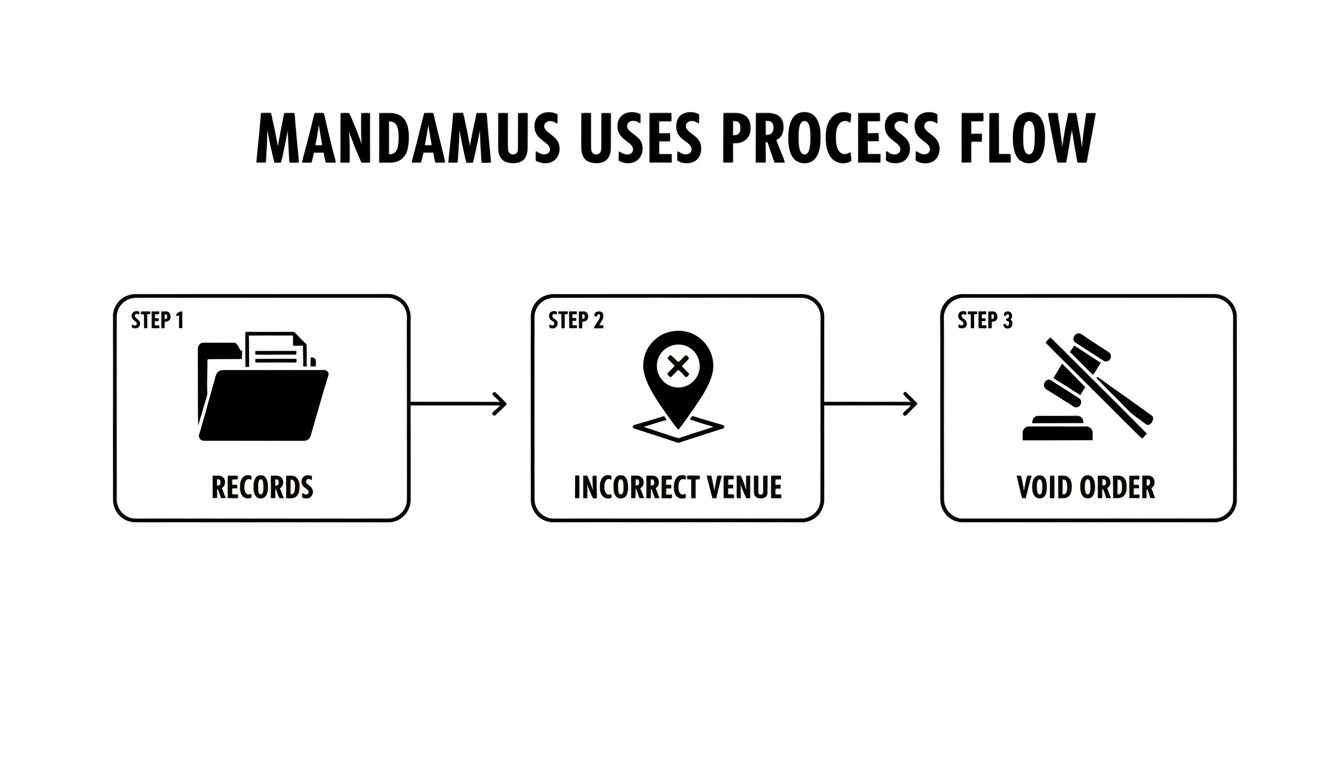
As the chart implies, this process is reserved for clear-cut legal errors where the damage can't be undone later.
Step 4: Filing and Potential Outcomes
Once finalized, the petition and record are filed with the court of appeals and "served" on the judge and opposing party. From there, the appellate court can:
- Deny the Petition Outright: If the court sees no merit, it can deny the petition immediately.
- Request a Response: A good sign. It means the judges see a potential problem and want to hear the other side's argument.
- Grant Temporary Relief: The court can "pause" the trial judge's order to prevent further harm while it reviews the case.
- Schedule Oral Argument: In complex cases, the court may ask lawyers to argue their positions in person.
In fiscal year 2023, Texas trial courts saw 216,499 new family law cases filed. You can find more details in the Texas courts' annual statistical report. This sheer volume is why a powerful tool like mandamus is so critical. The court of appeals will eventually issue its final decision: either grant the writ and order the trial judge to correct the error, or deny your petition.
Why Succeeding on Mandamus Is Exceptionally Difficult
Anyone considering a mandamus in a Texas family law case needs to understand that this is an “extraordinary remedy.” That isn't just legal jargon; it’s a warning. Mandamus is a last resort, and appellate courts deny the vast majority of them.
If higher courts intervened every time a party disagreed with a trial judge's decision, the system would grind to a halt. The trial courts would lose their authority, and appellate dockets would be flooded. This is why the process is strictly reserved for true legal emergencies, not for second-guessing a judge’s tough-but-legal calls.
The Statistics Show the Challenge
The statistics paint a clear picture of how steep the climb is. Mandamus relief in Texas family law is exceptionally rare, with grant rates consistently between 3.0% and 9.5% in recent years. Data from the Texas Supreme Court showed petitions were granted at rates of 3.3%, 6.9%, 6.6%, 6.7%, and 7.5% in five recent fiscal years. You can see a breakdown of these mandamus statistics.
These low numbers underscore a critical point. It's not enough to feel the judge made a mistake. You must prove the ruling was a “clear abuse of discretion”—a standard that means the judge blatantly ignored the law or acted without any supporting evidence. We explain this high bar in our guide on the abuse of discretion standard.
The low success rate isn't a reason to lose hope; it's a reason why absolute precision is required. It underscores the necessity of having a case with the right facts and a flawlessly prepared petition drafted by a skilled appellate lawyer.
The "Near-Perfect Case" Requirement
Because mandamus is such a long shot, only a near-perfect case has a real chance. Your appellate attorney's first job is to give your case an honest assessment to see if it qualifies. There is simply no room for error. The facts must be clear, the legal mistake obvious, and the harm you're facing immediate and irreversible.
Your petition must prove:
- A Clear Legal Error: The judge's ruling must fly in the face of a specific statute, rule, or established case law.
- Irreparable Harm: You must show that waiting for a final appeal will cause damage that can never be fixed.
- Flawless Procedure: The petition itself must be filed quickly and follow every single technical rule to the letter.
A mandamus isn't a general plea for fairness. It's a highly technical legal strike, arguing that the trial court violated a clear, non-discretionary duty. Only a petition that frames the issue with this kind of legal precision can hope to beat the long odds.
Let Our Appellate Team Fight for a Fair Outcome
If you feel a trial court’s decision has just turned your world upside down, you don’t have to simply accept a profoundly unjust order. But securing a mandamus in a Texas family law case is an uphill battle reserved only for the most clear-cut and damaging judicial mistakes.
Winning a mandamus requires proving two things: that the judge clearly abused their discretion under the law, and that the damage is so severe it can't be fixed through a standard appeal. This high bar requires a perfectly executed legal strategy based on a deep understanding of Texas appellate procedure. Our team includes attorneys board-certified in both family law and appellate law. We specialize in spotting these critical errors and know how to fight for our clients' rights at the next level, especially when a wrongful order affects something as fundamental as child custody, your property, or your safety.
A writ of mandamus is a powerful tool that can provide immediate relief when a standard appeal won't suffice. When a judge’s order goes beyond their authority, swift and strategic action is essential to restore fairness.
If an unfair ruling has put you in an impossible situation, time is of the essence. The window to challenge a damaging order is incredibly short. Our team is here to offer the calm, confident, and strategic guidance you need.
If you believe the court made a mistake in your family law case, our appellate attorneys can help you seek a fair outcome. Contact The Law Office of Bryan Fagan today for a free consultation at familylawcourtappeals.com.