If you have just received a final custody order and believe the outcome was fundamentally unfair, you may feel that the legal system failed your family. When a court's decision doesn't seem to protect your child's best interests, it can be a deeply unsettling experience. However, a trial court's ruling is not always the final word. The Texas legal system provides a path to seek justice when a significant legal mistake has been made: the appellate process.
An appeal is not a new trial or a chance to present new evidence. It is a focused, strategic review of the trial court record to determine if a reversible legal error occurred. It’s about ensuring the law was followed correctly and that the final judgment was based on a fair and proper application of legal standards. This guide will walk you through what "joint custody" means in Texas and how the appellate process can be used to correct a flawed outcome.
What Does Joint Custody Mean in a Texas Appeal?
In Texas, the law presumes that keeping both parents involved in a child's life is in the child's best interest. This is why the state's default arrangement is a Joint Managing Conservatorship (JMC). You may feel your case was handled unfairly, especially if the judge’s order doesn't reflect what you know is best for your children. Understanding the legal framework is the first step toward evaluating whether you have grounds to appeal.
Think of JMC as a court-ordered partnership for raising your children. Under this arrangement, both parents share a bundle of legal rights and responsibilities for making major decisions. If a court significantly limited your rights or created an unworkable possession schedule, a skilled appellate attorney will scrutinize the record to determine if that decision was an "abuse of discretion."

Separating Decision-Making from Physical Time
A common point of confusion is the difference between shared decision-making (conservatorship) and the parenting time schedule (possession). A court can name both parents as Joint Managing Conservators, granting equal say on major issues like education and healthcare, while still ordering a possession schedule that is not 50/50.
These are two distinct parts of every Texas custody order. An appeal might challenge the conservatorship appointments, the possession schedule, or both, depending on where the trial judge may have made a legal error. For example, a judge could correctly appoint both parents as JMCs but then create a possession schedule based on inadmissible evidence—a potential reversible error.
The Texas Family Code presumes that naming parents as joint managing conservators is in the best interest of the child. This legal starting point is very strong and can only be overcome if there is evidence of family violence or other circumstances that would harm the child's physical or emotional well-being.
This presumption is a powerful legal standard. To deviate from it and award a Sole Managing Conservatorship, the court must have clear evidence that appointing a parent as a joint conservator would impair the child’s physical or emotional well-being. For a deeper dive into these rights, you can discover more insights about parental rights on this family law blog.
Joint Managing Conservatorship vs. Sole Managing Conservatorship
Understanding the differences between the two primary conservatorship models is crucial for evaluating whether your custody order was decided fairly and in accordance with Texas law.
| Feature | Joint Managing Conservatorship (Presumed Standard) | Sole Managing Conservatorship (Less Common) |
|---|---|---|
| Decision-Making | Both parents share the right to make major decisions (education, medical, etc.). | One parent has the exclusive right to make most major decisions. |
| Legal Presumption | Presumed to be in the child's best interest. | Awarded only if joint conservatorship would be harmful to the child. |
| "Primary" Parent | One parent is designated as "primary" and establishes the child's residence. | The sole conservator establishes the child's residence. |
| Common Scenarios | The vast majority of Texas custody cases. | Cases involving family violence, substance abuse, or extreme parental conflict. |
| Parental Access | Both parents have access to the child's records (school, medical, etc.). | The non-conservator parent may have limited or no access to records. |
The law favors the joint model because it is designed to keep both parents actively and meaningfully involved. An appeal can challenge whether the evidence presented at trial supported the court’s decision to follow or deviate from this standard.
Core Rights of a Joint Managing Conservator
Under a standard JMC order, both parents are typically granted a slate of legally enforceable rights and duties to share:
- Educational Decisions: The right to consult on the child's school choice and educational needs.
- Medical and Dental Care: The right to consent to non-emergency medical, dental, and psychological care.
- Moral and Religious Training: The shared right to guide the child's spiritual upbringing.
- Access to Records: The legal right to access all of the child's medical, educational, and psychological records.
If a trial court stripped you of one of these fundamental rights without a legally sound reason directly tied to the child's best interest, that decision may constitute an abuse of discretion—a strong foundation for an appeal.
The "Primary" Parent Designation
Even in a joint custody arrangement, the court designates one parent as the "primary" conservator. This parent has the exclusive right to determine the child's residence, usually within a specified geographic area. This designation is often the most contested issue in a custody case, as it also determines who receives child support. If you believe the judge awarded this critical role based on a misapplication of the law or improper evidence, it is a significant issue to evaluate for a potential appeal.
Understanding the Standard of Review for Texas Possession Schedules
A judge’s final order must include a detailed calendar, or possession order, that specifies when the child will be with each parent. If the schedule in your order feels unworkable or is not in your child's best interest, the first step in challenging it on appeal is to understand the legal standards that should have guided the court’s decision.
For parents living within 100 miles of each other, Texas law provides a default template known as the Standard Possession Order (SPO). The law presumes the SPO is in the child's best interest because it is designed to provide consistency and predictability.

Breaking Down the Standard Possession Order
The SPO gives the "non-primary" parent (the parent who does not determine the child's residence) a predictable schedule.
- Weekends: The non-primary parent typically has possession of the child on the first, third, and fifth weekends of a month.
- Holidays: Major holidays like Thanksgiving and Christmas are divided and alternated annually to ensure both parents can create lasting memories.
- Summer: The non-primary parent generally has possession for 30 days in the summer, which can often be exercised in shorter increments.
A judge cannot deviate from this standard without a good, evidence-based reason. If your order contains a highly restrictive or unusual schedule that was not supported by evidence presented at trial, that decision could be considered an abuse of discretion and a key point in an appeal.
The Rise of the Expanded Standard Possession Order
In recent years, Texas courts have increasingly favored the Expanded Standard Possession Order (ESPO). This schedule provides the non-primary parent with more time, bringing the parenting arrangement closer to an equal 50/50 split. The ESPO builds on the SPO by making two key additions:
- Thursday Overnights: The non-primary parent picks the child up from school on the Thursday preceding their regular weekend and keeps them until school resumes on Friday.
- Sunday Returns: After their weekend, the non-primary parent keeps the child until they are returned to school on Monday morning, rather than on Sunday evening.
These changes significantly increase parenting time and allow the non-primary parent to be more involved in the daily school routine. Under the Texas Family Code, a judge is required to order an ESPO if a parent requests it and the evidence shows it is in the child's best interest and logistically feasible. A judge's refusal to grant an ESPO without a compelling, on-the-record reason could be a reversible error.
The goal of any possession schedule is to provide a stable and predictable environment for the child while fostering a strong relationship with both parents. The SPO and ESPO are simply tools the court uses to achieve that goal.
While schedules are moving closer to equal time, a true 50/50 split is not yet the default in Texas. Practical challenges, such as the distance between parental homes or a child's special needs, can lead a court to order a more traditional schedule. On average, fathers in Texas receive around 33% of parenting time, which aligns with the national average of 35%. You can learn more about these gender-based custody statistics and the factors influencing them.
Why Your Possession Schedule Matters in an Appeal
An unfair or poorly constructed possession order can disrupt your child's life and damage your parent-child relationship. If you believe the trial judge ignored key evidence, misapplied the law regarding the SPO or ESPO, or created a schedule that is genuinely harmful to your child's well-being, you may have strong grounds for an appeal. An appellate attorney is trained to scrutinize the trial record to determine if the judge’s decisions were reasonable and legally sound.
The Best Interest of the Child: The Guiding Principle in Appeals
In every Texas custody case, the court's primary consideration must be the best interest of the child. You may feel the judge in your case lost sight of this principle and that the final order does not actually protect your child's well-being. To successfully challenge that ruling, your appeal must demonstrate how the court failed to correctly apply this legal standard.
The framework for this analysis comes from a landmark Texas Supreme Court case, Holley v. Adams. This case established a list of factors, now known as the "Holley Factors," that judges are required to consider when making custody decisions.
So, What Are the Holley Factors?
The Holley Factors serve as a mandatory checklist for the judge. While other relevant information may be considered, the court must evaluate these specific points to make a determination about the child's best interest. It is not a mathematical formula but a comprehensive assessment.
The court examines:
- The Child’s Needs: The child's current and future emotional and physical needs.
- Each Parent's Abilities: Each parent's capacity to provide a safe, stable, and nurturing environment.
- The Child's Wishes: For children aged 12 and older, a judge may interview the child to ascertain their preference. This is not the sole deciding factor but is given consideration.
- Home Stability: The stability of the home environment each parent can offer.
- Parental Conduct: Acts or omissions by a parent that may indicate an improper parent-child relationship.
- Any Danger to the Child: Evidence of any immediate or potential physical or emotional harm.
An appellate attorney will meticulously review the trial record to see if the judge misinterpreted these factors, ignored critical testimony related to them, or based the decision on legally irrelevant considerations.
How These Factors Play Out in an Appeal
In an appeal, the "best interest" standard is the legal battleground. The goal is not to re-argue the facts but to demonstrate that the trial judge committed a reversible error by misapplying the law to the evidence presented.
For example, did the judge base a ruling on personal bias rather than on the evidence? Was substantial testimony about one parent's stable home life ignored while undue weight was given to minor issues? Such actions do not represent a proper application of the Holley Factors.
A judge's decision can be overturned for an "abuse of discretion" when it is so contrary to the overwhelming weight of the evidence that no reasonable person could have come to that conclusion. It's a tough standard to meet, but it's the key to reversing a bad custody order.
An abuse of discretion occurs when a judge acts arbitrarily or without reference to guiding legal principles. In custody cases, the Holley Factors are those guiding principles.
If a judge ignores them or makes a decision that is unreasonable given the evidence, it may constitute an abuse of discretion. This creates a powerful argument for an appeal, allowing your attorney to show the ruling was not a fair determination of your child's best interest. Proving this requires a detailed, line-by-line review of all testimony and evidence from your trial—the precise work of an appellate specialist.
What You Can Appeal: Finding Reversible Error in a Custody Case
If you have received a final custody order that feels deeply unjust, it is important to understand what an appeal can and cannot do. An appeal is not a second chance to re-litigate your case. It is a highly technical review of the trial court record focused on a single question: did the judge make a significant legal mistake that led to an improper outcome? That feeling of injustice may be tied to a specific, identifiable error, and the appeals process is designed to find and correct it.
The "Abuse of Discretion" Standard of Review
In Texas family law appeals, the most common standard of review is “abuse of discretion.” The trial judge is given significant latitude to weigh evidence and make decisions. An "abuse of discretion" occurs when the judge's decision is so arbitrary or unreasonable that it falls outside the bounds of that latitude.
To win on these grounds, your appellate attorney must prove that the judge’s ruling was not just incorrect, but fundamentally unfair based on the evidence and the law. It’s a high bar, but it is the key to overturning many unjust custody orders.
Plain-English Definition: “Abuse of Discretion”
This legal term means the trial judge made a ruling that was arbitrary, unreasonable, or made without reference to guiding legal principles. In a custody case, it often means the judge ignored clear, important evidence related to the child's best interest or severely misapplied the law, such as the Holley Factors.
Identifying this type of error requires a meticulous review of the entire trial record, from pre-trial motions to the final judgment.
Common Reversible Errors in Texas Family Courts
Not every mistake warrants a reversal. The error must be a “reversible error”—a mistake so significant that it likely caused the court to render an improper judgment. A minor procedural issue that did not affect the outcome is not enough. The appellate court looks for substantial errors that undermined the fairness of the trial.
Examples of common reversible errors in custody cases include:
- Misapplying the Best Interest Standard: The judge ignored key Holley Factors or based the decision on something legally irrelevant to the child's welfare.
- Improperly Admitting or Excluding Evidence: The court allowed prejudicial or inadmissible evidence to be considered, or it refused to admit crucial testimony or documents that should have been part of the record.
- Ignoring a Legal Presumption: For example, if the law presumes an Expanded Standard Possession Order is in the child's best interest and the judge denies it without a valid, evidence-based reason, that could be a reversible error.
- Demonstrating Judicial Bias: The judge's comments or rulings throughout the trial revealed a clear prejudice that made a fair hearing impossible.
Understanding the specific grounds for appeal in a Texas family court is the first step. Your appellate attorney will search the record for these kinds of substantial mistakes.
"Preserving Error" for Appeal
A critical concept in appellate law is “preserving error.” In most cases, for an appellate court to review a mistake, your trial attorney must have made a timely and specific objection at the moment the error occurred during trial. If no objection was made to an improper ruling or inadmissible evidence, the right to complain about it on appeal is usually waived.
This rule exists to give the trial judge an opportunity to correct their own mistakes in real time. The performance of your trial lawyer, therefore, has a direct impact on the viability of an appeal. A skilled appellate attorney will carefully review the trial transcript to identify which errors were properly "preserved," as these form the foundation of your appeal.
Understanding the Texas Appeals Process Step-by-Step
Once you receive a final custody order that you believe is the result of a serious legal error, what are the next steps? The Texas family law appeals process is a methodical, rule-driven review of what occurred in the trial court. The focus is singular: determining if the judge applied the law correctly to the facts.
The process begins with filing a Notice of Appeal. This formal document notifies the trial court and the opposing party that you are challenging the judgment in a higher court. The timeline is strict: you generally have only 30 days from the date the final order was signed to file this notice. Missing this deadline will likely forfeit your right to appeal, regardless of the merits of your case. You can get a deeper understanding of what a Notice of Appeal entails in our detailed guide.
Preparing the Appellate Record
After the notice is filed, the appellate record must be prepared. This is the official case file that the court of appeals will review, and it is the only information they will consider. The record consists of two main parts:
- The Clerk’s Record: A collection of all documents filed in your case, including pleadings, motions, and the final order itself.
- The Reporter’s Record: The official, word-for-word transcript of everything said during the trial, as recorded by the court reporter.
This flowchart illustrates how a potential error is identified and reviewed during the appeal.
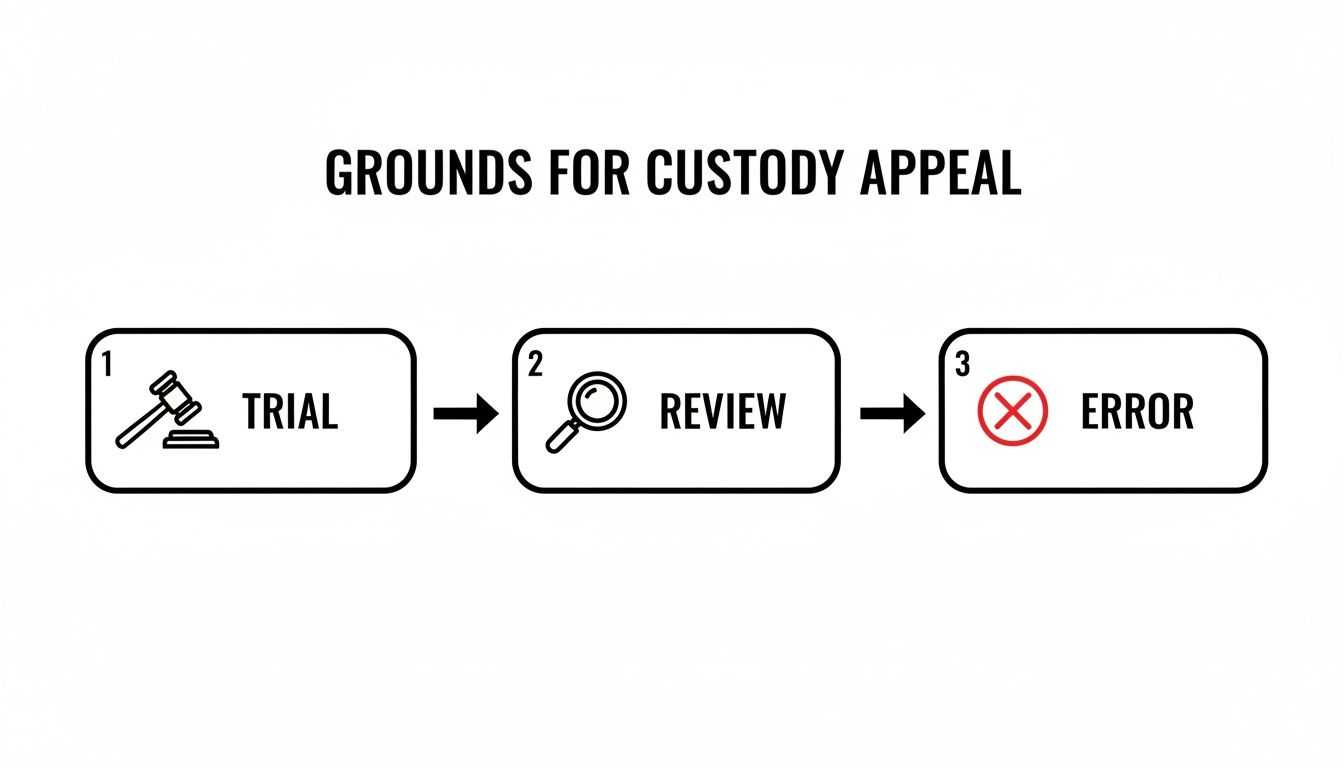
The appellate process moves from the trial court’s decision to an in-depth review of this record, all with the goal of presenting a reversible error to the appellate judges.
The Appellate Brief: The Core of Your Appeal
With the record assembled, the briefing stage begins. This is where your appellate attorney constructs the formal legal argument that will be presented to the court of appeals. An appellate brief is a highly structured document that methodically presents the facts from the record, identifies the specific legal errors made by the trial judge, and uses statutes and prior court decisions (precedent) to argue why the judgment was legally flawed and should be reversed.
Plain-English Definition: “Briefing”
Briefing is the process of writing a persuasive legal argument for a panel of appellate judges. The brief tells the story of your case using only information from the official record. It then guides the judges through the trial, highlighting exactly where the lower court erred and explaining, with legal authority, how those mistakes led to an unjust outcome.
The opposing party will file a response brief, and your attorney may have a final opportunity to respond with a reply brief. The clarity, precision, and legal strength of these briefs are paramount to the success of an appeal.
Oral Argument and the Court's Decision
In some cases, the court will schedule an oral argument, where attorneys for both sides appear before a panel of appellate judges. This is not a debate but an opportunity for the judges to ask probing questions about the arguments made in the written briefs.
Finally, after all briefs have been filed and reviewed—and after oral argument, if one occurs—the appellate court will deliberate and issue a written opinion. The court can: affirm the trial court’s ruling (let it stand), reverse the ruling and remand the case back to the trial court for further proceedings, or, in rare cases, render a new judgment.
Your Top Questions About Texas Custody and Appeals, Answered
Navigating the aftermath of a custody ruling can be confusing. Here are answers to some of the most common questions parents have when considering an appeal in the joint custody state of Texas.
Can I Appeal a Temporary Custody Order?
Generally, no. An appeal can only be taken from a final judgment—a signed order that resolves all issues in the case. Temporary orders are designed to maintain stability for the children while the case is pending and are not considered final. Because they are not the last word on the matter, they are typically not appealable orders in various legal contexts.
Does a 50/50 Possession Schedule Mean No More Child Support?
This is a common misconception. Even with a 50/50 possession schedule, a judge will still designate one parent as the "primary" conservator who has the right to determine the child's residence. Child support is often still ordered. The court will consider both parents' incomes, and the higher-earning parent is typically required to pay support to ensure the child’s standard of living remains consistent between both households.
How Do Recent Law Changes Affect My Custody Case?
Texas family law is constantly evolving. For example, a new child support cap takes effect on September 1, 2025. The maximum net monthly resources subject to child support guidelines will increase from $9,200 to $11,700. This adjustment could significantly impact support calculations in cases filed or modified after that date. You can learn more about the 2025 Texas Family Code changes here.
Will the Appeals Court Hear From New Witnesses or See New Evidence?
No. This is one of the most important distinctions between a trial and an appeal. The appellate court is restricted to reviewing what already happened in the trial court. Its review is limited to the appellate record—the official collection of documents and the court reporter's transcript from your original trial. The court’s role is to identify legal errors made by the judge based only on the evidence and arguments presented at that time.
Navigating post-divorce parenting dynamics can be challenging. Many parents find that resources like co-parent counselling for separated couples can provide valuable tools for effective communication and creating a healthier environment for their children.
If you believe the court made a mistake in your family law case, our appellate attorneys can help you seek a fair outcome. Contact The Law Office of Bryan Fagan today for a free consultation.