You may feel your case was handled unfairly if a business was a central part of your divorce. When you’re untangling a marriage, and a business is part of the equation, things get complicated. A divorce business valuation is the formal process of figuring out exactly what that business is worth in real dollars. This isn't just about balancing a checkbook; it's a deep dive into the company's economic value so it can be divided fairly under Texas law.
In Texas, if a business was launched or grew substantially while you were married, it's almost always considered community property. That means both spouses have a claim to its value, and a professional, unbiased appraisal is the only way to make sure the division is truly just and right. If you believe the trial court made a mistake in this critical area, you have the right to seek justice through the appeals process.
Why a Proper Business Valuation Is Critical in a Texas Divorce
Facing a divorce when you own a business can feel like your life’s work is on the line. A business is often the biggest and most complex asset a couple owns, and its true value is rarely obvious from a quick look at a bank statement. A formal valuation cuts through the confusion and provides the court with a clear, defensible number for property division.
A professional valuation moves your case from emotional guesswork to a structured analysis grounded in hard financial data. This is essential for achieving the "just and right" division required by the Texas Family Code.
How Valuation Errors Can Lead to an Appeal
Without a professional valuation, a judge is left with little more than one spouse's opinion versus the other's. This is a recipe for an unfair outcome, where one person might walk away with far less than they deserve. If a trial court gets the business valuation wrong and accepts a valuation that is fundamentally flawed, it can be considered a reversible error. This is a legal mistake so serious that an appellate court could overturn the entire decision.
An expert valuation does a few critical things:
- It creates an objective baseline. Gut feelings and arguments are replaced with a fact-based assessment of the business's fair market value.
- It helps with negotiations. A credible report from a neutral expert often gives both sides the confidence to settle out of court, saving everyone time, money, and stress.
- It serves as powerful evidence. If you can’t reach an agreement, the valuation report and the expert's testimony become the bedrock of your case at trial. The strength of this evidence is critical if an appeal becomes necessary.
- It prevents future fights. By setting a clear, agreed-upon value, you shut the door on later conflicts over allegedly hidden or undervalued assets.
For instance, if a judge signs off on a valuation that used the wrong method or wasn't backed by solid evidence, their ruling could be deemed an abuse of discretion. This is the legal standard an appeals court uses to decide if the trial judge’s decision was unreasonable, arbitrary, or failed to follow Texas law. Navigating the complexities of divorcing with a business means you have to get these details right from day one, as they form the basis of a potential appeal.
Understanding Key Legal Terms
This table breaks down the essential legal terms and concepts that you'll encounter during the valuation process and a potential appeal.
| Concept | Plain-English Explanation | Why It Matters in Your Divorce Appeal |
|---|---|---|
| Abuse of Discretion | The legal standard used in appeals to determine if a trial judge made a decision that was unreasonable, arbitrary, or without reference to guiding legal principles. | To win a property division appeal, you must prove the judge’s decision on the business value was an abuse of discretion, not just that the appellate court might have decided differently. |
| Reversible Error | A legal mistake made during trial that is serious enough to have affected the outcome of the case. If found, an appellate court can reverse the trial court's judgment. | A flawed business valuation—such as one using the wrong methodology or ignoring key evidence—can constitute a reversible error, providing grounds to appeal the property division. |
| Briefing | The process where attorneys write detailed legal arguments (briefs) for the appellate court, explaining why the trial court’s decision was right or wrong based on the trial record and the law. | Your appellate brief is where your attorney will meticulously outline the errors in the business valuation and argue why they amount to an abuse of discretion under Texas law. |
| Standard of Review | The specific legal framework an appellate court uses to analyze a trial court’s decision. For property division, the standard is abuse of discretion. | This is different from a trial. The appellate court does not hear new evidence; it only reviews the existing record to see if the trial judge made a legal error based on this standard. |
Understanding these concepts from the start will give you a major advantage as you navigate the process. They are the building blocks of any credible valuation and a successful appeal.
The Three Main Approaches to Valuing a Business
When it comes to putting a number on a business in a Texas divorce, experts don't just guess. They rely on established, defensible methods. Think of these as different lenses for viewing a company's worth, each offering a unique and valuable perspective.
A seasoned valuation professional will dig into the specifics of the business to figure out which approach—or more often, a combination of approaches—paints the most realistic picture of its fair market value. Getting this choice right is crucial. Using the wrong methodology isn't just a simple mistake; it's a significant legal error that can be challenged and potentially overturned on appeal.
The Asset-Based Approach
The most straightforward method is the asset-based approach. The logic here is simple: a business is worth the sum of its parts. An expert catalogs all of the company’s assets—both the tangible things you can touch, like equipment and real estate, and the intangible ones, like patents. Once they have a total value for the assets, they subtract all the company's liabilities, like business loans and outstanding bills. The number that's left is the valuation.
- Best For: This works well for companies where the value is tied up in physical assets, like real estate holding companies or manufacturing plants with heavy machinery.
- Limitation: The big drawback is that this method often completely misses the value of future earning potential or a company's hard-won reputation (goodwill). For a thriving service business, that's where most of the real value lies.
The Market Approach
Next up is the market approach, which is all about comparison. It works on the same principle a real estate agent uses to price your home: they look at what similar houses in your neighborhood have sold for recently. A valuation expert does the same thing, but for businesses.
The expert will hunt through databases to find recent sales of companies in the same industry that are a similar size and have similar profitability. They then use that data to estimate the value of the business in your divorce case.
This method is powerful because it's grounded in reality; it reflects what actual buyers in the open market are willing to pay for a similar business. The catch? Its accuracy depends entirely on finding truly comparable companies, which can be nearly impossible for unique or niche businesses.
If an expert cannot find good "comps," a valuation based on this method is built on a shaky foundation and may not hold up under cross-examination in court or on appeal.
The Income Approach
Finally, we have the income approach. This method values a business based on its power to generate future profits. Instead of valuing a rental property by the cost of its bricks and mortar, you’d value it based on how much rent it's expected to bring in over the years. That’s the income approach in a nutshell.
An expert projects the business's future earnings or cash flow and then applies a "discount rate" to calculate what that future stream of money is worth today. For most profitable, ongoing businesses, this is often the most relevant and telling approach.
If you want to dive deeper into the nuts and bolts, you can learn how to value a business accurately from resources that explore these methods in greater detail.
As the concept map below shows, a proper valuation is the bedrock for achieving fairness, protecting assets, and resolving disputes.
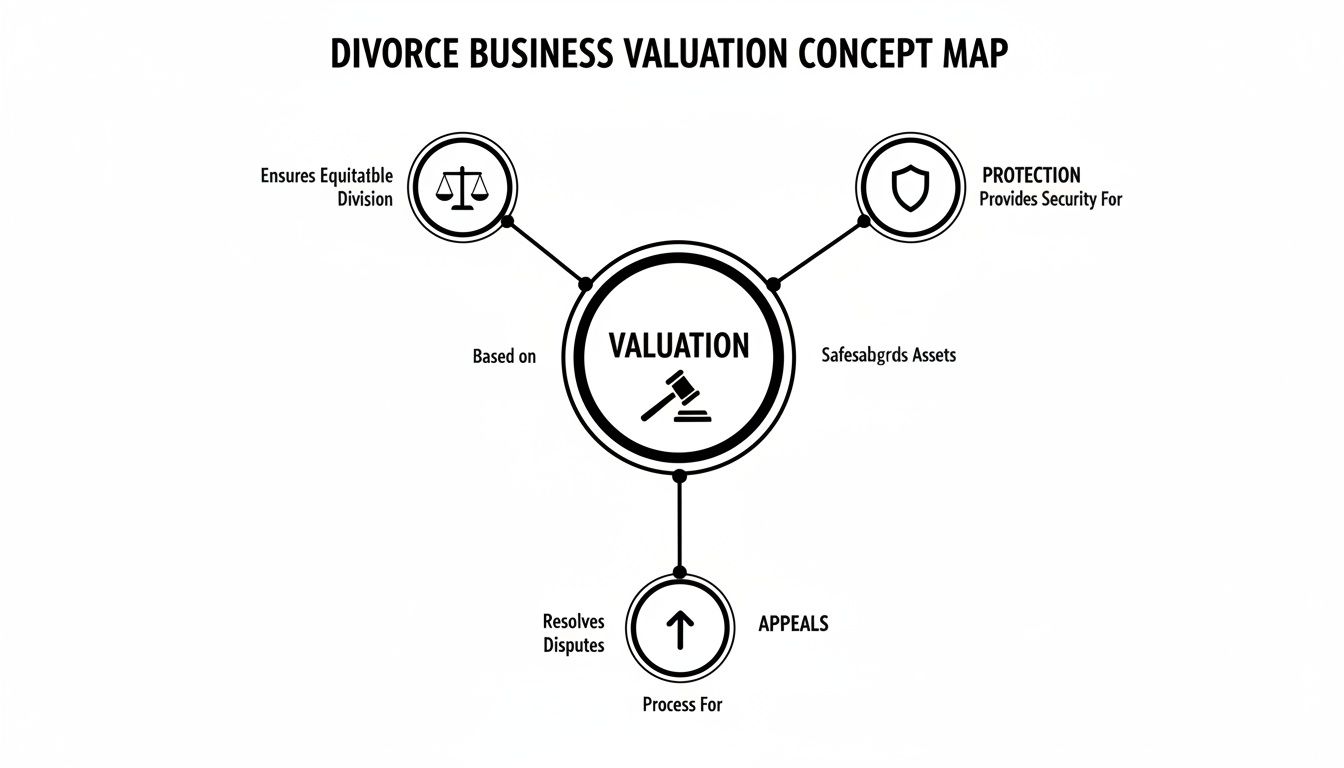
This visual drives home the point: a sound valuation is the pillar supporting a just outcome. It's what safeguards your financial future and provides the grounds to correct a judge's error. When a trial court accepts a valuation based on an inappropriate method—say, using an asset approach for a successful law firm where "goodwill" is the main asset—it can be deemed an abuse of discretion. This kind of mistake often becomes the central issue in a property division appeal.
How the Valuation Process Actually Works

Going through a business valuation in a divorce can feel invasive and intensely personal. But knowing what to expect can pull back the curtain on the process, giving you a clearer sense of what’s coming. Think of it as a structured investigation designed to provide the court with objective facts.
At its core, the entire process is built on expert analysis. The real goal is to give the court a credible, fact-based number to ensure the property division is grounded in reality, which is critical for a just and right outcome under Texas law.
Selecting the Right Expert
The first, and arguably most important, move is picking the right valuation expert. This isn’t a job for your regular CPA. You need a specialist—typically a forensic accountant or a professional holding credentials like a Certified Valuation Analyst (CVA). Your appellate attorney can help you find an expert with a track record of testifying in Texas family courts whose work can hold up under scrutiny.
In some cases, both spouses can agree on a single, neutral expert to save money and reduce conflict. However, when the stakes are high, each side often brings their own expert to the table. This sets up a "battle of the experts" at trial, where the judge must decide which valuation is more credible.
The Discovery and Document Exchange Phase
Once an expert is chosen, the "discovery" phase kicks off. This is the formal legal process for gathering information. The expert will provide your attorney with a detailed list of every document they need. Complete transparency is essential.
You can expect to provide these documents:
- Tax Returns: At least five years of business and personal returns.
- Financial Statements: Profit and loss statements, balance sheets, and cash flow statements.
- Bank Records: Statements for all business checking, savings, and loan accounts.
- Legal Documents: Things like partnership agreements, articles of incorporation, and any buy-sell agreements.
Getting this information to your attorney promptly and completely is non-negotiable. Withholding documents can damage your credibility and lead to sanctions from the judge.
The Expert's Analysis and Final Report
With all the documents in hand, the expert gets to work. They'll comb through the financials, make "normalization adjustments" to get a picture of the company's true earning power, and apply the appropriate valuation methods. This is a meticulous review of the company's financial health.
The result of all this work is the expert's final report. This is a detailed document that lays out the expert’s conclusion of value and, just as crucially, shows their work on how they got there. It will pinpoint the valuation date, explain the methods used, list the data they relied on, and justify every major decision.
This report is more than just a number; it is a roadmap of the expert’s analysis. A well-written, thoroughly supported report becomes powerful evidence at trial, while a weak or conclusory report can be easily attacked by the opposing side, potentially leading to a flawed judgment that requires correction on appeal.
The global market for divorce services, which includes legal and financial experts, was valued at around $4.35 billion. For a closer look at the steps and factors that go into this, general guidance on how to value a company can be incredibly helpful. This trend highlights why specialized expertise is a must in modern divorce. To learn more, feel free to check out our guide on getting an appraisal for divorce in Texas.
Where the Fights Happen: Common Business Valuation Disputes

A business valuation in a divorce is rarely a straightforward exercise. Because it’s built on interpretation, financial projections, and professional judgment, it’s a natural breeding ground for conflict. You might look at your spouse’s expert report and feel like they’re playing games with the numbers—and you may be right.
Understanding where these battles are typically fought is the first step to building a strong case for trial and, if necessary, for appeal. These aren't just minor quibbles; disputes over these key areas can swing the final valuation by hundreds of thousands of dollars. This is where you get the classic "battle of the experts" at trial, leaving the judge to decide whose opinion is more credible.
Disagreements Over the Valuation Date
One of the first and most fundamental arguments is often over the valuation date. In Texas, the court usually wants to see the value as of, or very near, the date of trial. However, this becomes a major point of contention if the business's value has changed significantly since separation.
Imagine one spouse continues to run and grow the business for two years while the divorce is pending. They will likely argue for a valuation date closer to the separation, claiming the subsequent growth is due to their sole effort and should be their separate property. The other spouse, naturally, will want the trial date valuation to receive their share of that growth.
The Goodwill Debate: Personal vs. Enterprise
Another major battleground is goodwill—that intangible value tied to a business's reputation and customer loyalty. Texas law forces a critical distinction between two types:
- Enterprise Goodwill: This value is attached to the business itself (its brand, location, systems). This is a community asset that gets valued and divided.
- Personal Goodwill: This value is tied directly to the skill and reputation of one spouse. It's considered that spouse’s separate property, so it’s not divisible in the divorce.
For example, a large portion of a renowned surgeon's private practice value comes from that surgeon's personal reputation. Separating this personal goodwill from the value of the clinic's brand and patient database (the enterprise goodwill) is a complex, subjective process where experts frequently clash.
Normalization Adjustments and Uncovering Hidden Income
Perhaps the most technical—and most intense—disputes happen over normalization adjustments. This is where an expert digs into the company's financial statements to figure out its true, ongoing earning power. This is necessary because owners of closely-held businesses often run personal expenses through the company books.
The goal of normalization is to paint a realistic picture of the business’s profits if a typical owner were running it. An expert might "add back" things like a spouse's country club membership, personal car payments, or family salaries to the business's income, which drives up its overall value.
This is a prime area for disagreement. One expert will find a dozen personal expenses to add back, while the other will argue they were legitimate business costs. If a court accepts a valuation that fails to make these adjustments correctly, the result can be a profoundly unfair property division. This kind of error can be considered an abuse of discretion by the judge and may provide powerful grounds for a property division appeal.
Appealing an Unfair Business Valuation After the Divorce
The final divorce decree is in your hands, but something feels deeply wrong. You look at the numbers, and you're certain the court accepted a flawed or completely unfair valuation of a business. It’s a gut-wrenching feeling, but the fight might not be over.
A major mistake in how a business was valued can be the very foundation you need to challenge the court's entire property division. In Texas appeals, we call this a reversible error. It’s not about a minor disagreement; it's about a fundamental flaw in the judge's decision-making process that led to an unjust result. An appeal is your chance to have a higher court take a second look and restore balance.
What You Can Appeal: Understanding the Standard of Review
When you appeal a property division in Texas, it's important to understand that the appellate court isn't going to hold a new trial. They don't hear from witnesses or see new evidence. Instead, they examine the trial judge's decisions through a very specific legal lens known as the abuse of discretion standard of review.
In simple terms, the appellate court asks: "Was the trial judge's decision on the business value and property split reasonable, or was it arbitrary and completely disconnected from the evidence presented?" The higher court won’t overturn the decision just because they might have valued the business a bit differently. To win on appeal, you have to prove the trial court acted "without reference to any guiding rules and principles."
Examples of Common Reversible Errors in Business Valuations
Some mistakes are so significant they can rise to the level of reversible error, giving you a powerful basis for an appeal. These are foundational errors that poison the entire valuation.
Here are a few common examples of reversible errors in Texas family courts:
- Adopting a Valuation with No Evidence: A judge can't just pull a number out of thin air. Their final decision must be firmly rooted in the expert reports, financial documents, and testimony presented in court.
- Relying on an Improper Methodology: This is a big one. If an expert uses a valuation method that makes no sense for the business—like using an asset-based approach for a service company where the main value is goodwill—and the judge accepts it, that can be a clear abuse of discretion.
- Failing to Classify Goodwill Correctly: The distinction between divisible 'enterprise goodwill' and non-divisible 'personal goodwill' is a legal minefield. When a court gets this wrong and divides personal goodwill as if it were community property, it can lead to a massively skewed property division and is a frequent basis for appeals.
- Using the Wrong Valuation Date: Timing is everything. Accepting a valuation that improperly includes a spouse's post-separation efforts as part of the community estate can absolutely be a reversible error.
An appeal isn't a do-over. It is a precise, strategic review of the trial court record for specific legal errors. Our job is to show the appellate judges that the mistake was so damaging that it created an unjust division of your marital estate.
The Appellate Process: A Step-by-Step Insight
Knowing what lies ahead can bring a sense of clarity and control. The appellate process follows a structured path laid out by the Texas Rules of Appellate Procedure. It is very different from a trial.
- Filing the Notice of Appeal: This is the first, non-negotiable step. It must be filed within a strict deadline, usually 30 days after the judge signs the final divorce decree. Missing this deadline means you lose your right to appeal.
- Preparing the Appellate Record: We immediately order the official court reporter's transcripts of every word spoken at trial, along with a collection of every document admitted into evidence. This record is the only thing the appellate court will look at.
- Briefing: Here's where the real work begins. Our attorneys draft a powerful legal argument, called an appellate brief. It meticulously lays out the trial court’s errors, backing up every point with case law and direct citations to the appellate record.
- Oral Argument: In some cases, the court of appeals schedules a hearing where the lawyers for both sides argue their case in person before a panel of judges and answer their direct questions.
- The Court's Decision: Finally, the appellate court issues a written opinion. It will either affirm (uphold) the trial court's decision or reverse it and send the case back for a new hearing with instructions to follow the correct legal standards.
If you are worried about the valuation of a business in your divorce and feel an error has led to an unfair outcome, our experienced appellate team is here to analyze your case.
Common Questions We Hear About Business Valuations
Even after laying out the basics, you're bound to have questions about how a business valuation will play out in your specific divorce. This part of the process can feel like a maze. Let’s tackle some of the most common questions our appellate clients have brought to us over the years.
What’s This Going to Cost Me? A Look at Valuation Fees in Texas
The price tag on a business valuation can swing pretty wildly. For a small, straightforward business with tidy books, you might be looking at a few thousand dollars. But if you’re dealing with a larger, more complex company—maybe one with multiple locations or financial records that are a bit of a mess—the cost can easily jump into the tens of thousands.
A few key things drive the price: the business's size and complexity, how easy it is to get ahold of clean financial documents, and frankly, the level of conflict between you and your spouse. It might feel like a big check to write, but a credible, independent valuation isn't just an expense; it's an investment. It’s the only real way to get an accurate number for what is often the biggest asset on the table.
Can We Just Use One Expert and Save Some Money?
Yes, absolutely. Spouses can agree to hire a single, neutral expert to value the business. This can be a fantastic way to cut costs, lower the temperature, and keep things moving forward. It tends to work best when both people trust each other and share the goal of finding a fair number without a drawn-out court battle.
The catch? You both have to be prepared to accept the expert’s final number, even if it’s not what you were hoping for. If there’s serious disagreement about how the business is run or what the financials really look like, it’s much more common for each side to hire their own expert. When that happens, the judge will hear from both and decide which valuation is more believable and better supported by the facts.
What Happens If My Business Has Other Partners?
When other partners or shareholders are in the picture, the valuation gets more focused. The expert isn’t trying to value the entire company; their job is to figure out the value of your specific ownership slice. This means they have to dig into the foundational legal documents.
Your expert will need to get their hands on:
- Shareholder or Partnership Agreements: These are huge. They often have "buy-sell" clauses that can directly impact the value of your share.
- Operating Agreements: This document lays out the rules of the road for the business and what each owner’s rights and duties are.
- Stock Ledgers and Ownership Records: These are the official proof of exactly what percentage of the business you own.
Now, while the court will definitely look at these agreements, it isn't always stuck with them—especially if a buyout price in the agreement is way off from the real fair market value. The expert’s job also includes separating your community property interest from any separate property you might have owned before the marriage. This protects your business partners while making sure the division between you and your spouse is fair.
How Does Texas Deal with "Goodwill"?
This is where things can get tricky. Texas law is very particular about how it treats a business's intangible value, known as goodwill. This is easily one of the most contested issues in a divorce valuation, and you absolutely need to know the difference between the two types.
-
Enterprise Goodwill: Think of this as the value attached to the business itself—its brand, its reputation, its customer lists, its proven systems. It’s the reason a well-known local coffee shop is worth more than just its espresso machines and furniture. This type of goodwill is considered a community asset, and its value can be split in a divorce.
-
Personal Goodwill: This is the value tied directly to one spouse’s personal skills, reputation, and relationships. A renowned heart surgeon’s stellar reputation, for example, is attached to her, not just the clinic where she works. In Texas, personal goodwill is treated as separate property and is not divisible in a divorce.
A huge part of a valuation expert's job is to untangle these two. It's a complex analysis that can be highly subjective, which is why it so often becomes a major point of contention between experts and a frequent issue we see in property appeals. If a trial court gets this wrong and divides personal goodwill, it can completely skew the property division and may be a reversible error on appeal.
If you believe the court made a mistake in your family law case, our appellate attorneys can help you seek a fair outcome. Contact The Law Office of Bryan Fagan today for a free consultation.