Skip to content
If you have received a final order on joint custody in Texas that you believe is unfair or harmful to your child, you may feel that the justice system has failed your family. You presented your case, shared your concerns, and yet the judge’s decision does not reflect what is truly in your child’s best interest. It is a frustrating and often disheartening experience, but it may not be the final word.
The Texas appeals process exists specifically to correct legal errors made in trial courts. This guide will walk you through the core principles of Texas joint custody, explain how trial court mistakes can lead to unjust outcomes, and outline the steps for seeking a fair resolution through an appeal.
What is "Joint Custody" and Why Does It Matter on Appeal?
In Texas, the legal term for joint custody is "Joint Managing Conservatorship." This is the default arrangement under the Texas Family Code because the law presumes that keeping both parents actively and meaningfully involved in a child’s life is in that child’s best interest. However, if you are reading this, the final order in your case may feel anything but collaborative or fair.
An appeal does not re-litigate your case. Instead, it is a focused review of the trial court record to determine if the judge made a significant legal mistake—known as a reversible error—that led to an improper ruling. Understanding what the law requires is the first step in identifying if such an error occurred in your case.
The Legal Presumption for Both Parents' Involvement
Texas law establishes a strong preference for naming parents as Joint Managing Conservators. A judge must start every custody case with this presumption. This legal framework is designed to give both parents the right to participate in major decisions affecting their child, such as those concerning education and non-emergency healthcare.
To deviate from this standard, a court must have compelling evidence that appointing a parent as a Joint Managing Conservator would endanger the child's physical or emotional well-being. This high standard is intended to protect the parent-child relationship. If a judge ignored this presumption without sufficient evidence, it could be a foundational point for your appeal.
Core Rights and Responsibilities in a Joint Custody Order
When parents are named Joint Managing Conservators, they share a bundle of critical decision-making powers. While one parent is often given the exclusive right to determine the child’s primary residence (making them the "primary" parent), many other major decisions are intended to be made jointly.
These shared rights often include:
- Making decisions about the child’s education.
- Consenting to major medical, dental, or surgical treatments.
- Agreeing on psychological or psychiatric care.
- The right to access all of the child's school and medical records.
All decisions are guided by the Texas Family Code, specifically Section 153.002, which states that the child's best interest is the primary consideration. The law aims to ensure frequent contact between a child and both parents. You can learn more about the statutory preference for joint custody and its legal basis.
How a Court Can Misapply the "Best Interest of the Child" Standard
Every custody decision in Texas hinges on the “best interest of the child.” If you are considering an appeal, you likely believe the trial court failed to correctly apply this standard. This is not just a vague concept; it is a specific legal test that judges are required to follow.
The law presumes that naming parents as Joint Managing Conservators is what’s best for a child. This presumption can be overcome if there is evidence that a joint arrangement would be harmful. An appellate court will review the record to see if the trial judge properly considered the evidence or if their decision amounted to an "abuse of discretion."
This flowchart illustrates the analysis a Texas court should undertake when determining a custody arrangement.
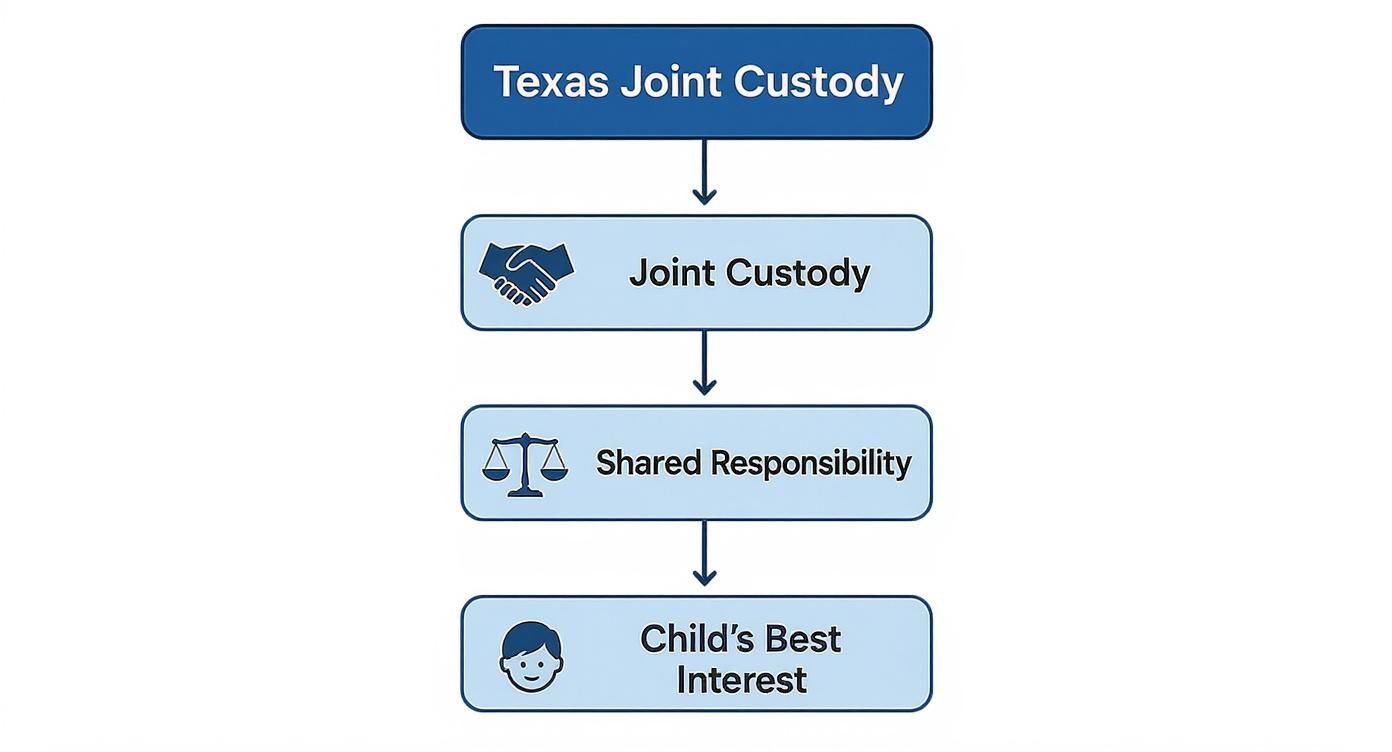
When a court deviates from this analysis without a sound legal basis, its decision may be reversible on appeal.
The Holley Factors: A Required Framework for Analysis
To determine a child's best interest, a judge must use a set of criteria known as the "Holley factors." These are not optional suggestions but a required analytical framework. A judge must weigh the evidence presented on these points to make a reasoned decision.
A judge will evaluate evidence related to:
- The child’s needs: The emotional, physical, and developmental needs of the child, now and in the future.
- Parental abilities: Each parent's capacity to provide a safe, stable, and nurturing home.
- Stability of the home: The consistency and security offered by each parent's living environment.
- The child's preference: For children 12 and older, the judge must meet with them to hear their wishes, though it is not the sole deciding factor.
- Parental conduct: Any acts or omissions that may indicate an unhealthy parent-child relationship.
When the Presumption for Joint Custody Is Challenged
While joint custody is the standard, a trial court can be persuaded to order a different arrangement if there is credible evidence of serious issues. A judge’s failure to give proper weight to this evidence can be a significant error.
Common grounds for challenging the presumption include:
- A history of family violence or child abuse.
- Evidence of significant drug or alcohol abuse.
- Severe mental health issues that could endanger the child.
- A pattern of one parent actively alienating the child from the other.
Destructive behaviors like parental alienation can be particularly damaging. You can learn more about this in our article covering examples of parental alienation. Proving these issues with evidence is vital, and a judge's failure to consider them can be grounds for an appeal.
In plain English, an "abuse of discretion" occurs when a trial judge makes a decision that is arbitrary, unreasonable, or without reference to any guiding rules and principles. For example, if a judge ignores undisputed evidence of harm and still appoints a parent as a joint conservator, that decision may be an abuse of discretion and a reversible error.
An appellate attorney can review the trial record to determine if the judge’s decision was legally sound or if it failed to properly prioritize your child's best interests according to the law.
Building a Clear and Effective Parenting Plan
A flawed or unworkable court-ordered parenting plan can create constant conflict and instability for a child. This document is the foundation of a joint custody arrangement in Texas. When appealing a custody decision, the parenting plan itself often becomes a central piece of evidence.
The appellate court will scrutinize the trial court’s order to determine if it is specific enough to be enforceable and, most importantly, if it truly serves the child’s best interests. A vague, ambiguous, or impractical plan can be a clear sign of an abuse of discretion—a legal mistake that could be grounds for reversing the original ruling.

Key Pillars of a Texas Parenting Plan
Every parenting plan under a Joint Managing Conservatorship must contain three fundamental components. If a judge fails to properly define these areas or creates an order that is impossible to follow, it can be a reversible error.
The three non-negotiable elements are:
- Allocation of Rights and Duties: This section details who makes major decisions for the child.
- Possession Order: This is the calendar that specifies when the child will be with each parent.
- Child Support: The plan must clearly outline the financial obligations for the child’s care.
A well-argued appeal will demonstrate exactly how flaws in these areas harm the child's stability and why the trial court's decision was legally incorrect. A parenting plan must be a clear, comprehensive document that leaves no room for ambiguity.
Key Components of a Texas Parenting Plan
| Component | Description | Common Arrangement |
|---|---|---|
| Designation of Conservators | Identifies parents as Joint Managing Conservators and may name one as the "primary" parent. | One parent is designated the right to establish the child's residence. |
| Parental Rights and Duties | Specifies decision-making authority for education, healthcare, and general welfare. | Rights can be shared, exclusive to one parent, or require joint agreement. |
| Possession Schedule | The detailed calendar of when the child is with each parent, including holidays and vacations. | Follows the Texas Standard Possession Order (SPO) or a custom schedule. |
| Geographic Restriction | Defines the area (e.g., county) where the primary parent must establish the child's residence. | Typically the county where the divorce was filed and contiguous counties. |
| Child Support | Outlines the financial obligations of the non-primary parent based on Texas guidelines. | Includes monthly payments, health insurance, and uninsured medical costs. |
| Communication Protocols | Sets rules for how parents will communicate with each other and with the child. | May specify methods (e.g., co-parenting app) and response times. |
If these components are poorly defined in your order, it may be grounds for an appeal.
Deciding Who Makes the Big Decisions
The allocation of parental rights covers the major decisions that shape a child's future. In a typical Texas joint custody order, one parent is named the "primary" conservator and given the exclusive right to determine the child’s residence and receive child support.
Other critical decisions, such as those regarding non-emergency medical procedures or educational choices, are often meant to be made jointly. This requires parents to consult one another. If they cannot agree, the primary parent often has tie-breaking authority.
A classic example of a reversible error is when a court grants final decision-making power to a parent despite clear evidence that they are unable or unwilling to act in the child's best interest. For instance, if a parent has a documented history of neglecting a child's medical needs, giving them the final say on healthcare could be deemed an abuse of discretion on appeal.
The Possession Order: The Co-Parenting Calendar
The possession order sets the schedule for a child's life. Texas has a default schedule called the Standard Possession Order (SPO), which the law presumes is in the child's best interest. The SPO generally gives the non-primary parent possession on the first, third, and fifth weekends of a month, along with alternating holidays and summer visitation.
However, the SPO is not a one-size-fits-all solution. A trial court’s refusal to consider a family's unique circumstances can be grounds for an appeal. For example:
- A 50/50 schedule may be more appropriate if parents live close and can co-parent cooperatively.
- Customized schedules are often necessary for parents with non-traditional work hours, like first responders or medical professionals.
If a judge imposed a standard order despite compelling evidence that a different schedule was necessary for the child's well-being, an appellate court may find that the decision was an abuse of discretion. A fair outcome requires a plan that reflects your family’s reality.
If your circumstances have changed since the order was made, you can find more information in our resources on child custody modifications.
The Reality of Parenting Time Schedules
A common source of frustration in Texas joint custody cases is the parenting time schedule. Many parents hear "Joint Managing Conservatorship" and assume it means a 50/50 division of time. The reality is often quite different.
When a judge issues a final order with a schedule that feels inequitable or unworkable, an appeal can examine whether the judge properly considered all the evidence about your family's specific needs and circumstances.

Primary Conservator and the Standard Possession Order
Even in a joint custody arrangement, Texas courts nearly always designate one parent as the "primary" conservator—the parent who establishes the child's residence. The other parent is named the "possessory" conservator and is typically ordered to pay child support.
The court's default schedule is the Texas Standard Possession Order (SPO). This schedule gives the possessory parent the child on the first, third, and fifth weekends, splits holidays, and allocates summer time.
The Standard Possession Order generally results in a time split closer to 65/35. This means the primary parent has the child for roughly two-thirds of the year, while the possessory parent has the child for about one-third.
This reality can be jarring for parents who expected equal time. It also highlights an imbalance where, despite the law's preference for joint conservatorship, equal physical possession remains the exception, not the rule.
Pushing for a True 50/50 Possession Schedule
While the SPO is the default, a court can order a true 50/50 split if it is proven to be in the child's best interest. To achieve this, a strong case must be presented at trial.
A judge is more likely to order a 50/50 schedule if the evidence shows:
- Geographic Proximity: The parents live close to each other, ideally in the same school district.
- Cooperative Co-Parenting: The parents have a demonstrated ability to communicate respectfully and make joint decisions.
- Shared Caregiving History: Both parents were actively and equally involved in daily child-rearing tasks before the separation.
- Child's Preference: For children 12 and older, their stated desire can be a persuasive factor.
If you presented strong evidence on these points and the judge still imposed a restrictive SPO without a clear justification, this could indicate a reversible error. A judge's failure to tailor the schedule to a family's unique circumstances may be an abuse of discretion.
Life circumstances change, and an order that becomes unworkable may need to be altered. Learn more in our guide on child custody modifications.
Challenging an Unfair Custody Decision Through Appeal
A final order from a trial court is not always the end of the road. If you are convinced the court made a legal error in your joint custody Texas case, the appellate process is the mechanism for seeking correction.
An appeal is not a second trial. You cannot introduce new evidence. Instead, a panel of appellate judges reviews the trial court record—every motion, exhibit, and line of testimony—to determine if a significant legal mistake occurred that led to an improper outcome. This is a highly technical process that focuses on errors of law, not disagreements over the facts.
Understanding the Standard of Review: Abuse of Discretion
In Texas family law appeals, the key to success is often proving an “abuse of discretion.” This is the legal standard appellate courts use to evaluate a trial judge's decisions. It is a high bar to meet.
An abuse of discretion occurs when a judge’s ruling is arbitrary, unreasonable, or made without considering the guiding legal rules and principles. The appellate court is not asking if it would have made the same decision. It is asking if the trial judge's decision was legally defensible based on the law and the evidence presented.
In plain English, a reversible error is a legal mistake so significant that it likely caused the trial court to issue the wrong judgment. Identifying these errors requires a deep understanding of the Texas Family Code and the Texas Rules of Appellate Procedure.
Your appeal must be built on a strong legal argument that pinpoints a clear error and demonstrates how that error harmed your case.
Common Examples of Reversible Error in Custody Cases
To win an appeal, you must identify a “reversible error”—a legal blunder so significant that it probably caused the judge to issue an improper order. In joint custody cases, these errors often arise when a judge misapplies the "best interest of the child" standard.
Examples of reversible errors include:
- Ignoring Key Evidence: The judge disregarded undisputed testimony about a parent's ongoing substance abuse or history of family violence when setting the possession schedule.
- Misapplying the Law: The court failed to properly apply all the required Holley factors and instead mechanically ordered a Standard Possession Order despite evidence that it was not in the child’s best interest.
- Excluding Admissible Evidence: The judge improperly refused to allow crucial testimony from a child's therapist, teacher, or other key witness regarding the child’s well-being.
These are not minor procedural issues; they are fundamental errors that can unjustly alter a family's future. If you are living with an unfair order, it may be the result of a reversible error.
While an appeal challenges the original ruling, a modification is a separate process for when circumstances change over time. You can learn more about how to change a custody agreement through modification. An appeal, however, directly attacks the legal correctness of the judge's initial decision.
Common Questions We Hear About Joint Custody
Navigating a joint custody order can be confusing. Here are answers to some of the most common questions we receive from parents.
Can my child choose which parent to live with?
In Texas, a child aged 12 or older can speak with the judge in private to state their preference on which parent they want to live with. The judge is required to listen to the child.
However, the child's preference is not binding. The judge must make a final decision based on the child's overall best interest. The court will consider the child's maturity and reasons for their choice as one factor among many.
What’s a geographic restriction?
A geographic restriction is a standard provision in Texas custody orders that limits where the primary parent can establish the child’s residence. Typically, this is restricted to the county where the case was heard and any adjoining counties.
The purpose is to ensure both parents can remain actively involved in the child's life by living in close proximity. To move outside this designated area, the primary parent must obtain either the other parent's written consent or a new court order.
How does child support work with joint custody?
A common misconception is that "joint custody" means no one pays child support. In nearly all Joint Managing Conservatorship cases, one parent is ordered to pay child support.
Typically, the non-primary parent (the parent who does not have the exclusive right to determine the child's residence) pays support. The amount is calculated using a formula in the Texas Family Code based on the paying parent's net monthly income. While a true 50/50 possession schedule may be grounds for adjusting the amount, it rarely eliminates the support obligation entirely.
If you believe the court made a mistake in your family law case, our appellate attorneys can help you seek a fair outcome. Contact The Law Office of Bryan Fagan today for a free consultation by visiting our appellate law website.