Skip to content
You may feel your case was handled unfairly if a judge issued a court order against you based solely on someone else's testimony, without you even being in the room. That's exactly what a temporary ex parte protective order is in Texas. It's a swift, emergency action taken when a judge believes there's a "clear and present danger" of family violence. While designed to offer immediate protection, this one-sided process can feel unjust and overwhelming, leaving you searching for a way to restore balance.
What a Temporary Ex Parte Protective Order Means for You

Being served with one of these orders can be jarring and confusing, especially when you feel blindsided by accusations you haven't had a chance to defend against. This reaction is completely normal.
The most important thing to understand is that this order is not a final verdict on your case. It is a temporary measure—the legal system's way of hitting "pause." A judge heard one side of the story and decided there was enough concern of an immediate risk to put temporary safeguards in place until a full hearing. This temporary nature is a fundamental part of due process.
Understanding the Immediate Impact
The purpose of a temporary ex parte protective order is to create an immediate safety buffer. While active, it carries the full force of law and places strict limitations on your actions. It is critical to comply with these terms, as even a minor violation can lead to serious legal consequences, including new criminal charges.
Here are the most common restrictions you'll face:
- No Contact: You are legally barred from all forms of communication with the petitioner. This includes calls, texts, emails, social media messages, or asking a third party to pass along a message.
- Stay-Away Provisions: The order will specify a minimum distance you must maintain from locations like the petitioner's home, workplace, or their children's school.
- Firearm Restrictions: Under both Texas and federal law, you are immediately prohibited from possessing or purchasing firearms or ammunition as long as the order is in effect.
Your Right to Be Heard Is Next
While the initial ex parte process is one-sided by design, it is not the end of the story. The order serves as your official notice that a full court hearing is scheduled, typically within 20 days.
This hearing is your constitutionally protected opportunity to appear before the judge, present your evidence, call witnesses, and share your side of the story. The goal is to ensure all facts are considered so the judge can make a fair, informed, and final decision.
A key distinction to remember is that while a temporary ex parte protective order provides immediate relief, it is based on a minimal evidentiary standard. The subsequent hearing requires a higher burden of proof from the petitioner, giving you the chance to challenge the claims directly. For a broader understanding of similar legal mechanisms providing immediate relief, explore the details of a temporary restraining order in Texas.
The First 20 Days: What Happens After a Judge Signs the Order
The moment a judge signs a temporary ex parte protective order, a specific legal clock begins ticking. You now have a window—typically no more than 20 days—before your day in court. This period is governed by strict rules and immediate consequences. Understanding what to expect is the first step toward building a strategic response for the upcoming hearing.
Your first official notice will likely be delivered in person. A constable or sheriff's deputy will hand you the legal documents. This is called "service of process," and it is the court's formal method of notifying you that an order exists and what it requires.
Understanding the Immediate Restrictions
The paperwork you receive is a direct command from a judge. You must read every word and follow every restriction to the letter, without exception. Violating any part of this order can lead to immediate arrest and new criminal charges, which will significantly complicate your family law case.
Here are the most common rules you'll see:
- No Contact, Period: All forms of communication are prohibited. This means no phone calls, texts, emails, or social media messages. You cannot ask a friend or family member to convey a message for you.
- Keep Your Distance: The order will specify "stay-away" distances. A common requirement is to remain at least 400 feet away from the petitioner's home, workplace, and your child's school or daycare to create a physical buffer zone. The Texas Family Code lays out specific language for these prohibitions.
- Firearms Are Prohibited: Both Texas and federal law are clear. While the order is active, you are immediately banned from possessing or purchasing any firearms or ammunition.
Mapping the Procedural Timeline
From the moment you are served, every action matters. The 20-day window is designed to provide immediate safety for the petitioner while giving you the opportunity to prepare for a full hearing where your due process rights are protected.
This 20-day period is your preparation time, not a punishment. It is your opportunity to gather evidence, consult with an appellate attorney, and build a case that provides the judge with a complete and accurate picture.
To help you visualize the process, here’s a breakdown of what typically happens and when.
Timeline of a Temporary Ex parte Protective Order in Texas
This table outlines the typical sequence of events from the initial filing to the final hearing, helping you understand the legal process.
| Procedural Step | Typical Timeframe | What Happens |
|---|---|---|
| Order Issuance | Day 1 | A judge reviews the petitioner's claims and, if they find a "clear and present danger," signs the temporary order without you present. |
| Service of Process | Days 1-3 | A constable or sheriff's deputy personally delivers the order and the notice for your full court hearing. The 20-day clock starts now. |
| Strict Compliance | Immediately | You must begin following every rule in the order the moment you receive it. There is no grace period. |
| Legal Consultation | As Soon as Possible | You should immediately contact a family law appellate attorney to review the order, discuss the allegations, and start planning your defense. |
| Evidence Gathering | Days 3-18 | Your legal team helps you organize relevant texts, emails, documents, and identify witnesses who can support your side of the story. |
| The Full Hearing | On or before Day 20 | Both you and the petitioner appear in court to present evidence and testify. The judge will then decide to either let the order expire or issue a final protective order, which can last for up to two years. |
This period requires a calm and deliberate approach. Complying with the order demonstrates respect for the court's authority and prevents further legal trouble. Simultaneously, using these 20 days to strategically prepare is key to ensuring your voice is heard and your case is presented fairly.
Why a Judge Can Issue an Order Without Your Testimony
https://www.youtube.com/embed/mevUUWvSB8M
It can feel fundamentally unfair to learn that a judge has issued an order against you—one affecting your home, children, and rights—without you ever setting foot in the courtroom. It is natural to feel that your rights were bypassed, and that reaction is valid.
However, the legal system allows this process for a specific, emergency-driven reason. Texas law permits a judge to issue a temporary ex parte protective order based on a single person's sworn statement to prevent imminent harm. The goal is to act quickly when there is a belief that family violence presents a "clear and present danger" and waiting for a full hearing could be too late. This initial step is a temporary shield, not a final verdict.
The Legal Bar for an Emergency Order
In a typical hearing, a judge hears from both sides before making a decision. The ex parte process is an exception designed for speed in a crisis. It operates on a different, lower standard of proof tailored to these urgent situations.
The judge reviews the applicant's petition and sworn affidavit with one question in mind: If I accept these statements as true, do they indicate a credible, immediate threat? This is not about proving a case "beyond a reasonable doubt," as in a criminal trial. It is a rapid risk assessment to ensure safety until a formal hearing can be held. Courts nationwide rely on these emergency orders to intervene and prevent harm based on assertions of imminent danger.
What Qualifies as "Family Violence"?
To understand the judge's perspective, it is important to know how Texas law defines "family violence." It is a broad term that covers more than just physical conflict.
Under the Texas Family Code, it can include:
- An act against a family member intended to cause physical harm, injury, or assault.
- A threat that places a family member in fear of imminent physical harm, injury, or assault.
- Abuse directed at a child within the family.
When a judge sees allegations that fit these descriptions, the legal process moves quickly.
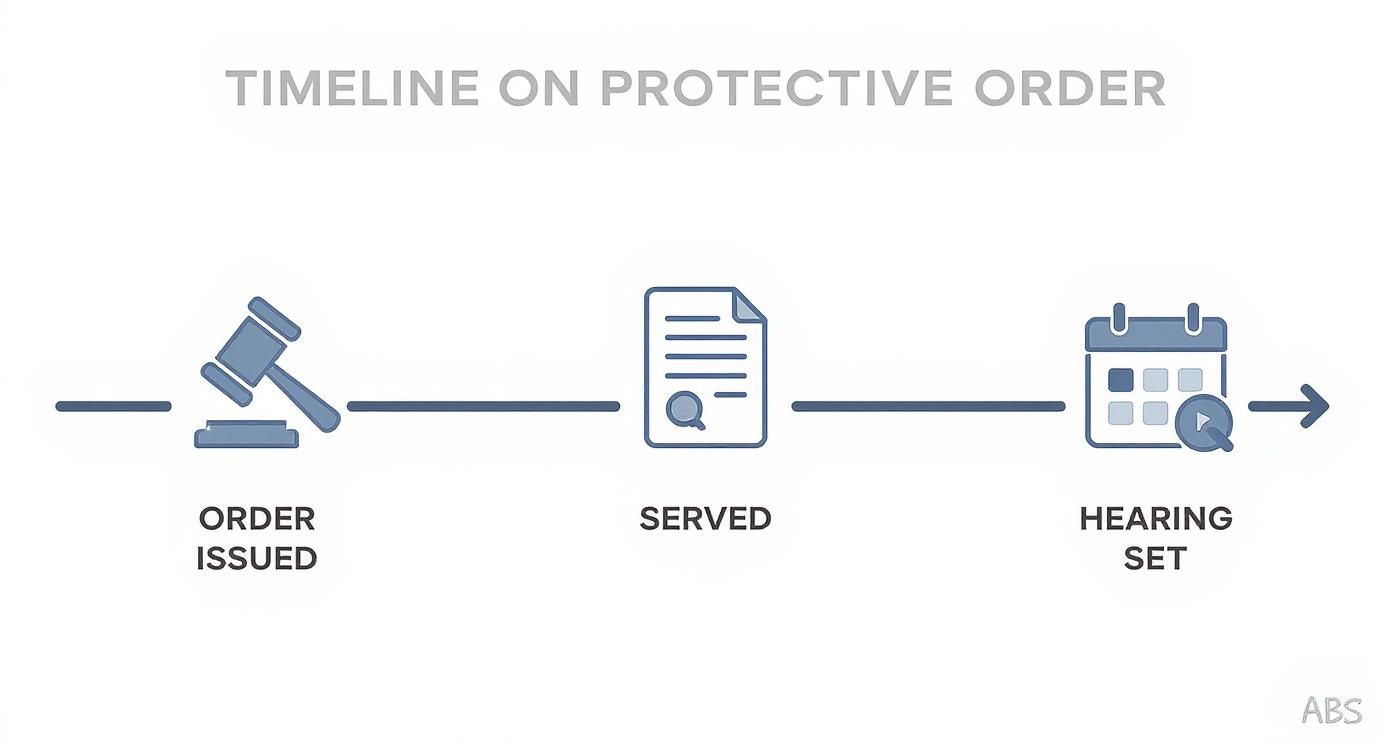
This timeline illustrates the rapid progression of events—from the judge's initial order to the moment you are served and, most importantly, to the hearing where you finally have your opportunity to speak.
While this process is designed to protect, it can be misused. Allegations may be exaggerated or facts twisted, with the knowledge that you are not present to correct the record. That is precisely why the full hearing is so critical—it is your constitutional right to due process. Understanding the "clear and present danger" standard is the first step toward preparing your defense and demonstrating why the initial claims do not justify a final protective order.
How a Protective Order Affects Custody and Firearm Rights

A temporary ex parte protective order carries significant weight, with consequences extending far beyond a no-contact rule. The moment a judge signs it, the order can immediately disrupt two fundamental aspects of your life: your relationship with your children and your Second Amendment right to own a firearm.
The court's primary objective is to create an immediate zone of safety based on the applicant's allegations. This can mean a sudden and jarring change to your family dynamic and personal liberties—all before you have had a chance to present your side of the story.
Immediate Impact on Child Custody Arrangements
If you share children with the person who filed the order, it can instantly override any existing custody or visitation schedule. As part of an ex parte order, a judge has the authority to issue "temporary orders" concerning the children to ensure their safety until a full hearing can be conducted.
This can manifest in several ways:
- Temporary Suspension of Visitation: In serious cases involving allegations of direct harm or threat to a child, a judge may temporarily suspend all of your possession and access rights.
- Supervised Visitation Only: The order could mandate that any time you spend with your children must be supervised, either by a trusted family member or a professional supervision agency.
- Restricted Contact: The order may prohibit you from visiting your child’s school or daycare, effectively preventing you from picking them up or attending their activities.
These changes can be devastating, but it is crucial to remember they are temporary. The judge's initial decision is based on a limited, one-sided account. The scheduled hearing is your opportunity to present evidence and testimony to demonstrate to the court that maintaining your parent-child relationship is in your children's best interest.
For a deeper dive into how courts handle these situations, you can read our guide on getting an emergency custody order in Texas.
Automatic Prohibition on Firearms and Ammunition
The second major consequence of a protective order is both immediate and non-negotiable. Under Texas and federal law, being named as a respondent in a protective order automatically prohibits you from possessing or purchasing firearms and ammunition. This is a strict legal command with severe penalties for non-compliance.
This restriction is absolute. It applies to every firearm you own, regardless of how it was acquired or whether you have a license to carry. Failure to comply can lead to new criminal charges, which will seriously complicate your family law case and may result in fines and jail time.
Once served with the order, you must take immediate steps to legally divest yourself of any firearms in your possession. This may involve transferring them to a licensed dealer or a trusted individual who is legally permitted to possess them. If you need to send them out of state, you must follow the specific rules for shipping firearms across state lines. The court will expect you to have addressed this responsibly before your hearing date.
These profound impacts on your parental and constitutional rights underscore the critical importance of the upcoming hearing. It is your crucial opportunity to restore fairness by presenting a complete and accurate picture to the court.
Preparing to Challenge the Order at Your Hearing

Being served with a temporary ex parte protective order can make you feel as though you have been judged without a chance to tell your side of the story. Because, up to this point, you have been. The upcoming court hearing is your opportunity to change that.
This is not another one-sided proceeding. It is a full adversarial hearing, where both parties present their case. The rules of evidence apply, and the petitioner no longer has the automatic benefit of the doubt. The legal burden now shifts to them to prove their claims.
Shifting the Burden of Proof
At the initial emergency stage, a judge only needed to find a "clear and present danger" based on the petitioner's sworn statement. The standard is much higher for the final hearing.
The petitioner must now prove their case by a "preponderance of the evidence." This legal term means they must convince the judge that their allegations are more likely true than not—a 50.1% probability. This is a significant leap from the emergency standard and provides an opportunity for you to build a strong defense. Your goal is to introduce evidence and testimony that brings the likelihood of their claims below that 50% threshold.
Judicial culture can sometimes play a role in these cases. Sociological studies have shown that the rates at which courts grant temporary orders can vary based on local factors like urbanization and community attitudes. This highlights why understanding the specific court and local legal environment is a critical piece of your strategy. You can learn more about these research findings on judicial tendencies here.
Building Your Evidentiary Case
While your testimony is important, solid, objective evidence is what truly persuades a judge. The time before the hearing—often around 20 days—is your window to gather everything that supports your version of events. This is not just about denying allegations; it is about constructing a counter-narrative backed by proof.
Consider collecting these types of evidence:
- Digital Communications: Preserve all text messages, emails, and social media exchanges. They can provide essential context, demonstrate a normal conversation, or even reveal a petitioner's ulterior motive.
- Witness Testimony: Identify credible individuals who can speak to your character or confirm your whereabouts during an alleged incident. A statement from a friend, coworker, or family member can directly contradict the petitioner’s story.
- Documentation: Collect anything that can establish an alibi. This could include store receipts, photos with timestamps, location data from your phone, or any other document that proves where you were and what you were doing.
An experienced family law appeal attorney is invaluable in this process. They know what kind of evidence has the greatest impact and how to present it correctly under the Texas Rules of Evidence.
Common Defense Strategies
A strong defense involves more than just poking holes; it requires presenting a clear, logical reason why the order should be denied. While every case is unique, most successful strategies focus on one of three core arguments.
- Factually Untrue: This is the most direct defense. You use your evidence—an alibi, a contradictory text message—to prove the alleged incident did not happen as described.
- Taken Out of Context: Sometimes an event did occur, but the petitioner has twisted the facts, exaggerated its meaning, or omitted key details. Your goal is to provide the full picture so the judge understands what really transpired.
- Not "Family Violence": You can argue that even if the petitioner's account is accurate, the actions described do not legally meet the definition of "family violence" under the Texas Family Code. For example, a heated argument is not the same as a threat of imminent physical harm.
The hearing is also your attorney’s opportunity to cross-examine the petitioner. By asking targeted questions, they can expose inconsistencies in the story, challenge credibility, and highlight a lack of proof. This structured, evidence-based approach is your most powerful tool for dismantling an unfair order and achieving a just outcome.
Appealing an Unfair Final Protective Order
If the hearing has concluded and the judge has issued a final protective order against you, you may feel that the facts were misinterpreted, your side of the story was not fully heard, or the law was applied incorrectly. This frustrating and often devastating moment does not have to be the end of the road. The Texas appellate process exists for this very reason—to provide a second look when a trial court's decision seems unjust.
An appeal is not a retrial. You do not present new evidence or re-argue the case from scratch. Instead, as appellate attorneys, our job is to meticulously review the entire court record. We examine every hearing transcript, every piece of evidence admitted or excluded, and every ruling the judge made to identify specific legal errors.
The Standard for Reversing an Order: Abuse of Discretion
To succeed on appeal, we must prove the trial judge made a "reversible error." In protective order cases, this often comes down to an "abuse of discretion." In plain English, this legal term asks a simple question: Did the judge make a decision that was arbitrary, unreasonable, or without reference to any guiding rules and principles?
A legal term like “abuse of discretion” does not mean you simply disagree with the judge’s decision. It occurs when a court's ruling is so far outside the bounds of reasonable judgment that it constitutes a legal mistake. We must show that the ruling lacked a solid foundation in either the facts presented or the law itself.
Common examples of reversible error we identify include:
- Misapplying the Law: The judge may have used an incorrect definition of "family violence" as defined in the Texas Family Code.
- Insufficient Evidence: The order was granted even though the petitioner failed to provide enough credible evidence to meet the legal standard of "preponderance of the evidence."
- Procedural Errors: The court made a critical mistake, such as wrongly refusing to admit key evidence or testimony that could have changed the outcome.
The Appellate Journey Explained
Challenging an unjust protective order is a methodical and strategic process. It begins when we file a Notice of Appeal, the formal document that informs the court system you are challenging the judge's decision. Following this, our team compiles the official record for the appellate court to review.
The core of the appeal is the "briefing." This is an in-depth, persuasive legal document where we meticulously detail the judge's mistakes, supporting our arguments with relevant statutes and case law. The brief is our opportunity to show a panel of appellate judges precisely how and why the trial court's order was an abuse of discretion and should be reversed.
A negative outcome in the trial court does not have to be the final word. Our appellate division specializes in these cases, helping clients who feel the system has failed them. For a more detailed look at this process, you can learn more about challenging a protective order in Harris County, Texas.
If you feel the court got it wrong in your family law case, our appellate attorneys can help you fight for a just result. Contact The Law Office of Bryan Fagan today for a free consultation.
Common Questions After Being Served a Protective Order
Being served with a temporary ex parte protective order can feel disorienting and unfair, as if you have been judged before you have had a chance to speak. You have urgent questions and need clear answers. Let's address some of the most common ones.
Can I Just Call Them to Clear This Up?
Absolutely not. Once an order is in place, you are legally prohibited from having any contact with the person who filed it.
This means no phone calls, text messages, emails, or social media DMs. It also means you cannot ask a friend to pass a message along for you—this is considered indirect contact and is also a violation. Ignoring this rule is a serious mistake. Violating the order can lead to your immediate arrest and new criminal charges, which will only worsen your situation.
What if I Just Don't Go to the Hearing?
Skipping your court date is one of the worst actions you can take. If you are not present to defend yourself, the judge will only hear one side of the story—the petitioner's.
As a result, the temporary order will almost certainly become a final protective order, which can remain in effect for up to two years. This is more than an inconvenience; a final order can have lasting negative effects on your child custody rights, employment, and your Second Amendment right to own a firearm. You must attend the hearing.
While a protective order begins as a civil matter, violating it is a criminal offense that can lead to jail time and significant fines. The order can also appear on background checks, creating obstacles for future employment and housing opportunities.
Attending the hearing is your opportunity to be heard. It is your constitutional right to due process and your only chance to present evidence, challenge the claims made against you, and advocate for a fair outcome.
If you believe the court made a mistake in your family law case, our appellate attorneys can help you seek a fair outcome. Contact The Law Office of Bryan Fagan today for a free consultation at https://familylawcourtappeals.com.