You may feel your Texas family law case was decided unfairly, especially if the jury's verdict seems disconnected from the facts presented at trial. When a jury hands down a decision in your divorce or custody case that feels unjust, the sense of shock can be overwhelming. Fortunately, the law provides a powerful tool called a motion for judgment notwithstanding the verdict. This is a formal request asking the judge to set aside a jury’s decision when it is so unsupported by the evidence that no reasonable jury could have reached that conclusion.
Challenging an Unjust Jury Verdict
You sat through the entire trial, hearing every witness and seeing every piece of evidence. Yet, the final verdict feels like it came from left field, completely detached from what happened in the courtroom. It’s a gut-wrenching feeling, especially when the future of your children or your financial security is at stake.
If you believe the jury got it fundamentally wrong, you are not out of options. Whether the issue involves a deeply flawed property division or a custody order that ignores key facts, the legal system provides a path to challenge a verdict that simply isn't supported by the evidence.
What is a JNOV Motion?
A Motion for Judgment Notwithstanding the Verdict—often called a JNOV—is not merely a chance for a "do-over." You cannot use it to re-argue your case or get a second bite at the apple.
Instead, a JNOV is a critical legal failsafe. It is a formal request that asks the trial judge to step in and correct a clear and significant error made by the jury. In plain English, a JNOV argues that the evidence presented at trial was legally insufficient to support the verdict. This is a very high standard, meaning that even if you accept all the evidence favoring the other side as true, it still isn't enough for them to have legally won.
Essentially, a JNOV motion makes one of these powerful arguments:
- The jury must have based its decision on emotion, bias, or pure guesswork instead of the facts and the law.
- The other side completely failed to present any evidence on a critical point they were required to prove.
- The verdict is one that no fair-minded, reasonable person could have ever reached.
This motion empowers the judge to set aside the jury’s flawed verdict and enter a new judgment that aligns with the evidence and the law. It is a vital tool for correcting a serious injustice and, just as importantly, for preserving your right to raise these issues on appeal. Understanding the different grounds for an appeal in family court is key, and filing a JNOV is often the first, essential step. A jury's verdict may feel final, but it does not always have to be the last word.
Understanding the Motion for Judgment Notwithstanding the Verdict
So, what exactly is a motion for judgment notwithstanding the verdict? It is almost always shortened to JNOV, from its Latin name non obstante veredicto.
Think of it like this: a referee makes a call during a football game, but the instant replay shows crystal-clear evidence that the call was wrong—so wrong it changes who should have won. The head referee then overturns the initial call.
In a courtroom, a JNOV motion asks the trial judge to act as that head referee after the jury has made its decision. It’s a bold legal move that essentially says the jury’s verdict is so disconnected from the actual evidence presented that it cannot be allowed to stand.
The "Legally Insufficient" Standard of Review
The entire argument hinges on one core claim: the evidence presented during the trial was legally insufficient to justify the jury’s verdict. This is a high bar to clear.
What does "legally insufficient evidence" mean in plain English? It means that even if you take every single piece of the other side's evidence and assume it's 100% true—while completely ignoring all the evidence that helps your side—they still haven't proven their case as a matter of law.
You are arguing to the judge that the jury must have reached its decision based on something other than the facts—like emotion, bias, or speculation—because the evidence itself just doesn’t support the outcome. This legal error is often called an abuse of discretion when a judge makes a ruling without sufficient evidentiary support.
An Extraordinary but Necessary Tool
Our legal system places great faith in juries, so overturning their decision is a significant event. A JNOV is considered an extraordinary remedy, reserved for situations where a clear legal error—a reversible error—has occurred.
Judges grant these motions in only a small fraction of civil jury trials. To succeed, you must show that "no reasonable jury" could have possibly arrived at that verdict with the evidence they heard. When reviewing the motion, the judge must view all evidence in the light most favorable to the party who won the verdict. You can learn more about this strict legal standard on the Cornell Law School Legal Information Institute website).
Filing a JNOV is a crucial strategic step. It’s not just about getting the trial judge to fix the mistake; it's also about preserving your right to challenge the evidence later on appeal. This motion lays the groundwork for a higher court to review the case, making it clear that you aren't just unhappy with the result—you're arguing the verdict is legally indefensible based on the trial record itself, a key step in any Texas family law appeal.
Navigating the Strict Rules for Filing a JNOV in Texas
After the emotional rollercoaster of a trial, navigating complex legal rules is challenging. But when you’re challenging a jury's verdict, getting the timing and procedure right is everything. Filing a motion for judgment notwithstanding the verdict (JNOV) in Texas is governed by strict requirements under the Texas Rules of Appellate Procedure, and a single misstep can close this door permanently.
The process doesn't begin after the verdict is read. It actually starts much earlier, in the middle of the trial.
The Prerequisite: A Motion for Directed Verdict
Before your lawyer can file a JNOV, they must have already made a motion for a directed verdict during the trial. This is a non-negotiable prerequisite under Texas law.
A motion for a directed verdict is typically made after the other side has presented all their evidence but before the case goes to the jury. The argument is that the other side has failed to present legally sufficient evidence on a key issue, leaving nothing for the jury to decide. It asks the judge to end the case right then and there.
The JNOV is essentially a renewal of that same argument, brought back to the judge after the jury has returned a verdict that you believe proves your point. If your attorney did not make that initial motion for a directed verdict, you have unfortunately waived your right to file a JNOV.
The flowchart below illustrates how these procedural steps fit together.
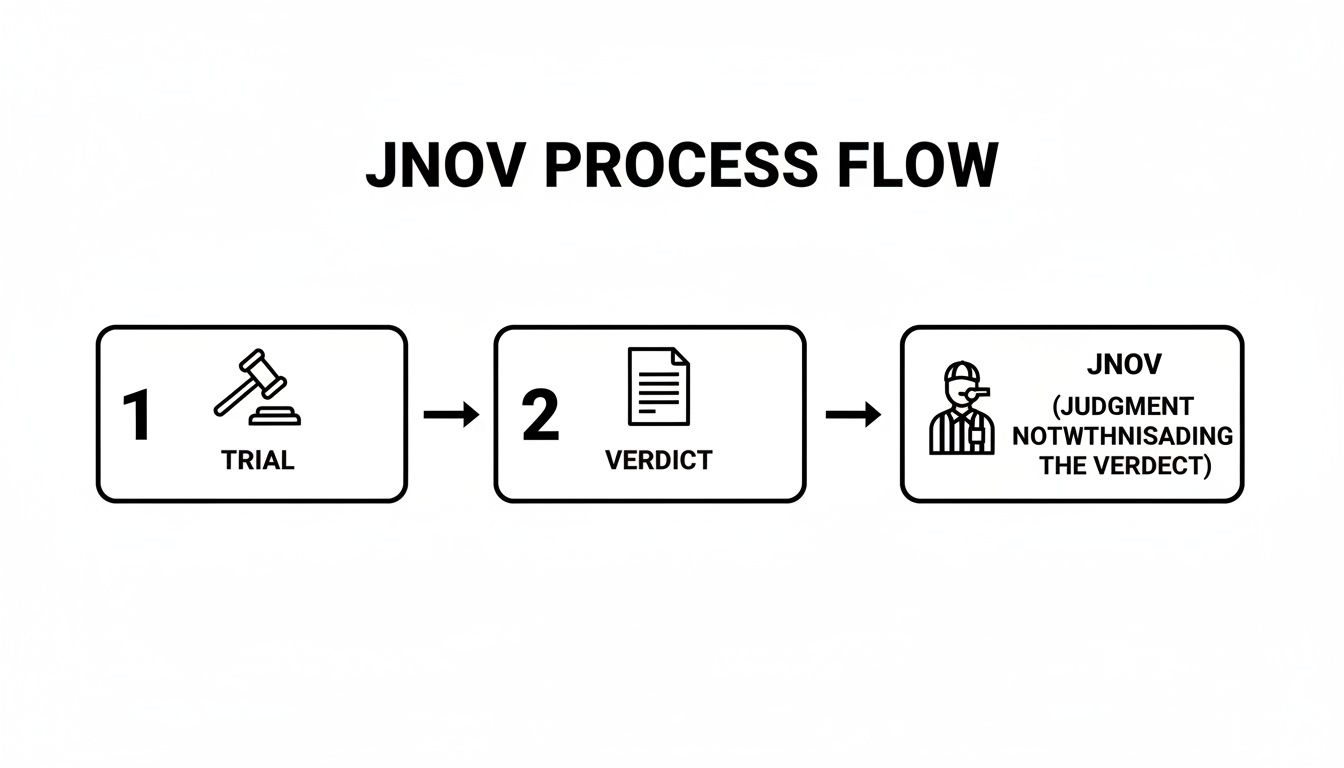
As you can see, a JNOV is not a standalone request; it is the final step in a sequence that starts with a critical move made during the trial itself.
Strict Timelines and Procedural Precision
With post-trial motions, timing is everything. In Texas, the clock starts ticking the moment the judge signs the final judgment. You generally have a firm 30-day window from that date to file your JNOV motion.
This deadline often runs parallel to the timeline for another common post-trial motion: a motion for new trial. While they are often filed around the same time, they ask for very different outcomes. Knowing which one to use is a crucial part of your post-trial strategy.
To clarify the difference, here’s a quick comparison of these two important motions.
JNOV vs. Motion for New Trial: A Quick Comparison
| Aspect | Motion for Judgment Notwithstanding Verdict (JNOV) | Motion for New Trial |
|---|---|---|
| Core Argument | "There is no evidence to support the jury's verdict on a specific issue." | "A serious error occurred during the trial that requires a redo." |
| Legal Standard | Legal sufficiency of the evidence. | Factual sufficiency, errors in jury instructions, newly discovered evidence, etc. |
| Requested Outcome | The judge should disregard the jury's verdict and enter a new judgment in your favor. | The judge should scrap the verdict and order a brand-new trial. |
| Prerequisite | Must have filed a Motion for Directed Verdict during trial. | No specific prior motion is required. |
Ultimately, a motion for new trial asks for a do-over, while a JNOV asks for a win.
Following these procedural rules isn't just about checking boxes. Each step is a deliberate legal maneuver designed to protect your arguments and give the trial judge an opportunity to correct a significant error before you must take the fight to a higher court. Properly filing a motion for judgment notwithstanding the verdict is a foundational step in building a strong Texas family law appeal and seeking the fair outcome you deserve.
Common Reversible Errors in Texas Family Courts
It's one thing to discuss a legal tool like a motion for judgment notwithstanding the verdict in theory, but it's another to see how it applies to the intensely personal world of a family law case. This motion becomes essential when a jury’s decision is not just disappointing—it’s completely detached from the evidence required by the Texas Family Code.

Let's ground this in reality. A JNOV is a precision instrument used when a jury’s finding has no factual basis in the trial record. It targets verdicts that are legally impossible based on the evidence—or, more often, a glaring lack of it.
Examples of Reversible Errors in Family Law
So, when might a JNOV be the right strategic move after a jury verdict in a Texas divorce or custody fight? Here are a few common scenarios involving reversible errors:
-
A Wildly Unequal Property Division: Imagine a jury awards 90% of the marital estate to your ex. Under the Texas Family Code, a property division must be "just and right." Such a skewed award requires strong evidence of fault—like proven cruelty or adultery—or a massive disparity in earning capacity. If the other side never presented evidence to justify that imbalance, a JNOV argues the jury had no legal basis for their decision. This would be considered an abuse of discretion.
-
Mischaracterizing Separate Property: Suppose you owned a rental property long before you were married. A jury, however, decides it's community property and divides its value. To do that, the law requires your spouse to present clear and convincing evidence to overcome the presumption that it's your separate property. If they presented zero evidence to that effect, a JNOV is the perfect tool to correct that specific reversible error.
-
Baseless Custody Restrictions: A jury imposes a tight geographic restriction, preventing you from moving for a better job. For that to be valid, there must be evidence showing the move is not in the child's best interest. If the other parent simply stated they disliked the idea but offered no actual proof of harm to the child, a JNOV can attack that restriction as being legally unsupported.
A JNOV challenges a specific, unsupported finding. It isn't a general complaint about the outcome but a targeted legal strike against a conclusion that the evidence simply does not permit. It's about holding the verdict accountable to the facts presented in court.
The Focus Is Always on Legal Sufficiency
The common thread in these examples is that the jury reached a conclusion that the evidence, as a matter of law, cannot support. The motion is a direct request to the judge to fix a specific part of the verdict where the other side failed to meet their legal burden of proof.
While we often associate JNOV motions with large corporate lawsuits, the underlying principle is universal. You may have seen news stories where a company files a motion for judgment notwithstanding the verdict after a jury awards a massive sum. Their argument is almost always that the plaintiffs failed to prove a critical element, like causation. You can see this exact strategy in action in this detailed court filing.
That same logic—challenging a fundamental failure of proof—is what makes a JNOV so powerful in family court. For family law attorneys, mastering these post-trial tools is just as important as knowing effective divorce law firm marketing strategies to connect with clients in the first place. If you are facing a verdict that seems to have come out of nowhere, a JNOV may be your first and best chance at justice.
Using a JNOV as a Critical Step for a Successful Appeal
Filing a motion for judgment notwithstanding the verdict often feels like a long shot at the trial court level, but it's much more than that. It is a calculated, strategic move that sets the stage for a strong appeal. Winning on appeal is not just about pointing out a mistake; you must show the trial judge had a fair chance to fix that mistake first.
This is a core legal principle known as preservation of error. Think of it this way: you cannot blame a mechanic for not fixing a strange noise in your car if you never told them about it. In court, you must give the trial judge the chance to correct a legal error before you can complain about it to a higher court.
A JNOV motion is your formal way of doing just that. You are putting the trial judge on notice, stating, "The jury's verdict is legally unsupportable based on the evidence presented, and you have the authority to fix this injustice right now." This action perfectly preserves your "no evidence" or "legal sufficiency" argument, making it a powerful weapon for your appeal.
Preserving Your Argument for the Appellate Court
If you skip this step, your options on appeal become very limited. An appellate court will likely refuse to even consider your argument that the verdict lacked evidentiary support, stating you failed to preserve the issue. That’s why a sharp JNOV is an absolute must for any serious appellate strategy.
It shows the appellate court you are not just unhappy with the outcome. Instead, it proves you identified a specific, fundamental legal flaw in the verdict and followed the proper procedures to give the trial court a chance to address it. Building this argument requires combing through the trial record, often using accurate legal court transcription to pinpoint exactly where the evidence failed to meet the legal standard.
Once you have preserved the error, the next move is to officially begin the appeal by preparing the record and briefing your arguments for the higher court. Understanding the rules and deadlines for this is non-negotiable. You can learn more about this crucial first step and what a notice of appeal in Texas involves to ensure you don’t miss a critical deadline.
Understanding the Standard of Review on Appeal
When the appellate court reviews the "no evidence" argument you preserved with your JNOV, it looks at the case through a very specific lens called the standard of review. The bar is high, but the test is straightforward.
The appellate justices examine all the trial evidence in the light most favorable to the jury's verdict. They must ignore any contradictory evidence unless it is so compelling that no reasonable juror could have disregarded it.
The central question the appellate court is trying to answer is this: Is there more than a tiny, vanishing speck—a mere scintilla—of evidence to support what the jury found? If the answer is yes, the verdict will stand. But if the evidence is so weak it does nothing more than create a vague suspicion, the verdict has to be overturned.
This entire process shows that post-trial motions are anything but an afterthought. They are the essential groundwork for a winning appeal, creating a clean record and preserving the very arguments you need to fight for a just result. A well-argued motion for judgment notwithstanding the verdict can be the key that unlocks the door to justice at the appellate level.
Let Our Appellate Attorneys Fight for the Fair Outcome You Deserve
When a jury gets your family law case wrong, it’s not just disappointing—it can feel like a profound injustice. You have already invested so much emotional energy and financial resources into the trial. Seeing it end in a verdict that defies the facts is a gut-wrenching experience.
However, a jury’s decision is not always the end of the road. There are still legal avenues available to fight for the right result for you and your family.
A Motion for Judgment Notwithstanding the Verdict (JNOV) is one of the most powerful tools in this situation. It's a direct request to the judge to step in and correct a jury’s clear legal mistake. Filing a successful JNOV, however, requires a specific skill set. It takes an experienced appellate lawyer to spot the grounds for a reversible error, write a persuasive motion, and protect your arguments for a potential appeal.
Your Path to Justice
Moving forward after a trial means diving deep into the Texas Rules of Civil and Appellate Procedure, which is exactly where our team excels. We focus on this complex area of law. Our process involves a meticulous review of the entire trial record—every testimony, every exhibit, every objection—to find legal errors that can change the outcome of a case. We know what trial judges and appellate courts are looking for, and we know how to build a case that speaks directly to them.
Perhaps the jury disregarded the Texas Family Code when dividing your marital estate, or maybe they made a custody ruling that had no factual support in the evidence. These are the kinds of injustices our appellate division is prepared to fight.
You do not have to simply accept an unfair verdict. The best next step is to speak with a dedicated Texas family law appeal attorney who can provide a thorough, expert review of your case.
If you’re feeling lost after a verdict, let us bring the calm, confident guidance you need. Contact The Law Office of Bryan Fagan today for a free consultation to go over the details of your case and map out the best path toward justice.
Common Questions About JNOV Motions in Texas Family Law
After a difficult trial, the path forward can seem confusing. Let's clarify some of the most common questions our clients ask when considering a motion for judgment notwithstanding the verdict.
Can I Bring in New Evidence with My JNOV Motion?
No. A JNOV motion is not a second chance to present your case. It is strictly about challenging the evidence that was already presented and admitted at trial.
The entire argument hinges on the idea that the evidence the jury did hear was legally too weak to support their decision. You cannot introduce new documents, facts, or witness testimony at this stage.
What Happens if the Judge Denies My JNOV Motion?
If the judge denies your motion, the jury's verdict stands for now. While this may sound like a defeat, it is often a critical and necessary step in the larger legal strategy.
By filing the JNOV and getting a ruling, you have officially "preserved" your arguments about the lack of evidence. This is crucial because it properly sets up the issue for a higher court to review, clearing the way for you to file a Texas family law appeal.
How Often Do Judges Grant a JNOV?
It is rare. Judges are very hesitant to overrule a jury. The legal system gives immense respect to a jury’s findings, and the standard for a JNOV is incredibly high.
You must convince the judge that "no reasonable jury" could have possibly reached the same conclusion based on the evidence they heard. While it's a long shot, it is not impossible, especially if there was a total failure of proof on a key element of the case.
Is a JNOV Something You Can Use After Any Trial?
No, this motion is specifically for challenging a verdict from a jury trial.
If a judge decided your case without a jury (a "bench trial"), you would use different post-trial motions. You might file a motion for a new trial or a motion to modify the judgment, but a JNOV is not an option.
If you believe the court made a mistake in your family law case, our appellate attorneys can help you seek a fair outcome. Contact The Law Office of Bryan Fagan today for a free consultation at https://familylawcourtappeals.com.