Skip to content
If you believe a Texas family court decided your case unfairly, you may feel that the justice system has failed you. The feeling that a judge misunderstood the facts, ignored critical evidence, or simply made the wrong call is deeply unsettling. An appeal offers a path to seek a fair outcome, and the most powerful tool in this process is the statement of facts for a Texas family appeal. This isn't an emotional plea, but a strategic, evidence-based narrative designed to show a higher court what truly happened at trial.
The Most Important Story You Will Tell in Your Appeal

If you are convinced the trial judge made a critical mistake in your divorce, custody, or property case, an appeal provides a structured opportunity to correct that error. However, it's vital to understand that an appeal is not a "do-over" or a second trial. You cannot introduce new witnesses or evidence. Instead, it is a focused review of the trial court record to determine if a significant legal error occurred that changed the outcome of your case.
The Statement of Facts is the foundation of that review. It sets the stage for every legal argument that follows. Its purpose is to guide the appellate judges through a clear, factual, and persuasive account of what happened, using only the evidence from your trial to show—not just tell—them how the judge's decision was unjust and legally flawed.
What is a Reversible Error?
To win a family law appeal, you must prove the trial court made a reversible error. This is more than simply disagreeing with the final order.
Reversible Error: A legal mistake made by the trial court that was so significant it likely caused an improper judgment. For the error to be "reversible," your attorney must show that without the mistake, the outcome of your case would have probably been different.
A skillfully drafted Statement of Facts is your primary tool for highlighting these errors. It allows your attorney to methodically demonstrate how the trial judge:
- Ignored crucial testimony about a parent's instability during a contentious child custody hearing.
- Misinterpreted specific financial records, leading to an unfair property division.
- Disregarded clear evidence of family violence when denying a necessary protective order.
By laying out the facts with precise citations to the official court record, your lawyer builds a narrative that makes the judge's legal missteps undeniable.
Understanding the Standard of Review: Abuse of Discretion
Appellate courts do not simply substitute their judgment for the trial judge's. They review decisions based on a specific legal yardstick called the standard of review. In many Texas family law appeals, that standard is "abuse of discretion."
Abuse of Discretion: This legal term means the trial judge made a decision that was unreasonable, arbitrary, or without reference to any guiding legal rules or principles. It describes a ruling so far outside the bounds of reasonable disagreement that it requires correction.
Your Statement of Facts is essential for proving this. It provides the factual context that allows the appellate court to see the trial judge’s ruling not just as an outcome you dislike, but as a decision that was legally indefensible based on the very evidence presented in court. A clear, chronological narrative can expose the logical gaps or factual inconsistencies in the trial court's reasoning.
Crafting a powerful Statement of Facts requires a deep understanding of the Texas Rules of Appellate Procedure, painstaking attention to detail, and the skill to build a persuasive narrative without explicit argument. It is the story that breathes life into your legal arguments and is often where the fight for a just outcome is won.
If you believe the court made a mistake in your family law case, our appellate attorneys can help you seek a fair outcome. Contact The Law Office of Bryan Fagan today for a free consultation.
Building Your Statement of Facts from the Trial Record
Think of your appeal's Statement of Facts as a careful reconstruction of the trial, told exclusively through the official court record. This is not the place to re-tell your side of the story or introduce new information. Instead, your appellate attorney's job is to methodically present the facts the trial judge had before them, with every single point supported by a citation to the record.
The entire foundation for your argument rests on two sources:
- The Reporter's Record (RR): The official, word-for-word transcript of everything said during the trial, including all testimony and rulings made from the bench.
- The Clerk's Record (CR): A compilation of all documents filed in your case, such as pleadings, motions, orders, and—most critically—all exhibits admitted into evidence.
Obtaining these records is the first step in the appellate process. Your attorney will formally request them from the court, a process that must be done correctly and within strict deadlines.
Combing Through the Record for Key Evidence
Once the records are prepared, the real work begins. An experienced appellate lawyer doesn't just read these volumes; they analyze them to find the specific testimony, admissions, or documents that prove the trial court made a reversible error.
This process involves looking for:
- Crucial Testimony: We search the Reporter's Record for key admissions from your ex-spouse or testimony from an expert that the judge appeared to ignore.
- Key Exhibits: We pore over the Clerk's Record to find the critical documents—the financial statement, the text messages, the report card—that were admitted into evidence but overlooked in the final ruling.
- Conflicting Evidence: A common basis for appeal is when a judge accepts one side's evidence while completely disregarding credible, conflicting evidence without a valid reason. We pinpoint exactly where this happened.
In a complex case, the sheer volume of information can be overwhelming. Modern tools like an AI Legal Case Researcher can help an attorney quickly sift through thousands of pages to find specific facts and testimony, ensuring nothing is missed.
Turning Raw Facts Into a Compelling Narrative
Finding the facts is only half the battle. A disorganized list of citations will only confuse the appellate justices and weaken your arguments. The next step is to organize those raw facts into a clear, compelling framework that tells the story of the trial as it happened.
An effective Statement of Facts doesn't argue—it demonstrates. By arranging the facts in a logical sequence, with every detail meticulously cited, you allow the appellate judges to see the trial court's error for themselves, guided only by the official record.
One of the first steps is creating a detailed timeline. This chronological list of every important event, with each entry citing the exact page and line number from the record (e.g., RR 123:14-18), can reveal patterns of behavior or a sequence of events the trial judge may have missed. You can learn more about this crucial component in our guide to the appellate record in a Texas family law case.
Above all, the guiding principle is 100% accuracy. Every assertion made in the Statement of Facts must be directly supported by a citation to the record. There is no room for opinions, assumptions, or anything that happened "outside the record." By methodically structuring the chaos of the trial record, you create a clear roadmap that leads the appellate court directly to the error you need them to see.
Telling the Story: How to Build a Powerful Statement of Facts
Once the clerk’s and reporter’s records are in hand, the real work begins. You’re looking at a mountain of raw material—transcripts, exhibits, and orders. The next step is where an experienced appellate lawyer really earns their keep: transforming that chaotic pile of information into a compelling narrative for your statement of facts Texas family appeal.
This isn't about making arguments or openly criticizing the judge. It’s much more subtle. The goal is to tell a story—using only the facts from the record—that quietly guides the appellate justices to one simple conclusion: the trial court’s decision just doesn’t make sense.
Finding the Narrative: Chronological vs. Thematic
How you structure this story is a major strategic decision. A good appellate attorney knows that the framework you choose can make or break how the court understands the injustice that occurred. There are two main paths to take.
- The Chronological Story: This is the classic approach for a reason. Presenting the facts as they happened creates a clear, easy-to-follow timeline. This works exceptionally well when you need to show a pattern of behavior, like a parent’s growing instability in a child custody battle or a spouse’s methodical efforts to hide money in a high-asset property division case.
- The Thematic Story: Sometimes, a straight timeline dilutes the power of your facts. In those cases, grouping facts by theme is far more effective. Imagine an appeal where the judge ignored clear evidence of family violence. Your attorney might build the narrative around themes like "Patterns of Coercive Control," "Incidents of Physical Harm," and "Third-Party Witness Accounts," pulling evidence from various points in the record to build an undeniable picture under each heading.
This meticulous process of sifting, sorting, and structuring is the foundation of a strong appeal.
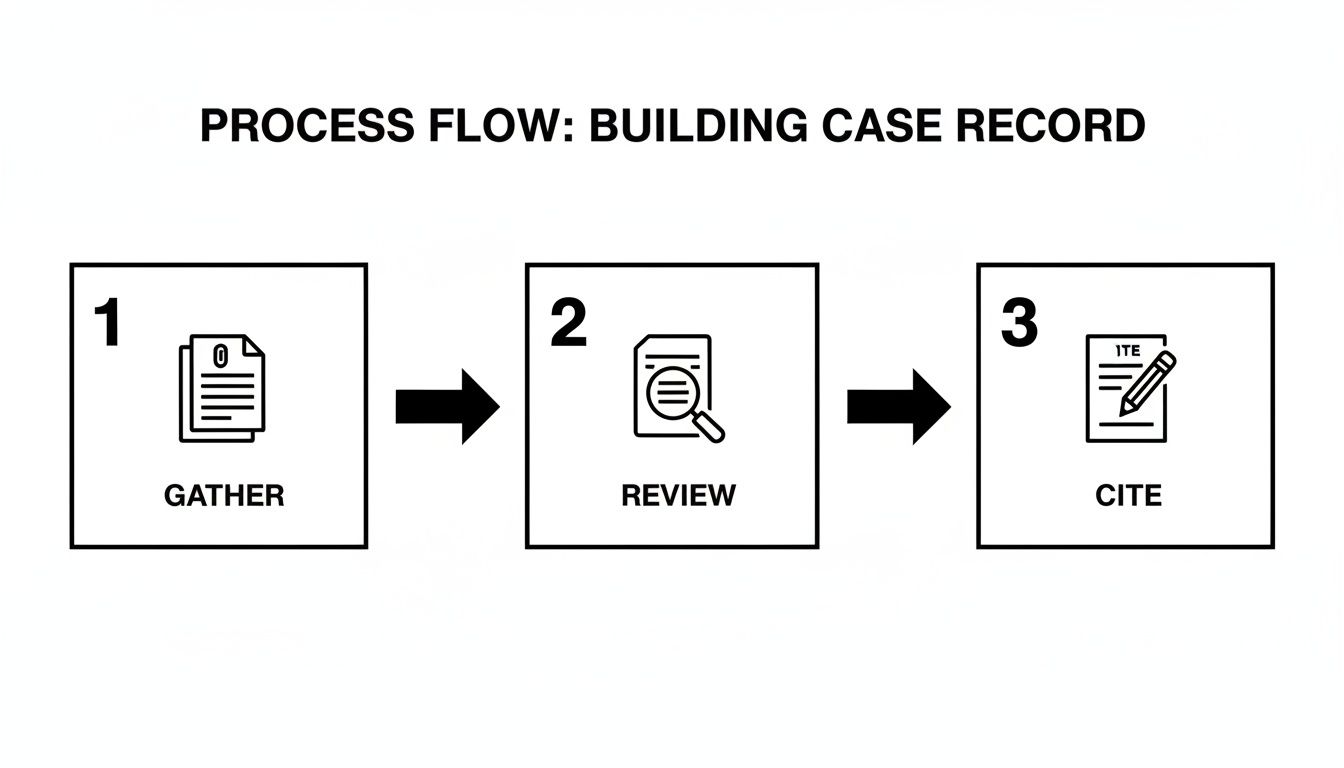
As you can see, every fact selected must be rigorously reviewed and cited directly back to its source in the record. This is non-negotiable; it’s what gives your story its legal power.
Before we go further, it's helpful to see how these two components—the raw trial record and the finished Statement of Facts—differ. Think of it as the difference between a pile of bricks and a finished house.
Trial Record vs. Appellate Statement of Facts: A Comparison
| Component | Trial Record (Raw Material) | Appellate Statement of Facts (Strategic Narrative) |
|---|---|---|
| Content | Every word spoken, every exhibit filed, every order signed. Includes irrelevant testimony and procedural discussions. | Only the specific, relevant facts that support the issues on appeal. |
| Organization | Chronological and procedural (e.g., testimony by witness, exhibits by number). | Strategic. Can be chronological or thematic to best highlight the trial court's error. |
| Tone | Objective but chaotic. A verbatim transcript of everything that happened. | Objectively toned, but carefully constructed to tell a persuasive story without argument. |
| Purpose | To be a complete and accurate account of the trial court proceedings. | To create a factual foundation that makes the legal argument feel inevitable and correct. |
This table shows the transformation. You aren't just summarizing; you are building a specific, legally sound case out of the raw materials provided by the court.
Showing the Error Without Saying It
This is the hardest part of writing a great Statement of Facts: you have to lead the judges right to the edge of a conclusion and let them take the final step themselves. Your narrative must show the error, not tell the court it happened.
This is all about the careful selection and placement of facts.
For example, you would never write: "The judge ignored all the evidence about Father's drinking problem."
Instead, a skilled attorney lets the record speak for itself:
- Mother testified that on May 15, she discovered several empty liquor bottles hidden in Father’s car. (RR 45:12-15)
- A photo of the bottles was admitted as Exhibit 7. (CR 112)
- Officer Smith testified he responded to a disturbance call on May 18 and noted that Father smelled strongly of alcohol. (RR 98:6-10)
- The court’s final order, signed June 1, contains no mention of this testimony and grants Father unsupervised possession of the child. (CR 250)
See the difference? The facts are laid out one by one, creating an unavoidable question in the reader’s mind: How could the judge ignore all of this?
A masterfully written Statement of Facts makes the trial judge’s decision look like a complete outlier—a conclusion that no reasonable person could reach based on the evidence presented.
This is how you prepare the legal argument for an abuse of discretion. By first building a factual story that exposes a major gap in logic, the formal argument in your brief becomes infinitely more persuasive. This powerful storytelling must operate within the strict confines of the Texas Rules of Appellate Procedure.
If you feel the trial court got the facts wrong and issued an unjust order in your family law case, our appellate team knows how to build the story for your appeal. Contact The Law Office of Bryan Fagan for a free consultation to discuss your options.
Common Mistakes That Can Weaken Your Texas Appeal

Drafting a Statement of Facts is a precise and demanding task. One wrong step can undermine your credibility with the appellate court and weaken your entire case. As appellate attorneys, we have seen strong cases falter due to simple, avoidable errors in this crucial section.
Following the rules is not just about procedure; it's about building trust with the justices who will decide your case and making your arguments as compelling as possible.
Including Information Outside the Record
This is the most common and damaging mistake an appellant can make. Your Statement of Facts must be built exclusively from the evidence that was officially admitted into the Reporter's Record and Clerk's Record at trial.
Attempting to include new information is a critical error that can destroy your credibility. The appellate court’s role is to review the trial judge's decision based on the information they had at the time, not on new evidence that has surfaced since.
Consider these real-world examples:
- Post-Trial Text Messages: A parent wants to show the appellate court text messages from their ex-spouse that demonstrate recent instability. Because those texts were not admitted as evidence at trial, they are "outside the record" and cannot be included.
- A Child's New Report Card: A father appealing a custody order wants to submit his child's latest report card showing a drop in grades. This is new information, outside the record, and therefore inadmissible in the appeal.
Injecting Argument or Emotional Language
Save the arguments for the "Argument" section of your brief. The Statement of Facts must remain a neutral, objective presentation of the facts, free from emotional language or legal conclusions. Its power comes from its objectivity.
When you inject your own opinions, you are not only breaking the rules but also signaling to the justices that you do not trust the facts to speak for themselves.
Your narrative should be so well-constructed that the justices arrive at the "right" conclusion on their own. You guide them; you don't push them. Phrases like "the ruling was clearly biased" or "the decision was blatantly unfair" are red flags to an appellate court.
Let the record do the heavy lifting.
- Incorrect: "The trial judge completely ignored the fact that Spouse lied on the stand about his finances."
- Correct: "Spouse testified he had no other bank accounts. (RR 115:20-22). Bank statements admitted as Petitioner's Exhibit 14 show a separate account with a balance of $50,000. (CR 210). The final decree does not divide or mention this account. (CR 305)."
The second example lays out the damning facts and allows the court to connect the dots.
Misrepresenting the Record or Quoting Out of Context
Accuracy is paramount. Appellate justices and their staff attorneys have the full record and will check your citations. If you misquote a witness, take testimony out of context, or misrepresent what an exhibit shows, you lose their trust. Once that trust is gone, it is nearly impossible to regain.
This commitment to the record is fundamental to a successful appeal. An experienced appellate lawyer is obsessive about accuracy. Every fact, quote, and citation is cross-referenced against the record to ensure complete precision. This painstaking work is the foundation of a persuasive and winning appeal.
Connecting a Strong Statement of Facts to a Winning Appeal
You have done the hard work of sifting through the trial record, meticulously citing every key piece of testimony and referencing every important exhibit. How does that effort translate into winning your appeal?
The connection is direct and powerful. A strong Statement of Facts is the engine that drives your entire appeal. It powers your legal arguments and illuminates the trial court’s errors, setting the stage for a successful outcome.
An appeal is won by proving a reversible error—a legal mistake so significant that it likely led to an improper judgment. Your Statement of Facts is the best tool for revealing that error, not by arguing, but by painting such a clear factual picture that the judge’s decision appears illogical and unsupported by the evidence.
From Facts to Reversible Error
Your ultimate goal is to frame the trial court’s ruling as an abuse of discretion. This legal standard means the judge acted unreasonably, arbitrarily, or without considering the guiding legal rules and principles.
A well-crafted Statement of Facts makes this argument for you. It tells a story that makes the judge's decision seem completely out of sync with the actual evidence presented in their own courtroom.
Consider how this plays out in common Texas family law appeals:
- Ignored Evidence in a Custody Case: Imagine your Statement of Facts chronologically details clear testimony from teachers, counselors, and relatives about the other parent's substance abuse. If the final custody order ignores all of it, your factual narrative highlights a glaring omission, making a strong case for an abuse of discretion.
- Mischaracterizing Property in a Divorce: In a high-asset divorce, the Statement of Facts can methodically walk the court through financial records and expert testimony proving a business was separate property. If the judge then classifies that asset as community property, your narrative makes the error impossible to ignore.
- Overlooking Procedural Rules: For a protective order appeal, your facts can show how you properly presented evidence of family violence, but the judge failed to make the required statutory findings. Here, the facts themselves demonstrate a clear procedural mistake, which is often a straightforward path to reversal.
In each scenario, the Statement of Facts is not shouting "error!" It is calmly and methodically presenting the evidence in a way that leads the appellate justices to ask, "Based on these facts, how could the trial judge have possibly reached that conclusion?"
The Foundation for Your Legal Argument
Once your Statement of Facts has told the story, the "Argument" section of your appellate brief connects the dots legally. Here, your attorney takes the factual groundwork you’ve laid and applies specific laws and case precedents.
A well-presented record is the key to demonstrating reversible error. The Statement of Facts builds the factual foundation, and the Argument section builds the legal framework on top of it. Without a strong foundation, the entire appeal can crumble.
For instance, after the Statement of Facts details the ignored evidence of parental unfitness, the Argument section will cite the Texas Family Code's "best interest of the child" standard. It will then point to case law establishing that a judge's failure to consider credible evidence of endangerment is an abuse of discretion.
This combination of showing the facts and then applying the law is the essence of effective appellate advocacy. To learn more about the specific rules governing this process, explore the fundamentals of Texas appellate procedure for family law cases.
The appeals process is a structured system designed to correct injustice. Armed with a powerful Statement of Facts and a sharp legal argument, you give yourself the best possible chance to secure the fair outcome you deserve.
Common Questions About Texas Family Law Appeals
When a family court issues a final order that feels fundamentally wrong, it can be devastating. You are left facing the world of appellate law—a maze of complex rules and rigid deadlines. It is normal to feel overwhelmed and have many questions.
Here are answers to some of the most common questions our clients ask when considering an appeal.
How Long Do I Have to File My Appeal in Texas?
This is the most critical question because the deadlines are absolute. In most cases, you have just 30 days from the day the judge signs the final judgment to file your Notice of Appeal. This document officially starts the appellate process.
That deadline can sometimes be extended to 90 days, but only if you file a specific post-judgment motion, like a Motion for New Trial. Appeals are frequently dismissed because this initial deadline was missed. The clock starts ticking the moment the judgment is signed, so it is essential to speak with an appellate attorney immediately.
Can I Use New Evidence in My Statement of Facts?
No. This is a core principle of every appeal. The appellate court’s job is not to re-try your case but to review the trial judge’s decisions based only on the evidence that was already presented. Your entire appeal, including the statement of facts for a Texas family appeal, must be built from the official record—the Clerk's Record and the Reporter's Record.
You cannot introduce new facts. A text message you found after the trial or a new witness who has come forward cannot be included. Trying to introduce new information is called going "outside the record" and is a mistake that can damage your credibility and even lead to sanctions. The goal is to show that the trial judge made a reversible error with the information they had at the time.
What Is the Difference Between the Statement of Facts and the Argument?
This is an excellent question that gets to the heart of how an effective appellate brief is structured. These two sections have very different jobs, and confusing them weakens an appeal.
The Statement of Facts: This section tells the story of your case. It is a carefully crafted narrative of what happened at trial, told persuasively but without legal argument. Every sentence must be tied directly to the trial record with a specific citation. Its job is to show the appellate court the problem.
The Argument: This is where your lawyer formally presents your legal case. Here, they will pinpoint the specific legal errors the judge made, cite the laws and previous cases that prove it was an error, and connect everything back to the facts. This section directly asks the court for a new outcome. Its job is to prove the problem legally.
A winning appeal needs both parts working together: a compelling factual story that sets the stage and a laser-focused legal argument that proves the error.
What Kinds of Errors Can Be Appealed in a Family Law Case?
You cannot appeal a ruling just because you dislike it. To succeed, you must prove the trial court made a "reversible error"—a significant legal mistake or abuse of judgment that likely caused the wrong outcome.
Common examples of reversible errors in Texas family law include:
- Mischaracterizing separate property as community property (or vice versa) in a divorce.
- Failing to correctly apply the "best interest of the child" standard in a child custody dispute.
- Making a clear mathematical error when calculating child support or ignoring a major source of income.
- Allowing highly prejudicial evidence that should have been excluded.
- Failing to make legally required findings of fact after a hearing for a protective order.
An experienced appellate attorney can analyze your trial record to identify these kinds of errors and provide an honest assessment of your chances on appeal.
If you believe the court made a mistake in your family law case, our appellate attorneys can help you seek a fair outcome. Contact The Law Office of Bryan Fagan, PLLC today for a free consultation at https://familylawcourtappeals.com.