
If you are reeling from a court decision in your divorce that feels fundamentally wrong, you may feel your case was handled unfairly. It’s a disheartening experience, but a judge's final order isn't necessarily the last word. Texas law provides specific legal paths, like a motion for a new trial or a direct appeal, to challenge a judgment you believe is flawed. However, the deadlines are incredibly strict, and missing one can mean losing your chance to seek justice.
What to Do After an Unfair Divorce Ruling
The feeling of walking out of a courtroom with an unjust divorce ruling can be overwhelming. You might believe the judge didn’t listen, that critical evidence was ignored, or that a mistake was made that now threatens your financial future or your relationship with your children. It’s crucial to understand that a final order can be challenged. Texas law provides real, strategic avenues to correct a decision that is legally flawed.
You are not alone in feeling this way. Many clients leave the courthouse disheartened, especially after complex battles over child custody or the division of marital property. The key, however, is to understand that you can't simply ask for a "do-over" because you disagree with the outcome. You must prove the trial court made a specific legal mistake, known as a reversible error.
Understanding Your Path to a Fairer Outcome
Overturning a divorce judgment is not about re-trying your entire case. Instead, it is a detailed review of what already happened. An appellate court will examine the trial record—every transcript, every piece of evidence—to determine if the judge misapplied Texas law or made a decision so far outside the bounds of the law that it amounts to an "abuse of discretion."
What does a reversible error look like? Here are a few common examples from Texas family law cases:
- Mischaracterization of Property: The judge incorrectly labels property you owned before the marriage (your separate property) as community property, making it subject to division.
- Procedural Mistakes: The court fails to follow the proper rules of procedure, which may have prevented you from presenting key testimony or evidence.
- Ignoring Key Evidence: The judge disregards crucial, properly admitted evidence, such as a business valuation or an expert’s report on a child's best interests.
Challenging an improper ruling is a path toward fairness. While not every appeal succeeds, Texas appellate courts regularly correct errors made at the trial level. This is why having an experienced appellate attorney who can identify these critical mistakes and argue them persuasively is so important.
The legal challenge is an achievable goal when the law and facts are on your side. Statistically, Texas courts of appeals have reversed or remanded family law appeals in roughly 20-25% of cases in recent years, though this can vary by judicial district. These numbers represent real families who found justice on appeal. When a legitimate error is brought to light, higher courts do step in. You can discover more insights in the Texas Judiciary’s annual statistical report.
The first step is to have an attorney who focuses on Texas family law appeals conduct a meticulous review of your case. Our goal is to provide the information you need to decide on the right path forward in the pursuit of a fair result. You do not have to navigate this complex journey alone.
If you believe the court made a mistake in your family law case, our appellate attorneys can help you seek a fair outcome. Contact The Law Office of Bryan Fagan today for a free consultation.
Your Legal Options for Challenging the Judgment
When a Texas judge signs your final divorce decree, it can feel like the end of the road. But what if the outcome is fundamentally unjust? What if the judge made a critical legal error, or you discovered evidence that was hidden from you during the trial? Fortunately, a signed decree is not always the final word.
Texas law provides specific, structured pathways for challenging a judgment. These are not simple do-overs; each is a distinct legal tool with its own strict rules, deadlines, and strategic purpose. Your options generally fall into three categories: a Motion for New Trial, a Direct Appeal, and a more specialized action called a Bill of Review. Choosing the right one depends on what went wrong, how much time has passed since the judgment was signed, and your legal objectives.
The Motion for New Trial
Your first and fastest opportunity to address a flawed judgment is by filing a Motion for New Trial. This is a direct request to the same judge who heard your case, asking them to either modify the judgment or grant a new trial. You are essentially pointing out a significant mistake and giving the trial court a chance to correct it before the case moves to a higher court.
You have a very narrow window for this action: the motion must be filed within 30 days of the final judgment being signed. This is a non-negotiable deadline. Filing this motion is also a smart strategic move because it extends the deadline to file an appeal from 30 days to 90 days, giving your legal team valuable time to prepare if the motion is denied.
Grounds for a new trial typically include:
- Newly Discovered Evidence: You have found crucial evidence that you could not have located before trial, even with diligent effort.
- Jury Misconduct: If a jury decided your case, this might involve improper outside influence or behavior that tainted their verdict.
- Clear Legal or Factual Error: The judge clearly misinterpreted the law or the facts in a way that led to an improper judgment.
For example, if you discover a hidden bank account 20 days after your divorce is final, a Motion for New Trial is the ideal tool to bring this new evidence before the judge and argue for a more just property division.
The Direct Appeal
If your Motion for New Trial is denied, or if the mistake is purely a legal one, the next step is a Direct Appeal. This is what most people think of when they hear the term "appeal." You are not returning to the same judge; instead, you are asking a higher court—the Court of Appeals—to review the case for legal errors made by the trial judge.
An appeal is not a second trial. You cannot introduce new evidence or call new witnesses. The appellate court's role is to review the existing record, which includes trial transcripts and evidence, along with written legal arguments called briefs. Their focus is narrow: did the trial judge commit a reversible error?
In an appeal, the focus is on errors of law. The question is not whether the appellate justices would have divided the property differently. The question is whether the trial judge’s decision was legally incorrect or so arbitrary that it constituted an abuse of discretion.
Common issues raised in a divorce appeal include the improper characterization of property (separate vs. community), errors in a child custody ruling, or a miscalculation of spousal support. It is a highly technical process where success depends on meticulous legal research and persuasive argumentation.
This flowchart provides a high-level overview of your initial choices after receiving an unfavorable ruling.
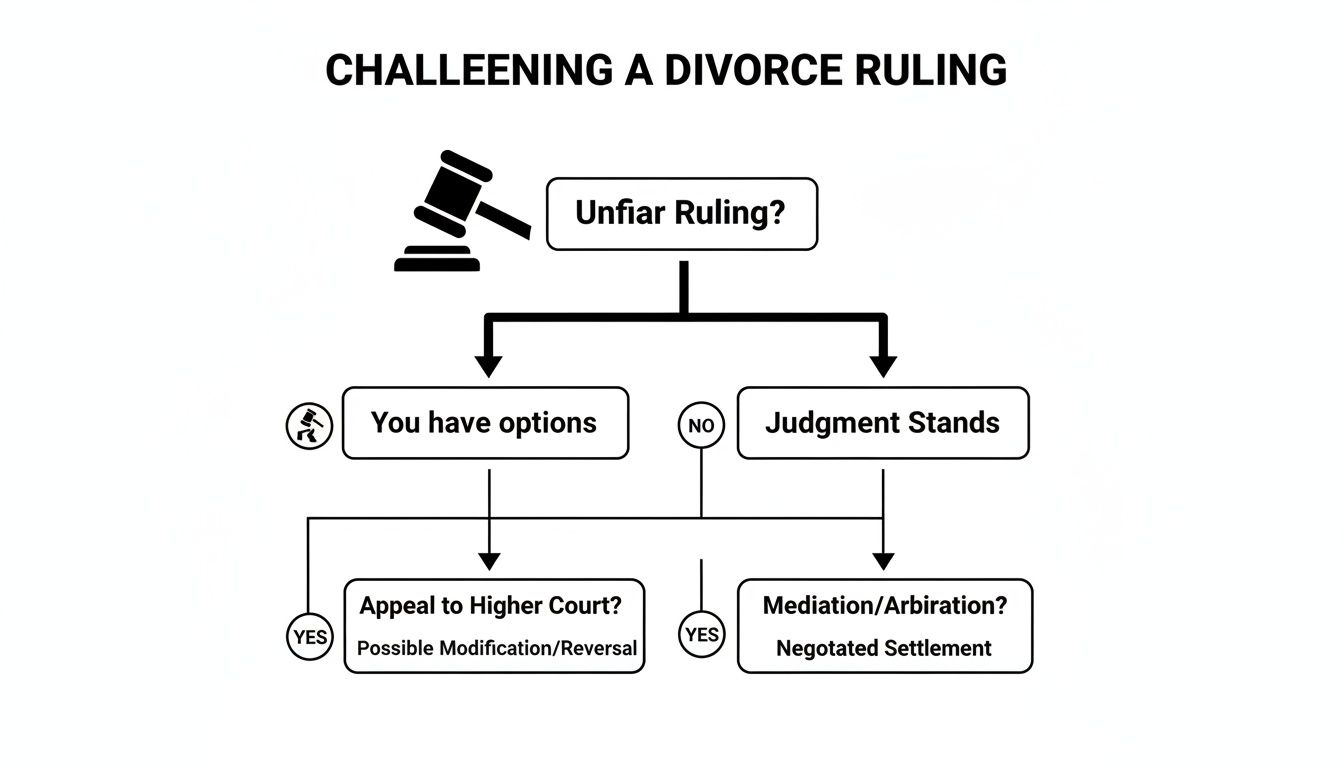
As you can see, the moment a decision is made, a new set of strategic choices begins. Understanding these pathways is your first step toward seeking a remedy.
The Bill of Review
What if you miss the deadlines for a new trial and an appeal? In very specific, limited circumstances, there is one last resort: the Bill of Review. This is not an appeal but an entirely new lawsuit filed to set aside the old judgment. Because it is an extraordinary remedy, the standard for success is extremely high.
A Bill of Review is only available if you were prevented from presenting your case due to deception or a serious accident, not because of your own mistake. You must prove all three of the following:
- You had a valid, meritorious defense in the original divorce case.
- You were prevented from presenting that defense by the fraud, accident, or wrongful act of your ex-spouse.
- Your failure to defend yourself was not due to your own fault or negligence.
A classic scenario is where one spouse serves the other with divorce papers but then lies, saying, "Don't worry, I'm dropping the lawsuit," only to proceed and obtain a default judgment. A Bill of Review is the tool designed to provide justice in these rare cases of deception after all other doors have closed.
Navigating these post-judgment options requires a different skill set than trial work. To help clarify the differences, here is a quick comparison of these three pathways.
Pathways to Challenge a Texas Divorce Judgment
| Method | Purpose | Typical Deadline | Best For |
|---|---|---|---|
| Motion for New Trial | Ask the same judge to correct a mistake or consider new evidence. | 30 days from judgment | Correcting clear factual errors or presenting newly discovered evidence quickly. |
| Direct Appeal | Ask a higher court to review the trial judge’s legal errors. | 90 days from judgment (if motion for new trial was filed) | Challenging a judge's misapplication of the law or abuse of discretion. |
| Bill of Review | File a new lawsuit to set aside the old judgment due to fraud or deception. | Up to 4 years, but complex rules apply | Cases involving fraud where a party was prevented from defending themselves in the original case. |
Ultimately, choosing the right path forward is a critical decision. Each method has its own strategic advantages and procedural hurdles, and the tight deadlines mean you must act quickly.
Identifying a Reversible Error in Your Case

Let's clarify one of the biggest misconceptions about the appellate process. An appeal is not a do-over. It is not a second chance to tell your story or present new evidence. The appellate court is not there to re-weigh the facts or second-guess a trial judge's credibility determinations.
Instead, an appeal is a highly technical legal argument focused on one thing: identifying specific, critical legal mistakes made by the trial judge. These are called reversible errors.
Winning an appeal is not about convincing a new panel of judges that the property division was simply "unfair." It's about proving the trial judge misapplied the law. Your entire opportunity for overturning a divorce judgment in Texas hinges on successfully identifying and proving such an error.
Understanding the Standard of Review: Abuse of Discretion
In Texas family law, most appeals are decided based on a single legal standard: abuse of discretion. This term does not imply the judge acted maliciously or in bad faith.
In plain English, "abuse of discretion" means the judge made a ruling that was arbitrary, unreasonable, or without reference to any guiding legal rules and principles.
Think of it this way: a trial judge abuses their discretion when they make a decision that is so far outside the realm of reasonable disagreement that it becomes legally indefensible. It’s like a referee making a call that no other reasonable referee, given the same rulebook and facts, would ever make.
For instance, if the Texas Family Code outlines specific factors for a judge to consider in a custody case and the judge ignores them without a legally sound reason stated on the record, that is a classic example of an abuse of discretion. The appellate court’s job is to review the trial record to see if that happened.
Common Examples of Reversible Errors
Not every mistake is a reversible one. An error must be significant enough that it probably caused the court to issue an improper judgment. Our appellate attorneys spend countless hours poring over every page of the trial record, searching for these specific, outcome-determinative mistakes.
From our experience, here are some of the most common reversible errors we find in Texas divorce cases:
- Property Division Errors: This happens frequently. A judge might mischaracterize a major asset, such as treating a business you owned long before the marriage as community property and dividing its entire value.
- Child Custody Ruling Flaws: The judge might focus on one negative factor while ignoring a mountain of positive evidence regarding the child's best interests. Or, they might fail to make the specific, written findings of fact required by law to justify their custody decision.
- Procedural and Evidentiary Mistakes: We often see cases where a judge improperly excluded crucial expert testimony for no valid reason. Another common error is allowing inadmissible, highly prejudicial evidence that likely swayed the case's outcome.
- Spousal Maintenance Errors: The court might order you to pay spousal maintenance for a duration that exceeds the maximum limit set by the Texas Family Code. It could also award maintenance when there is no evidence the receiving spouse met the strict eligibility requirements.
These are not just points of disagreement; they are demonstrable legal failures. Proving one is the only way to successfully overturn a divorce judgment.
The Likelihood of a Successful Appeal
What are the chances of success? An appeal's outcome is directly tied to the strength of the legal error you can prove. While appellate courts generally give significant deference to trial judges, they will correct clear mistakes when presented with a strong, well-reasoned argument.
While a majority of family law appeals are affirmed, a significant number result in a reversal or remand, particularly when an experienced appellate lawyer can pinpoint a genuine abuse of discretion.
Statistically, Texas appellate courts reverse or send back around 15-20% of family law cases for a new trial or ruling. Many of these reversals are based on errors in financial rulings, such as property division or child support. The entire process requires meticulous attention to deadlines and a deep knowledge of what constitutes a reversible error.
Ultimately, identifying a reversible error is the foundation of any successful appeal. Without it, there is no case. You can learn more about this critical concept by reading our detailed article on what qualifies as a reversible error in Texas family court.
How the Texas Appellate Process Works
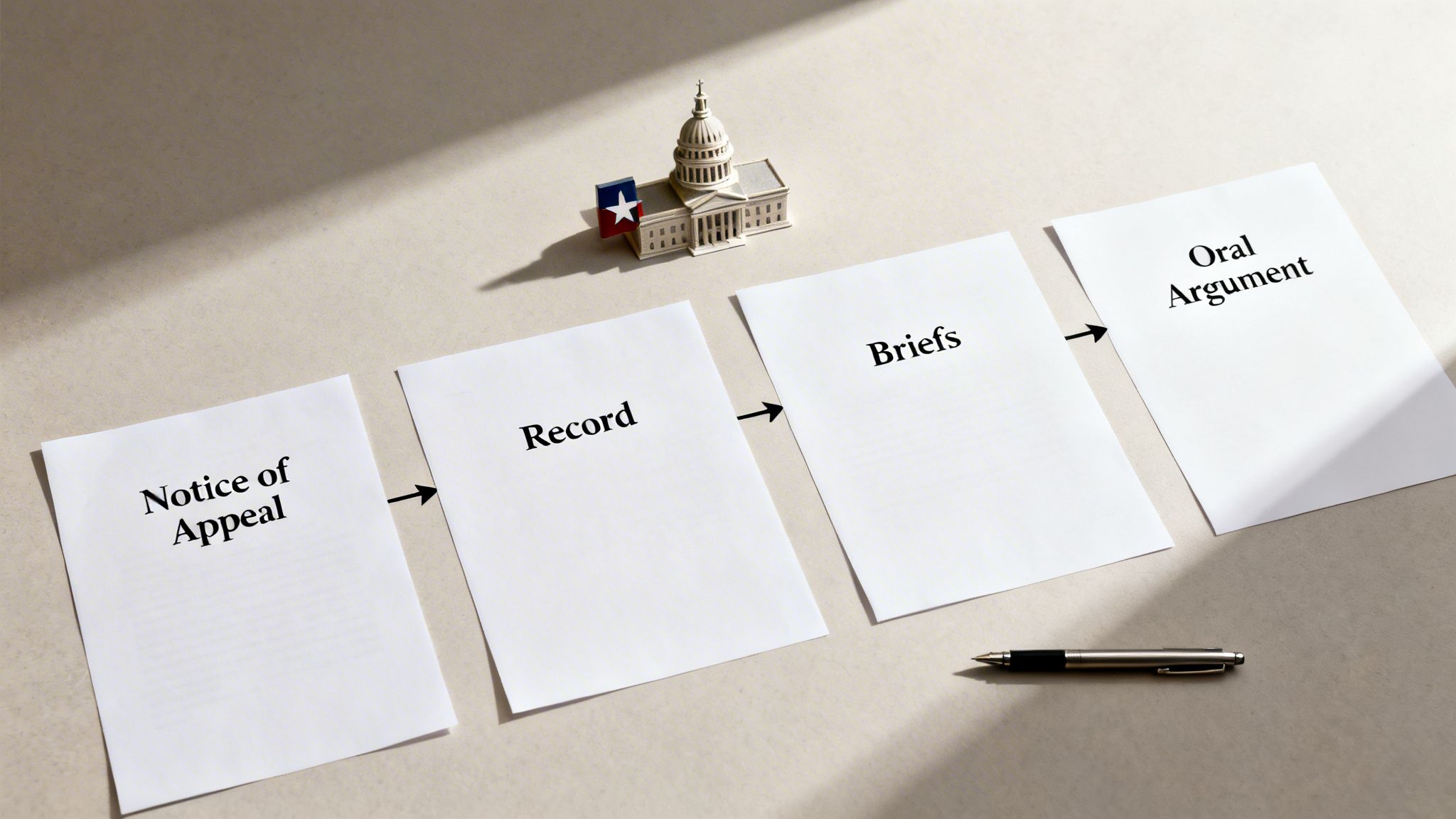
Challenging a Texas divorce decree can feel daunting, but the path is not uncharted. The appellate process is a well-defined road governed by the Texas Rules of Appellate Procedure. Understanding the steps—and, most importantly, the deadlines—is the first step toward seeking a just result.
An appeal is not a new trial. Instead, it is a meticulous, paper-intensive review to determine if the trial judge made a significant legal mistake. The dynamic trial courtroom is replaced by quiet, deep legal analysis. An appellate lawyer’s job is to navigate this world of procedure and written advocacy, ensuring your arguments are heard by the appellate judges.
Step 1: Initiating the Appeal with a Notice
The process begins with filing a Notice of Appeal. This is a straightforward but absolutely critical document that officially informs the court system and the opposing party that you are challenging the final judgment.
The deadlines are unforgiving. You typically have only 30 days from the day the divorce decree was signed to file this notice. However, filing a timely Motion for New Trial can extend this deadline to a more manageable 90 days, providing valuable time to prepare. Missing this initial deadline almost always forfeits your right to appeal, which is why acting quickly is essential.
Step 2: Assembling the Official Appellate Record
Once the notice is filed, the appellate court needs to know what happened at your trial. We must compile the official appellate record and provide it to them. This record is the entire universe of your case on appeal; if it wasn't said or filed in the trial court, it does not exist for the appellate judges.
The record consists of two parts:
- The Clerk’s Record: A collection of all the documents filed in your case—the original divorce petition, motions, discovery responses, temporary orders, and the final decree.
- The Reporter’s Record: The court reporter’s word-for-word transcript of every hearing and the trial itself. It captures all testimony, attorney arguments, and the judge’s rulings.
This step requires meticulous attention. A missing exhibit or an inaccurate transcript can undermine a key legal argument. We double- and triple-check to ensure the record is complete and accurate before it is sent to the court of appeals.
Step 3: The Heart of the Appeal: Legal Briefing
With the complete record in hand, the real substance of the appeal begins: writing the brief. A brief is a formal, written legal argument that explains to the appellate judges exactly what went wrong at trial, why it matters, and why the law requires a different result.
In plain English, "briefing" is the process of writing these detailed legal arguments.
An appellate brief is our opportunity to tell your story through the lens of the law. It is where we connect the specific facts from the trial record to established legal precedent, building a powerful, persuasive case that the trial judge committed a reversible error.
The person appealing (the "Appellant") files the first brief. The other party (the "Appellee") then files a response, and the Appellant usually has a chance to file a final reply brief. This is where most appeals are won or lost—long before anyone steps into the appellate courtroom.
Step 4: Oral Argument and the Final Decision
In some cases, the court will schedule an oral argument. This is not a time for new evidence; it is a structured Q&A session where we appear before a panel of appellate judges. They will have already read the briefs and will ask pointed questions. It is our opportunity to emphasize our most important points and clarify complex issues.
After all briefs are filed and any oral argument is held, the case is "submitted." The judges then deliberate and eventually issue a formal written opinion explaining their decision. This can take several months. The court might affirm the trial court's judgment, reverse it and order a new outcome, or send the case back ("remand" it) to the trial court with instructions.
The procedural journey has many turns. For a closer look at the specific rules, you can find more information on Texas appellate procedure for family law cases.
If you are facing an unjust outcome from your divorce, do not assume it's the final word. Our appellate attorneys can analyze your case for reversible errors and guide you through the process of seeking a better result.
Why an Appellate Attorney Is Crucial for Your Appeal
When a divorce judgment feels fundamentally unjust, your first instinct may be to want a "do-over"—another chance to explain your side of the story. But an appeal is not a second trial. It is a completely different legal arena that requires a different kind of lawyer.
Your trial attorney was focused on presenting evidence, questioning witnesses, and persuading a single judge. Their job was to build a case from the ground up. Appellate law, however, is about deconstructing a case. It is a specialized world of deep legal research, precise technical writing, and navigating the rigid Texas Rules of Appellate Procedure. It is less about courtroom theatrics and more about legal scholarship.
The Advantage of a Specialist
An appellate attorney brings a fresh, objective perspective to your case. They are not caught up in the history or emotion of the trial; their entire focus is on the "cold record"—the official transcripts and documents. They are trained to spot the subtle legal errors that others, including the trial judge and attorneys, may have missed.
The core of their work is a meticulous, three-part process:
- Meticulous Record Review: Combing through every page of the trial record to find a reversible error—an error so significant that it likely led to an improper judgment.
- Strategic Issue Spotting: Identifying the strongest legal arguments with the best chance of persuading a panel of experienced appellate judges.
- Persuasive Brief Writing: Crafting a compelling legal brief that masterfully weaves the facts of your case into the fabric of Texas law and legal precedent.
This unique skill set is a strategic necessity. The emotional arguments that can be effective with a trial judge are often unpersuasive in an appellate court, which is focused solely on correcting mistakes of law, not re-weighing evidence.
Navigating a Complex Legal Landscape
Texas appellate law is a minefield of deadlines and procedural rules. Winning an appeal often comes down to proving a clear abuse of discretion by the trial court or identifying a critical procedural mistake. For example, a core rule dictates that only final orders can be appealed—a detail that can derail a case before it starts.
Consider a high-net-worth business owner whose separate property was incorrectly classified as community property. The appellate strategy isn't to re-argue the business's value. It is to pinpoint the exact legal error the judge made in applying Texas property law and frame that argument perfectly within the strict 30-day window to file a Notice of Appeal.
An appellate attorney is like a master watchmaker, carefully disassembling the intricate mechanism of your trial to find the one component that is not working correctly. It is that single flaw that can unwind an unjust result.
Our firm’s dedicated appellate division is immersed in this area of law. We have years of experience with the specific standards of review for divorce, custody, and property division appeals, and we know how to build arguments that resonate with appellate panels. Choosing the right lawyer is one of the most critical decisions in this process. For more guidance, check out our guide on how to choose a family law attorney.
Ultimately, having a seasoned appellate specialist in your corner gives your case the strongest possible chance for a just outcome. If you believe the court made a mistake, our appellate attorneys can help you seek a fair outcome.
Common Questions About Overturning a Divorce Judgment
When a judge’s ruling in your divorce feels fundamentally unfair, it’s natural to feel overwhelmed and confused. You likely have urgent questions about what can be done. The road ahead can seem complicated, but getting clear, straightforward answers is the first step toward making a confident decision.
Let's address the most common concerns we hear from people in your exact situation. This is about understanding your options, the strict rules you must follow, and what a "win" on appeal can look like.
How Long Do I Have to Appeal My Texas Divorce Decree?
This is the most critical question, and the answer is unforgiving. The deadlines are absolute. In most Texas divorce cases, you have just 30 days from the date the judge signed the final decree to file a Notice of Appeal.
There is one major exception. If you file a Motion for New Trial within that initial 30-day window, the deadline to file your Notice of Appeal is extended to 90 days from the signing of the decree.
Filing a Motion for New Trial is a crucial strategic step. It not only gives the trial judge an opportunity to correct their own error but also provides your legal team valuable time to properly analyze the case and prepare for an appeal if needed. Missing these deadlines will likely close the door on your right to appeal forever. It is essential to contact an appellate attorney immediately to preserve your rights.
Can I Use New Evidence in My Divorce Appeal?
No. This is a common point of confusion, but it is a fundamental principle of appellate law. An appeal is not a second trial where you can introduce a new witness or a document you forgot to present.
The court of appeals is restricted to reviewing the official "record" from the trial court. The record is simply everything that was officially part of your original case. It consists of two components:
- The Clerk’s Record: All the documents—petitions, motions, discovery responses, and orders filed with the court clerk.
- The Reporter’s Record: The word-for-word transcript of everything said in court, from witness testimony to attorney arguments.
The appellate judges place themselves in the trial judge's shoes, looking only at what was presented to that judge at that time. Their job is not to re-hear the facts; it is to determine if the trial judge made a legal mistake based on the evidence and arguments that were before them.
What Are My Chances of Winning a Divorce Appeal?
Winning an appeal is not about luck. It is about identifying and proving a "reversible error"—a legal mistake so significant that it likely caused the wrong outcome in your case. While it is true that most trial court decisions are upheld, a significant number are reversed or modified when a compelling legal argument is presented.
The success of an appeal has nothing to do with whether the appellate judges would have decided your case differently. It is entirely about whether the trial judge’s decision was legally correct based on the law and the facts presented.
An experienced appellate lawyer will conduct a thorough review of your trial record to provide an honest, candid assessment of your case’s strengths and weaknesses. A case where the judge clearly misapplied the law on property division, for example, or made a custody decision contrary to established legal standards, can have a strong chance of success.
What Happens if I Win My Appeal?
Winning an appeal does not necessarily mean the case is over and you immediately get everything you wanted. It means the higher court agrees that a serious legal error occurred. From there, a few things can happen:
Reverse and Render: This is when the appellate court corrects the error itself by issuing a new, correct judgment. This is the cleanest but less common outcome. It usually occurs when the correct result is obvious from the record and requires no further fact-finding.
Reverse and Remand: This is the most common outcome. The appellate court reverses the incorrect ruling and sends the case back ("remands" it) to the same trial court for a new proceeding on the specific issue that was appealed. The court will receive instructions on how to handle it correctly, whether that means recalculating property division or holding a new hearing on custody.
Modify: Sometimes, the court can simply "modify" or edit the original decree. This is used to fix a clear, discrete mistake—like a mathematical error in a child support calculation—while leaving the rest of the judgment intact.
Any of these results is a major victory. It means the injustice you experienced has been recognized, and you have a new opportunity to achieve a fair and lawful resolution.
If you believe the court made a mistake in your family law case, our appellate attorneys can help you seek a fair outcome. Contact The Law Office of Bryan Fagan today for a free consultation at https://familylawcourtappeals.com.