Skip to content
You may feel your case was handled unfairly when the judge’s final ruling in your divorce lands, and it feels completely wrong. The first reaction is often a mix of shock and helplessness. But a judge's signature is not always the end of the story. The law provides specific tools, like a Motion for New Trial or a direct appeal, precisely for situations where you believe the court made a mistake.
Challenging a final divorce order in Texas is possible, but it is not about re-litigating your entire case out of frustration. It is about strategically using the legal system to correct genuine errors and seek the just outcome you are entitled to under Texas law. If you believe your case was decided unfairly, our appellate attorneys can help you seek justice.
What You Can Appeal in a Texas Divorce Case
Receiving a final decree that seems to ignore the facts or misapply the law is deeply unsettling. Perhaps the judge incorrectly classified your separate property as community assets, or made a custody decision that disregards the evidence you presented. That feeling of injustice is valid, and Texas law provides structured pathways to challenge such a ruling.
The most important thing to know is that you must act quickly. These options are governed by strict deadlines under the Texas Rules of Appellate Procedure, making your window of opportunity very small.
To give you a clearer picture, here is a summary of the main legal avenues you can explore.
Key Methods for Challenging a Texas Divorce Order
This table breaks down the most common legal tools for challenging a final divorce decree, explaining what each one does and when it is typically used.
| Legal Method | Primary Purpose | Typical Deadline After Judgment |
|---|---|---|
| Motion for New Trial | Asks the original trial judge to reconsider and fix errors, potentially avoiding an appeal. | 30 days |
| Direct Appeal | Asks a higher court (Court of Appeals) to review the trial record for legal errors. | 30 days (or 90 days if a Motion for New Trial was filed) |
| Restricted Appeal | A limited type of appeal for parties who did not participate in the trial. | 6 months |
| Bill of Review | A separate lawsuit to set aside a prior judgment due to fraud, mistake, or official error. | Up to 4 years (in specific circumstances) |
Understanding which path is right for your situation is the first step toward restoring balance through appellate advocacy.
Pathways to Challenge a Judgment
Immediately after the judgment is signed, your primary options are usually:
Filing a Motion for a New Trial: This is your first opportunity to address an error. It is a formal request asking the same judge to take a second look at their own decision. A successful motion can fix the problem quickly without the time and expense of a full appeal.
Pursuing a Direct Appeal: If the trial judge denies your motion or the time to file one has passed, you can take your case to a higher court—the Court of Appeals. An appeal is not a new trial; instead, appellate judges review the trial court's record for specific legal mistakes, known as "reversible error," that likely changed the outcome of your case.
This flowchart illustrates the general path from an unfair ruling to a potential resolution through the court system.
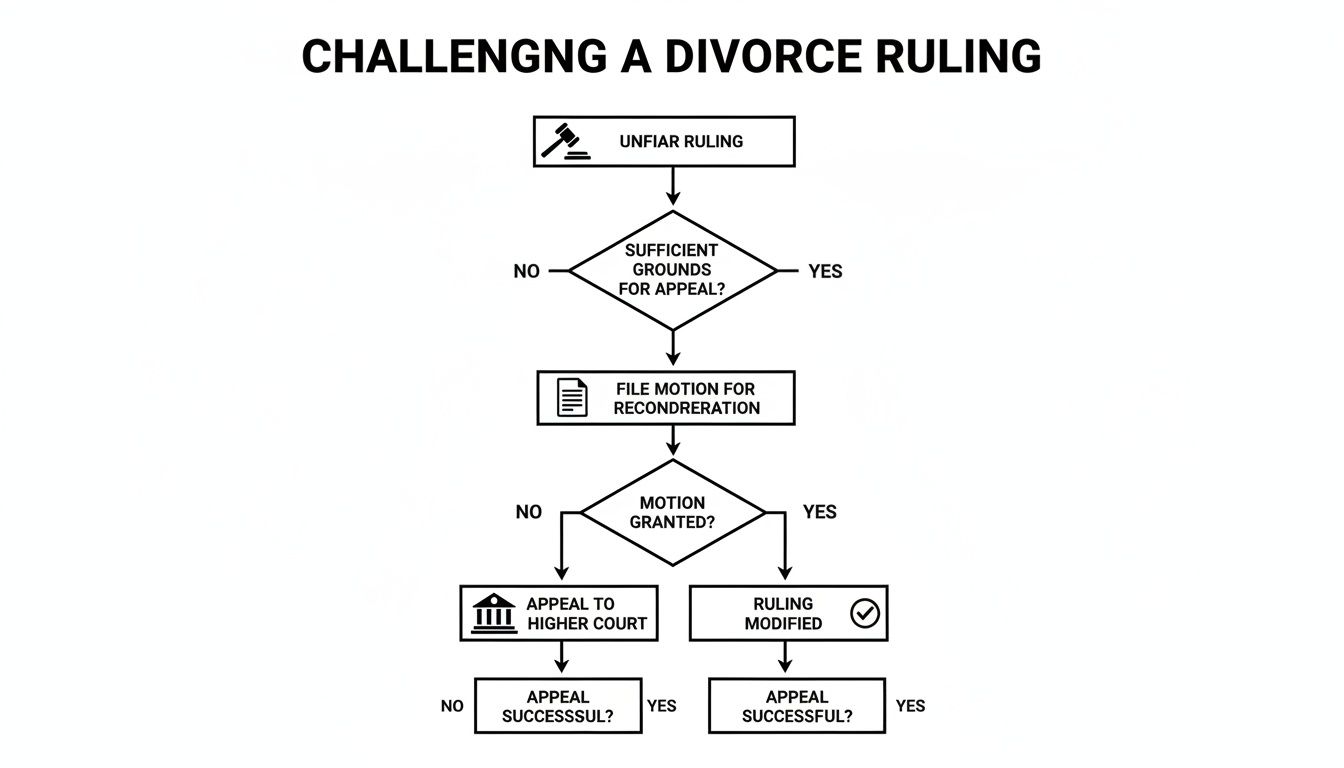
As you can see, the process starts in the trial court with post-judgment motions before it can move up to the appellate courts.
Understanding the First Steps
Your first move should be to consult an attorney specializing in family law appeals. They have the trained eye needed to meticulously review the court record, trial transcripts, and the final decree to spot appealable errors.
Was your spouse's inherited property improperly divided? Did the judge ignore overwhelming evidence about what was in your child's best interest? These are the kinds of critical mistakes an appeal is designed to fix. You can get more details by reading our guide on overturning a divorce judgment in Texas.
A judge’s signature on a final decree does not have to be the end of your fight for a fair result. The Texas Rules of Appellate Procedure exist to provide a remedy when the trial court gets it wrong.
Our goal is to help you move past the initial shock and see a clear, strategic path forward. By understanding how these legal processes work, you can get a realistic assessment of your case and take the right steps toward a just resolution.
When that final divorce decree lands and your heart sinks because it is fundamentally wrong, your fight is not over. But your next move is likely not to the court of appeals—not yet. The first, and arguably most important, steps happen right back in the same trial court that just issued the order.
These initial challenges are called post-judgment motions. Think of them as your official request for the trial judge to take a second look and fix a serious mistake. They are the critical first line of defense and absolutely essential for protecting your right to appeal later.

A well-argued motion can get the problem fixed without the time and expense of a full-blown appeal. The two primary tools you will use are the Motion for New Trial and the Motion to Modify, Correct, or Reform the Judgment.
The Motion for New Trial: Asking for a Do-Over
A Motion for New Trial is exactly what it sounds like. It’s a formal request asking the trial judge to set aside the original judgment and start over with a new trial. The clock on this is unforgiving: you must file this motion within 30 days after the judge signs the final divorce decree. If you miss that deadline, you lose your right to ask for a new trial and can seriously jeopardize your appellate timelines.
You cannot file one simply because you are unhappy with the result. You need solid legal grounds. Some of the most common reasons include:
- Jury Misconduct: For instance, if a juror was caught accepting a bribe or conducted their own "research" online against the court's instructions.
- Newly Discovered Evidence: The standard here is incredibly high. You must prove the evidence is a game-changer, that you found it after the trial ended, and that you could not have possibly found it earlier even with diligent effort.
- Clear Legal or Factual Error: This motion is your chance to argue that the judge misinterpreted the law or that the decision is so contrary to the evidence presented that it simply cannot stand.
For example, let's say your ex-spouse testified that a collection of classic cars was a family inheritance and thus their separate property. After the decree is signed, you uncover a bill of sale proving they bought the cars with money from your joint savings account. This is exactly the kind of "newly discovered evidence" that could justify a new trial.
The Motion to Modify, Correct, or Reform the Judgment
What if the error is smaller? A Motion to Modify, Correct, or Reform the Judgment does not ask to scrap the whole thing. Instead, it asks the judge to fix specific errors in the written decree. This is for when the core decision is sound, but the paperwork is wrong.
This motion runs on the same tight 30-day deadline as the Motion for New Trial. It is the right tool for cleaning up mistakes that do not require re-litigating the entire case.
This motion is often used to fix things like:
- A typo in the legal description of the house, which would make selling or refinancing it impossible.
- A simple math error in how a 401(k) was divided.
- Vague language in the possession schedule that makes it unclear where the kids are supposed to be on a holiday weekend.
While these motions seem technical, their strategic value is immense. Filing one not only gives the trial judge the power to fix a problem quickly but also, crucially, extends the deadline for filing your appeal from 30 days to a more manageable 90 days from the date the judgment was signed.
Why You Can't Skip These Motions
Filing a post-judgment motion does more than just ask the judge to reconsider. In legal terms, it "preserves error" for your appeal. You are officially putting the trial judge on notice about the specific mistakes and giving them a chance to make it right. An appellate court is far more receptive to an argument that the trial judge was first given an opportunity to correct the error.
That deadline extension is the other huge benefit. Filing one of these motions automatically pushes back your deadline to file a Notice of Appeal to 90 days from the judgment date. That extra 60 days is invaluable. It gives your appellate counsel the time needed to obtain the full trial record, analyze every page, spot every potential error, and build the strongest possible case for your appeal.
You can dive deeper into the nuts and bolts of this process in our guide to the Motion for New Trial in Texas family law.
In the end, it all comes down to strategy. By acting fast within that initial 30-day window, you open a path for a quick fix at the trial court while simultaneously protecting your absolute right to seek justice from a higher court if you need to.
What Happens When You Appeal a Texas Divorce Decree?
If the judge has signed the final divorce decree and post-judgment motions did not fix the problem, your next stop is the court of appeals. But it is critical to understand that an appeal is a technical, methodical review of what already happened in the trial court, not a do-over.
You will not get to call new witnesses, introduce new evidence, or re-tell your story to a new set of judges.
Instead, a panel of appellate judges will comb through the existing record of your case, looking for a specific, significant legal mistake. We call this a "reversible error"—a mistake so substantial that it likely caused the judge to reach the wrong conclusion. This is not about emotion; it is about law and procedure.

The entire process operates on a different set of rules and a unique vocabulary. Understanding this roadmap is the first step toward building a winning appellate strategy.
The Path of an Appeal: From Notice to Argument
The appellate process is highly structured and runs on a strict timeline set by the Texas Rules of Appellate Procedure. Once you decide to challenge the final order, a clear path unfolds.
It all starts with filing the Notice of Appeal. This document officially kicks things off. The deadline is unforgiving: you generally have just 30 days from the day the judgment was signed. However, if you filed a Motion for New Trial or another qualifying post-judgment motion, that window extends to 90 days.
From there, your legal team will work on assembling the Appellate Record—the complete collection of every document, motion, and transcript from your trial. This record is the entire universe for the appellate court; they cannot consider anything outside of it.
Next comes the heavy lifting: briefing. Your appellate attorney will draft a detailed, persuasive legal argument called a brief. This document points out the specific errors the trial judge made, cites the law and previous cases, and explains exactly why the judgment should be overturned.
Finally, in some cases, the court will schedule an Oral Argument. This is a formal hearing where your lawyer and the opposing counsel present their cases directly to the appellate judges and answer their pointed questions.
Many people think an appeal is their chance for a fresh start. In reality, the case is won or lost based on what is already in the record and your attorney's ability to prove the trial judge made a critical legal error.
Getting Familiar with Appellate Lingo
As you enter the appellate world, you will hear many new terms. Knowing what they mean is key to understanding what is happening with your case.
Here is a plain-English rundown of the essentials:
- Reversible Error: A legal mistake made by the trial judge that was so significant it probably led to an incorrect outcome. This is the foundation of any successful appeal.
- Abuse of Discretion: The legal standard used to review most family law decisions. It means the trial judge's ruling was arbitrary, unreasonable, or made without any regard for the law or the facts.
- Appellate Record: This is the official case file the higher court reviews. It has two parts: the Clerk's Record (all the paperwork like petitions and orders) and the Reporter's Record (the word-for-word transcript of everything said in court).
- Briefing: The process of writing the detailed legal arguments that form the core of the appeal. Your attorney files a brief explaining the errors, the other side files a response, and your attorney may file a final reply.
The more complicated the marriage, the higher the odds of an appeal. In Texas, the risk of divorce jumps from about 30% for first marriages to 67% for second marriages and a staggering 74% for third ones. These later marriages often come with tangled finances and complex custody arrangements for blended families—precisely the kinds of issues that can lead to an appeal when one party feels the final order was unjust. You can see more on how these factors play out by reviewing Texas divorce statistics and their relevance to contested cases.
These intricate histories make the precision of an appeal even more vital. Every word in the record counts, and how those facts are framed in the brief can be the difference between success and failure.
If you believe the court made a mistake in your family law case, our appellate attorneys can help you seek a fair outcome. Contact The Law Office of Bryan Fagan today for a free consultation.
Identifying Reversible Errors in Divorce Cases
When you are reeling from a bad divorce ruling, it is natural to feel like the outcome was simply unfair. But winning an appeal is not about asking a higher court for a do-over. It is about proving the trial judge made a specific, significant legal mistake—what we call a reversible error.
Your entire case hinges on finding these critical errors in the trial record. Think of it as locating a crack in the foundation. A minor slip-up will not bring the house down, but a serious error can undermine the entire judgment and give you grounds to challenge the final divorce order.

Understanding the Standard of Review
Appellate courts do not just rehear your case and decide what they would have done. Instead, they review the trial judge's decisions through a specific legal lens called a "standard of review." In most Texas family law appeals, that standard is "abuse of discretion."
This is a tough standard to meet. It means you have to show the judge's decision was not just wrong in your opinion, but that it was arbitrary, unreasonable, or made without any regard for guiding laws and principles. You are arguing that the judge either misapplied the law or made a decision that had no factual support in the evidence presented.
An abuse of discretion is not just a bad call. It is a ruling so far off the mark that it falls outside the zone of reasonable disagreement. We have to show the judge acted without a sound legal or factual basis, which is why a trained appellate eye is so important.
Common Reversible Errors in Texas Divorce Cases
While the facts of every divorce are different, the same types of legal errors tend to appear in appeals. Knowing what to look for is half the battle.
Errors in Property Division
Texas law requires a "just and right" division of community property. While this does not strictly mean a 50/50 split, the final division must be equitable. An unfair outcome based on a legal mistake can be a powerful basis for an appeal.
Common errors we see include:
- Mischaracterization of Property: This is a major one. The judge treats separate property (like an inheritance, a gift to one spouse, or an asset owned before the marriage) as community property and divides it.
- Improper Valuation: The court uses a completely wrong value for a major asset, like a family business or a piece of real estate, which throws the entire division out of balance.
- Unsupported Unequal Split: A judge awards a lopsided division, like 70/30, without clear evidence in the record to justify it (such as proven fault in the marriage or a huge disparity in earning potential).
For instance, if your spouse inherited a substantial sum of money and the judge split it with you in the decree, that is a classic misapplication of Texas property division law—and a strong point for your appeal.
Errors in Child Custody Rulings
In Texas, every decision about children must be based on the "Best Interest of the Child" standard. A judge who makes a custody ruling without enough evidence supporting that standard, or who ignores key facts, has committed a reversible error. We have written extensively about what qualifies as reversible error in Texas family court, and it is a critical concept to understand.
Some of the most common custody-related errors are:
- Creating an unworkable order by naming parents as joint managing conservators but failing to clearly define each person's rights and duties.
- Imposing a geographic restriction (telling a parent where they can and cannot live) without any evidence that the move would harm the child.
- Ignoring credible, documented evidence of family violence, substance abuse, or neglect when determining who the child lives with and when.
Finding these errors requires a deep dive into every hearing transcript, every exhibit, and every motion filed in your case. The mistake must have been properly preserved for the appellate court to even consider it, which is why a detail-oriented review is the first, most crucial step in building your appeal.
So, the strict 30- or 90-day deadline to file a notice of appeal has come and gone. It is a sinking feeling, and many people assume that a bad outcome is now set in stone. While the main highway for challenging the court's decision is closed, Texas law provides a few lesser-known but powerful off-ramps for truly extraordinary situations.
Once you have missed the window for a standard appeal, the game changes completely. You are no longer just asking a higher court to review the trial record for errors. Instead, you are looking at entirely new legal actions designed to tackle fundamental injustices that the normal appellate process could not address.
The two most important tools in this situation are the Bill of Review and the Motion to Modify.
The Bill of Review: A New Lawsuit to Correct an Old Wrong
A Bill of Review is not an appeal. It is a completely separate lawsuit you file in the very same court that issued your original divorce decree. The goal is drastic: to set aside that entire prior judgment because you were prevented from properly making your case due to fraud, an official mistake, or the wrongful actions of your ex-spouse.
Think of it as the justice system's last-resort safety valve. Because this is such an extreme remedy, the timeline is much longer than for an appeal. You generally have up to four years from the date the judgment was signed to file. But be warned: the legal standard you have to meet is incredibly high.
To win a Bill of Review, you must prove all three of these elements:
- You had a valid claim or defense that you were prevented from presenting.
- You were prevented from presenting it by your opponent's fraud, accident, or wrongful act—not by your own mistake or negligence.
- You acted diligently to file the Bill of Review as soon as you discovered the fraud or mistake.
A classic scenario is when one spouse successfully hides a major asset—say, a multi-million dollar investment portfolio—during the divorce. If the other spouse uncovers the deception two years later, the appeal deadline is long gone. A Bill of Review is the perfect, and really the only, tool to go back and attack the original property division.
A Bill of Review acknowledges that sometimes, a final order is reached under circumstances so fundamentally unfair that it cannot be allowed to stand. It is a powerful remedy, but one reserved for situations where the legal process itself was compromised.
Motions to Modify: Changing the Order Moving Forward
What if the divorce decree was perfectly fair when it was signed, but life has changed so much that it is now unworkable? This is where a Motion to Modify comes in. This is not about attacking the past; it is about adjusting the court’s orders to fit your family’s future.
A Motion to Modify does not overturn the original judgment like a Bill of Review. Instead, you are asking the court to issue a new, updated order for things like child custody, visitation schedules, or child support. The one major thing you cannot change is the property division. Once the deadline to appeal has passed, the division of assets and debts is final.
The legal standard here is a “material and substantial change in circumstances.” That is a broad term, but it typically covers situations like:
- One parent needs to relocate for a significant job opportunity.
- A parent has a significant, involuntary drop in income that impacts their ability to pay child support.
- A child's needs have changed dramatically as they have gotten older, requiring a new possession schedule.
While the overall rate of divorce in Texas has decreased relative to its population growth, the post-divorce issues families face are as complex as ever. As you can see from studies on Texas divorce statistics, life moves on and orders sometimes need to change with it. Understanding whether you need to fix a past injustice or simply adapt to a new reality is the first step in protecting your rights long after the ink on the decree is dry.
Straight Answers to Your Texas Divorce Appeal Questions
Once a judge signs that final divorce decree, it can feel like the end of the road. But what if you are certain the judge got it wrong? It is completely normal to have a flood of questions about what comes next.
The path to challenging a final order can feel complicated, but getting clear, practical answers is the first step. Let's tackle the questions we hear most often from clients standing in your shoes.
How Much Does a Divorce Appeal Cost in Texas?
This is usually the first question on everyone's mind, and the honest answer is: it depends. The cost can swing dramatically based on how complex your case is, but the single biggest factor is the size of the trial record.
Think of it this way—the appeal is built on that record. Key expenses will always include:
- Court filing fees.
- The court reporter's fee for preparing the official transcript (the Reporter’s Record).
- Your appellate attorney's fees.
Appeals are an intense, writing-heavy process that requires a very specific skill set to spot a “reversible error.” It is a serious financial commitment. However, when you are talking about major errors in how your property was divided, the loss of significant assets, or decisions that affect your fundamental rights as a parent, a successful appeal is not just a cost—it is an investment in seeking the just outcome you deserved in the first place.
What Are My Chances of Winning an Appeal?
Winning a divorce appeal is challenging. Appellate courts start with the assumption that the trial judge made the right call and give them a great deal of deference. Your job is to prove otherwise.
Success comes down to one thing: finding a reversible error within the four corners of the official court record. We cannot introduce new evidence or call new witnesses. We have to work with what is already there.
Your odds are best when we can point to a clear mistake where the trial court either misunderstood or misapplied the law. For example, perhaps the judge incorrectly labeled your pre-marriage 401(k) balance as community property, or made a custody ruling with absolutely no evidence in the record to back it up. The only way to truly know your chances is to have an experienced appellate lawyer dig into every page of your case record. That meticulous review is the foundation of everything.
Can I Get My Attorney's Fees Back if I Win?
It is possible, but it is never a sure thing. If the court of appeals agrees that the trial judge made a critical error, they typically “remand” the case. This just means they send it back down to the same trial court with instructions to fix the mistake.
Once the case is back in the trial court for a "do-over" on that specific issue, your attorney can absolutely argue that you should be awarded the fees you had to spend on the successful appeal. Whether the judge grants that request really depends on the unique facts of your case and why the original decision was reversed. It is a key part of the overall strategy we will discuss from the very beginning.
If you believe the court made a mistake in your family law case, our appellate attorneys can help you seek a fair outcome. Contact The Law Office of Bryan Fagan today for a free consultation at https://familylawcourtappeals.com.