When a divorce decree labels an important asset as your spouse’s separate property, or rejects your own separate property claim, the result can feel personal and financial at the same time. You may be looking at a final order and thinking the court got the facts wrong, trusted the wrong evidence, or ignored records that mattered.
That reaction is common. It’s also the point where many people misunderstand what happens next.
A Texas appeal is not a fresh trial. It’s a structured review of whether the trial court made a legal mistake that changed the outcome. In an overturning separate property finding texas appeal case, the work is precise. The appellate court studies the written record, the admitted exhibits, the transcript, and the legal rulings. It asks whether the law was applied correctly and whether the evidence was legally sufficient to support the property characterization.
If you believe the court treated a house, business interest, account, reimbursement claim, or sale proceeds unfairly, there may be a path forward. The key is to move quickly, protect the record, and evaluate the issue with realism.
Your Divorce Decree Feels Unfair What Now
A common scene after trial looks like this. One spouse leaves court believing the judge missed the real paper trail. Bank statements may have shown commingling. An LLC distribution may have happened during the marriage. A home may have been acquired through facts that don't line up with the decree. Yet the final order still labels the asset as separate property and builds the property division around that ruling.

That kind of ruling can change everything. It can affect who keeps proceeds, who carries debt, and whether the overall division still feels balanced. For many clients, the hardest part is that the decree sounds final even when serious appellate issues remain.
Fairness still has a process
Texas family law gives trial courts broad authority in divorce cases, but that authority has limits. If the court mischaracterized property and that mistake affected the division, an appeal may be the tool for restoring fairness. The process is formal, deadline-driven, and focused on specific legal errors.
Two practice areas often overlap here:
- Property division disputes: Records, tracing, and characterization usually drive the appeal.
- Divorce decree challenges: The error may sit in findings, valuation treatment, or the structure of the final order.
If your case involves those issues, it helps to review the legal framework for Texas divorce appeals and related property division appeals.
You don't need to prove the decree felt unfair. You need to show the record supports a reversible legal error.
The first question to ask
The right opening question isn't, "Was the judge wrong?" The better question is, "Can the appellate record show a reversible mistake under Texas law?"
That shift matters. Appeals reward disciplined analysis, not frustration. A calm review of the decree, findings, exhibits, and transcript usually tells far more than a strong emotional reaction ever will.
How a Texas Appeal Differs from Your Trial
Many clients come into an appellate consultation expecting another chance to testify, add missing records, or explain what the trial judge didn't seem to understand. That's not how the process works.
An appeal is closer to a referee reviewing recorded footage than replaying the entire game. The appellate court doesn't hear the witnesses live. It doesn't take new exhibits. It reviews what already happened and decides whether the trial court committed reversible error.
Trial vs appeal at a glance
| Aspect | Trial Court | Appellate Court |
|---|---|---|
| Purpose | Decides disputed facts and enters judgment | Reviews the judgment for legal error |
| Evidence | Witness testimony, exhibits, objections, live presentation | Existing appellate record only |
| Decision-maker | One judge, and sometimes fact findings based on witness credibility | A panel of justices reviewing the written record |
| New evidence rule | Evidence is presented and admitted here | New evidence usually isn't allowed |
| Main question | What happened, and how should the court rule? | Did the trial court apply the law correctly and have sufficient support in the record? |
| Output | Final decree or order | Opinion that may affirm, reverse, render, or remand |
What the appellate record means
The appellate record is the official package the court of appeals reviews. It usually includes two main parts:
- Clerk’s record: Pleadings, motions, orders, admitted documents filed with the court, and often findings of fact and conclusions of law.
- Reporter’s record: The transcript of hearings and trial testimony.
If something important never made it into that record, the appellate court usually can't consider it. That surprises people, especially when they have documents on hand that were discussed informally but never admitted.
Plain-English terms that matter
A few terms come up in almost every appeal:
- Reversible error: A mistake serious enough to justify changing the result.
- Briefing: The written legal arguments filed by each side. Appellate lawyers perform much of their key work during this stage.
- Record preservation: Making sure the issue was properly raised in trial court so the appellate court can review it.
For a broader look at this process, readers often benefit from reviewing Texas family law appeals.
The appellate judges won't decide whose story sounds better. They decide whether the law and the record support the judgment already entered.
Why this distinction matters in property cases
Separate property disputes often turn on tracing, account history, timing, and how documents fit together. At trial, a witness may seem credible. On appeal, credibility alone usually won't fix missing paperwork or an unsupported leap in the characterization analysis.
That's why appellate work in property cases is technical. The record either carries the issue or it doesn't.
The High Bar for Overturning a Property Division
Texas appellate courts don't reverse property rulings just because a different judge might have seen the evidence differently. The standard is much tougher.
The key phrase is abuse of discretion. In plain English, that means the trial court had room to decide the issue, but not unlimited room. If the ruling falls outside what the law permits, or if there isn't legally sufficient evidence to support it, an appellate court can step in.
Abuse of discretion in everyday terms
Think of this standard as a high hurdle. It's not enough to argue that the trial court made a close call and got it wrong. The appellant must show the ruling cannot stand under the governing rules.
In property characterization disputes, that often means one of two things:
- The court applied the wrong legal rule.
- The evidence in the record was not legally sufficient to support the finding.
That second point matters because family courts weigh testimony and documents, and appellate courts usually defer to that role. But deference has limits.
What legally sufficient evidence means
When a spouse claims an asset is separate property, Texas law imposes a serious burden at trial. The spouse must overcome the community property presumption with clear and convincing evidence. Under Texas Family Code § 3.003(b), that is a higher standard than an ordinary civil preponderance standard and requires proof capable of producing a firm conviction.
The Texas Supreme Court reinforced the appellate side of that rule in Landry v. Landry, 687 S.W.3d 512 (Tex. 2024). The Court reversed and remanded after the court of appeals misread the record, incorrectly stating that key account statements from July through October 2018 were missing when they were present. The Supreme Court emphasized that legal sufficiency review must look at the evidence in the light most favorable to the trial court’s finding and ask whether a reasonable fact-finder could form a firm belief. It also stressed that trial courts, not appellate courts, judge witness credibility and the weight of the evidence.
That case matters because it shows both sides of the standard. Appellate courts must defer to supported findings, but they also can't rewrite the record or ignore documents that were admitted.
For a deeper discussion of this framework, see this explanation of the abuse of discretion standard in Texas family law.
Practical rule: A strong appeal usually attacks the legal support for the finding, not the personality of the judge.
What works and what doesn't
Certain arguments tend to carry more weight than others.
| Approach | Usually stronger | Usually weaker |
|---|---|---|
| Record-based challenge | Shows the decree rests on a misread exhibit, missing proof, or incorrect legal standard | Relies on broad claims that the result felt unfair |
| Tracing attack | Points to breaks in documentary tracing | Assumes testimony alone should have carried the day |
| Appellate framing | Connects the mistake to the final property division | Focuses on isolated complaints without showing impact |
Why clients need candid advice
Some decrees are frustrating but still hard to reverse. If the record contains enough support for the trial court’s characterization, the court of appeals may affirm even where the evidence was contested. A good appellate assessment doesn't promise a second chance. It identifies whether the trial court had legal support for what it did.
That honesty is part of strategy. It protects clients from pursuing an appeal on emotion alone and helps focus resources on issues the appellate court can correct.
Why Your Actions at Trial Dictate Your Appeal
Most appeals are shaped long before the notice of appeal is filed. They are shaped when evidence is offered, when objections are made, and when counsel creates a record that clearly identifies the disputed issue.
That is why two cases with similar facts can have very different appellate outcomes. One record may preserve the error cleanly. The other may leave the appellate court with no procedural path to review the complaint.

Preservation of error decides what can be reviewed
Preservation of error means the complaint was properly raised in the trial court. If a party never objected, never asked for a ruling, or never put the issue on the record in a way the trial judge could address, the appellate court often treats the complaint as waived.
In practical terms, that can involve:
- Timely objections: Counsel must object when the problem happens, not later when the decree is already signed.
- Specific grounds: The objection must explain the legal basis, not just say something is unfair.
- Ruling by the court: The record should show the judge ruled, or refused to rule after being asked.
This is a core issue in all family appeals, including Texas appeal preservation through objections.
Findings and admitted exhibits matter more than people expect
In separate property disputes, the appellate fight often turns on details that seem small during trial:
- Whether an exhibit was duly admitted rather than merely shown to a witness.
- Whether the final decree conflicts with the findings of fact.
- Whether a party requested findings of fact and conclusions of law that force the court to reveal its path.
Findings of fact are the trial court’s written factual determinations. Conclusions of law are the court’s legal conclusions based on those facts. In an appeal, they help isolate where the court may have gone wrong.
A careful appellate review often starts with a simple question. Did the record clearly preserve the point you now want to argue?
Trial choices that often help an appeal
Some trial steps make later review much easier:
- Building a tracing file through documents, not memory. Separate property claims rise or fall on records.
- Objecting when the opposing party blurs separate and community character without support.
- Requesting findings after judgment. That can expose whether the court applied the wrong rule.
Later in the case, video can help clients understand how these procedural choices affect review.
This issue reaches beyond property disputes
The same preservation rules apply across family law. A custody issue, support ruling, or protective order problem can be just as difficult to appeal if the trial record is thin. Readers dealing with related matters may also want to review child custody appeals and protective order appeals.
A strong appellate lawyer reads the transcript with two questions in mind. What did the trial court do, and did the record preserve a clean path to challenge it?
Common Reversible Errors in Separate Property Rulings
Property appeals become much easier to understand when you stop thinking in labels and start thinking in mistakes. The question is not about whether the decree says "separate" or "community." The question is whether the trial court used the correct legal method to reach that label.
The court may have accepted tracing that wasn't complete
This is one of the most common problems. A spouse claims an account, business interest, or sale proceeds came from premarital property. The story may sound plausible. The documents may even support part of it. But if the paper trail breaks, the separate property claim may fail.
A Texas appeals court illustrated that in a 2025 property division case involving an LLC distribution during marriage. The court reversed the trial court’s finding that $338,749.63 in sale proceeds from the W. property was separate property. The distribution from Family Holdings, LLC occurred during the marriage, and the court held the proceeds were community property because the separate-property claim did not satisfy the clear and convincing evidence standard. The opinion also noted payments totaling $376,000 ($7,500 option plus $368,500 purchase) required uninterrupted documentary proof, not just testimony or oral agreements. The court stated that the mischaracterized amount represented about 37% of the actual community estate, making the error significant to the overall division.
That case is a practical warning. Tracing is not a general narrative. It is a chain of proof.
Business entities don't automatically preserve separate character
Clients often assume an LLC, partnership, or investment structure protects the original character of an asset. Sometimes it does. Sometimes it doesn't. The legal analysis depends on when the right was acquired, how the transfer occurred, what was distributed during marriage, and whether the records show uninterrupted separate origin.
That issue appears often in high-asset divorces. It also overlaps with commingling problems in real estate and investment disputes. For related background, see this discussion of commingling in real estate cases.
Other errors that can support appeal
Separate property appeals often involve one or more of these trial-level mistakes:
- Ignoring the community property presumption: Property possessed during marriage is presumed community unless properly rebutted.
- Treating testimony as enough without the documents to match it: Courts may hear the testimony, but appellate scrutiny becomes sharper when tracing records are incomplete.
- Misreading the timing of acquisition: Character often depends on when the right originated, not just when money changed hands.
- Folding a large mischaracterization into a broader division without testing the effect on fairness: Even a technically wrong label may or may not justify reversal, depending on impact.
What clients should compare against their own file
If you're evaluating your own decree, gather these items and compare them carefully:
| Record item | Why it matters |
|---|---|
| Final decree | Shows exactly how the court characterized the asset |
| Findings of fact and conclusions of law | Reveal the court’s reasoning, if requested |
| Trial transcript | Shows what testimony was offered and what objections were made |
| Admitted financial exhibits | Confirms whether tracing documents were actually in evidence |
| Entity documents and distribution records | Often decide whether business-related proceeds can be traced |
One option for this kind of detailed record review is The Law Office of Bryan Fagan, PLLC, which handles Texas family law appellate matters involving property characterization, briefing, and appellate record analysis.
In separate property appeals, the strongest issue is often not "the judge believed the wrong person." It is "the record does not legally support the label attached to the asset."
Your Texas Family Law Appeal Step by Step
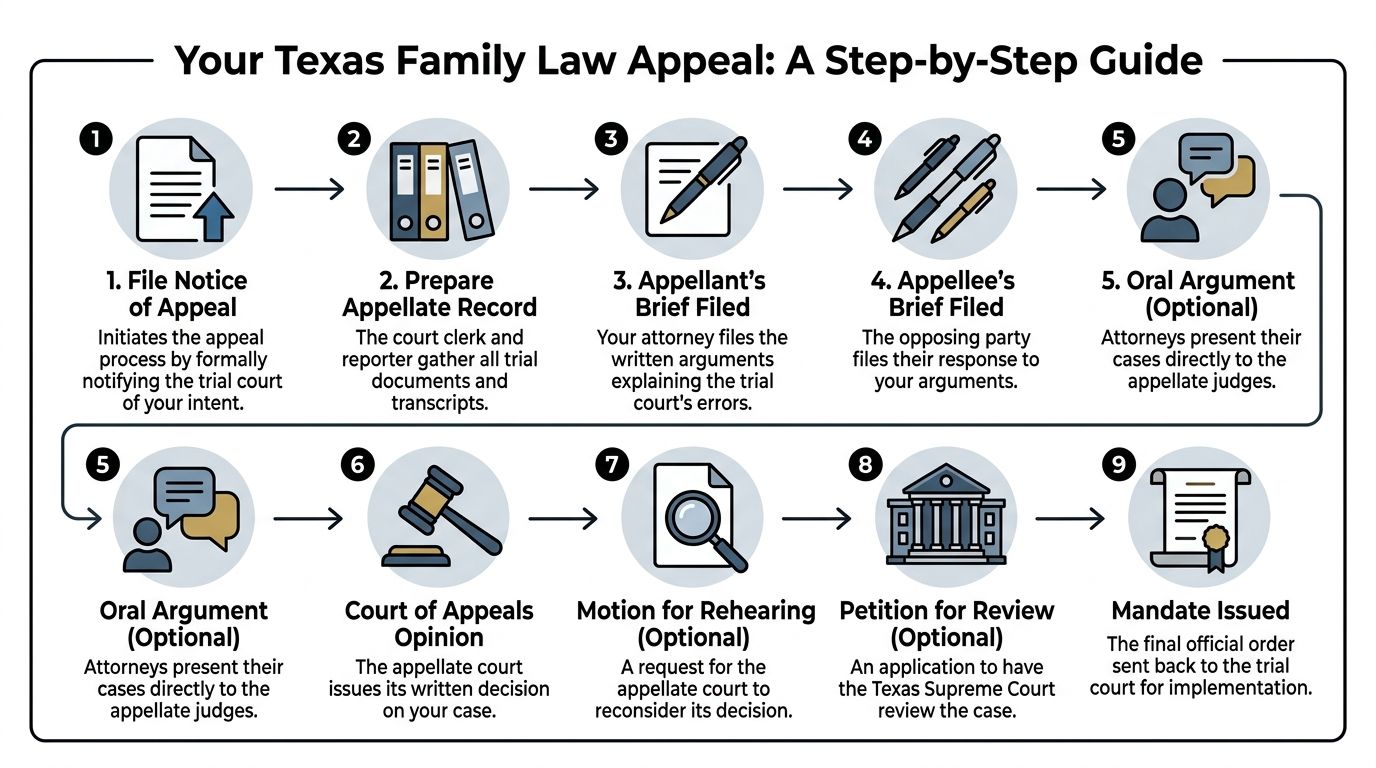
Once the decision to appeal is made, the process follows a sequence. That sequence matters because appellate courts expect strict compliance with the Texas Rules of Appellate Procedure. Missing a deadline can damage or end the appeal before the court ever reaches the property issue.
Step one through step three
The case usually starts with the Notice of Appeal. This filing tells the court and the opposing party that the judgment will be challenged. The deadline is strict under the appellate rules, so early review is critical.
After that, the parties arrange the clerk’s record and reporter’s record. Those materials become the universe the court of appeals reviews.
Then comes the appellant’s briefing. A brief is the written legal argument explaining what the trial court did wrong, where that error appears in the record, and why it requires relief.
The response and possible oral argument
The opposing party files an appellee’s brief answering those arguments. Sometimes there is also a reply brief from the appellant, though not in every case.
The court may set oral argument. This is not another evidentiary hearing. It is a focused exchange with the justices about the law, the record, and the requested remedy.
Oral argument rarely fixes a weak brief. It can, however, sharpen a strong one.
What happens after submission
After briefing and any oral argument, the appellate court issues a written opinion. That opinion may:
- Affirm the decree
- Reverse and remand for further proceedings
- Reverse and render a different judgment in narrower circumstances
There may also be post-opinion steps, including a motion for rehearing or a petition for review to the Texas Supreme Court in appropriate cases.
What clients should do during the process
Clients often ask what they should be doing while the appeal is pending. The answer is practical:
- Stay organized: Keep orders, notices, and financial records in one place.
- Read for accuracy: When your lawyer asks you to review names, dates, and account references, do it carefully.
- Ask focused questions: Appeals move through documents and deadlines. Good communication helps avoid confusion.
- Prepare for patience: Appellate work involves writing, record review, and waiting for the court’s schedule.
For many people, the stress drops once they see the process as a sequence rather than a mystery. Each step has a purpose. Each filing builds the legal path the court will follow.
What Winning an Appeal Actually Means
Clients often use the word "win" to mean the appellate court fixes everything immediately. Sometimes that happens in part. More often, a successful appeal means the higher court identifies the error and sends the case back with instructions.
The most common outcomes
A reversal and remand means the appellate court found a material problem and returned the case to the trial court for further action consistent with the opinion. In a property case, that often means the trial court must reconsider characterization or redo the just-and-right division.
A reversal and rendition is narrower. That means the appellate court effectively enters the proper judgment itself on the issue before it. Whether that is available depends on the record and the nature of the error.
Not every mistake changes the result
Candid case assessment proves most critical. Texas appellate courts don't reverse every property mischaracterization. The error must be large enough to distort the overall division in a meaningful way.
As explained in this discussion of when mischaracterization makes a division manifestly unjust, Texas courts look at whether the error had a substantial effect on the just-and-right division. The article notes one example where a mischaracterization changed the division by about 14% of the community estate, which the court treated as more than de minimis and therefore reversible. It also notes another case involving a $641,458 reimbursement award, described as nearly half the total community estate, that was reversed entirely.
That is the practical threshold many clients need to understand. An appellate issue may be legally interesting but still too small to produce relief. On the other hand, a major mischaracterization that skews the division can justify the cost and effort of appeal.
A realistic way to evaluate viability
Ask these questions:
- Is the characterization error clear from the record?
- Was the issue preserved?
- Did the mistake materially affect the overall property division?
- Is the requested remedy something the appellate court can grant?
Those questions don't guarantee success. They do help separate strong appellate issues from disappointment that, while understandable, may not lead to reversal.
Contact Our Appellate Attorneys to Seek a Fair Outcome
A separate property ruling can shape the entire financial outcome of a divorce. If the court got that issue wrong, the answer isn't to relive the trial. The answer is to examine the record carefully, identify preserved error, and build a focused appellate argument under the Texas Family Code and the Texas Rules of Appellate Procedure.
That work calls for precision, judgment, and honesty about what the record can support. Some decrees should be challenged. Others should be approached with caution. A clear review can tell the difference.
If you believe the court made a mistake in your family law case, our appellate attorneys can help you seek a fair outcome. Contact The Law Office of Bryan Fagan today for a free consultation.
If you believe your divorce decree wrongly characterized property and left you with an unjust result, schedule a consultation with The Law Office of Bryan Fagan, PLLC. Our appellate attorneys review trial records, identify reversible error, and advise whether an appeal offers a realistic path toward a fairer outcome.