You may feel like the judge missed something obvious. Maybe community money paid down a mortgage on separate property, covered major improvements, or reduced debt that clearly benefited one side of the marital estate, and the final decree still gave little or no credit for it.
That frustration is common in a reimbursement claim appeal texas divorce case. It’s also the point where many people misunderstand what an appeal can do. An appeal doesn’t give you a new trial or a second chance to put on better evidence. It asks a higher court to review whether the trial court followed Texas law, applied the right standards, and based its ruling on the record that was admitted.
A reimbursement claim is, in plain English, a request for fairness between marital estates. Texas Family Code Section 3.402 addresses situations where one estate, often the community estate, benefits another estate, often one spouse’s separate property. That can involve mortgage reduction, debt payoff, or improvements that enhanced value. If the trial court mishandled that issue, the error can affect the entire property division.
Your Guide to Challenging an Unfair Reimbursement Ruling
A reimbursement ruling can shape the whole divorce decree. In many cases, it’s not just one line item. It changes how the judge views equity, offsets, and what counts as a just and right division of property.
That’s why reimbursement disputes often continue after trial. A denied claim can leave one spouse feeling that years of financial contributions were ignored. An awarded claim can leave the other spouse believing the court gave credit without proper proof. Both scenarios can justify a careful appellate review.
What reimbursement means in real terms
Texas courts treat reimbursement as an equitable issue. The basic question is whether one marital estate should receive credit because it conferred a benefit on another. Common examples include:
- Mortgage reduction: Community earnings paid down principal on a home one spouse owned separately.
- Property improvements: Funds were used to improve separate real estate, and the improvement enhanced value.
- Debt discharge: One estate paid obligations that should have been borne by another.
What an appeal can and cannot do
An appeal can correct a legal mistake. It can’t fix a trial presentation that left out key evidence.
Practical rule: If the trial judge made the wrong call because the law was misapplied, the court of appeals can step in. If the right documents never made it into evidence, the appellate court usually can’t supply them later.
That distinction matters. A strong appeal focuses on legal error, preserved objections, and the existing record. A weak appeal argues only that the result felt unfair.
Clients usually want direct answers at this stage. Was the ruling legally vulnerable? Was the proof sufficient under Texas law? Did the court misunderstand tracing, offsets, or property characterization? Those are the questions that move an appeal forward.
Understanding When a Reimbursement Decision Can Be Appealed
Not every disappointing ruling is appealable. Texas appellate courts don’t reverse property decisions because another judge might have weighed the facts differently. They look for a legal reason to intervene.

Abuse of discretion in plain English
In family law, many reimbursement rulings are reviewed for abuse of discretion. That means the appellate court asks whether the trial judge acted unreasonably, applied the wrong legal standard, or made a decision without supporting evidence.
A judge doesn’t abuse discretion just because you disagree with the outcome. The problem has to be more specific. The court may have ignored controlling law, accepted a reimbursement theory that Texas law doesn’t allow, or based the ruling on proof that doesn’t satisfy the required burden.
What reversible error looks like
A reversible error is a mistake serious enough to justify changing the judgment. In reimbursement disputes, common examples include:
- Misapplying the Family Code: The court uses the wrong legal framework under Section 3.402.
- Ignoring tracing requirements: The ruling accepts a claim without clear tracing through the record, or rejects a claim after overlooking admitted evidence that directly addressed tracing.
- Property characterization mistakes: The court treats separate and community property as though they were interchangeable.
- Offset errors: The decree grants or denies reimbursement without properly addressing equitable offsets that matter to the final division.
For a deeper look at how appellate courts review these property rulings, see this guide on appealing property division in a Texas divorce.
Why reimbursement appeals are different from trial fights
Trial courts hear witnesses, receive exhibits, and make judgment calls in real time. Courts of appeals do something different. They study transcripts, exhibits, objections, and written orders. They ask whether the ruling can stand under Texas law.
That difference is especially important in tracing cases. One appellate discussion of this issue noted that a June 2025 Dallas Court of Appeals case reversed awards exceeding $641,000 because the claimant did not satisfy the clear-and-convincing tracing burden, underscoring that appellate review is about abuse of discretion, not retrying the case, as discussed in this analysis of how not to prove a reimbursement claim.
Appellate courts don’t decide whose story they like better. They decide whether the ruling is legally defensible on the record that exists.
A quick self-check for potential appellants
If you’re considering an appeal, these questions usually matter more than your level of frustration:
| Question | Why it matters |
|---|---|
| Did the judge apply the correct law? | A legal misstep creates stronger appellate issues than a factual disagreement alone. |
| Was the key evidence actually admitted? | Appellate courts can review only what’s in the record. |
| Were objections or arguments preserved? | Unpreserved complaints often can’t be raised later. |
| Did the reimbursement ruling affect the overall property split? | A reimbursement error often reshapes the whole decree. |
How the Trial Record Becomes Your Most Critical Appellate Tool
Most reimbursement appeals are decided long before the notice of appeal is filed. They’re shaped at trial, exhibit by exhibit, objection by objection, and by whether the court reporter captured what mattered.
Texas appeals run on the record. That means the court of appeals reviews the written and transcribed material from the trial court. It doesn’t call witnesses back. It doesn’t take fresh financial statements. It doesn’t let a party repair missing proof with documents found after judgment.
What the record actually includes
The appellate record usually has two main parts:
- Reporter’s record: The transcript of hearings, testimony, objections, and rulings.
- Clerk’s record: Filed pleadings, orders, admitted exhibits, inventories, and other papers in the case file.
If your reimbursement issue depended on tracing money, the record needs to show exactly how those funds moved and why they support the claim. A useful overview of trial-level preparation explains that reimbursement under Section 3.402 requires rigorous tracing with documents such as bank statements and receipts, starts with a Sworn Inventory & Appraisement, and that trial occurs in about 5% of cases, making a complete record essential because appellate courts review only what the trial judge received, as described in this article on how to present a reimbursement claim.
What usually works
A persuasive appellate record in a reimbursement case often includes:
- A clean Sworn Inventory & Appraisement: Assets, debts, community property, and separate property are laid out in an organized format.
- Tracing documents that connect the dots: Bank statements, receipts, invoices, appraisals, and photos of improvements.
- Clear testimony tied to exhibits: Witnesses explain what each document proves, rather than speaking in conclusions.
- Specific objections and rulings: If the court excluded evidence or misapplied the law, the record needs to show it.
What usually fails
The weak version is familiar. A party testifies that inherited money paid for improvements, but the statements are incomplete. Transfers move through mixed accounts. The appraisals don’t separate cost from enhancement. Counsel argues fairness, but the exhibits don’t trace the funds with precision.
That kind of record is hard to salvage on appeal.
If a bank statement stayed in a folder at home and never became an exhibit, the appellate court won’t treat it as part of the case, even if it would have helped.
A practical example
Suppose community earnings were used over time to reduce principal on a spouse’s separate-property home. At trial, counsel mentions monthly payments and refers generally to “the statements,” but only some statements are admitted. The amortization details never make it into evidence. The witness also gives inconsistent testimony about which account the payments came from.
On appeal, the party can argue the judge got it wrong. But if the key proof was never admitted, the argument usually collapses into, “The court should have accepted my version anyway.” That’s not strong appellate ground.
Organizing financial records before trial
Good appellate records often start with simple organization. If you’re still in the trial stage, one practical way to prepare tracing evidence is to categorize your bank statements by account, date range, transaction type, and source of funds before your lawyer builds the exhibit set.
For readers trying to understand how appellate courts use testimony and exhibits together, this explanation of the statement of facts in a Texas family appeal is useful.
Preservation is not technical busywork
Issue preservation often decides whether a complaint can be heard at all. If the judge excluded a tracing exhibit, counsel needed to make the right record. If the court relied on an incorrect legal theory, counsel needed to raise that theory in a way the appellate court can verify.
That’s why appeals in reimbursement cases are rarely about dramatic courtroom moments. They’re about whether the transcript, exhibits, and rulings were built carefully enough for a reviewing court to see the error.
The Texas Reimbursement Appeal Process Step by Step
The process is structured, deadline-driven, and mostly written. That can feel unfamiliar after a trial centered on testimony and live hearings. The upside is that the process is orderly. Once you know the sequence, you can evaluate your case more calmly.
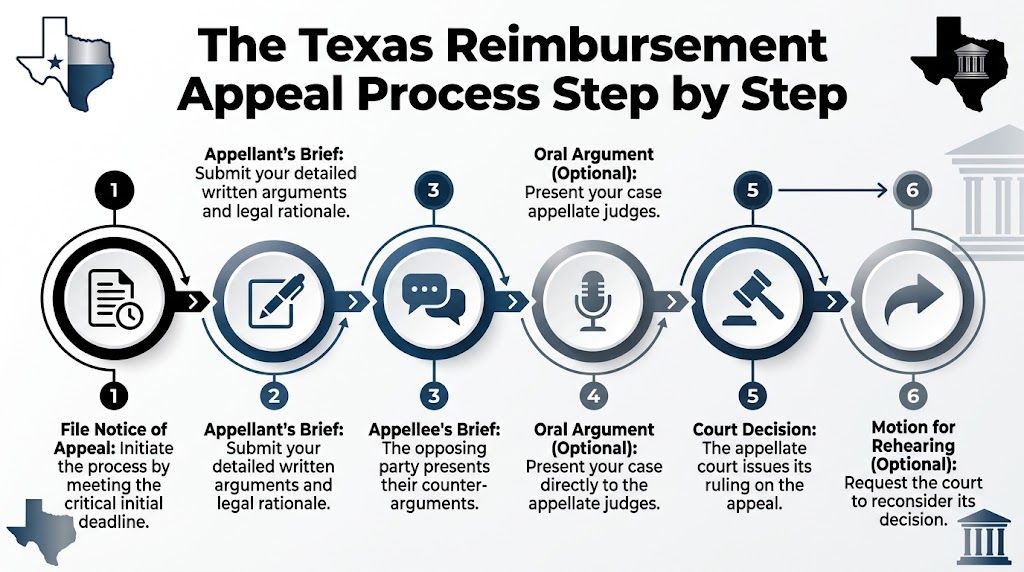
A visual overview helps:
Step one starts fast
The first major deadline is the Notice of Appeal. In a Texas divorce appeal, that usually must be filed within 30 days of the judgment. A practical summary of the process notes that success depends on a complete appellate record and a brief showing abuse of discretion, and that overall family law appeals succeed around 20% to 30% of the time, while missed deadlines and incomplete records are common reasons cases are dismissed or affirmed, as explained in this guide on appealing a divorce decree or judgment.
If that deadline is missed, the merits may never be reached.
The basic sequence
File the Notice of Appeal
This starts the appellate case. It tells the court and the other party that you’re seeking review.Request the appellate record
The reporter’s record and clerk’s record must be ordered. This step matters because reimbursement appeals rise or fall on the actual trial materials.Identify preserved issues
Counsel reviews the judgment, findings if any, exhibits, objections, and transcript to isolate legal error.Draft and file the appellant’s brief
This is the core written argument. It explains what the trial court did, what rule or statute governs, where the error appears in the record, and why the error requires reversal.Await the appellee’s brief
The opposing party responds. They will usually argue that the complaint wasn’t preserved, the evidence supports the ruling, or any mistake was harmless.Prepare for oral argument if granted
Not every case gets oral argument, but when it happens, the judges usually focus on weak spots, preserved objections, and the practical effect of the requested relief.Receive the opinion
The appellate court may affirm, reverse, modify, or remand.
A short video explanation can also help if you’re trying to picture the rhythm of the process:
Briefing is where the real work happens
Briefing means the formal written presentation of legal arguments to the appellate court. In reimbursement cases, the brief has to do more than say the ruling was unfair. It must cite the record precisely, identify the governing law, and explain why the trial court’s choice falls outside the zone of reasonable discretion.
That often requires a careful review of whether trial counsel preserved the issue properly. If you want to understand that concept better, this article on preserving error for appeal in Texas family court is a helpful starting point.
What the judges are looking for
Judges usually want clear answers to practical questions:
| Issue | What the appellate court wants to know |
|---|---|
| Legal standard | Did the brief identify the correct standard of review and governing statute? |
| Record support | Where exactly in the record does the claimed error appear? |
| Harm | Did the error matter to the property division, or was it minor? |
| Remedy | Should the court reverse outright, modify the decree, or send the case back? |
Common procedural mistakes
Some of the most damaging errors in reimbursement appeals have nothing to do with tracing law itself. They happen because the appellant mishandles procedure.
- Late notice: The appeal starts too late.
- Partial record without strategy: Important testimony or exhibits are omitted.
- Loose briefing: Arguments make broad fairness claims but don’t tie them to preserved legal error.
- No remedy analysis: The brief complains about the ruling but doesn’t explain what the appellate court should do next.
A strong appeal is disciplined. It respects deadlines, works from the record, and asks for a remedy the appellate court can actually grant.
Crafting a Winning Brief Common Arguments That Succeed
A reimbursement appeal is won on paper. Testimony is over. New exhibits don’t come in. The brief carries the case.

The brief has one job
A good appellate brief narrows the dispute. It doesn’t reargue every frustration from trial. It identifies the precise legal defect in the ruling and proves it through the record.
In reimbursement cases, that often means focusing on tracing, presumptions, burdens of proof, and the connection between the reimbursement ruling and the overall property division.
A real example of why tracing controls
In a 2022 Dallas divorce case, the appellate court completely reversed a $641,458.40 reimbursement award because the wife did not provide sufficient tracing evidence. The court applied the presumption that when separate and community funds are commingled in one account, community funds are withdrawn first, and her failure to overcome that presumption led to reversal, as discussed in this analysis of the Texas court reversing a $641,458.40 award.
That case is a strong lesson in how an appellate lawyer thinks. The winning argument was not, “This result feels too large.” The winning argument was, “The evidence did not satisfy the tracing burden required by Texas law.”
Arguments that often carry weight
A persuasive brief may build around one or more of these themes:
The claimant failed to trace funds clearly enough
If money moved through mixed accounts, the brief should walk the court through the gaps and explain why testimony alone could not fill them.The trial court applied the wrong presumption or ignored the right one
In commingling cases, presumptions matter. If the decree assumes separate funds were spent without the required tracing, that’s a legal vulnerability.The evidence showed cost, not enhancement
For improvement-based claims, the law may require proof of benefit or enhancement, not merely proof that money was spent.The reimbursement ruling skewed the whole property division
Because property division is interrelated, one reimbursement error can require a broader remand.
What strong briefing sounds like
Strong briefing is specific. It cites page numbers, exhibit numbers, and transcript lines. It avoids exaggeration. It doesn’t accuse the trial judge of bad faith. It demonstrates, calmly, that the decree cannot stand under the standard of review.
The most effective briefs usually sound restrained. They don’t overclaim. They show the court exactly where the legal error happened and why it mattered.
What weak briefing sounds like
Weak briefing usually has one of three problems:
| Weak approach | Why it fails |
|---|---|
| “The judge just got it wrong.” | Too general. It doesn’t identify legal error. |
| “I have better documents now.” | New evidence usually can’t be considered on appeal. |
| “The other side lied.” | Credibility complaints rarely succeed unless tied to a preserved legal issue. |
A seasoned appellate lawyer often spends more time cutting issues than adding them. In a reimbursement case, one clean issue grounded in the record is usually stronger than six scattered complaints.
Outcomes Costs and Why an Appellate Specialist Is Essential
You may leave the courtroom believing the reimbursement issue was only one line item in the decree, then learn on appeal that it may affect the entire property division. That is why appellate outcomes matter so much in these cases.
An appellate court may affirm the decree and leave the ruling in place. It may reverse the reimbursement ruling. It may also remand the case for further proceedings under the legal rules the trial court should have applied. In a divorce appeal, that last result often matters most because reimbursement findings can influence the overall just-and-right division of the marital estate.
Texas reimbursement law has changed. The Legislature revised the reimbursement statute effective September 1, 2023, and those revisions can affect which rules govern a pending or newly filed claim, as explained in this discussion of the new reimbursement law applying to pending cases.
That timing issue is not academic. On appeal, counsel has to identify which version of the statute controls, whether the trial court applied the correct framework, and whether any error likely changed the decree. A good argument is not merely that the ruling felt unfair. The argument has to show why the court used the wrong legal rule, misapplied the statute, or entered a division that cannot stand once the reimbursement error is corrected.
Cost also needs a clear-eyed review.
An appeal usually includes filing fees, clerk’s and reporter’s record charges, and attorney time for reviewing the record, researching the law, and preparing the briefs. The total varies with the length of the trial, the volume of exhibits, and the number of issues worth raising. In practice, the right question is whether the likely financial benefit or strategic value of the appeal justifies that investment.
That analysis is case-specific. A reimbursement error involving a modest amount may not justify a full appeal. A reimbursement ruling that shifted a large share of the property division often does. I tell clients to focus less on whether the trial felt wrong and more on whether the record shows a reversible error that could produce a materially better result.
That is where appellate specialization earns its keep.
Trial counsel and appellate counsel do different jobs. Trial lawyers develop testimony and exhibits in real time. Appellate lawyers work from a fixed record, preservation rules, standards of review, and written argument aimed at showing exactly why the decree should be reversed or sent back. In reimbursement appeals, that difference is especially important because the case is usually won or lost on legal framing, not on emotion.
The Law Office of Bryan Fagan, PLLC handles Texas family law appeals, including disputes involving divorce decrees, property division, support, custody, and related orders. For a reimbursement appeal, the value of experienced appellate counsel is usually straightforward. Spot the issue that gives the court a valid reason to act, cut the weaker points, and present a disciplined argument tied to the record and the standard of review.
Frequently Asked Questions About Reimbursement Appeals
Can I add new bank records or appraisals on appeal
Usually, no. Appeals are decided on the existing record. If a document was not admitted in the trial court, the appellate court generally won’t consider it. That’s why reimbursement appeals are so record-driven.
What if the judge said my tracing was not enough
That depends on why the judge ruled that way. If the court applied the wrong legal standard, ignored admitted evidence, or misunderstood the reimbursement framework, an appeal may be viable. If the record lacked the necessary proof, the appellate court usually won’t repair that problem for you.
Does a prenup or marital property agreement automatically waive reimbursement claims
Not automatically. A recent Houston appellate decision clarified that reimbursement rights are not released unless the agreement says so explicitly. The court rejected the idea that general equal-division language automatically waived those claims, and commentary on the decision notes that trial courts often err when reading vague waiver clauses, with about 25% of recent property appeal reversals involving waiver issues, as discussed in this article on reimbursement rights and marital property agreements.
What if my former spouse also appeals
That can happen. The other side may file a cross-appeal or raise alternative grounds to defend the judgment. When both sides appeal, the case becomes more complex because the appellate court may need to address multiple property issues together.
What does briefing mean
Briefing is the written legal argument filed in the appellate court. It includes the facts drawn from the record, the legal authorities that govern the case, and the argument for why the judgment should be changed or affirmed.
What does abuse of discretion mean again
It means the appellate court is asking whether the trial judge acted unreasonably, applied the wrong law, or ruled without sufficient support in the record. It is not a simple “who do we believe more” test.
How long does the process feel from the client side
It usually feels slower than trial and more document-heavy. There is less courtroom activity and more concentrated legal analysis. Clients often find the process easier to understand once they see the timeline, the record, and the specific issues being argued.
Should I talk to an appellate lawyer even if I’m unsure
Yes. Reimbursement appeals are highly technical, and early review matters because deadlines are short and issue preservation can be decisive. Even when an appeal is not the right path, a focused review can tell you why.
If you believe the court made a mistake in your family law case, our appellate attorneys can help you seek a fair outcome. Contact The Law Office of Bryan Fagan, PLLC today for a free consultation.