Receiving a court order that says your parental rights are terminated in Texas is a devastating blow. You may feel your case was handled unfairly, that the judge misunderstood the facts, or that a terrible legal mistake was made. It's a life-altering moment that can leave you feeling lost and convinced the system has failed your family.
Your Path Forward After an Unfair Termination Ruling

If you believe the court’s decision was unjust, it's critical to know that the trial court does not automatically get the last word. The Texas appellate system exists for this exact reason: to review and correct legal errors made by trial courts, especially in cases where the stakes are this high. This guide is for any parent who feels the court made a mistake and is seeking justice through the appeals process.
An appeal is not a second trial or a chance to present new evidence. Instead, it is a focused, technical review of the trial record to determine if the judge made a legal mistake that led to the wrong outcome. Our goal is to provide a clear, calm roadmap for this challenging journey and explain how a skilled appellate lawyer analyzes a case to find a path toward a fair result.
Understanding the Focus of an Appeal: How Appeals Differ from Trials
The nature of your case changes completely on appeal. The focus shifts away from your personal story and onto the legal rulings and procedures from the trial. An appellate court reviews the trial transcript, the admitted evidence, and the judge's final order to answer one key question: Was the law applied correctly?
This review is guided by strict legal standards. Winning an appeal depends on identifying a "reversible error."
- Reversible Error (Plain-English Definition): This is not just any minor mistake. It is a legal or procedural error so significant that it probably caused the court to reach the wrong outcome.
An appellate attorney will meticulously review the record for issues such as:
- Improperly Admitted Evidence: Was evidence used against you that should have been excluded under the Texas Rules of Evidence?
- Legally Insufficient Evidence: Did the other party truly meet the high standard of "clear and convincing evidence" required by the Texas Family Code?
- Procedural Errors: Did the court fail to follow any of the mandatory rules and procedures designed to protect your due process rights?
A termination of parental rights is often called the "death penalty" of family law because its consequences are permanent and severe. For this reason, Texas law demands strict compliance with legal procedures and a very high standard of proof. When those standards are not met, it creates an opportunity for a successful appeal.
Facing this process can feel overwhelming, but you do not have to do it alone. The first step is to understand your options and act quickly. If you believe the court made a mistake in your family law case, our appellate attorneys can help you seek a fair outcome. Contact The Law Office of Bryan Fagan today for a free consultation.
The Legal Standard for Terminating Parental Rights in Texas

To successfully challenge a termination order, you must first understand the strict legal framework the trial judge was required to follow. Texas law treats the permanent severance of the parent-child bond with the utmost seriousness. The law sets an incredibly high bar for any party seeking to terminate a parent's rights.
The court must follow a rigid two-step legal test. A judge cannot terminate your rights based on a personal opinion or a belief that another home might be "better." The party seeking termination must prove both parts of this test with clear and convincing evidence. This is a much higher burden of proof than the "preponderance of the evidence" standard used in most other family law cases, which simply means "more likely than not."
Part One: Proving a Statutory Ground
The first step requires proving that the parent’s conduct falls into at least one of the specific categories listed in the Texas Family Code § 161.001. This statute provides a list of over 20 grounds for termination. The court must find that one of these grounds exists before it can proceed.
The table below explains some of the most common grounds cited in termination cases. Identifying which ground was used in your case is the first step in building an effective appeal.
Common Statutory Grounds for Termination in Texas Family Code §161.001
| Statutory Ground | Plain-English Explanation |
|---|---|
| Endangerment | Knowingly placing the child in physical or emotional danger, either through your actions or by failing to protect them from a dangerous environment. |
| Abandonment | Intentionally leaving a child with someone else and showing no intent to return, while also failing to provide for the child's basic needs. |
| Failure to Comply with a Court Order | Not following the court-ordered service plan (e.g., classes, therapy, drug tests) designed to help you regain custody of your child. |
| Use of a Controlled Substance | Using illegal drugs in a way that endangers the child's health or safety. |
| Unfit Parent | Being unable to care for the child due to a mental or emotional illness or deficiency that makes it unsafe for the child to be in your care. |
If the evidence presented at trial was legally insufficient to prove the specific ground the court cited, that failure can become a powerful basis for your appeal.
Part Two: The Best Interest of the Child
Even if a statutory ground is proven, the court’s analysis is not over. The second, equally critical step is for the party to prove that terminating your parental rights is genuinely in the best interest of the child. This is a separate finding the judge must make, based on a distinct set of evidence.
To guide this decision, the Texas Supreme Court established a list of factors, known as the Holley factors, that trial courts must consider. These factors include the child's emotional and physical needs, the stability of the proposed home, and any parental acts or omissions that may indicate an improper parent-child relationship.
In Texas, a judge cannot terminate your rights just because they believe a foster home or another relative could provide a "better" life for your child. The law requires a direct link between the parent's specific conduct and harm to the child, and a finding that severance—not a lesser option like a monitored return—is the only way to serve the child's best interests.
This two-part standard is designed to be a strong shield for families. Despite these protections, the reality in Texas is stark. Texas terminates parental rights more than any other state. Since 2006, over 91,589 children in Texas have had their legal ties to their parents permanently severed. This is partly due to a common agency practice of seeking termination early in a case, sometimes before a parent has a fair opportunity to complete reunification services. You can learn more about the frequency of termination cases in Texas and review the data.
If you believe the court lacked the clear and convincing evidence required to satisfy both parts of this test when your parental rights were terminated in Texas, an appeal may be your only path to justice. Our experienced appellate team can analyze every page of your case record to identify where these strict legal standards may not have been met.
How an Appeal Is Different from a Trial
After a judge terminates your parental rights, it is natural to want a second chance to tell your side of the story. Many parents mistakenly assume an appeal is like a new trial where they can present new evidence or call different witnesses.
This is one of the most critical misunderstandings about the appellate process. An appeal is not a "do-over."
The appellate court is like a panel of referees reviewing game footage after the game is over. Their role is not to replay the game but to scrutinize the trial judge's decisions to see if a rule was broken that unfairly changed the outcome.
No New Evidence or Testimony Allowed
This is the single most important rule to understand: an appeal is confined to the trial record. The appellate court will not hear new testimony, review new documents, or consider any evidence that was not officially presented and admitted during the original trial.
Everything an appellate attorney uses to build your case already exists in the record, which consists of two parts:
- The Reporter's Record: The official, word-for-word transcript of everything said in court.
- The Clerk's Record: A compilation of all documents filed in your case, including motions, pleadings, and exhibits admitted into evidence.
An appellate lawyer's task is to meticulously analyze this existing record to find legal errors. The argument is no longer about the facts but about whether the law was applied correctly to those facts.
The Focus Is on Legal Error, Not Factual Disagreements
In a trial, the central question is, "What happened?" The judge or jury resolves factual disputes.
On appeal, the question changes to, "Did the trial judge make a legal mistake?" Appellate judges give significant deference to the trial judge's assessment of witness credibility because they were not present in the courtroom to observe testimony firsthand. Their focus is entirely on identifying a reversible error.
A reversible error is a legal or procedural mistake so serious it likely caused the court to reach the wrong conclusion. Proving such an error is the only way to overturn a termination order.
This requires shifting from an emotional appeal for fairness to a precise, technical legal analysis of the trial court proceedings.
Understanding the Standard of Review
Appellate courts do not simply decide if they would have reached the same conclusion. They review the case through a specific legal lens called the standard of review, which determines how much deference they must give to the trial court's decisions.
In parental rights cases, a key standard is abuse of discretion.
- Abuse of Discretion (Plain-English Definition): This occurs when a trial judge makes a decision that is arbitrary, unreasonable, or without reference to any guiding legal rules or principles.
For example, if a judge ignored a mandatory step required by the Texas Family Code or based the termination on legally insufficient evidence, that could constitute an abuse of discretion. Another critical standard involves reviewing the evidence to determine if it was legally sufficient to meet the high “clear and convincing” standard required before parental rights are terminated in Texas. If the evidence was too weak to meet this standard, the termination cannot stand.
Because an appeal is technical and based entirely on the existing record, your success depends on having an attorney who specializes in this unique field. They must have the skill to dissect a cold record, identify subtle legal errors, and write a persuasive legal argument—known as briefing—that convinces a panel of appellate judges that a profound legal error occurred.
Identifying Reversible Errors in a Termination Case
If you are appealing after your parental rights were terminated, the entire case hinges on finding a specific kind of mistake from your trial—a reversible error. The appellate court will not rehear your story or reconsider whether you are a good parent.
Think of your appellate attorney as a legal investigator, analyzing every document, line of testimony, and ruling from your case. We are not looking for sympathy; we are looking for legal flaws. Did the court follow the letter of the law? Was the evidence legally sufficient to meet the high standard of proof? A successful appeal demonstrates that the outcome was not just unfair, but legally incorrect.
Was the Evidence Legally Sufficient?
One of the most common and powerful arguments on appeal is that the other side failed to meet its burden of proof. In Texas, terminating parental rights requires legally sufficient evidence, which is an extremely high bar.
The petitioner had to prove two things with clear and convincing evidence: at least one of the statutory grounds in the Texas Family Code and that termination was in the child's best interest.
Clear and convincing evidence means the proof must be strong enough to produce in the mind of the judge a "firm belief or conviction" that the allegations are true. This is a much higher burden than the "more likely than not" standard in most civil cases.
If the case against you was built on weak evidence—such as speculation, past mistakes unrelated to current fitness, or isolated incidents that do not show a pattern of endangerment—an appellate court can review the record and conclude that the evidence was legally insufficient. For example, if the only evidence of endangerment was a single argument, we can argue that no reasonable judge could have formed a "firm belief" based on such thin proof.
Errors in Admitting or Excluding Evidence
The Texas Rules of Evidence are the guardrails of a fair trial. When a judge makes a mistake by allowing improper evidence in—or by keeping critical evidence out—it can corrupt the entire case and become a prime basis for an appeal.
Common examples of a reversible error include the judge allowing harmful, improper evidence to be used against you, such as:
- Hearsay: Testimony about what someone else said outside of court.
- Irrelevant History: Bringing up old issues that are not relevant to your current fitness as a parent.
- Unfairly Prejudicial Information: Evidence presented simply to cast you in a bad light rather than to prove a relevant fact.
Equally damaging is when a judge wrongfully excludes evidence that was essential to your defense. If you were prevented from introducing documents or witness testimony that would have supported your side of the story, you did not have a fair trial. An appellate court can determine that the judge made a decision without a complete picture, leading to a flawed outcome.
Procedural and Due Process Violations
The Texas Family Code and the Texas Rules of Appellate Procedure contain strict, mandatory rules designed to protect a parent's constitutional right to raise their child. When a court fails to follow these rules, it is a serious violation and a strong foundation for an appeal.
Due process is a constitutional guarantee that the government must respect all of your legal rights. In a termination case, this includes your right to proper notice, your right to be heard in court, and your right to a decision based on the correct application of the law. A denial of these rights is a significant legal error.
Common procedural mistakes include:
- Improper Notice: Failing to properly notify you of the lawsuit or court dates, which prevents you from defending yourself.
- Ignoring Statutory Deadlines: The law sets strict timelines for termination cases. A court’s failure to adhere to them can be a fatal flaw.
- Misapplying the Law: The judge making an error in legal interpretation, such as misunderstanding the Holley factors for determining a child's best interest.
Sometimes the error is subtle, revealed in a comment from the judge in the trial transcript that shows a misunderstanding of the law, particularly in complex cases involving allegations of parental alienation in Texas. A trained appellate lawyer knows how to identify these procedural missteps and demonstrate to the appellate court how they led to a wrongful termination.
Navigating the Strict Deadlines of a Termination Appeal
When a judge signs an order terminating your parental rights, a clock starts ticking that cannot be ignored. The path to an appeal exists, but the window to act is extremely narrow. Unlike other civil cases, Texas law places appeals for parental rights termination on an accelerated timeline, demanding immediate and decisive action.
This accelerated process is intended to promote a child's need for permanence and stability. However, it places immense pressure on parents who believe a profound legal error was made in their case. Missing a deadline, even by one day, can permanently close the door to challenging the ruling, regardless of the strength of your legal arguments. This is why the very first step after a termination order is to consult an experienced appellate attorney.
The Countdown Begins Immediately
The moment the judge signs the final order, the legal clock is running. The appellate process is governed by rigid, unforgiving deadlines.
Your first and most critical deadline is for filing the Notice of Appeal. This is the formal document that notifies the court system of your intent to challenge the judge’s decision. In a termination case, you have only 20 days from the date the order was signed to file this document. This tight timeframe leaves no room for delay.
The 20-day deadline to file a Notice of Appeal is one of the strictest rules in Texas law. If this deadline is missed, your right to appeal is almost certainly lost forever. Immediate consultation with an appellate lawyer is essential to preserve your legal options.
Mapping the Accelerated Appellate Process
Filing the Notice of Appeal is just the beginning. From that point forward, every step is on a compressed schedule. An appellate attorney must work with speed and precision to build your case while meeting these deadlines.
Here is a brief overview of the key stages:
- Requesting the Court Record: Your attorney will immediately order the official record from your trial, which includes the reporter's record (the word-for-word transcript) and the clerk's record (all filed documents and evidence).
- Record Preparation and Filing: The court reporter and clerk must also work quickly, as they are required to prepare and file these records with the appellate court on an accelerated timeline.
- Briefing the Case: This is the core of the appeal. Your attorney will conduct in-depth legal research and write a detailed legal argument called an appellate brief. This document is the heart of your appeal, meticulously outlining the legal errors from your trial and explaining why the judge's decision should be overturned. The deadline to file this brief is much shorter than in other appeals. You can learn more about the critical role of what is an appellate brief in our guide.
- Oral Argument: In some cases, the court of appeals may schedule an oral argument. This is a formal hearing where attorneys present their arguments to a panel of appellate judges and answer their questions.
The image below illustrates the core areas an appellate lawyer scrutinizes when searching for reversible errors in a termination order.
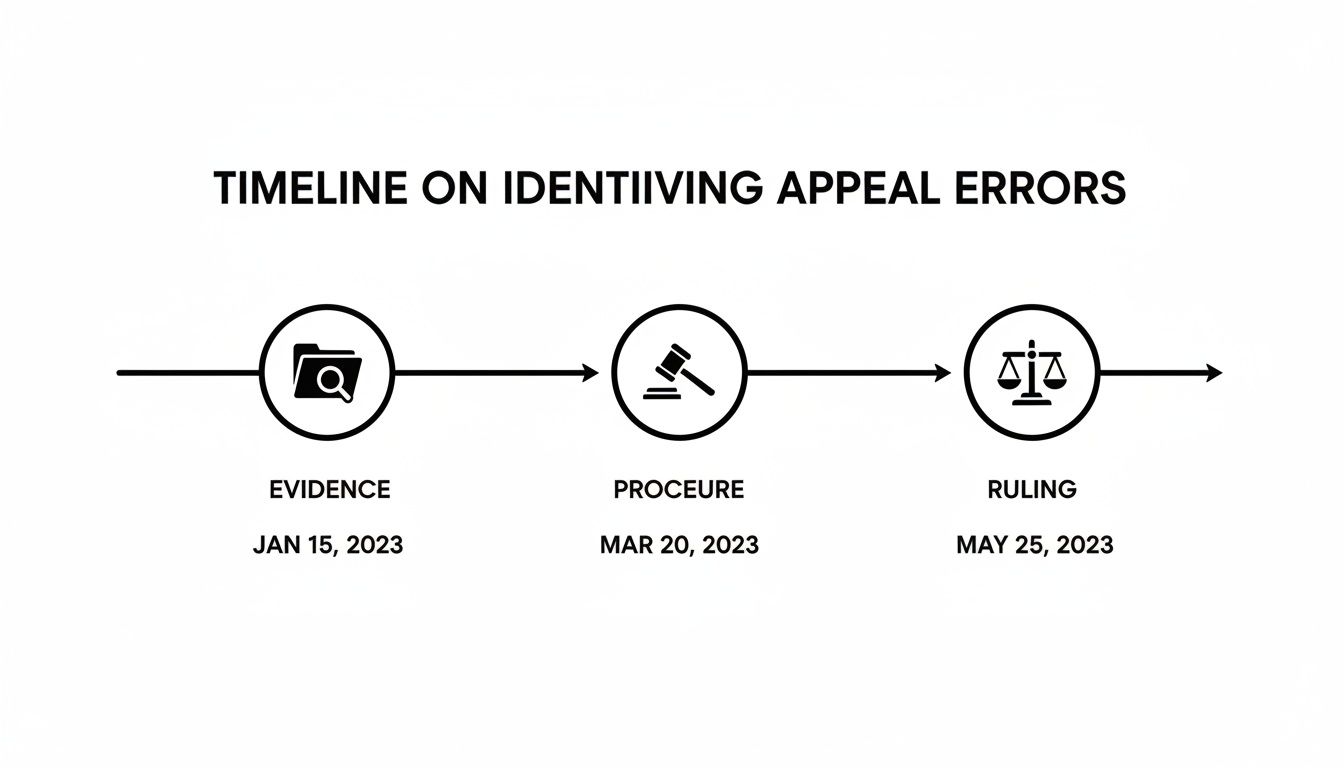
This process highlights how an appeal is not a retrial of facts but a search for flaws in how the trial court handled evidence, followed legal procedures, and applied the law. If a serious legal error occurred in your case, the strict appellate deadlines provide your only opportunity to have it corrected.
Common Questions After a Termination of Parental Rights Case
After a judge terminates your parental rights, it is normal to feel overwhelmed and have urgent questions about what happens next. The appeals process is complex, with strict deadlines and intricate rules where there is no room for error.
Here are plain-English answers to some of the most common questions.
How Long Do I Have to File an Appeal?
You must act immediately. In Texas, you generally have only 20 days from the date the judge signs the final termination order to file your Notice of Appeal.
This is a strict and unforgiving deadline. If you miss it, you will almost certainly lose your right to challenge the court's decision forever. This is one of the tightest timelines in the legal system, which is why it is critical to contact an appellate attorney as soon as possible. The clock starts ticking the moment the order is signed.
Can We Bring in New Evidence or Witnesses on Appeal?
No. This is a common misconception. An appeal is not a new trial.
The appellate court acts as a review panel, examining the record of the game that has already been played. It cannot add new players to the field. Its function is to review the existing trial record—which includes the transcripts of all testimony and all admitted evidence—to determine if the trial judge made a critical legal error.
An appellate lawyer does not present new facts. Instead, they meticulously analyze the closed record to identify errors in legal procedure, evidence rulings, or the application of the law.
The appeal is won or lost based on what has already happened. The appellate court is not there to find new facts; it is there to find legal errors that led to an unjust outcome.
What Are My Realistic Chances of Winning?
Winning a termination appeal is challenging. Appellate courts give significant deference to the trial judge’s decisions, as the judge was present to observe witnesses and hear testimony firsthand.
However, a successful appeal is achievable. The key is to identify a "reversible error." A reversible error is a legal mistake so significant that it likely caused the wrong result. This could range from the judge misinterpreting a key provision of the Texas Family Code to admitting improper evidence or making a decision without legally sufficient proof. A skilled appellate attorney can analyze your case to determine if such an error exists and provide you with a realistic assessment of your chances.
What Happens If We Win the Appeal?
Winning an appeal does not mean you automatically regain custody of your children that day. Typically, the appellate court will "reverse and remand" the case.
- Reverse: This means the court of appeals formally vacates the trial court’s termination order.
- Remand: This sends the case back down to the same trial court for new proceedings.
In essence, winning an appeal gives you a second chance. It resets the legal process, requiring the trial court to address the case again, this time in accordance with the appellate court's instructions and correcting the legal error that led to the appeal. It is a critical step that marks the beginning of a new chapter in your fight for justice.
If you believe the court made a mistake in your family law case, our appellate attorneys can help you seek a fair outcome. Contact The Law Office of Bryan Fagan today for a free consultation at https://familylawcourtappeals.com.