If you have just received a final child custody order and feel the court’s decision was fundamentally unfair, you may be feeling overwhelmed and uncertain about the future. It is a difficult position to be in, especially when you believe the outcome does not protect your child’s best interests or your parental rights. In Texas, what most people refer to as "shared custody" is legally known as a Joint Managing Conservatorship. This is the standard starting point for courts, as the law presumes that both parents should share in the major decisions for their child.
However, a Joint Managing Conservatorship does not automatically mean a 50/50 split of parenting time. This distinction is often a source of conflict and can be a critical issue in an appeal. If you believe the trial court misapplied the law or ignored key evidence, the appeals process is the designated path to seek a fair and just outcome.
Understanding the Foundation of Texas Custody Orders and Appeals

When you are facing a custody dispute, the legal terminology can feel confusing. You may feel the court’s decision was unjust or that the final order fails to reflect your family's reality. Understanding the core legal principles is the first step toward determining if an appeal is the right path forward. An appeal is not a retrial; it is a meticulous review of the trial court’s record to find significant legal mistakes, known as reversible errors.
At the heart of every custody decision is one guiding principle: the best interest of the child. This is the legal standard a judge must use for every ruling, from assigning parental rights to creating the physical possession schedule. A judge’s failure to properly apply this standard can be a powerful basis for an appeal.
The Presumption of Joint Managing Conservatorship
Texas law begins with the presumption that naming both parents "Joint Managing Conservators" is what’s best for the child. This means you and the other parent are granted shared legal authority for major decisions.
This shared authority typically covers critical areas like:
- Education: Deciding where your child goes to school.
- Healthcare: Making choices about non-emergency medical, dental, and psychological care.
- General Welfare: Consenting to major life events like marriage or enlistment.
Even in this arrangement, the court will almost always name one parent as the "primary" conservator, who has the exclusive right to determine the child's residence and receive child support. If you believe this designation was made unfairly or without proper legal basis, it may constitute a reversible error.
How Appeals Differ from Trials
It is crucial to understand that an appeal is fundamentally different from a trial. A trial is about presenting evidence and testimony to establish the facts. An appeal, however, focuses on questions of law. The appellate court reviews the existing trial record—transcripts, evidence, and rulings—to determine if the judge made a legal error.
This review is guided by a legal standard called “abuse of discretion.”
Abuse of Discretion (Plain English Definition): This legal term means the trial judge’s decision was unreasonable, arbitrary, or made without regard for the guiding rules and principles of the law. It doesn't mean the judge was malicious; it means the ruling was not supported by the evidence or the law.
The difference between shared legal rights and the actual time a child spends with each parent is where many legal errors occur. While the law defaults to shared decision-making, it does not mandate a 50/50 possession schedule. Our detailed guide on joint custody in Texas dives deeper into these concepts.
If you feel the trial court misapplied these principles and created an unfair outcome, you might have strong grounds for an appeal. A judge’s failure to properly apply the "best interest" standard is a serious error that an appellate court is designed to correct, ensuring the law is applied fairly.
Rights vs. Schedules: What You Can Appeal in a Texas Custody Case
It's easy to get tangled in the legal jargon of a Texas custody case, but one of the most important things to understand is the difference between your rights as a parent and your possession schedule. They are not the same thing, and understanding how they work separately is the first step in determining if your custody order is truly fair—and if it contains reversible errors worth challenging on appeal.
Many parents feel the judge got it wrong because these two critical pieces were not balanced correctly according to the law and evidence. This feeling can be the first sign of a legal error that could form the basis of a successful appeal. Joint Managing Conservatorship is your legal status—it gives you a shared say in the big decisions. The Possession Order is the day-to-day calendar dictating who has the child and when.
Comparing Conservatorship Rights and Possession Schedules
The table below illustrates how your legal authority as a conservator is a separate issue from the physical time you are granted in a possession order. An error in either area can be grounds for an appeal.
| Aspect | Joint Managing Conservatorship (Legal Rights) | Possession Order (Physical Time) |
|---|---|---|
| What It Is | Your legal authority to make major decisions for your child. | The calendar that dictates when your child is physically in your care. |
| Focus | Long-term welfare and upbringing (health, education, legal matters). | Daily, weekly, and holiday schedules. |
| Example | The right to consent to a medical procedure or choose a school. | Having your child on the first, third, and fifth weekends of the month. |
| Common Setup | Most parents are named Joint Managing Conservators. | Schedules vary widely, from a Standard Possession Order to a 50/50 split. |
Understanding this distinction is crucial for an appeal. A judge might grant both parents equal rights on paper but then create a possession schedule that heavily favors one parent without a sound legal basis in the record, which can be challenged as an abuse of discretion.
Conservatorship: Appealing Errors in Parental Authority
When a Texas court names you a Joint Managing Conservator, it affirms your role in raising your child. This comes with a bundle of rights and duties outlined in the Texas Family Code.
These rights typically include the power to:
- Make Medical Decisions: Consent to your child's non-emergency medical care.
- Guide Education: Make decisions about your child’s schooling and access their records.
- Represent Legally: Act as your child’s legal representative.
- Stay Informed: Access information from the other parent about your child's welfare.
A common reversible error occurs when a trial court strips a parent of these standard rights without sufficient evidence to justify such a drastic measure. An appellate court will review the record to see if the judge’s decision constituted an abuse of discretion—meaning it was an unreasonable ruling not supported by the facts or law. If you believe the judge unfairly designated the "primary" parent or stripped you of your rights, an appeal is the proper channel to seek a fair review of that decision.
The Possession Order: Correcting Unfair Parenting Schedules
While conservatorship is about legal authority, the possession order details your physical time with your child. It is very common for two Joint Managing Conservators to have vastly different amounts of parenting time. The default schedule in Texas is the Standard Possession Order (SPO), which is legally presumed to be in the child's best interest.
If a judge ordered a schedule that drastically and unfairly limits your time, or if they deviated from the standard order without a clear, evidence-based reason documented in the record, you may have a reversible error. An appeal is not a chance to relitigate facts, but it is an opportunity for a higher court to identify and correct legal mistakes. For many parents, correcting an unjust possession schedule is a primary objective when filing a child custody appeal.
How Judges Make Custody Decisions in Texas
When parents cannot agree, a judge must make the decision for them. This ruling is not based on personal preference but is legally required to follow the “best interest of the child” standard, guided by a list of considerations known as the “Holley Factors.”
If you have an order that feels wrong, demonstrating that the judge misapplied or ignored these factors is often the foundation of a successful child custody appeal. An appeal focuses on whether the judge followed these legal rules when making their decision.
This infographic helps illustrate the two major components of a custody order: legal rights and the parenting time schedule.
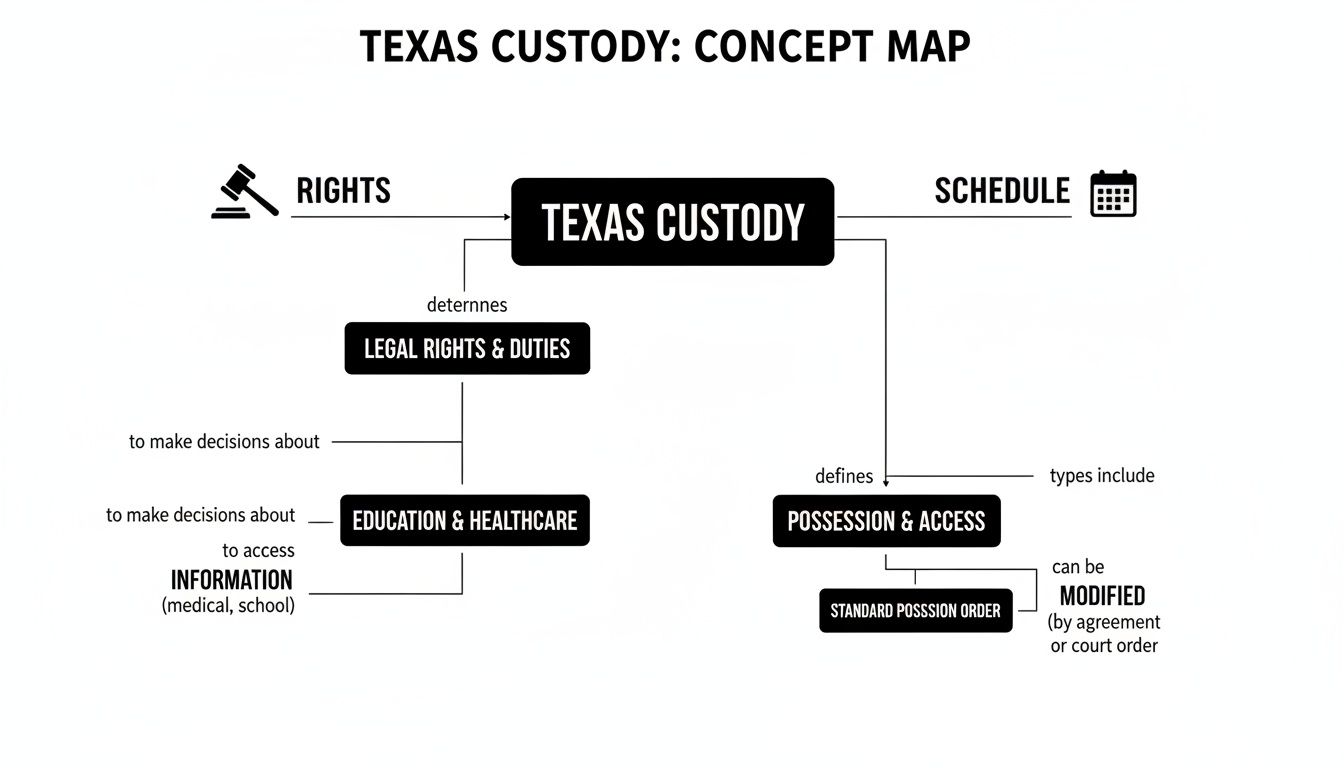
As you can see, the court separates the power to make decisions (Rights) from the calendar dictating possession (Schedule). A legal error in either part can be challenged on appeal.
Understanding the Standard of Review and the Holley Factors
The "Holley Factors" provide a framework for judges to analyze what serves a child's well-being. A judge must consider the complete picture presented by the evidence. An appellate court will review the record to ensure the decision was properly grounded in these factors.
Key factors include:
- The Child's Needs: The child's emotional, physical, and developmental needs.
- Parental Abilities: Each parent's capacity to provide a stable, loving home.
- Stability of the Home: The environment that offers the most stability.
- The Child's Wishes: For children 12 or older, a judge can interview them to hear their preference.
In a contested case, judges must rely on evidence from formal legal discovery, such as documents, witness testimony, and depositions. understanding the deposition process is crucial as this sworn testimony becomes part of the record an appellate court reviews.
Common Reversible Errors in Texas Family Courts
While trial courts have broad discretion, they must follow the law. Certain issues are "red flags" that can lead to a decision being overturned on appeal.
A powerful legal argument in an appeal is “abuse of discretion.” This means the judge’s decision was so unreasonable that it went against guiding legal rules, like the Holley Factors. For example, ignoring credible evidence of family violence and failing to make the required findings in the order would be a textbook abuse of discretion and a clear reversible error.
Behaviors that can lead to reversible errors if not properly considered by the court include:
- Any history of family violence, child abuse, or neglect.
- Current or past struggles with substance or alcohol abuse.
- Actions that create instability, such as parental alienation.
- Any behavior that puts the child in physical or emotional danger.
If you believe the trial court made a decision that was not grounded in the facts—especially if it ignored critical evidence related to these issues—you may have strong grounds for an appeal. The appellate process exists to review the trial record for these kinds of reversible errors and ensure the law was applied correctly.
Navigating Common Texas Custody Schedules

Many parents enter a custody case hoping for an even 50/50 split, but this is not the automatic standard for shared custody in Texas. The law begins with a default framework called the Standard Possession Order (SPO), which is legally presumed to be in a child’s best interest.
Understanding this legal starting point is crucial, especially when evaluating a final order for an appeal. A judge is required to order the SPO unless there is clear evidence showing it would not be in the child's best interest. If a judge deviates from this standard without a solid, evidence-backed reason, it may constitute a reversible error—a legal mistake significant enough to be corrected by an appellate court.
The Standard Possession Order (SPO)
The Standard Possession Order is the default possession schedule in Texas when parents live within 100 miles of each other. It is designed to provide a predictable routine and ensure both parents remain involved.
The SPO typically gives the non-primary parent possession on:
- The first, third, and fifth weekends of a month.
- Alternating major holidays like Thanksgiving and Christmas.
- A 30-day period during the summer.
This schedule is detailed, but the time division is closer to a 70/30 split rather than an equal one.
The Expanded Standard Possession Order (ESPO)
Texas law also provides for the Expanded Standard Possession Order (ESPO). A judge must order this expanded version unless evidence shows it is not in the child’s best interest.
Key differences in the ESPO include:
- Earlier Weekend Pickups: The parent picks the child up from school on the Thursday before their scheduled weekend.
- Later Weekend Drop-offs: The parent brings the child back to school on Monday morning.
These adjustments can shift possession time closer to a 60/40 or 55/45 split. A trial court’s decision to not order the ESPO without a compelling reason documented in the trial record can be a key issue in an appeal.
A critical part of any appeal is ensuring the trial court followed the law. If the evidence supported an Expanded Standard Possession Order, but the judge did not grant it—and failed to provide a clear, justifiable reason on the record—that decision may represent an abuse of discretion. Appellate attorneys are skilled at identifying these errors and arguing them persuasively to a higher court.
Achieving a 50/50 Schedule
A true 50/50 schedule is possible in Texas and is becoming more common, especially when parents can co-parent effectively and live near each other.
Popular 50/50 schedules include:
- Week-On/Week-Off: Each parent has the child for a full seven days at a time.
- 2-2-5-5 Schedule: Parents alternate weekends, with one parent always having Monday/Tuesday and the other having Wednesday/Thursday.
While courts favor joint legal decision-making, equal physical possession is less common. Studies show that Texas fathers receive, on average, about 33% of parenting time. You can discover more insights about Texas custody statistics to see how these schedules play out.
A court is not required to order a 50/50 schedule. Every decision must be based on the child’s best interest as supported by the evidence. If you feel the court wrongly denied a workable 50/50 plan and that the decision was not supported by the evidence, our appellate attorneys can help.
How to Appeal an Unfair Custody Decision
When a judge issues a final custody order that you believe is fundamentally wrong, an appeal is your legal path forward. It is a gut-wrenching feeling when an order fails to protect your child or unfairly limits your parental rights. That feeling is often the first signal that a serious legal error might have occurred.
An appeal is not a do-over or a second trial. You cannot introduce new evidence. Instead, an appeal is a highly technical review of the trial court record. The goal is to pinpoint a critical legal mistake the judge made that led to an unjust outcome.
Understanding the Standard of Review
An appellate court is bound by a specific legal standard called the standard of review. For most family law matters in Texas, that standard is “abuse of discretion.”
Abuse of Discretion: This is a legal finding that a trial judge's decision was unreasonable, arbitrary, or made without regard for guiding legal rules and principles. In plain English, the judge’s ruling was not supported by the law or the evidence presented at trial.
For example, if a judge ignored the Holley Factors or based a decision on personal bias instead of the testimony and exhibits, an appellate court could find that to be an abuse of discretion. This is often the cornerstone of a successful custody appeal.
What is a Reversible Error?
Not every mistake a judge makes is enough to overturn a decision. To succeed, you must prove a reversible error—a mistake so significant that it likely caused the court to issue an improper judgment.
Common reversible errors in Texas custody cases include:
- Misapplication of the Law: The judge incorrectly interpreted a statute from the Texas Family Code.
- Improperly Excluding or Admitting Evidence: The court wrongfully refused to consider crucial evidence or considered evidence it should have excluded.
- Critical Procedural Mistakes: The court failed to follow the mandatory Texas Rules of Appellate Procedure or Texas Rules of Civil Procedure, harming a parent's ability to present their case fairly.
Identifying these errors requires an appellate attorney who can meticulously review every page of the trial record. This is why appellate advocacy is a specialized and highly technical field of law.
The Appellate Process Step-by-Step
Challenging a custody order is time-sensitive and governed by strict deadlines under the Texas Rules of Appellate Procedure. Missing a deadline can result in losing your right to appeal.
- File the Notice of Appeal: This formal document must be filed with the trial court clerk, typically within 30 days from the date the final judgment was signed. This is a critical deadline.
- Order the Record: Your attorney will order the official Clerk’s Record (all documents filed) and the Reporter’s Record (the word-for-word transcript of the trial). This is the evidence the appellate court will review.
- Briefing: Your appellate attorney will draft a persuasive legal argument called an appellate brief. This document tells the story of your case, identifies the judge's reversible errors, and uses statutes and case law to argue why the trial court’s decision should be reversed.
Successfully handling an appeal requires deep knowledge of both family law and appellate procedure. If you are also weighing options to revisit an order later, our guide on how to change a custody agreement in Texas can offer additional perspective.
If you believe the court made a mistake in your family law case, our appellate attorneys can help you seek a fair outcome. Contact The Law Office of Bryan Fagan today for a free consultation.
Your Texas Custody Questions, Answered
After a judge’s ruling, many parents are left with a new set of questions. What do these legal terms mean for my family? What are my rights? And what if I am convinced the judge made a legal error?
Here, we provide plain-English answers to common questions from parents who are making sense of a custody order and considering an appeal.
Does "Shared Custody" Actually Mean 50/50 Time?
No. In Texas, the court will likely name parents Joint Managing Conservators, which is about sharing rights and responsibilities, not a 50/50 calendar. The actual schedule is in the Possession Order, and the default schedule, the Standard Possession Order, is not a 50/50 arrangement. An unfair possession schedule that is not supported by the evidence can be challenged on appeal.
Can We Change the Custody Order Later On?
Yes, but it is not simple. To modify an order, you must prove a “material and substantial change” in circumstances has occurred since the last order was signed, and that the modification is in the “best interest of the child.” This is a separate legal action from an appeal, which challenges the correctness of the original order.
What Does "Abuse of Discretion" Mean in a Custody Appeal?
Abuse of Discretion is the legal standard appellate courts use to review a trial judge's decision. It means the decision was unreasonable, arbitrary, or made without regard for legal rules. For example, a judge ignoring clear evidence or misapplying the Texas Family Code could be an abuse of discretion. Proving it is the key to most successful custody appeals.
What’s the Real Difference Between a Trial and an Appeal?
They are two different legal processes.
- A Trial is for presenting facts and evidence for the first time to get a decision.
- An Appeal is a review of the trial court’s record to find significant legal mistakes, or “reversible errors,” made by the judge. No new evidence is allowed. The focus shifts from arguing facts to arguing the law.
How Long Do I Have to File an Appeal?
The deadlines are extremely strict. In most custody cases, you must file a Notice of Appeal with the court clerk within 30 days from the date the judge signed the final order. If you miss this deadline, you will likely lose your right to appeal. It is critical to contact an appellate attorney immediately after receiving a ruling you believe is unjust.
If you believe the court made a mistake in your family law case, our appellate attorneys can help you seek a fair outcome. Contact The Law Office of Bryan Fagan today for a free consultation about your legal options.