Receiving a final decree of divorce in Texas should bring closure, but for many, it can feel like the beginning of a new injustice. This document, signed by a judge, is the court's final order legally ending your marriage and dictating the terms of your future. It controls everything from your property to your relationship with your children.
You may feel your case was handled unfairly or that the judge’s decision was fundamentally wrong. While a final decree marks the end of the trial process, it isn't always the last word, especially when a serious legal error has led to an unjust outcome. The Texas appeals process exists to correct these mistakes and restore fairness.
Understanding the Final Decree of Divorce and Your Right to Appeal
Holding the final decree can be a difficult moment. While there may be relief that the process is over, that relief is often overshadowed by profound disappointment if the rulings on critical issues like child custody or property division feel unjust. It is natural to ask, "Is this truly the end? Do I have to accept a decision that seems so wrong?"
The most important thing to remember is that while a final decree is a binding court order, it must be based on a correct application of Texas law. Judges are human, and they can make mistakes. This document is governed by the Texas Family Code, and if the court committed a significant legal error in its final judgment, the Texas appellate system provides a clear path to seek a just result.
What the Decree Actually Does
The Final Decree of Divorce serves as the official rulebook for your post-divorce life. It is not just a summary; it's a binding order with significant legal power.
- It Legally Ends the Marriage: This is the document that officially dissolves your marital status. Once signed, Texas law requires a 30-day waiting period before either party can legally remarry.
- It Defines Rights and Duties: The decree specifies, in detail, the responsibilities of each party regarding children, finances, and property. There should be no ambiguity.
- It Is an Enforcement Tool: If your ex-spouse fails to comply with the decree—for instance, by not paying child support or failing to turn over property—this document is the legal instrument used to seek enforcement from the court.
Final Does Not Always Mean Flawless
The legal system values finality, as it provides closure and allows individuals to move forward. However, this principle has limits, especially when a serious legal mistake—a reversible error—has compromised the outcome. The purpose of the appellate process is to examine a trial court’s decisions for these specific types of errors.
An appeal is not a retrial. You cannot present new evidence or argue the entire case again. Instead, it is a focused review of the existing trial record to determine if the judge made a legal or procedural error that resulted in an improper judgment. Understanding this distinction is fundamental to a successful appellate strategy.
If you believe the judge misapplied the law, improperly excluded evidence, or made a ruling that constitutes an abuse of discretion, you may have strong grounds to challenge the decree. However, you must act quickly. The timeline for filing an appeal begins the moment the judge signs the final decree, and the window to preserve your rights is extremely short.
What's Actually Inside Your Divorce Decree?
Your final decree of divorce is a detailed legal document that outlines the rules for your post-marriage life. Familiarizing yourself with every provision is critical, especially if you question the fairness of the judge's decisions. Often, the very grounds for an appeal are found within the specific language of these sections.
The decree is designed to resolve every aspect of the life you shared, transforming joint responsibilities and assets into separate, legally binding orders. A thorough review can uncover potential errors that may form the basis of a legal challenge.
Splitting Up Your Marital Property
In Texas, all property acquired during the marriage is presumed to be community property. The law mandates that a judge divide this property in a "just and right" manner. "Just and right" does not automatically mean a 50/50 split. A judge may award a disproportionate share to one spouse based on factors such as fault in the divorce or significant disparities in earning capacity.
One of the most common reversible errors involves the mischaracterization of property. For example, if you owned a business before marriage, it is your separate property. While any increase in its value during the marriage might have a community component, the original asset belongs to you alone. If a court incorrectly classifies your separate property as community property and divides it, this is a classic example of an abuse of discretion and strong grounds for an appeal. Pre-marital agreements, such as those detailed in understanding prenuptial agreements, can also significantly alter how assets are treated.
Orders for Child Custody and Visitation
For parents, the divorce decree must include a comprehensive parenting plan that details the co-parenting relationship.
It will always specify:
- Conservatorship: Texas law's term for legal custody. It defines which parent has the right to make major decisions about the child's life, such as education, medical care, and religious upbringing.
- Possession and Access: This is the visitation schedule, which maps out when the child will be with each parent, including regular weeks, holidays, and summer vacations.
- Geographic Restriction: The decree typically establishes a boundary, often a specific county and its contiguous counties, within which the primary parent must reside with the child.
Every decision a judge makes must be in the best interest of the child. If a judge imposes an unworkable visitation schedule or one that is clearly not beneficial for the child without solid evidence in the court record to support it, that decision may be a reversible error. An appeal in such cases is not just about parental rights; it is about protecting the child's stability.
Child Support and Spousal Maintenance
Financial orders are another critical component of the decree. In Texas, child support is typically calculated using a formula based on the paying parent's net monthly resources. A judge can deviate from this formula but must state the specific, legally sound reasons for doing so in the decree. Ordering support that significantly departs from state guidelines without a valid explanation is a common ground for appeal.
Spousal maintenance, often called alimony, is more difficult to obtain in Texas and is generally awarded only in specific circumstances, such as a marriage lasting over 10 years or cases involving family violence. If a judge awards or denies spousal maintenance without strictly adhering to the statutory requirements, that decision can be challenged.
The Path to a Finalized Divorce in Texas
If you are looking at a divorce decree and feel the outcome was unjust, understanding the process that led to it is the first step toward determining your next move. The journey from filing the initial petition to receiving a judge's signature is a structured legal process.
Every divorce in Texas begins when one spouse files an Original Petition for Divorce. This filing initiates the case and starts a mandatory countdown.
The 60-Day Waiting Period
Texas law imposes a minimum 60-day waiting period starting the day the petition is filed. A judge cannot finalize a divorce until this period has passed. This is often referred to as a "cooling-off" period.
The purpose is to provide both parties time to process the situation, gather financial documents, and potentially reconcile without the pressure of an immediate final decision. While rare exceptions exist for cases involving family violence, this 60-day timeline is mandatory for nearly all divorces.
This timeline provides a high-level view of the basic process.
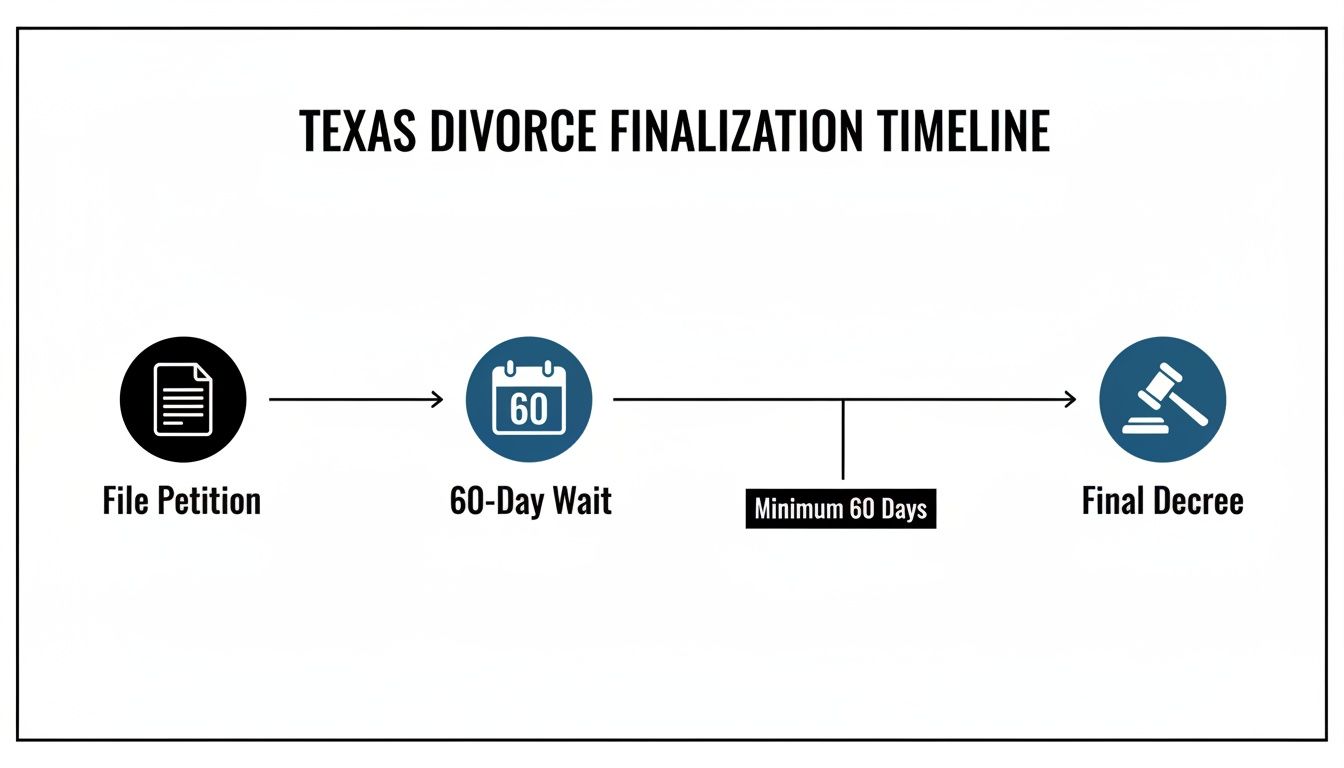
As shown, the entire process culminates in the moment the judge signs the decree. For anyone considering an appeal, that signature is the starting pistol for a very brief race against strict deadlines.
Two Roads to a Final Decree
After the waiting period, a divorce can be finalized in one of two ways. The path taken significantly impacts your ability to challenge the result.
- Agreed Decree (Settlement): In this scenario, you and your spouse reach an agreement on all issues—property, children, support, etc. This agreement is formalized in an Agreed Decree, which you both sign. By signing, you are affirming to the court your consent to all its terms. A judge then approves and signs it, making it a final, binding order. Because it is a voluntary agreement, appealing an Agreed Decree is extremely difficult.
- Contested Trial (Judge's Ruling): If you cannot agree, your case proceeds to trial. Both sides present evidence and arguments, and the judge makes the final decisions on all disputed issues. These decisions are then incorporated into the Final Decree of Divorce. It is this type of decree—one imposed by a judge after a contested trial—that is most commonly the subject of an appeal. Exploring the differences between divorce mediation vs. litigation can offer more insight into these divergent paths.
The moment a judge signs the Final Decree of Divorce is a critical point. This single action makes the court's orders legally effective and, crucially, starts the strict, unforgiving clock on your deadline to file an appeal.
If you went through a trial and believe the judge misinterpreted the law or made a ruling that was an abuse of discretion, you must act with urgency. The deadlines to challenge a final decree of divorce in Texas are short, and missing them could permanently forfeit your right to seek a fair outcome.
So, the judge has signed the final decree. For many, this moment brings relief, but what if the outcome feels deeply unfair? What if you’re staring at a court order that you believe completely overlooks the facts, misinterprets the law, or puts your family’s future in jeopardy?
It’s a gut-wrenching feeling, but it’s critical to know this: the judge's signature isn't necessarily the final word. Texas law provides several clear, but time-sensitive, paths to challenge a decision. The clock starts ticking the moment the decree is signed, and acting decisively is the single most important thing you can do to protect your rights.
Let's walk through your legal options, because understanding which tool to use for which job is half the battle.
Motion for New Trial
Before escalating to a higher court, one of the first and most powerful actions is filing a Motion for New Trial. This is a formal request for the original judge to reconsider their decision and correct a mistake. You are not going to a new court but asking the same judge to take a second look.
This is not a casual request. You need solid legal grounds, such as:
- The evidence presented does not legally support the final decision.
- A major procedural error occurred during the trial that affected the result.
- You have discovered crucial new evidence that was not available at the time of trial.
The deadline is extremely short—you generally have only 30 days from the date the judge signs the decree. Filing this motion is a critical strategic move. It not only gives the trial court an opportunity to fix the error but can also extend your deadline to file a full appeal from 30 days to 90 days. This additional time can be invaluable for an appellate attorney to prepare the strongest possible case.
Appealing the Court's Decision
If a Motion for New Trial is denied or is not the appropriate strategy, your primary path to justice is an appeal. This involves asking a higher court—the Court of Appeals—to review the trial judge's actions.
It is essential to understand what an appeal is not. It is not a new trial. You cannot introduce new evidence, call new witnesses, or re-argue your case.
Instead, appellate judges review the official trial record—transcripts, evidence, and motions—to determine if the trial judge made a serious legal error.
The focus of an appeal is to identify a "reversible error." This is not a minor oversight but a significant legal mistake that likely caused the judge to issue an improper ruling and create an unfair outcome.
To make this determination, the appellate court applies a legal standard of review. In most family law cases, that standard is "abuse of discretion." This means you must prove the trial judge acted unreasonably, arbitrarily, or without regard for guiding legal principles. It takes an attorney with deep expertise in appellate law to successfully argue this standard. You can learn more by reviewing the common grounds for appeal in a Texas family court.
Modification Versus Appeal
People often confuse appeals with modifications, but they are fundamentally different legal actions for entirely different situations.
- An appeal looks backward. It challenges the original decree, arguing that a legal mistake was made in the past based on the facts and law as they existed at that time.
- A modification looks forward. It is a new lawsuit filed because a significant life change has occurred after the divorce was finalized. A major change in income or a child’s evolving needs may be grounds to modify child support or custody.
You cannot use a modification to correct an improper property division or a legally flawed custody ruling from your original trial. If you believe the judge made a mistake from the beginning, an appeal is your only recourse.
Enforcement Actions
What if the decree is fair, but your ex-spouse is simply violating its terms? This is where an enforcement action is necessary. This is not about changing the order; it is about compelling your ex-spouse to follow the existing rules.
If your ex-spouse is not paying child support, refusing to turn over property, or violating the visitation schedule, you can file a Petition for Enforcement. The court has significant power to enforce its orders. A judge can garnish wages, award you attorney's fees, and find the non-compliant party in contempt of court—a ruling that can result in fines or even jail time.
Post-Decree Actions: A Comparison
Navigating these options can be confusing. The table below breaks down the purpose, timing, and legal standard for each action, helping you see how they fit together.
| Action | Purpose | Typical Deadline | Key Legal Standard |
|---|---|---|---|
| Motion for New Trial | Ask the trial court to reconsider and correct its own errors in the final decree. | 30 days from the date the decree is signed. | Show that a significant error of law or fact occurred during the trial. |
| Appeal | Ask a higher court to review the trial record for a legal mistake that led to an unfair outcome. | 30 days (or 90 days if a Motion for New Trial was timely filed). | Prove the trial judge committed "abuse of discretion" or another reversible error. |
| Modification | Change an existing order (like custody or support) due to a major change in circumstances after the decree. | No deadline; can be filed anytime a "material and substantial change" occurs. | Show that a "material and substantial change" has occurred since the last order. |
| Enforcement | Compel a party to follow the existing terms of the final decree. | Varies, but it's best to act promptly. | Prove the other party knowingly and intentionally violated a clear and specific court order. |
Each of these legal tools serves a distinct purpose. Choosing the right one is the first step toward achieving the fair outcome you and your family deserve.
Common Reversible Errors in Divorce Decrees
When a final decree is issued, it is easy to assume the judge's decision is absolute. But what if that decision is based on a significant legal mistake? In Texas family law appeals, not all errors are equal. Some, however, are so serious they can be overturned.
These are known as reversible errors, and identifying one is the first step toward correcting an unjust result. A reversible error is not merely a decision you disagree with; it is a ruling that likely caused an improper outcome because the judge misapplied the law or ignored established legal rules. In family law, most of these errors fall under the standard of abuse of discretion. This legal term means the court made a decision that was arbitrary, unreasonable, or without reference to any guiding legal principles.
Improper Division of Community Property
One of the most common and financially impactful errors involves property division. Texas law requires that the community estate—all assets acquired during the marriage—be divided in a "just and right" manner.
A classic reversible error occurs when a judge mischaracterizes property. For example:
- Separate Property Is Divided: If you inherited a family farm years before your marriage, that farm is your separate property. If the court treats it as community property in the final decree and awards a portion to your ex-spouse, that is a clear abuse of discretion and a strong basis for an appeal.
- Reimbursement Claims Are Ignored: Perhaps you used funds from a pre-marriage savings account for a down payment on the marital home. You may have a legal right to be reimbursed for that separate property contribution. If your attorney presented clear proof of this claim and the judge disregarded it without a valid legal reason, that could be a reversible error.
These are not minor accounting errors; they can fundamentally alter your financial future. The appeals process is designed to correct these kinds of injustices.
Significant Errors in Child-Related Rulings
Nothing is more important than your children, and the law reflects this. Every decision regarding custody, visitation, and support must be made in the "best interest of the child." When a judge's order contradicts this core principle without solid evidence in the record to support it, it may be an abuse of discretion.
Consider these common scenarios:
- Child Support Miscalculations: The Texas Family Code provides specific guidelines for calculating child support. While a judge may deviate from them, they must state their specific reasons in the final decree. If a judge orders a substantially different amount without explanation or bases the calculation on an incorrect income figure that was proven to be wrong at trial, that order may be reversed on appeal.
- Unworkable Possession Schedules: A judge might order a visitation schedule that is impractical or harmful to the child—perhaps it conflicts with their school schedule or contradicts an expert’s recommendation without good cause. If the trial record lacks evidence to support such a disruptive schedule, an appellate court can intervene to protect the child's stability.
An "abuse of discretion" does not imply that the judge acted with ill intent. It simply means the final decision is not supported by the facts and the law presented in court. The appellate court’s role is to review the trial record to determine if the ruling was legally sound, not to second-guess the judge’s intuition.
Unjust Rulings on Spousal Maintenance
Spousal maintenance (alimony) is strictly regulated by the Texas Family Code. Eligibility, amounts, and duration are based on specific statutory factors. A judge who ignores these rules commits a reversible error.
For instance, if a spouse clearly qualifies for maintenance—perhaps after a marriage of over 10 years, they are unable to provide for their minimum reasonable needs—and the judge denies it without a sound legal basis, that decision can be appealed. The law establishes the rules, and judges must follow them. Discover more insights about Texas divorce law updates. Knowing when a judge has departed from these established standards is key to a successful appeal.
Why You Need an Appellate Attorney to Review Your Case

When your final decree of divorce in Texas feels deeply unfair, you may sense that a mistake was made. However, pinpointing and proving that mistake in a manner that an appellate court will recognize requires a specialized skill set distinct from that of a trial lawyer.
Challenging a judge’s decision is not a second chance to argue your case. It is a highly technical legal proceeding that demands an attorney who specializes in appellate law. An appellate attorney does not introduce new evidence or call new witnesses. Our role is to act as legal analysts, meticulously reviewing the entire court record—every transcript, exhibit, and motion—to identify reversible errors. This process involves deep legal research and strategic analysis aimed at constructing a compelling argument for the court of appeals.
The Power of the Appellate Brief
The cornerstone of any appeal is the brief. This formal written argument, submitted to the higher court, is where the case is won or lost. It is a highly structured, persuasive legal document that must pinpoint exactly how the trial judge erred—either by misapplying the law or abusing their discretion. Every argument must be supported by the Texas Family Code, Texas Rules of Appellate Procedure, and relevant case law.
Writing a powerful brief is a specialized skill. It must be clear, concise, and persuasive enough to convince appellate judges that a specific legal error led to an unjust outcome. To learn more about this critical document, please read our guide explaining what an appellate brief is.
An appellate attorney’s goal is to demonstrate that the trial court's decision was not just unfavorable, but legally flawed. We connect the facts from your trial to established legal precedent, showing the higher court precisely why the original judgment cannot stand.
It is also crucial to understand that the deadlines for filing an appeal are strict and unforgiving. The clock starts the moment the judge signs the final decree. If you delay, you could lose your right to challenge the decision forever.
If you believe the court made a mistake in your family law case, our appellate attorneys can help you seek a fair outcome. Contact The Law Office of Bryan Fagan today for a free consultation.
Got Questions About Your Divorce Decree? We've Got Answers.
After a divorce is finalized, navigating your new reality can be challenging. The final decree is the official rulebook, but questions often arise when circumstances change or something seems wrong. Here are straightforward answers to common questions about post-decree issues.
Can I Change My Divorce Decree After It's Final?
The answer depends on which part of the decree you want to change.
The division of property and debt is almost always final. The court intends for this to be a one-time division to provide a clean break.
However, orders involving children—such as custody (conservatorship), visitation, and child support—are different. These orders can be changed because life is not static. You can petition the court to alter these orders by filing for a "modification." To be successful, you must prove that there has been a “material and substantial change” in circumstances since the original decree was signed. A modification looks to the future, whereas an appeal addresses a mistake made in the past.
How Long Do I Have to Appeal My Divorce Decree?
The deadlines for appealing a judge's decision are extremely strict. In most cases, you have only 30 days from the date the judge signs the final decree to file a Notice of Appeal. This window can sometimes be extended to 90 days if you file a post-judgment motion, such as a Motion for New Trial, within the initial 30-day period. If you miss these deadlines, your right to appeal is likely lost forever. It is imperative to consult with an appellate attorney immediately to preserve your options.
What's the Difference Between an "Agreed Decree" and a Judge's Order?
This distinction is critical. An "agreed decree" is a settlement agreement. You and your ex-spouse negotiated the terms, signed the document, and a judge approved it. Because you voluntarily consented to its terms, appealing an agreed decree is nearly impossible.
A judge's order, on the other hand, is the result of a contested trial where you and your ex-spouse could not agree. You each presented your case, and the judge made the final decisions. These are the decrees that can be appealed, as the judge may have misinterpreted the law, made a factual error, or abused their discretion.
What Happens If My Ex-Spouse Ignores the Decree?
A decree is a binding court order. If your ex-spouse refuses to comply with it, you can take them back to court by filing a Petition for Enforcement. This legal action compels them to follow the order. A judge has various tools to enforce the decree, from garnishing wages for unpaid support to ordering the turnover of property. The court can also find the non-compliant party in contempt, which can result in significant fines and even jail time.
If you believe the court made a mistake in your family law case, our appellate attorneys can help you seek a fair outcome. Contact The Law Office of Bryan Fagan today for a free consultation at https://familylawcourtappeals.com.