You may feel your case was handled unfairly. A judge signed an order that affects your children, your home, your support, or your future, and now you're left asking whether anyone can correct it.
In Texas, an appeal is the legal process for asking a higher court to review whether the trial court made a legal mistake. That review doesn't give you a second trial. It gives you a structured way to challenge errors under the Texas Rules of Appellate Procedure and the Texas Family Code. If the trial court misapplied the law, abused its discretion, excluded important evidence the wrong way, or entered a judgment that the law doesn't support, the appellate courts exist to address that.
For many families, the first practical question is simple. Which court hears my appeal? That's where a Texas court of appeals districts map becomes more than a diagram. It becomes a strategy tool.
Navigating Your Appeal After an Unfair Family Court Ruling
If you're reading this soon after a final hearing, you may still be replaying what happened in the courtroom. Maybe the judge dismissed key evidence too quickly. Maybe the final order doesn't reflect the testimony you heard. Maybe the custody ruling, property division, or enforcement order feels disconnected from the law and the facts.
Those reactions matter, but an appeal won't turn on frustration alone. It turns on identifying a legal error, preserving that issue in the record, and presenting it to the correct appellate court. That's why geography matters at the start.
Texas has exactly fourteen geographically-based intermediate Courts of Appeals districts, each covering specific counties, with the First and Fourteenth Courts sharing concurrent jurisdiction over the same ten counties including Harris, Galveston, and Fort Bend, while the Fifteenth Court holds exclusive statewide civil jurisdiction over appeals involving the state or its agencies, according to the Texas courts of appeals structure.
For most family law appeals, your path begins with one of those geographic courts. The county where your trial court entered the order usually determines where the appeal goes. That affects filing, briefing, and the legal context your case will enter.
Practical rule: If you believe the ruling was wrong, don't start by arguing the facts to friends or posting online. Start by identifying the county, the final order, and the deadlines that control your appeal.
A clear map helps because it removes one layer of confusion. Once you know your district, you can focus on the issues that move an appeal forward, such as the standard of review, the appellate record, and whether the trial court committed reversible error, meaning a mistake serious enough to justify a new result or further proceedings.
The Official Texas Court of Appeals Districts Map
The Texas court of appeals districts map gives you a visual answer to a legal question. It shows how the state is divided for intermediate appellate review and helps you match your trial court county to the court that will hear your family law appeal.
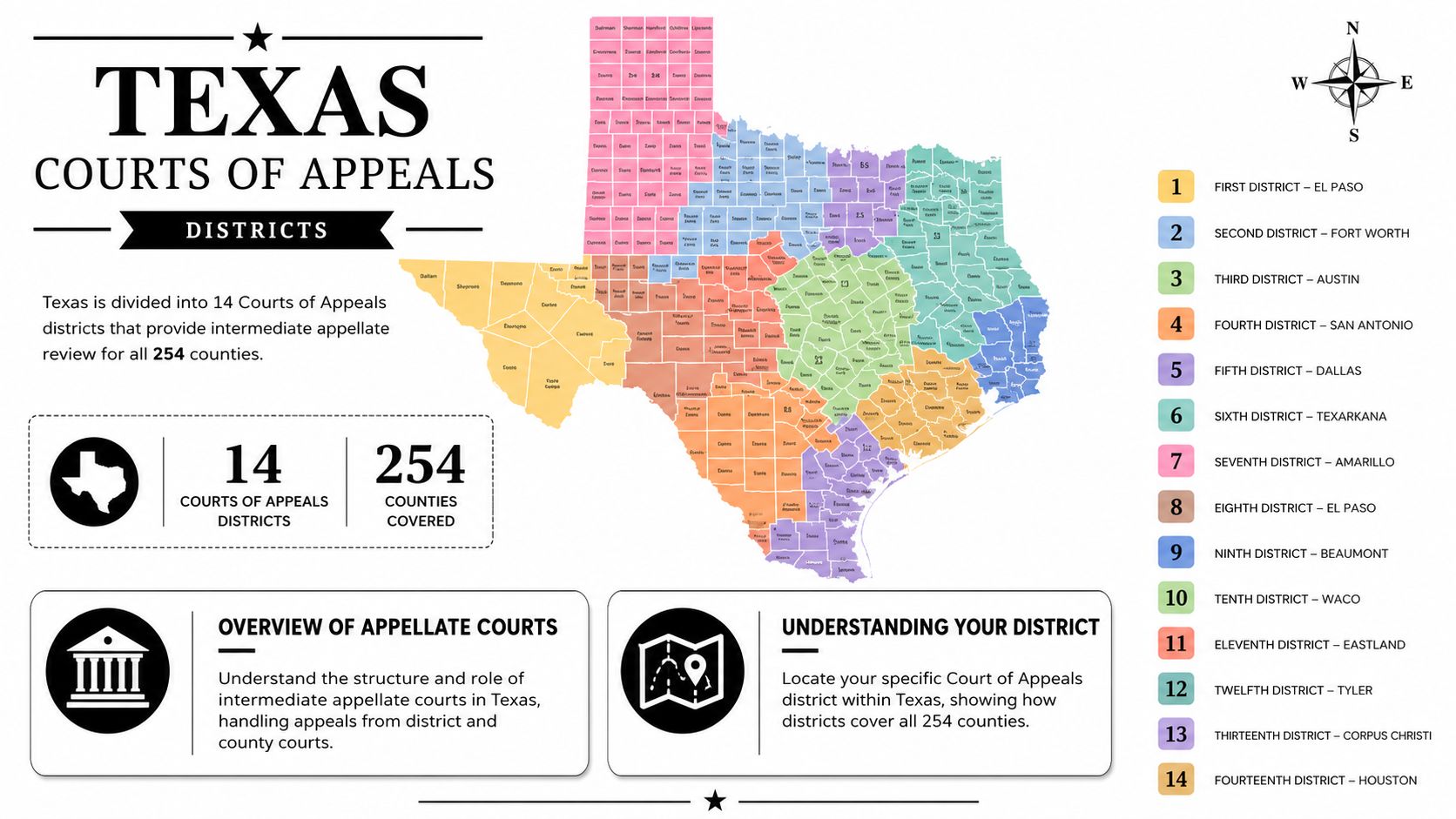
When clients look at this map for the first time, the key is to keep it simple. Find the county where the trial court signed the order. Then identify the numbered Court of Appeals district that covers that county. That court becomes the immediate reviewing court for most family law cases.
How to read the map
- Start with the county: Your appeal follows the county of the original case, not where you moved later.
- Match the district number: Each numbered district corresponds to a specific Court of Appeals.
- Watch for overlap: Some counties fall within concurrent or overlapping jurisdictions, which can affect assignment.
- Think beyond location: The map doesn't just show where to file. It helps you understand the procedural path ahead.
The map also makes one point clear. Texas appellate geography is statewide and complete. Every county fits somewhere in the system. If you're looking for practical help with that process, Texas Family Law Appeals Lawyer refers to appellate representation challenging final family law orders for legal error.
A map won't tell you whether your issue is strong. It will tell you where that issue must be argued, and that's the first step toward a disciplined appeal.
Understanding the Texas Appellate Court Structure
Texas family law appeals move through a court system with layers. Trial courts decide facts, hear witnesses, and sign orders. Courts of Appeals review whether the trial court followed the law. In civil cases such as divorce, child custody, support, property division, protective orders, and related family matters, these are intermediate appellate courts.

Where the Courts of Appeals fit
The Texas Courts of Appeals system was established by an 1891 amendment to the 1876 Texas Constitution, which created intermediate appellate courts for both civil and criminal cases. As of September 1, 2023, the Fifteenth Court of Appeals District was formally composed of all 254 counties in Texas, consolidating its statewide civil jurisdiction over appeals involving the state and business court matters, as described by Texas Tech University School of Law library materials.
For family law clients, the main takeaway is this. The Court of Appeals doesn't retry your case. It reviews the written record, the exhibits admitted below, the reporter's transcript if one exists, and the legal arguments presented in appellate briefs.
That review is shaped by appellate jurisdiction, which in plain English means the court's legal authority to hear and decide the appeal. If you file in the wrong place, or miss a rule-based deadline, the court may never reach the merits of your complaint.
What these courts actually do
Each Court of Appeals is led by a chief justice and includes additional justices. Bench size varies by district. Appeals are commonly decided from written submissions, and sometimes with oral argument. The court asks whether the trial court made an error under the law, not whether the appellate justices would have ruled differently as trial judges.
Here's the practical difference between a trial and an appeal:
| Trial court | Court of appeals |
|---|---|
| Hears testimony live | Reviews the written record |
| Decides disputed facts | Reviews legal error |
| Admits or excludes evidence | Evaluates whether those rulings were lawful |
| Signs the final order | Can affirm, reverse, remand, or modify in limited circumstances |
Why the Fifteenth Court usually isn't your family law court
The Fifteenth Court matters in Texas appellate structure, but it usually won't be the venue for a standard family law appeal. Its statewide civil jurisdiction is distinct from the county-based structure that governs most divorce and custody matters.
That's why clients shouldn't rely on broad internet summaries of “Texas appellate courts” without checking the county-specific route for their own case. In family law, small procedural assumptions often create big problems.
How to Determine Your Correct Appellate District
The correct appellate district is usually determined by the county where the trial court case was heard and decided. Not where you live now. Not where the other parent moved. Not where your lawyer's office is located.
If your divorce decree came from a district court in Harris County, the appeal belongs in Houston. If your SAPCR order came from Bexar County, the appeal belongs in the San Antonio-based Fourth Court of Appeals. The county drives the destination.
A simple way to identify your district
Use this checklist:
- Find the final order or judgment. Look for the court number and county.
- Confirm the trial court location. Family cases are often filed in district court or county court at law.
- Match that county to the Court of Appeals district. The map and county list below help with that.
- Check for overlap issues. A few counties fall into overlapping jurisdictions.
- File the notice on time and direct the appeal properly. The filing court and appellate court roles are different, so details matter.
If you're still at the beginning of the process, this guide on how to file a notice of appeal in a Texas family law case is a practical companion to district selection.
Overlapping counties can confuse people
Texas appellate geography isn't perfectly one-county, one-court in every situation. The geographic division creates specific county jurisdictions, including overlapping jurisdictions such as the counties of Gregg, Rusk, Upshur, and Wood which fall under both the Sixth and Twelfth Courts, and Hunt County which falls under both the Fifth and Sixth Courts, as outlined in the Texas Courts of Appeals overview.
That doesn't mean you're expected to solve a venue puzzle by yourself. In practice, assignment rules and court procedures handle that question. The point is to recognize that overlap exists and not assume every county maps to only one appellate court.
If your case comes from an overlapping county, don't guess. Review the notice, the district, and the assignment details before the briefing schedule starts.
What doesn't determine your appellate district
Clients often focus on the wrong facts. These don't control the district:
- Your current address: Moving after the order doesn't move the appeal.
- The children's present school district: That may matter in modification litigation, but not for appellate geography.
- The opposing party's county: The appeal tracks the original trial court's county.
- Where the hearing was convenient: Temporary appearances or remote settings don't change the underlying district.
This is one of those areas where a little precision early saves a lot of trouble later. A correct district means the clerk's record, reporter's record, notices, and briefing all move on the right track from the start.
Texas Appellate Districts A County and Court Guide
This is the quick-reference part of the Texas court of appeals districts map. If you need to identify the court tied to your county, use the list below. For family law litigants, this matters because your divorce, custody, support, enforcement, or protective-order appeal usually rises from the county where the trial court entered the order.
The Texas Fourteenth Court of Appeals guide can also help if your case comes from one of the Houston-area counties with concurrent jurisdiction.
District directory by court and county
First Court of Appeals, Houston: Austin, Brazoria, Chambers, Colorado, Fort Bend, Galveston, Grimes, Harris, Waller, Washington. The First Court serves 10 counties and has 9 justices, according to the Texas judges court structure reference. Official court site: First Court of Appeals.
Second Court of Appeals, Fort Worth: Archer, Clay, Cooke, Denton, Hood, Jack, Montague, Parker, Tarrant, Wichita, Wise, Young. The Second Court covers 12 counties and has 7 justices. Official court site: Second Court of Appeals.
Third Court of Appeals, Austin: Bastrop, Bell, Blanco, Burnet, Caldwell, Coke, Comal, Concho, Fayette, Hays, Irion, Lampasas, Lee, Llano, McCulloch, Milam, Mills, Runnels, San Saba, Schleicher, Sterling, Tom Green, Travis, Williamson. The Third spans 24 counties and has 6 justices. Official court site: Third Court of Appeals.
Fourth Court of Appeals, San Antonio: Atascosa, Bandera, Bee, Bexar, Calhoun, Comal, DeWitt, Dimmit, Edwards, Frio, Gillespie, Goliad, Gonzales, Guadalupe, Jackson, Karnes, Kendall, Kerr, Kinney, La Salle, Lavaca, Maverick, Medina, Real, Uvalde, Val Verde, Victoria, Wilson, Zavala, plus additional counties within the Fourth Court's district. The Fourth includes 32 counties and has 7 justices. Official court site: Fourth Court of Appeals.
Fifth Court of Appeals, Dallas: Collin, Dallas, Grayson, Hunt, Kaufman, Rockwall. Official court site: Fifth Court of Appeals.
Sixth Court of Appeals, Texarkana: Bowie, Camp, Cass, Delta, Fannin, Franklin, Gregg, Harrison, Hopkins, Hunt, Lamar, Marion, Morris, Panola, Red River, Rusk, Titus, Upshur, Wood. Official court site: Sixth Court of Appeals.
Seventh Court of Appeals, Amarillo: Armstrong, Briscoe, Carson, Castro, Childress, Collingsworth, Dallam, Deaf Smith, Donley, Gray, Hall, Hansford, Hartley, Hemphill, Hutchinson, Lipscomb, Moore, Ochiltree, Oldham, Parmer, Potter, Randall, Roberts, Sherman, Swisher, Wheeler. Official court site: Seventh Court of Appeals.
Eighth Court of Appeals, El Paso: Brewster, Culberson, El Paso, Hudspeth, Jeff Davis, Presidio. Official court site: Eighth Court of Appeals.
Ninth Court of Appeals, Beaumont: Hardin, Jasper, Jefferson, Liberty, Newton, Orange, Tyler. Official court site: Ninth Court of Appeals.
Tenth Court of Appeals, Waco: Bosque, Falls, Freestone, Hamilton, Hill, Johnson, Leon, Limestone, McLennan, Navarro, Robertson, Somervell. Official court site: Tenth Court of Appeals.
Eleventh Court of Appeals, Eastland: Borden, Callahan, Coleman, Comanche, Eastland, Erath, Fisher, Haskell, Howard, Jones, Kent, Knox, Mitchell, Nolan, Scurry, Shackelford, Stephens, Stonewall, Taylor, Throckmorton. Official court site: Eleventh Court of Appeals.
Twelfth Court of Appeals, Tyler: Anderson, Angelina, Cherokee, Gregg, Henderson, Houston, Nacogdoches, Rains, Rusk, Sabine, San Augustine, Shelby, Smith, Trinity, Upshur, Van Zandt, Wood. Official court site: Twelfth Court of Appeals.
Thirteenth Court of Appeals, Corpus Christi and Edinburg: Aransas, Bee, Brooks, Cameron, Duval, Hidalgo, Jim Hogg, Jim Wells, Kenedy, Kleberg, Live Oak, Nueces, Refugio, San Patricio, Starr, Webb, Willacy, Zapata. Official court site: Thirteenth Court of Appeals.
Fourteenth Court of Appeals, Houston: Austin, Brazoria, Chambers, Colorado, Fort Bend, Galveston, Grimes, Harris, Waller, Washington. The Fourteenth mirrors the First Court's 10-county jurisdiction and has 9 justices, with concurrent jurisdiction and random assignment used to balance dockets. Official court site: Fourteenth Court of Appeals.
How to use this list strategically
You don't need to memorize the directory. Use it to answer two practical questions:
- Where does the appeal go? Start with the county.
- What court's prior decisions should your lawyer study closely? The district's own case law often shapes how issues are framed.
The strongest appellate briefs don't read like generic statewide arguments. They speak to the court that will actually decide the case.
Why Your Appellate District Matters for Your Family Law Case
A lot of people assume every Texas Court of Appeals handles family law issues in exactly the same way. That isn't how real appellate practice works.
All Texas appellate courts are bound by the same controlling statutes and by higher-court precedent. But each court also develops its own body of opinions on recurring family law issues. That matters when your case turns on a close question, such as evidentiary harm, property characterization, preservation of complaint, or the limits of trial court discretion in custody and support rulings.
District knowledge changes how a case is framed
An appeal is not just about being “right.” It's about presenting the issue in a way that fits the governing law and the court's prior reasoning.
For example, when a client challenges a custody ruling, the argument may involve whether the judge abused discretion. In plain English, abuse of discretion means the trial court acted without following guiding legal rules or reached a decision the law won't support on this record. That standard is deferential. It requires careful framing.
A property-division appeal may raise a different kind of issue. If the complaint is about what legal rule applies to a category of property, some parts of the appeal may receive a more direct legal review. If the complaint is about how the trial judge weighed evidence, the argument becomes narrower and more demanding.
Common reversible errors in family law appeals
The following issues often appear in serious appellate reviews:
- Misapplying the Family Code: A court may use the wrong legal framework for support, conservatorship, enforcement, or division.
- Incorrect property characterization: Separate and community property errors can change the result in a meaningful way.
- Improper exclusion or admission of evidence: Some evidentiary rulings affect the fairness of the trial.
- Lack of due process: A party may not receive a meaningful chance to be heard.
- Unsupported contempt or enforcement rulings: Vague orders and defective findings can create appealable problems.
- Protective-order errors: The record may not support the scope or basis of relief granted.
What works and what doesn't
What works is a district-specific argument grounded in the record, the applicable standard of review, and the cases that court is likely to consider persuasive.
What doesn't work is a brief that reads like a closing argument from trial. Appellate judges don't reweigh every conflict in testimony because one side believes the judge should have seen things differently. They review legal error. That distinction controls everything.
Key Steps in the Texas Family Law Appeals Process
Once you know the correct district, the work becomes procedural and precise. Texas family law appeals are governed by the Texas Rules of Appellate Procedure, and the underlying family issues often come from the Texas Family Code. That combination matters because appellate success often depends as much on process as on the legal issue itself.

A broad overview of Texas appellate procedure in family law cases can help if you want a separate process-focused reference while reviewing your own order and deadlines.
Step one, identify the appealable order and the deadline
Most appeals start with a final order or judgment. In family law, that might be a divorce decree, a final SAPCR order, a modification order, a protective order, or an enforcement judgment that is appealable under the rules and governing law.
The first filing is usually the notice of appeal. In plain English, that's the document that tells the system you are invoking appellate review. It doesn't prove your case. It preserves your right to have the appellate court review it if it's timely and properly filed.
A missed deadline can end the appeal before briefing begins. That's why appellate review starts with calendars, signatures, filing dates, and post-judgment motions. Clients often want to begin with fairness. Lawyers must begin with jurisdiction.
Step two, make sure the issue was preserved
A strong legal point can still fail if it wasn't preserved in the trial court. Preservation of error means the complaint was raised in a way that gave the trial judge a fair chance to correct it.
That may include an objection, an offer of proof, a motion, a request for findings, or another record-based step depending on the issue. If the record doesn't show that the complaint was properly presented, the appellate court may decide the point was waived.
The appellate court usually reviews what the record shows, not what everyone remembers.
Step three, build the appellate record
The appellate record generally includes two main parts:
- Clerk's record: The filed documents, orders, pleadings, motions, and exhibits included through the clerk.
- Reporter's record: The transcript of hearings or trial testimony prepared from the court reporter's work.
If something important happened in a hearing but no reporter's record exists, that can sharply limit the appeal. If key exhibits were discussed but not admitted, the court may never consider them. Appeals rise or fall on the record that was created.
Step four, understand the standard of review
The standard of review is the rule the appellate court uses to evaluate the trial court's decision. It is one of the most important ideas in an appeal.
Here are three common terms in plain English:
| Term | Plain-English meaning |
|---|---|
| Abuse of discretion | The trial court had some room to decide, but it went outside the legal limits of that discretion |
| De novo review | The appellate court decides the legal question fresh, without deferring to the trial court on that issue |
| Reversible error | A legal mistake that justifies changing the outcome or sending the case back |
Family law appeals often involve abuse-of-discretion review, especially in custody, possession, and some property issues. That means your brief must show more than disagreement. It must show legal error tied to the record.
Step five, write the brief the right way
Briefing is the written argument submitted to the appellate court. A brief identifies the issues presented, states the relevant facts from the record, cites the governing law, and explains why the trial court's ruling should be affirmed or reversed.
Good appellate briefing is selective. It focuses on the strongest preserved issues and explains the harm clearly. Weak briefs often do the opposite. They raise too many complaints, argue facts without legal framing, or recycle trial themes without adapting them to appellate standards.
If your case is set for argument, this later stage can matter too. The court may decide the case on the briefs alone, but some appeals involve oral presentation and judicial questioning.
After the briefing stage, some litigants also want to understand what happens in oral argument:
Step six, know how the court decides the case
Appeals in all Texas Courts of Appeals are typically heard by a panel of three justices, unless an en banc hearing is ordered, in which instance all justices of the specific court hear the case, according to the Texas appellate redistricting materials.
That doesn't mean every appeal gets a dramatic courtroom argument. Many are decided on the written record and briefs. The quality of the record and the precision of the briefing usually carry more weight than courtroom style.
Let Our Appellate Attorneys Help You Seek a Fair Outcome
You may have walked out of family court feeling that the judge missed what mattered. In an appeal, that feeling has to become a focused legal argument tied to the right appellate district, the right deadline, and the right part of the record.
That is where many family law appeals are won or lost. A parent in Houston, Amarillo, or Austin is not just filing in a different place on the map. That party is stepping into a different court, with its own body of precedent, briefing expectations, and procedural habits. For family law appellants, geography is strategy.
Appeals also require a different skill set than trial work. Counsel has to read the final order closely, study the clerk's and reporter's records, identify preserved error, and frame issues under the standard of review that will control the case. In family law matters, that often means making careful choices about what to challenge and what to leave out.
The Law Office of Bryan Fagan, PLLC, a Texas-based family law appellate practice, handles appeals involving child custody, visitation, property division, spousal maintenance, child support, divorce decrees, protective orders, and contempt or enforcement judgments.
What a consultation should accomplish
A good appellate consultation should give you practical answers quickly:
- Is the order final and appealable?
- Which Texas Court of Appeals district has jurisdiction?
- Was the trial court error preserved in the record?
- What standard of review will likely govern the main issues?
- Does the record support reversal, modification, or another realistic form of relief?
- What deadlines are already running, and what has to be filed first?
A fair consultation should leave you with clarity about your options, your risks, and your next move.
If you believe the court made a legal error in your family law case, speak with appellate counsel promptly. Early review can help you protect deadlines, assess the correct district, and decide whether an appeal is worth pursuing.