Skip to content
When a family law case takes a turn involving family violence and an arrest, you may feel your case was handled unfairly or that the court rushed to judgment. Often, the first legal step is a Magistrate's Order of Emergency Protection (MOEP), commonly known as an emergency protective order (EPO). This civil court order is issued immediately after a criminal arrest to provide safety for an alleged victim, but it can also be based on incomplete information.
This order places strict, legally binding rules on the person who was arrested. If you believe the order against you was unjust or the result of a legal error, it's critical to understand your rights and the appellate process.
Understanding the Texas Emergency Protective Order
Navigating a family law crisis is incredibly overwhelming, especially when it involves allegations of violence. You might feel your side of the story wasn't heard or that your rights were ignored. The emergency protective order is one of the first tools the court uses, and understanding what it is—and isn't—is crucial for seeking a fair outcome.
An EPO is not a criminal punishment but a preemptive safety measure issued under the Texas Code of Criminal Procedure. Its primary purpose is to create a mandatory "cooling-off" period to prevent a difficult situation from escalating.
When Is an EPO Issued?
A magistrate judge typically issues an EPO almost immediately after an arrest. The request can come from the police officer, the prosecutor, or the alleged victim.
The most common triggers for an EPO include arrests for:
- Family Violence Assault: The most frequent reason. Any act of violence against a family member leading to an arrest can trigger an EPO.
- Stalking or Trafficking: An EPO is almost always issued following arrests for these offenses.
- Sexual Assault or Abuse: Arrests for sexual offenses involving a family or household member will also prompt an EPO.
The system is designed for speed, not a deep dive into the facts. A magistrate can issue the order without a formal hearing, often when the accused person is not present. While this one-sided process aims to protect those in immediate danger, it also means orders can be based on incomplete or biased information, creating a significant potential for reversible error.
These orders are becoming more common. In 2022, Texas recorded 254,339 reported family violence offenses, a 10% jump from the year before. This starkly illustrates why courts are using these protective measures more frequently. You can dig deeper into these statistics in official family violence reports.
An EPO’s purpose is straightforward: to give the alleged victim time to make arrangements for their safety and to de-escalate a volatile situation. It imposes serious restrictions on an individual's freedom before any conviction has occurred.
If an unfair EPO has been issued against you, the impact is immediate and devastating. It can affect your parental rights, remove you from your home, and damage your reputation. Our appellate attorneys are skilled at scrutinizing these orders for legal mistakes and fighting for a fair outcome. Contact The Law Office of Bryan Fagan today for a consultation to evaluate your case.
How an Emergency Protective Order Is Issued
When you're reeling from a family violence arrest, the legal system moves at a dizzying pace. A Texas emergency protective order (EPO) is often issued within hours—a speed designed to protect potential victims but one that can leave the accused feeling their side of the story was completely ignored. Understanding this rapid process is the first step toward seeking a just outcome through an appeal.
Unlike a typical court proceeding, issuing an EPO is not a drawn-out affair. It happens right after an arrest for an offense involving family violence. There's no trial, no jury, and usually no opportunity for the person arrested to present their case, which can lead to mistakes.
This flowchart breaks down the straightforward, three-step path from arrest to the issuance of a Texas EPO.
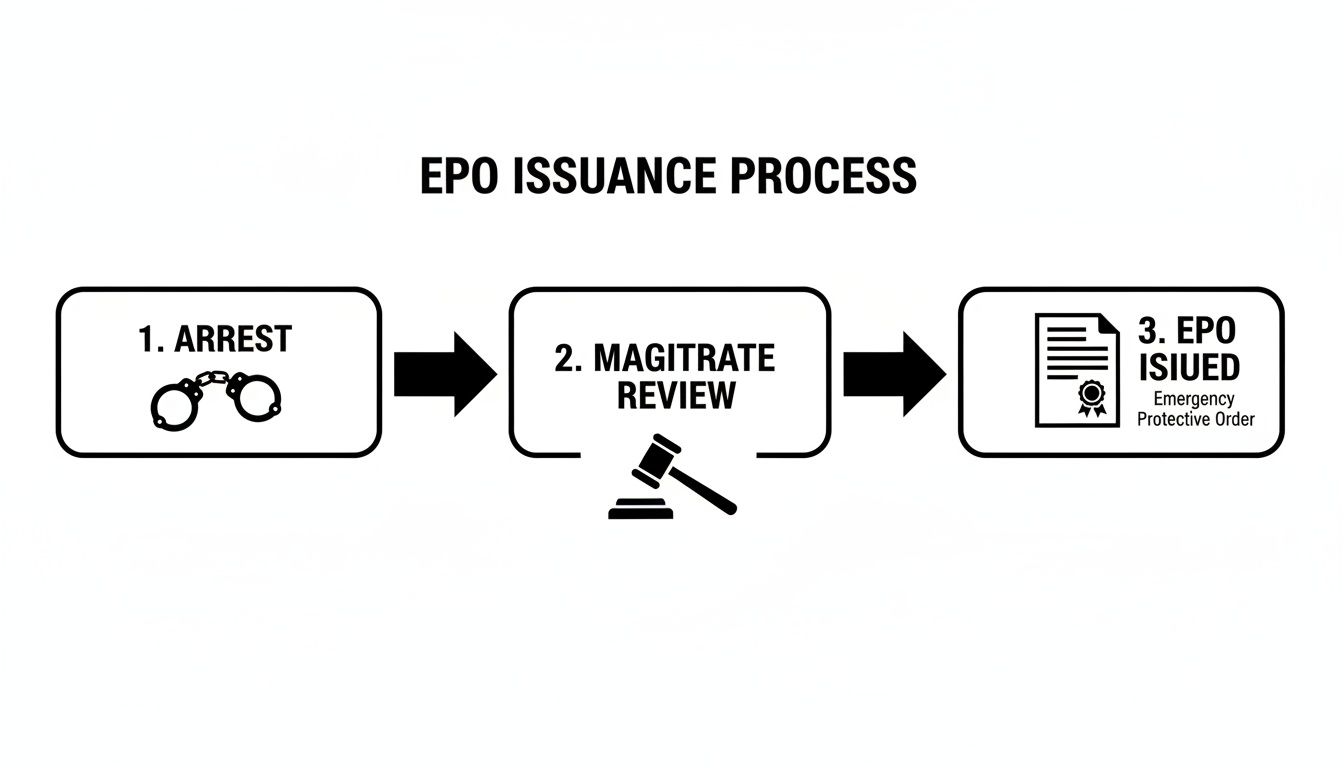
The primary takeaway is the speed and simplicity of the process. That very simplicity is why legal errors can occur when a judge must make a significant decision with limited information.
The Magistrate's Role and Criteria
The power to grant an EPO lies with a magistrate judge, typically during the accused person's first court appearance after an arrest—a hearing known as a magistration.
The request for the order can be initiated by:
- The police officer who made the arrest
- The prosecutor assigned to the criminal case
- The alleged victim
- The parent or guardian of the alleged victim
The magistrate reviews the initial facts, which usually consist only of the police report. Their job is to decide if there's probable cause to believe family violence occurred and if an order is necessary to protect the alleged victim from further harm.
A critical point here is that this is an ex parte proceeding. "Ex parte" is Latin for "from one party." In plain English, it means the judge makes the decision based on information from only one side—the accuser's—without the accused person present to offer a defense or dispute the claims.
Because the process is intentionally one-sided to ensure immediate safety, it can result in orders based on misunderstandings, exaggerated claims, or an incomplete picture of events. While EPOs serve a vital function, their immediate impact on your freedom, your home, and your right to see your children is massive.
Challenging the Foundation of the Order
If you have been subjected to an unfair EPO, you cannot simply return to court the next day to fight it. While you can file a motion to modify the order, the grounds are very limited. You must prove the order is impossible to follow and that changing it poses no risk.
However, the way the order was initially issued can be a source of reversible error if the magistrate did not have a solid legal basis for granting it. In plain English, a reversible error is a mistake so significant that it likely led to an unfair outcome. This is where an appellate lawyer's review becomes essential. We scrutinize the record to determine if the legal standards were properly met, which is a key step in the appeals process.
This process is entirely different from a Temporary Ex Parte Protective Order, which comes from the civil court system and follows a separate set of rules under the Texas Family Code. Knowing the difference between these orders is essential for a successful legal strategy.
Comparing Different Types of Protective Orders
When a family law case becomes entangled with a criminal arrest, you may feel like you are trying to learn a new language overnight. In Texas, "protective order" is not a one-size-fits-all term. It covers several distinct legal tools, and understanding the differences is crucial to restoring balance in your case.
The type of order issued will dramatically shape your rights and next steps. Let's break down the three main types: the Emergency Protective Order (MOEP), the Temporary Ex Parte Protective Order (TEXPO), and the Final Protective Order. They all aim to prevent future family violence but originate from different courts and serve different functions.
The Emergency Protective Order (MOEP)
The MOEP is the rapid-response order, issued by a magistrate judge almost immediately after an arrest for an offense involving family violence.
- Who Initiates It? The arresting officer, prosecutor, or alleged victim requests it right after the arrest. The accused is not present to offer a defense.
- What's the Standard of Proof? The bar is low. A magistrate only needs to find probable cause that family violence occurred, a far lower standard than for a permanent order.
- How Long Does It Last? It’s strictly temporary, lasting either 61 days or 91 days if a deadly weapon was involved.
Think of the MOEP as an immediate safety measure designed to create a mandatory "cooling-off" period. Its speed is its strength, but that speed can also lead to errors because it is based on a one-sided account of events.
The Temporary Ex Parte Protective Order (TEXPO)
A TEXPO originates in civil court, not the criminal system. A person who fears future family violence can file an application to obtain one.
- Who Initiates It? The alleged victim (the "Applicant") files a formal application with the civil court.
- What's the Standard of Proof? The Applicant must provide evidence showing a clear and present danger of family violence. A judge reviews this evidence alone—"ex parte" means the other party (the "Respondent") is not yet present.
- How Long Does It Last? A TEXPO is a very short-term bridge, typically lasting up to 20 days. This is just enough time to schedule a full court hearing where both sides can be heard.
The TEXPO is the civil court's version of an emergency stopgap, holding things in place until a more thorough hearing can occur.
The Final Protective Order
This is the most serious and long-lasting type of protective order. It is issued only after a full evidentiary hearing where both parties have the opportunity to present their case, a key component of due process.
- Who Initiates It? An Applicant files for a protective order, often after first obtaining a TEXPO.
- What's the Standard of Proof? The standard is much higher. A judge must find that family violence has occurred and is likely to happen again. This requires proving the case by a "preponderance of the evidence."
- How Long Does It Last? A Final Protective Order can last for up to two years, and in some cases, it can be extended.
This order carries significant long-term consequences that can affect everything from firearm rights to child custody arrangements. It is not granted quickly; it requires a formal court proceeding.
Comparison of Texas Protective Orders
To clarify these distinctions, here is a side-by-side comparison. Each order serves a specific purpose in the timeline of a family violence case.
| Feature | Emergency Protective Order (MOEP) | Temporary Ex Parte Order (TEXPO) | Final Protective Order |
|---|---|---|---|
| Origin | Criminal Court (post-arrest) | Civil Court | Civil Court |
| Who Can Request It | Law enforcement, prosecutor, or victim at the time of arrest | The victim ("Applicant") by filing a formal application | The Applicant, following a TEXPO or as part of their initial filing |
| Legal Standard | Probable cause of family violence | A clear and present danger of future family violence | Family violence has occurred and is likely to occur again (Preponderance of Evidence) |
| Duration | Typically 61 or 91 days | Up to 20 days (until the full hearing) | Up to 2 years, sometimes longer |
| Hearing Type | Ex Parte (Respondent not present) | Ex Parte (Respondent not present) | Full evidentiary hearing with both parties present |
| Primary Purpose | Immediate, short-term "cooling-off" period after an alleged crime | Bridge the gap between filing for protection and a full court hearing | Provide long-term safety and legal protection from future violence |
Understanding which order you are facing is the first step in building a sound legal strategy. Data from 2021 to 2023 shows that MOEPs are the most common first response in Texas family violence cases. You can discover insights in the Texas judiciary's annual report to see these trends.
Finally, it’s important not to confuse these protective orders with other court orders, like a temporary injunction. An injunction handles different issues within a family law case. You can learn more about temporary injunctions in our article.
What You're Not Allowed to Do Under an EPO
When a judge issues an Emergency Protective Order, it immediately establishes a set of strict, legally binding rules. These are not mere suggestions; they are direct commands that can instantly impact where you can go, who you can contact, and whether you can see your own children.
Understanding these rules is critical. A simple, unintentional mistake, like sending a text message, could lead to your immediate arrest and new criminal charges. This can worsen a difficult situation, especially if you believe the order was issued unfairly.
Think of these prohibitions as a mandatory buffer zone, both physical and digital, created by the court to separate you from the protected person.
Common Conditions of a Texas EPO
While a magistrate can customize the conditions, most Texas EPOs contain a core set of restrictions. You will likely be ordered to stay away and cease all contact.
Here’s what that typically means:
- No Communication with the Protected Person: This is a total communication blackout. It covers phone calls, texts, emails, social media messages, and even attempting to send a message through a third party. Unless a judge explicitly allows an exception, any form of contact is a violation.
- Stay Away from Specific Locations: The order will list places that are now off-limits, almost always including the protected person's home and workplace, and often their children's school or daycare. It does not matter if you also live at that home or work at that same place—the order still applies.
- No Threatening or Harassing Behavior: You are legally prohibited from committing family violence or any act intended to harass, annoy, alarm, abuse, torment, or embarrass the protected person. This is a broad category covering a wide range of actions.
- No Firearms: A Texas emergency protective order will almost universally require you to surrender any firearms or ammunition you possess for the duration of the order. You must arrange for their legal storage by a third party.
These conditions are absolute. If the EPO states you cannot go to your own home, you must leave immediately, even if your name is the only one on the lease or deed.
The Impact on Your Home and Children
For anyone with children, two conditions can be particularly devastating. First, an EPO can completely suspend your access to your kids by barring you from their home and school, effectively severing contact until it expires or a court modifies it.
Second, the magistrate can include a "kick-out" provision. This is exactly what it sounds like.
A "kick-out" order is a powerful and immediate tool. It forces a person to vacate their own home on the spot, based solely on an accusation and a magistrate's initial review, without a full hearing. This can happen even if you are the sole owner of the property.
This creates an incredibly stressful situation, requiring you to find a new place to live and arrange to retrieve personal items without violating the order. You cannot simply drop by the house; you will need to coordinate through law enforcement or other third parties.
Understanding these prohibitions is your first line of defense. If you believe the conditions are unfair or that the court made a significant legal error, it is crucial to act strategically. While modifying an EPO is difficult, an appeal can be used to correct fundamental legal mistakes. Our experienced family law appellate attorneys can review your case for reversible error and help you seek a just outcome.
How to Challenge an Unfair Protective Order
Being served with a Texas emergency protective order can be a jarring experience. One moment you are living your life, and the next, you are legally barred from your home or from seeing your children. Because these orders are issued rapidly—often without you in the room—they can be based on a one-sided story. It is natural to feel that the system has failed you.
If you believe an unjust order has been issued against you, it is important not to panic. You have legal options. The key is to move forward with a clear, strategic approach focused on the law and due process.
Your Immediate Options in the Trial Court
After an EPO is issued, the first instinct is often to fight back immediately. The Texas Code of Criminal Procedure allows you to file a motion to modify the order. However, it is crucial to understand that this is not a do-over or a chance to re-litigate the original incident.
Instead, the law places the burden on you to prove three specific things to the court:
- The order as it stands is unworkable or impossible for you to follow.
- The changes you're proposing will not increase the risk to the person who sought the order.
- Your proposed modification will not endanger anyone else protected by the order.
The term "unworkable" carries significant legal weight. It means much more than just inconvenient. Simply being unhappy that you cannot go home is not enough. You must demonstrate a powerful, practical reason why the order, as written, cannot be followed.
The Power of an Appeal to Correct Legal Errors
While a motion to modify is a limited tool, a direct appeal is a far more powerful strategy for overturning an unjust final protective order. An appeal is not a new trial. You do not present new evidence or re-tell your story. Instead, it is a formal review of the trial court’s proceedings, designed to find legal mistakes that occurred the first time around.
Our appellate attorneys are skilled at meticulously examining every detail of your case—the filings, testimony, and the judge’s rulings—to pinpoint a reversible error. This is a specific legal term for a mistake so critical that it likely caused the wrong outcome.
A reversible error is not a minor technical slip-up. It is a fundamental flaw where the trial court misinterpreted the law, improperly excluded crucial evidence, or acted beyond its legal authority. In family law, this is often called an "abuse of discretion." Finding and proving this type of error is how an unfair order gets corrected on appeal.
Understanding the Standard of Review
In most family law appeals, including those involving protective orders, the legal standard of review is "abuse of discretion." This means the appellate court does not ask if it would have made the same decision. Instead, the question is whether the trial judge’s decision was so unreasonable, arbitrary, or unsupported by the facts that it amounted to an abuse of their power.
To win an appeal under this tough standard, our team constructs a rock-solid legal argument—called a "brief"—that demonstrates exactly how the trial judge erred. We might prove, for instance, that there was legally insufficient evidence to support a finding of family violence or that the court ignored evidence that contradicted the petitioner's claims. You can get a deeper understanding of this process by reading our guide on a Texas emergency protection order.
Challenging a protective order is a complex legal battle, whether through a motion to modify or a full appeal. The rules are strict, and the stakes—affecting your freedom, finances, and ability to see your children—could not be higher.
If you believe the court made a mistake in your family law case, our appellate attorneys can help you seek a fair outcome. Contact The Law Office of Bryan Fagan today for a consultation.
The Texas Protective Order Registry Explained
When dealing with a protective order in Texas, it is critical to realize the order's reach extends far beyond the local courthouse. To ensure these orders are enforced consistently statewide, Texas created a secure, centralized database: the Texas Protective Order Registry. This system is crucial for safety and profoundly impacts the long-term consequences of an order.
Think of the registry as a digital file cabinet that any law enforcement officer in Texas can access instantly. Before this system, tragic gaps existed. An officer in Dallas might have no way of knowing about an active protective order issued in Houston. Now, that officer can verify an order on the spot and enforce its terms.

Monica's Law and Its Impact
This vital system was created by 'Monica's Law.' Launched in September 2020, the law requires courts to enter every MOEP, TEXPO, and Final Protective Order into the statewide registry within 24 hours.
The law was named for Monica Deming, who was murdered in 2015 by an ex-boyfriend who, unbeknownst to her, had two previous protective orders against him from other women. The registry was designed to close these deadly information gaps. Shortly after its creation, it had logged over 40,000 entries for cases involving family violence, sexual assault, and stalking. You can read more about the registry's background and purpose to truly grasp its significance.
Thanks to this system, a Texas emergency protective order is not just a piece of paper—it is a statewide command. For the protected person, this offers a much stronger shield. For the person under the order, it means the restrictions travel with you throughout Texas.
The registry transforms a paper order into an active, enforceable digital record accessible by law enforcement 24/7. This underscores the serious, long-term implications of having a protective order on your record.
Why the Registry Matters in an Appeal
The registry's existence highlights the permanent nature of a protective order. This is not a problem that quietly disappears. An entry in this law enforcement database can have a lasting impact on background checks, job opportunities, and personal reputation.
Managing sensitive legal records in a compliant and secure way is paramount, which is why specialized Law Firm IT Support is so important in this field.
If you are convinced the order against you was the result of a legal error or an abuse of discretion, its permanent place in a statewide police database adds urgency. Pursuing an appeal is not just about regaining immediate freedoms; it is about clearing your name from an official record that can follow you for life.
Common Questions About Emergency Protective Orders
When you are suddenly facing a Texas emergency protective order (EPO), a wave of urgent questions is normal. Whether you are the person seeking protection or have just been served with an order, you need clear answers quickly. These orders are issued rapidly, often based on one side of the story, which can leave everyone involved feeling confused and uncertain.
Let's walk through some of the most frequent questions we hear from clients. Understanding these key points can help you make calm, strategic decisions during what is almost always a chaotic and stressful time.
How Long Does a Texas Emergency Protective Order Last?
An EPO is not indefinite; it has a specific expiration date set by the judge. The duration of the order is tied to the details of the criminal arrest that triggered it.
- For cases where no deadly weapon was involved, the order remains in effect for 61 days.
- If a deadly weapon was used or even just displayed, the duration is extended to 91 days.
These timelines are set by law to provide a "cooling-off" period. They also give the protected person time to go to civil court and apply for a long-term Final Protective Order if they believe it is necessary. It is essential to check the exact dates on your order and follow it precisely until it officially expires.
Can an EPO Force Me to Leave My Own Home?
Yes, it absolutely can. Judges have the authority to include a "kick-out" provision in a Texas emergency protective order. If that language is in the order, you are legally required to leave the home you share with the protected person, and the police can enforce it immediately.
This is true even if you own the house outright or are the only person on the lease. The court’s number one priority in that moment is the immediate physical safety of the alleged victim and any children living there.
If you have been forced out of your home based on what you believe is a false or misleading accusation, it's crucial to speak with an appellate attorney right away to understand your options for seeking justice.
What Happens If I Violate an Emergency Protective Order?
Violating any rule in an EPO is a serious crime in Texas, not just a simple mistake.
Any violation—even something seemingly minor, like a single text message or a social media comment—is considered a Class A misdemeanor. The penalties are steep: up to a year in jail and a fine of up to $4,000. A violation means an immediate arrest and a new criminal charge. If you have violated a protective order before, the new charge could even be a felony.
The legal system handling these sensitive cases relies on a solid operational backbone. For instance, a strategic guide to managed IT for law firms explains how law offices manage the technology needed to handle confidential information securely. The only way to stay safe is to strictly follow every single condition listed in the order.
If you believe the court made a mistake in your family law case, our appellate attorneys can help you seek a fair outcome. Contact The Law Office of Bryan Fagan today for a free consultation.