Skip to content
When a Texas family court issues a child custody order that feels deeply unfair, it's natural to feel that the system has failed you and your child. You may be looking at the final decree, convinced the judge overlooked critical evidence, misinterpreted the law, or simply did not grasp what was truly in your child's best interest. It is a frustrating and disheartening position for any parent.
Understanding Your Path Forward After an Unfair Custody Ruling

However, an unjust court order does not have to be the final word. The Texas appellate process is designed specifically to correct legal mistakes made by a trial court. An appeal is not a new trial; you cannot introduce new evidence. Instead, it is a focused review of the trial record to determine if a significant legal error occurred that led to the wrong outcome.
This guide will explain the complex legal standards that judges must follow and clarify what a true 50/50 custody in Texas looks like under the law. More importantly, it will explore how a strategic appeal can challenge a flawed ruling and help you seek a fair and just result for your family.
Key Legal Terms in Texas Custody Appeals
To effectively challenge a judge’s decision, it is essential to understand the language of the court. Texas family law is filled with specific legal terms, and knowing what they mean is critical to understanding your rights and the court’s order.
Here is a plain-English guide to the key legal terms you will encounter in a Texas custody appeal.
Texas Custody & Appeals Terms at a Glance
| Legal Term | Plain-English Definition |
|---|---|
| Conservatorship | The Texas legal term for custody. It defines a parent's legal rights and responsibilities regarding their child. |
| Joint Managing Conservators | The most common outcome, where both parents share the rights and duties to make major decisions for the child. |
| Possession Order | The court-ordered schedule or calendar that details precisely when each parent has physical possession of the child. |
| Standard Possession Order | The default possession schedule in the Texas Family Code. It is presumed to be in the child's best interest but is not a 50/50 schedule. |
| Briefing | The process where appellate attorneys submit written legal arguments (briefs) to the court of appeals, detailing the trial court's errors and citing relevant law. |
| Reversible Error | A legal mistake made by the trial judge that was so significant it likely caused an improper judgment. Identifying a reversible error is the primary goal of an appeal. |
| Abuse of Discretion | The standard of review used by appellate courts in custody cases. It means the trial judge made a decision that was arbitrary, unreasonable, or without reference to guiding legal rules and principles. |
Understanding these terms is the first step in moving forward. It empowers you to analyze your court order, identify potential errors, and determine if you have strong grounds for an appeal of your child custody case.
What "50/50 Custody" Actually Means Under Texas Law
If you have received a custody order that grants you less time with your child than you believe is fair, you may feel the court overlooked your parental importance. Many parents enter a custody case seeking a 50/50 split, viewing it as the only equitable outcome. However, a common misunderstanding of how Texas law defines "custody" can create significant confusion.

In Texas, the law uses the term conservatorship, which is divided into two distinct parts: decision-making rights and physical possession. Grasping this distinction is key to interpreting your court order and evaluating whether an appeal is viable. An appeal often centers on whether the judge properly applied the law when creating the possession schedule.
Conservatorship Rights vs. Possession Schedules
When a court names both parents Joint Managing Conservators, it means you share the rights and responsibilities to make major decisions about your child’s education, non-emergency medical care, and religious upbringing.
However, sharing the power to make decisions is entirely separate from sharing equal physical time with your child. This is where many custody orders lead to frustration. A judge can name both parents as Joint Managing Conservators but then order a possession schedule that is far from equal.
The Texas Family Code presumes that naming parents as joint managing conservators is in the child’s best interest. There is no such presumption for a 50/50 possession schedule. The burden is on the parent requesting an equal schedule to prove to the court why it best serves the child.
A common misconception is that "Joint Managing Conservator" status automatically grants a 50/50 possession schedule. The Texas Family Code clearly separates decision-making rights from the calendar that dictates when you see your child.
Why the Standard Possession Order Is Not 50/50
Texas law includes a default schedule known as the Standard Possession Order (SPO). The law presumes this schedule is in the child's best interest, making it the default for most judges unless a parent provides a compelling reason for a different arrangement.
The SPO typically grants the non-primary parent possession on the first, third, and fifth weekends of a month, along with a split of holidays and an extended period in the summer. While it ensures regular contact, this schedule results in a possession split closer to 40/60.
This can be a significant disappointment for parents expecting an equal division of time. If the court defaulted to an SPO in your case without properly considering the evidence you presented for a 50/50 schedule, this could be a reversible error. For more details, see our guide on what Texas joint custody really means.
Understanding the Standard of Review: The Best Interest of the Child
When a custody ruling seems disconnected from your child's reality, it may feel as though the court failed in its primary duty. Every decision a Texas judge makes regarding conservatorship and possession must be guided by one principle: the best interest of the child.
This is a specific legal standard, not a judge's personal opinion. If you believe the final order was unjust, understanding this standard is the first step in determining if you have grounds for an appeal. A judge's failure to properly weigh the evidence related to your child's best interest can constitute a reversible error.
The Holley Factors: What Judges Must Consider
The Texas Supreme Court established a list of factors, known as the “Holley Factors,” to guide trial courts in determining a child's best interest. While not a rigid checklist, a judge is required to consider evidence related to these points:
- Emotional & Physical Needs: The child’s current and future emotional, physical, and developmental needs.
- Parental Abilities: Each parent's ability to provide a safe, stable, and nurturing environment.
- Stability of the Home: The stability of each proposed home environment.
- The Child’s Wishes: For children 12 or older, a judge may interview them to hear their preference, though it is not the sole deciding factor.
- Acts or Omissions: Any parental actions (or failures to act) that may indicate an unhealthy parent-child relationship, such as Texas parental alienation.
- Danger to the Child: Any immediate or future physical or emotional danger to the child.
Understanding the impact of divorce on a child's mental health is critical when applying this standard.
How These Factors Influence 50/50 Custody Rulings
The Holley Factors provide the framework for the judge's decision. If you are advocating for a 50/50 custody schedule in Texas, your role at trial was to present evidence demonstrating how an equal possession schedule better serves your child's best interest than the Standard Possession Order.
For instance, a court may hesitate to order a 50/50 schedule for very young children if factors like breastfeeding or the need for a single primary home are significant. Judges also examine parental work schedules, the proximity of the two homes, the history of primary caregiving, and which parent is better able to provide continuity in the child's daily life.
Abuse of Discretion: This is the key legal term you'll hear in an appeal. It means the trial judge made a decision that was arbitrary, unreasonable, or made without referring to guiding legal principles—like the Holley Factors. If a judge ignored substantial evidence related to these factors, it may be an abuse of discretion.
An appellate court does not rehear the case or reweigh the evidence. Its function is to determine if the trial judge made a legally sound decision based on the evidence presented. If the ruling demonstrates a clear failure to properly apply the best interest standard, that creates a strong argument for a reversible error.
Common Reversible Errors in Texas Family Courts
While many feel their trial was unfair, an appeal can only succeed if there was a reversible error—a legal mistake so significant that it likely led to an incorrect outcome. An appellate attorney's job is to scrutinize the trial record to find these errors.
Common examples of reversible errors in Texas family law cases include:
- Misapplication of the Law: The judge incorrectly applied a provision of the Texas Family Code or misunderstood the legal standard for the best interest of the child. For example, defaulting to a Standard Possession Order while ignoring substantial evidence that a 50/50 schedule was in the child's best interest.
- Exclusion or Admission of Improper Evidence: The court wrongfully excluded crucial evidence that could have changed the outcome or allowed prejudicial testimony that should have been kept out.
- Lack of Sufficient Evidence: The final order is not supported by the facts in the record. For example, a judge severely restricts a parent’s access to their child without any evidence of danger or harm.
- Procedural Errors: The judge failed to follow mandatory procedural rules, such as those governing timelines or the proper handling of a child interview, which unfairly disadvantaged one party.
If you believe one of these errors occurred in your case, you may have strong grounds for an appeal.
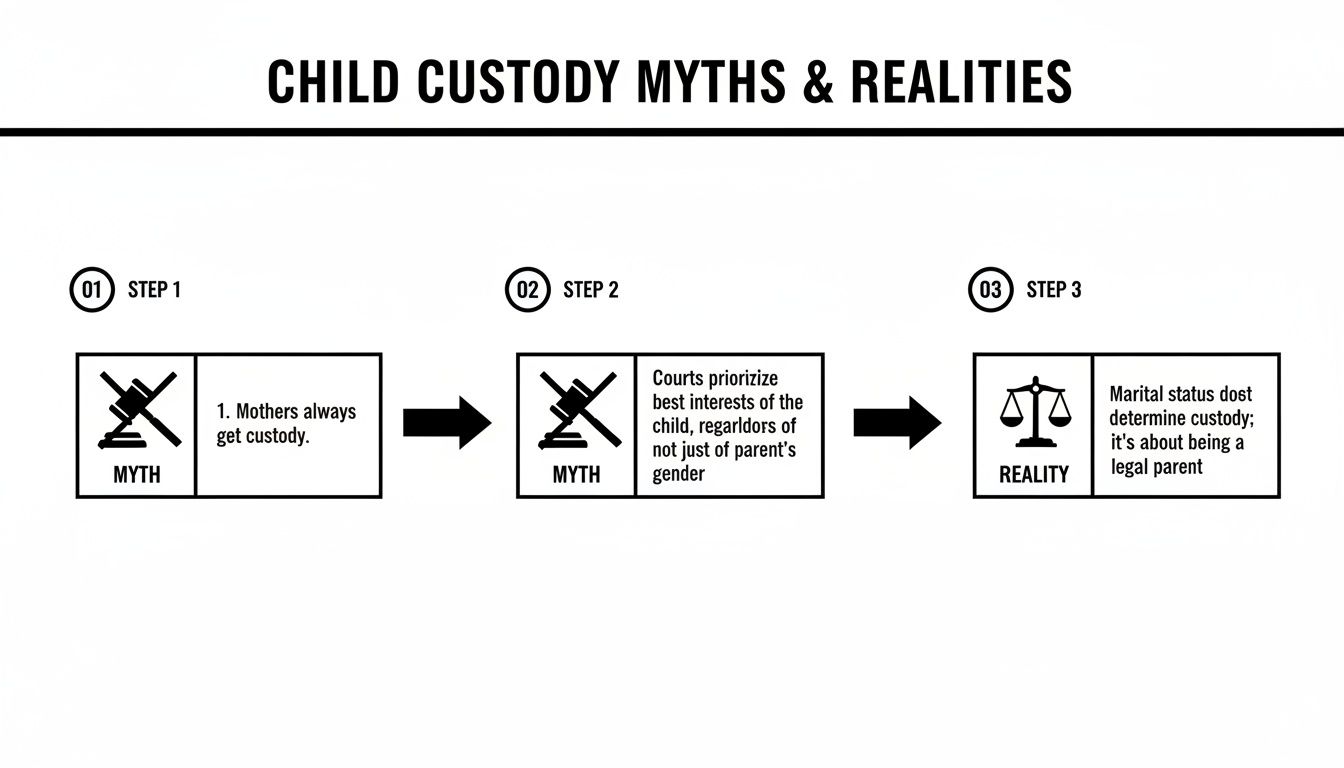
It is crucial that the court’s decision is based on evidence and law, not on outdated myths or assumptions.
How Appeals Differ from Trials: A Step-by-Step Overview
It is vital to understand that an appeal is not a second trial. The process is technical, deadline-driven, and governed by the Texas Rules of Appellate Procedure.
- Notice of Appeal: The first critical step is filing a Notice of Appeal, typically within 30 days of the final order being signed. Missing this deadline will likely forfeit your right to appeal.
- Record Preparation: Your appellate attorney will order the official trial record. This includes the reporter’s record (a word-for-word transcript of the trial) and the clerk’s record (all documents filed in the case). No new evidence is allowed.
- Appellate Briefing: This is the core of the appeal. Your attorney drafts a persuasive legal document called an appellate brief. The brief outlines the trial court’s reversible errors, cites relevant statutes and case law, and argues why the appellate court must reverse the decision.
- Oral Argument: In some cases, the appellate court may schedule an oral argument where attorneys appear before a panel of judges to present their case and answer questions.
- The Decision: The court of appeals will issue a written opinion that can affirm (uphold) the trial court’s order, reverse (overturn) it, or remand it (send it back to the trial court for further proceedings).
Because an appeal can be a lengthy process, life continues. If circumstances change significantly while the appeal is pending, you may need to file for child custody modifications in the trial court.
Common Questions After a Texas Custody Ruling
It is normal to have many questions after receiving a custody order that feels unjust. The world of Texas family law, particularly appeals, is complex. Clear answers are the first step toward determining your next course of action.
Here are some of the most common questions we hear from parents in your situation.
What Kind of Evidence Actually Works for a 50/50 Schedule?
To persuade a judge to order a 50/50 schedule, you must present concrete evidence that this arrangement is in your child's best interest. The most effective evidence demonstrates a history of cooperative co-parenting and logistical feasibility.
Powerful evidence includes:
- A history of shared parenting: Calendars, school records, and testimony showing both parents have always been actively involved in daily tasks like doctor’s appointments, homework, and extracurricular activities.
- Effective communication: Proof that you can co-parent without high conflict. Logs of civil text messages or communications through apps like OurFamilyWizard can be very persuasive.
- Geographic proximity: Evidence that both parents live near each other, and preferably in the same school district, shows that a 50/50 custody plan will not disrupt the child’s routine.
- Work-life balance: A flexible work schedule that demonstrates you are available to meet the child’s day-to-day needs.
If you presented this type of evidence at trial and the judge still ordered a Standard Possession Order without a clear explanation based on the Holley Factors, it could be a reversible error.
Can I Use New Evidence to Appeal a Custody Order?
No. An appeal is not a new trial. The court of appeals is strictly limited to reviewing the evidence that was presented to the trial court. No new information, no matter how compelling, can be introduced on appeal.
If a major event occurs after the final order is signed—such as the other parent relocating or a significant change in your child's needs—the proper course of action is not an appeal. Instead, you would file a petition to modify the custody order in the trial court based on a "material and substantial change in circumstances."
It is crucial to know the difference: An appeal argues the judge made a legal mistake with the old evidence. A modification asks for a new order based on new facts.
How Long Does a Texas Child Custody Appeal Actually Take?
The appellate process is a marathon, not a sprint. From filing the notice of appeal to receiving a final decision from the court of appeals, the process can often take a year or longer.
There is a series of steps with strict deadlines, including preparing the official record and the intensive legal research and writing involved in briefing. Once the briefs are filed, you must wait for the court to review the arguments, potentially schedule oral argument, and write its formal opinion. It is a thorough and deliberate process designed to ensure legal accuracy.
If you believe the court made a mistake in your family law case, our appellate attorneys can help you seek a fair outcome. Contact The Law Office of Bryan Fagan today for a free consultation.