Skip to content
You may feel your case was handled unfairly. When you're convinced a judge got it wrong in your Texas family law case, an appeal can feel like your only path to justice. Winning that appeal is a huge victory. It means a higher court has looked at your case and agreed that a serious legal mistake—a reversible error—was made. But winning doesn't just magically wipe the slate clean. It opens the door to a fair outcome, either by sending your case back to the trial court for a new hearing or, in some situations, by having the appellate court issue the right order itself.
What Comes Next After You Win Your Appeal?
Receiving the news that you've won your appeal is an incredible moment of relief. After the anxiety of the trial and the long, detail-oriented work of the appeal, it’s the validation you were fighting for. A win confirms the higher court found a reversible error—a mistake so significant it likely caused the wrong result in your case. But what happens now? This is a massive step, but it’s rarely the final one.

This is where all that hard legal work really starts to pay off. The appellate court’s decision gives you serious leverage as you head into the next phase of your case. Knowing what can happen next is key to setting realistic expectations and mapping out a strategy with your appellate attorney.
Understanding the Appellate Court's Actions
The victory comes in the form of a formal written opinion from the court of appeals. This document doesn’t just declare you the winner; it lays out exactly why. It points out the specific legal errors the trial judge made and, most importantly, gives instructions on how to fix them. When you win a family law appeal, the outcome typically falls into one of three categories:
- Reversal and Remand: This is the most common outcome. The appellate court vacates the trial court’s incorrect decision and "remands" (sends back) the case for new proceedings that must follow the higher court's specific instructions.
- Reversal and Rendition: In this scenario, the appellate court not only reverses the bad decision but also "renders" the correct judgment it believes the trial court should have made in the first place. This effectively ends the dispute on that issue.
- Modification: Sometimes, the court of appeals just tweaks one part of the original order. It might correct a mathematical error in a complex property division, for example, but leave the rest of the judge's orders untouched.
The outcome in your case depends entirely on the type of reversible error that was made and the evidence already in the appellate record in a Texas family law case. Your win proves the fight was worthwhile and sets the stage for achieving the fair and final resolution you deserve.
Remand vs. Rendition: Two Paths to a Fair Outcome
After the immense relief of winning a family law appeal, the next question is always the same: So, what happens now? The victory is huge, but it doesn't automatically close your case. The appellate court must give the trial court instructions on how to fix the error.
This is where you'll hear two very important legal terms: remand and rendition. They might sound alike, but they represent two completely different roads forward for your case. Knowing which path you're on is key to managing your expectations and planning what comes next with your attorney.

Remand: A Second Chance for a Correct Ruling
Most of the time, a successful appeal results in a remand. Think of it as the appellate court sending your case back down to the original trial judge with a note attached that says, "You got this part wrong. Do it again, and this time, follow these specific instructions."
This isn't just a full reset of the original trial. The trial judge is now legally bound to operate within the specific guidelines of the appellate court's opinion. They cannot simply repeat their previous mistake.
For instance, if the trial court misapplied the law when dividing your community property, the case would be remanded with orders for the judge to reconsider the property division using the correct legal standard. This could mean the judge will need to:
- Hear specific, limited new testimony on certain financial details.
- Review the old evidence again, but through the new legal lens provided by the higher court.
- Issue a brand-new order that follows the appellate court’s ruling.
A remand is essentially a second chance at getting a fair result. It forces the trial court to address its specific error and re-examine the issues on solid legal footing.
Rendition: A Direct and Final Judgment
In rarer cases, the court of appeals might "render" a judgment. Rendition is a much faster and more final fix. Instead of sending the case back with instructions, the appellate court simply issues the order that the trial court should have issued in the first place.
This typically happens when the mistake was a clear-cut error of law and all the facts needed to make the right call are already in the trial record. There's no need for new evidence or more hearings. The appellate court just steps in and corrects the final score, so to speak.
For example, if a judge correctly used undisputed income numbers but miscalculated the final child support amount, the appellate court could simply render a new judgment with the properly calculated support payment. This is also common when a trial court incorrectly applies a statute, and the proper application leads to only one possible outcome.
Rendition is the most efficient outcome, but it’s less common than a remand because many appeals involve factual disputes that need to be re-evaluated by the trial court. Understanding whether a remand or rendition is the likely outcome is a crucial conversation you'll have with your appellate lawyer. You can find more details on these procedures in this guide on appealing a judgment in Texas.
The Real-World Impact on Custody and Financial Orders
So, you won your appeal. What does that mean for your daily life? That legal victory isn't just a piece of paper; it’s the key to making real, tangible changes in your family's future. The appellate court’s ruling can completely reshape your custody schedule and financial structure.
Let's get practical. How does an appellate win actually change things for you and your kids on a Monday morning or when the bills are due? The impact is often profound, giving you the power to undo the specific harm caused by the trial court's original mistake.
How an Appeal Changes Child Custody Orders
For most parents we work with, appealing a bad custody order feels like the only way to truly protect their child’s best interest. When you win, you're not just proving a legal point; you're forcing the system to take a second look at a flawed decision and create a safer, more stable situation for your child.
For instance, a victory in the court of appeals can lead to significant changes:
- Restoring Possession Time: If the trial court drastically cut back your time with your child based on an abuse of discretion, an appeal can pave the way for a new possession schedule that gives you that meaningful time back.
- Removing Unjust Geographic Restrictions: An unfair geographic restriction can stop you from taking a better job or moving closer to family. A successful appeal can get that restriction lifted, giving you back control over your life.
- Correcting Decision-Making Rights: A win could overturn a ruling that stripped you of your right to make key decisions about your child’s education or medical care, especially if the judge’s initial decision lacked supporting evidence. You can explore more about how we handle child custody matters in Texas.
A successful appeal is not just about getting more time; it's about ensuring the final custody order truly serves your child's well-being and is grounded in Texas law, not a judge's error.
Correcting Unfair Financial Judgments
Nothing creates long-term stress like an unfair financial ruling in a divorce. When a trial court makes an error in dividing property or calculating support, it can saddle one person with an impossible burden. An appeal is your chance to get that financial mistake fixed for good.
Think of it in "before and after" terms. Before the appeal, you might have a divorce decree that incorrectly labeled your separate inheritance as community property. After a successful appeal, the case can be sent back to the trial court with instructions to re-do the marital property division correctly, protecting your separate assets.
The same goes for support orders. An appeal can reverse an improper spousal maintenance award that wasn't based on evidence or was a misreading of the law, freeing you from an unsustainable obligation. It can also fix errors in child support calculations, ensuring the final amount is fair. Ultimately, winning your appeal can transform a financially grim future into one that is equitable and secure.
How the Texas Appellate Process Works
To really grasp what a win means, it helps to understand the journey you just completed. A Texas family law appeal isn't a do-over of your original trial. Think of it less like a new trial and more like a detailed legal audit.
The appellate court doesn't call witnesses or look at new evidence. Instead, its job is to comb through the records of what already happened in the trial court—the reporter's record and clerk's record—searching for reversible error. This is a mistake so critical that it likely caused the judge to make the wrong decision. The entire appeal hinges on identifying and proving this error, which takes an attorney with a deep understanding of appellate law to spot where a judge misapplied the Texas Family Code or abused their discretion. For a closer look at the nuts and bolts, you can read our guide on Texas appellate procedure for family law.
Strict Rules and Key Procedural Steps
The path through the Texas appellate courts is governed by a strict set of rules and deadlines under the Texas Rules of Appellate Procedure. It all starts by filing a Notice of Appeal, the official document that informs the courts and the other party that you are challenging the trial court's judgment. Missing this first deadline can completely shut the door on your right to appeal.
After that, the real work begins on the appellate brief. This isn't just a summary; it's a powerful legal argument your attorney constructs to persuade the appellate judges. The brief meticulously lays out the trial judge's error and explains, using legal precedent, exactly why that error led to an unjust outcome. It is the heart and soul of your appeal, and it's what the judges will study before making their decision. This process of legal writing and argument is known as briefing.
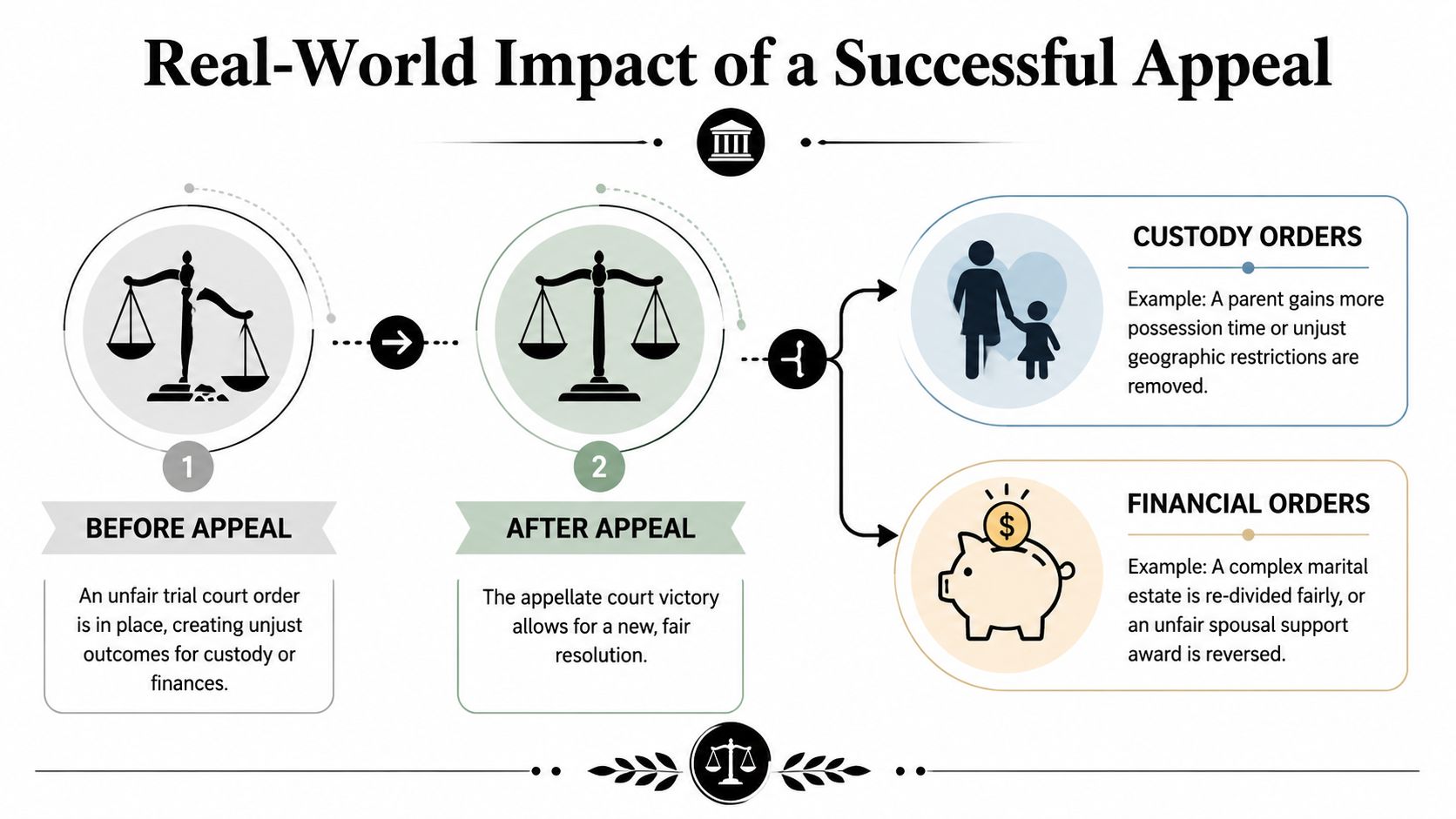
As you can see, winning can have a direct and powerful impact on the final orders for both custody and financial matters, restoring balance and fairness.
Deadlines and the Standard of Review
When it comes to timing, Texas law is precise. You generally have just 30 days from the day the judge signs the final order to file your notice of appeal. That window can extend to 90 days, but only if you file certain post-trial motions, like a motion for a new trial.
Once the process begins, the focus is entirely on legal errors, not re-litigating facts. The appellate court reviews the case based on a specific standard of review, which determines how much deference is given to the trial judge. For example, a trial court's decisions in child custody cases are often reviewed for an "abuse of discretion," which means the appellate court will only reverse if the trial judge acted unreasonably, arbitrarily, or without reference to any guiding rules or principles. This is a high bar, which is why specialized experience in appellate advocacy is essential.
Can the Other Party Appeal Your Win?
You’ve just been through the long and difficult process of winning your appeal. The last thing you want to hear is that the fight might not be over. So, can the other party try to appeal your victory?
The short answer is yes, they can try. But it is an incredibly rare and difficult path.
When a party loses their case at the court of appeals, their only remaining option is to file a petition for review with the Supreme Court of Texas. Unlike the court of appeals, which must review a properly filed appeal, the Supreme Court has discretionary review. This means they get to pick and choose the very small number of cases they want to hear each year.
The High Bar for Supreme Court Review
For a child custody or divorce case to even get a look from the Texas Supreme Court, it typically needs to present a novel legal question or address a major conflict between how different appellate courts are interpreting the law. Simply being unhappy with the outcome is not nearly enough to get their attention.
The reality is that for the overwhelming majority of Texas family law cases, the court of appeals' decision is the final word.
The path to the Supreme Court is designed to be steep. This ensures the Court can focus its limited resources on the most critical legal issues affecting the entire state. While the appellate process itself can add time to a case, we focus on identifying clear, reversible errors from the very beginning to build the strongest possible case. You can learn more about the realities of winning a child custody appeal.
While we are always prepared to defend your victory at the highest level, you can take comfort in knowing the odds are overwhelmingly in your favor. Your win at the court of appeals is almost always the end of the line, allowing you to finally move forward with a just result.
Securing Your Victory After a Successful Appeal
Winning an appeal feels like crossing the finish line, but in Texas family law, it’s actually the key that gets you back on the right track. You’ve just gone through the incredibly difficult process of proving a judge made a serious legal error. That win is a huge step, but the work isn't over. The next phase—turning that appellate victory into a concrete, fair result—is just as important.

From Appellate Win to New Orders
An appellate victory gives you powerful leverage. The higher court has sided with you, and now the case is likely heading back to the trial court with specific instructions. This is a critical moment where having an experienced appellate lawyer is indispensable. They ensure the trial judge follows the appellate court's roadmap to the letter, translating your hard-won appeal into a final, enforceable order that reflects a just outcome.
An appellate win doesn’t just end the fight; it resets the terms. It puts you in a much stronger position to get a final outcome that truly protects your children, your finances, and your future.
Our appellate team knows this process inside and out. We’ve been through the meticulous work of winning the appeal and the strategic follow-through required to make that win count back in the trial court. We will see your case through to its proper conclusion, making sure the new orders are not only fair but also correctly documented and enforced.
Part of this process involves managing any financial aspects that can come up, like the potential need to post a supersedeas bond in a Texas family law appeal to pause the trial court's original orders during the appeal. It's all part of a comprehensive strategy to restore balance and ensure the final judgment reflects the justice you fought so hard to achieve.
If you believe the court made a mistake in your family law case, our appellate attorneys can help you seek a fair outcome. Contact The Law Office of Bryan Fagan today for a free consultation.