You may feel your case was handled unfairly. In family court, that feeling often comes after a ruling that changes where your child lives, how property gets divided, or whether a protective order stays in place.
When that happens, many people ask the same question in plain English. What is an appellant in an appeal? In Texas, an appellant is the party who takes the next formal step and asks a higher court to review whether the trial court made a legal mistake.
That role matters. An appeal isn't about starting over. It's about using a structured legal process to test whether the trial court followed the law, applied the right standards, and reached a judgment supported by the record.
An Unfair Outcome Is Not the Final Word
A parent leaves court after a custody ruling and feels blindsided. A spouse reads a divorce decree and believes the property division doesn't match what happened at trial. Someone subject to a protective order thinks the judge relied on the wrong legal standard. These are the moments when people begin to wonder whether the trial court's decision can be challenged.
Sometimes the answer is yes. Not because the result feels harsh, but because the law gives a losing party a path to seek review. That party becomes the appellant.
Being an appellant means you're the person asking a higher court to examine the trial court's work. You're not asking for sympathy. You're asking for legal review. That difference is important, especially in Texas family law, where outcomes affect parenting time, support, property, and personal safety.
Practical rule: Appeals focus on legal error, not general unfairness.
An appeal can serve an important fairness function. Trial judges make hard decisions quickly and under pressure. Most rulings stand. But when a court misapplies the law, excludes critical evidence, applies the wrong standard, or signs a judgment that conflicts with Texas law, the appellate process exists to correct that kind of error.
This is why many people searching for what is an appellant in an appeal are really asking a deeper question. They want to know whether there is still a lawful, strategic way to be heard.
That question deserves a careful answer. The process is real. The deadlines are strict. The standards are demanding. But an unfavorable judgment isn't always the end of the story.
Defining Your Role in the Appeal Process
Under Texas Rules of Appellate Procedure 3.1(a), an appellant is the party who files the notice of appeal, and the appellee is the party adverse to the appellant. In plain language, the appellant starts the appeal, and the appellee responds to defend the trial court's judgment.
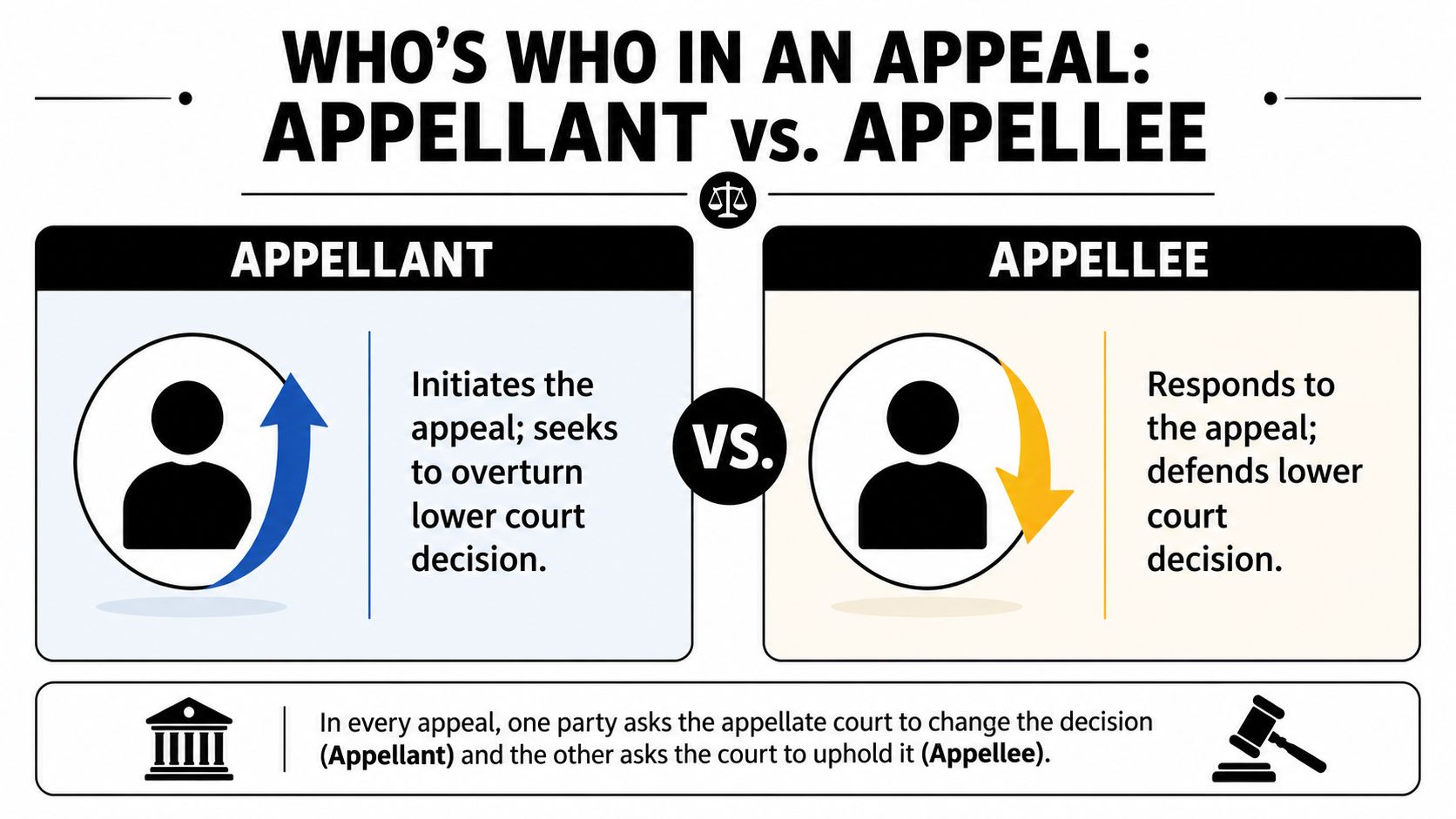
If you lost at trial and want review by a higher court, you're usually the appellant. If the other side wants the judgment left in place, that party is the appellee. In family cases, that could mean one parent appealing a conservatorship ruling while the other parent defends it, or one spouse challenging a divorce decree while the other argues the decree should stand.
Appellant vs appellee at a glance
| Role | Appellant | Appellee |
|---|---|---|
| Who starts the appeal | Files the notice of appeal | Does not start the appeal |
| Main goal | Seeks to overturn or modify the ruling | Defends the ruling |
| Position in the case | Claims the trial court made reversible error | Argues no reversible error occurred |
| Primary filing | Appellant's brief | Appellee's brief |
The first filing that gives life to the appeal is the notice of appeal. If you want a plain-language explanation of that document, this guide on what a notice of appeal does in a Texas family case is a useful starting point.
What the role really requires
Being the appellant doesn't just mean being unhappy with the result. It means taking on the burden of showing the appellate court that the trial court made a mistake that the law recognizes as serious enough to justify relief.
That is why the role is demanding. The appellant must identify the issue, tie it to the trial record, apply the right legal authorities, and explain why the error mattered. In practice, that work often involves focused appellate representation, such as a Texas Family Law Appeals Lawyer, which handles challenges to final family law orders for legal error.
The appellant is the party asking for correction. The appellee is the party asking the appellate court to leave the judgment alone.
The Appellant's Journey Through the Texas Appeal Process
Appeals feel abstract until you break them into steps. For a Texas family law appellant, the path usually begins very quickly after the final judgment is signed.
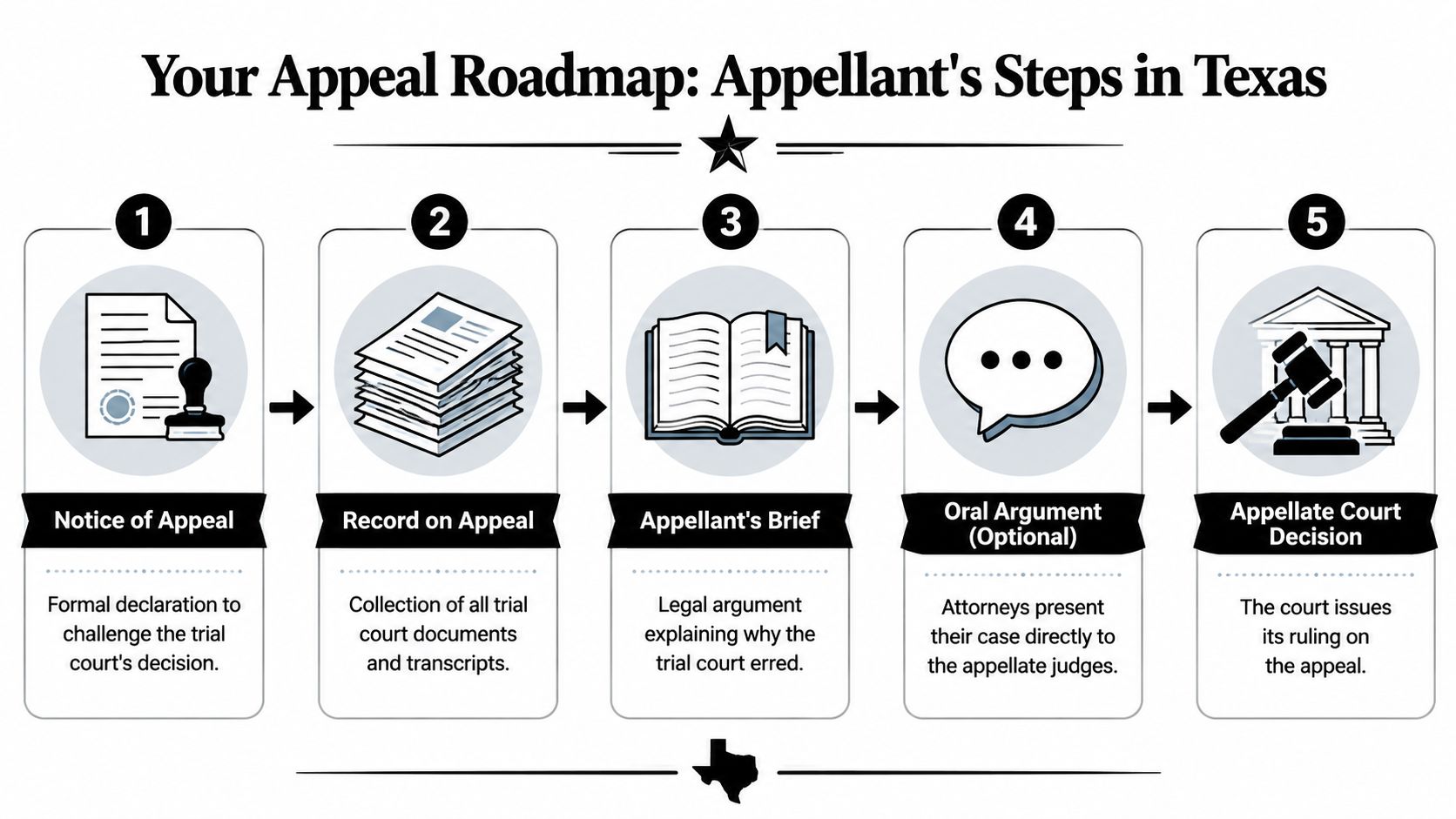
Step one starts the clock
In Texas civil cases, including family law disputes, the deadline to file a notice of appeal is 30 days after the trial court signs the final judgment. If a timely motion for new trial, motion to modify judgment, or request for findings of fact and conclusions of law is filed, that deadline extends to 90 days after the judgment was signed under TRAP 26.1.
Those deadlines are strict. Missing them can end the appeal before it begins.
A divorce decree, final custody order, property division judgment, or final enforcement order may trigger the deadline. In most situations, appeals are tied to a final judgment. That means the court has issued the conclusive ruling that ends the case, not just an interim disagreement during litigation.
The appellate court reviews a record, not a fresh case
After the notice is filed, attention turns to the record on appeal. This usually includes the clerk's record and the reporter's record. In everyday terms, that means the filed documents, orders, exhibits admitted below, and the transcript of what happened in court.
This process overview from the Texas family law appeal process can help you understand how those pieces fit together.
A short video can also make the sequence easier to visualize:
The brief does most of the heavy lifting
The most important document in many appeals is the appellant's brief. A brief isn't a short note to the court. It's a formal written argument that explains:
What the trial court did
The brief points to the ruling, order, or legal decision being challenged.Why it was error under the law
The appellant must connect the issue to statutes, rules, and case law.Why the error mattered
The court needs a reason to believe the mistake affected the outcome.
In family law appeals, the brief might challenge the legal basis for a conservatorship ruling, a property characterization decision, or the exclusion of key evidence in a support dispute. Precision matters. So does judgment. A weak issue can distract from a strong one.
Good appellate briefing is selective. It doesn't argue everything. It argues the points that the record and law can actually support.
Oral argument may happen, but not always
Some appeals include oral argument, where lawyers answer questions from the appellate judges. Not every case gets it, and not every case needs it. Oral argument doesn't replace the brief. It usually refines what the judges have already read.
Then the court issues its decision. It may affirm the judgment, reverse part of it, send the case back for further proceedings, or modify the result in a limited way. For the appellant, that outcome depends far less on emotion than on deadlines, record preparation, and disciplined legal analysis.
Identifying Reversible Errors in Your Family Law Case
Not every bad result is an appealable error. The law draws a line between losing and losing because the court made a legal mistake that changed the outcome.
A reversible error is a legal mistake that affected the judgment. To justify reversal, an appellant must show both the error and the harm it caused. Examples include misinterpreting a statute, improperly admitting or excluding critical evidence, applying the wrong legal standard, or signing a judgment that conflicts with Texas law, as explained in this discussion of how reversible error affects a Texas appeal.
What reversible error looks like in family court
In a Texas divorce or custody case, reversible error often appears in concrete ways:
Wrong legal standard in a custody ruling
If a court applies the wrong rule when deciding conservatorship or possession, the issue may be legal, not just factual.Improper evidence ruling
If the judge excludes critical evidence or admits evidence that should not have been considered, and that decision likely affected the result, the issue may support appeal.Property division based on a legal mistake
If a court mischaracterizes property or enters a division that conflicts with governing law, the appellant may have a legal basis to challenge the decree.Procedural error that affects fairness
If the court denies a party a fair chance to present the case within the rules, the harm may be significant enough to matter on appeal.
Plain-English terms that often confuse clients
Two phrases come up often in Texas appeals.
Abuse of discretion means the trial court had a range of lawful choices, but made a decision outside that range. It does not mean the appellate court disagrees. It means the ruling wasn't legally sound under the governing standard.
Briefing means the formal written presentation of legal arguments to the appellate court. It is where the appellant explains the issues, cites the record, and applies the law.
Another phrase worth understanding is standard of review. That is the lens the appellate court uses when evaluating the issue. Some rulings get more deference than others. In family law appeals, that lens can shape the entire case. The article on Standards of Review in Texas Family Appeals explains why.
A strong appeal usually turns on a narrow question. What legal rule applied, how the trial court used it, and whether that error changed the result.
The court won't reverse just because the case was hard
Family law cases are emotional because the stakes are personal. But appellate courts don't reverse judgments solely because the consequences are painful. They reverse when the appellant proves a legal mistake that mattered.
That distinction is difficult, but it protects fairness. It respects the trial court's role while preserving a remedy for real legal error. For many clients, understanding that line is the first strategic step toward deciding whether an appeal makes sense.
An Appeal Is Not a Do-Over Common Misconceptions
Many disappointed litigants think an appeal is their chance to tell the story again, bring in the missing witness, or hand the appellate court new documents that the trial judge never saw. That isn't how this process works.
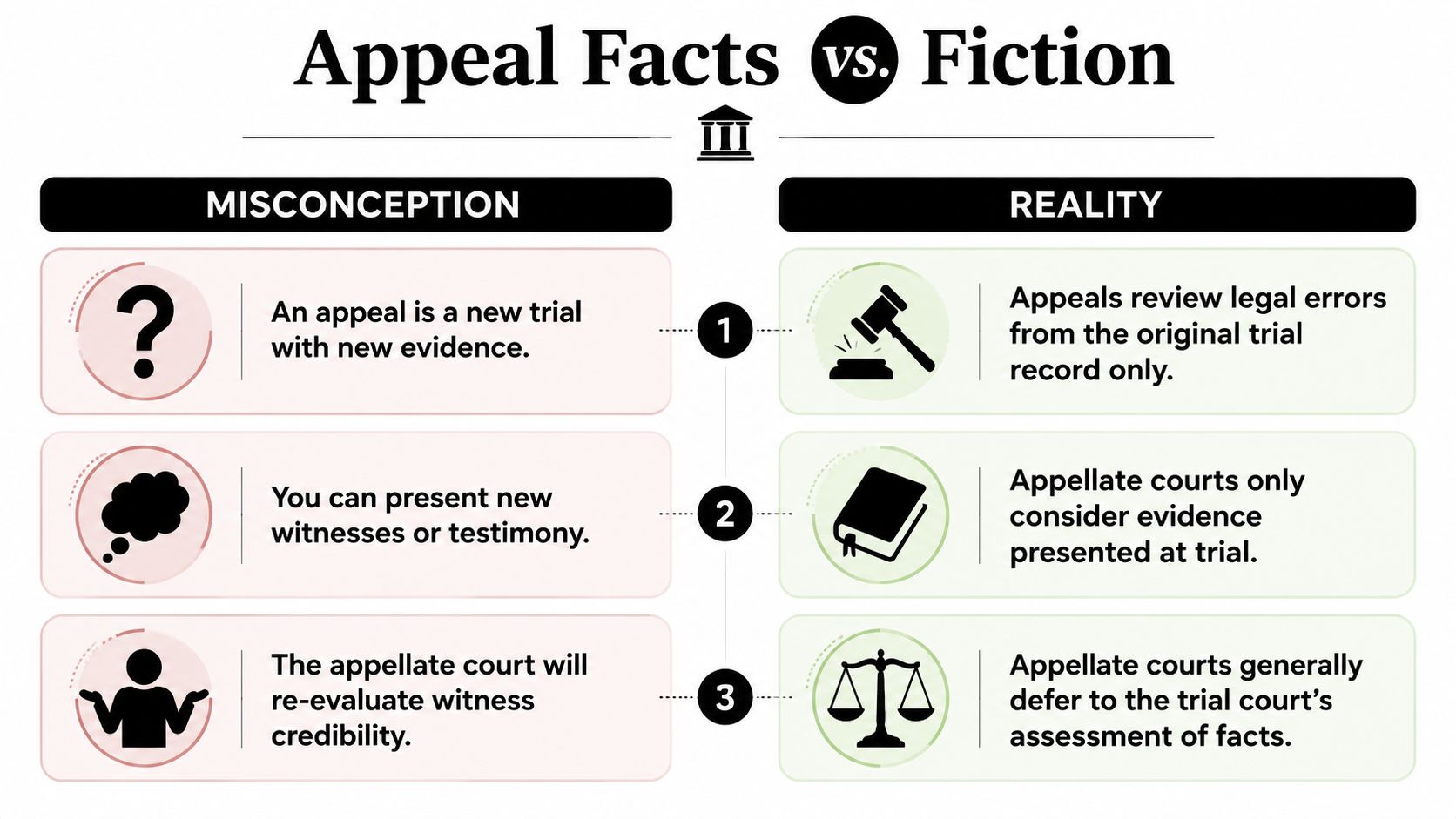
Appellate courts decide questions of law, not new questions of fact. An appellant must prove reversible error based only on the existing record, meaning the transcripts and documents from the trial court. New evidence isn't part of that review, as explained in this discussion of the record-based nature of appeals.
Facts versus fiction
| Misconception | Reality |
|---|---|
| An appeal is a new trial | An appeal reviews legal errors from the original case |
| You can bring new witnesses | The appellate court reviews the existing record |
| The judges will decide who was more believable | Appellate courts generally defer to trial-level fact decisions |
That rule frustrates people, especially in custody disputes. A parent may say, "I have texts the judge never saw," or "My child can explain what really happened now." Those facts may feel important, but they usually aren't something the appellate court can consider in a standard appeal.
Filing the appeal doesn't automatically pause the order
Another common misunderstanding concerns enforcement. People often assume that once they file an appeal, the trial court's order stops. It usually doesn't.
A custody order, support obligation, or property directive may remain in effect unless a separate request is made and granted to stop enforcement. That issue can be urgent in family law because daily life doesn't pause while an appellate court reviews the case.
If the order affects possession, money, or property right now, ask immediately whether a stay is available.
Understanding these limits doesn't weaken an appeal. It makes the appeal more realistic. Clients make better decisions when they know what the appellate court can do, what it can't do, and what must be handled separately while the case is under review.
How Texas Rules Shape Your Role as an Appellant
Texas appellate procedure is strict for a reason. The rules create a fair process, but they also require precision. One of the most important ideas is preservation of error.
That phrase means the complaint raised on appeal usually must have been raised properly in the trial court. In many cases, the trial lawyer had to object, request a ruling, or otherwise make the issue clear enough for the judge to address it. If that didn't happen, the appellate court may decide the issue wasn't preserved for review.
Why the trial record matters so much
This is one reason appellate lawyers study transcripts line by line. A client may strongly believe the judge was wrong, but the next question is whether the legal complaint was preserved in a form the appellate court can review.
That makes the record more than a history of the case. It becomes the boundary of the appeal. A missed objection, an unclear ruling, or an issue not presented to the trial court can sharply limit what the appellant can argue.
For that reason, many families benefit from a focused review of the record under Texas appellate procedure in family law cases.
Final judgments and limited exceptions
Appeals are generally tied to final judgments. The appellant is usually the party who lost at trial and seeks review of the conclusive decision, such as a divorce decree, although limited exceptions allow some interlocutory appeals during an ongoing case, as described in Cornell Law School's explanation of final judgments and interlocutory appeals.
In family law, that distinction matters. Many people want to appeal temporary orders immediately. Sometimes the law allows review of a mid-case ruling, but often the appeal must wait until the court signs a final order.
That timing rule can feel unfair when a temporary ruling causes immediate hardship. Still, the system limits piecemeal appeals so cases can move toward final resolution. A careful review of the order, the posture of the case, and the preserved issues is what tells you whether the person challenging that ruling can act now as an appellant or must wait for a final judgment.
When to Consult a Texas Appellate Attorney
You leave the courthouse with a signed family court order in your hand, and two questions start running at the same time. Was this wrong, and do I still have any way to challenge it?
That is usually the point to call a Texas appellate attorney.
In family law, people often wait because they are exhausted, angry, or hoping the problem will settle itself. That hesitation can cost you options. Appeal deadlines are short, and the first days after judgment often shape what can still be done.
A good consultation does more than define the word appellant. It answers the practical questions a parent or former spouse has. Is this order final? Is an appeal allowed now, or do you have to wait? Did the trial court make a legal mistake the court of appeals can review? Did anything happen in the courtroom that limits the arguments you can raise?
An appeal works like a quality-control review, not a second trial. An appellate lawyer examines the written order, the reporter's record, the clerk's record, the deadlines, and the legal standards that will govern review. That early assessment can bring some calm to a hard moment, but it can also deliver difficult news. Sometimes the law does not offer a strong appeal even when the result feels very unfair.
That honesty matters.
The Law Office of Bryan Fagan, PLLC is a Texas family law appellate practice that evaluates final family law orders for legal error and appellate viability.
If you believe the court made a mistake in your family law case, get the order and deadlines reviewed as soon as possible. For a Texas family law appellant, timing starts the process, but strategy, preservation, and the record usually decide whether the appeal has a real chance to help.