You may feel your case was handled unfairly. The judge may have signed orders about your children, your home, or your finances, and you walked away thinking the court missed something important.
That feeling is common after a hard family law case. Sometimes the problem is a legal mistake in the courtroom. Sometimes the problem happened outside the courtroom, such as lack of notice or conduct that kept one side from presenting a real defense. Those are not the same problem, and Texas law does not give them the same remedy.
In the appeal vs. bill of review in Texas family court question, the right answer usually turns on one issue first. What deadline has already passed? If the ordinary appellate window is still open, a direct appeal may be the proper path. If that window has closed, a bill of review may be the only realistic way to attack the judgment, but only in limited situations and only with the right proof.
Feeling Your Family Court Ruling Was Unjust
A parent loses primary custody after a short hearing and believes the judge relied on the wrong legal standard. A spouse learns months later that a divorce decree was entered after papers were sent to an old address. Another person agrees the hearing happened, but still believes the outcome was unfair because the judge believed the other side's testimony.
Those situations feel similar from the client's side. All three people feel wronged. But Texas courts treat them very differently.
If you think the court made a mistake, the first step is to separate an unfair result from a legally correctable result. A direct appeal asks a higher court to review what happened in the trial court. A bill of review asks the same trial court to set aside a judgment that is already final and no longer appealable.
For many families, the hardest part is not understanding the words. It's understanding the timing. People often spend weeks asking whether they should “appeal,” when the key question is whether they still can. If that deadline has already expired, the conversation changes fast.
Practical rule: The right remedy depends less on how upset you feel about the judgment and more on what went wrong, when it happened, and whether the problem appears in the court record.
If you're still trying to understand whether your order can be challenged at all, this guide on appealing a family court decision in Texas gives a helpful starting point. The key is acting quickly and choosing the right procedural tool before another deadline closes.
The Path of a Direct Appeal Explained
A direct appeal is a formal request for a higher court to review a final judgment for legal or procedural error. It is not a second trial. You don't bring in new witnesses, add new exhibits, or ask the appellate court to re-hear the facts from scratch.

Texas appellate data shows why that distinction matters. In family cases, the courts of appeals reversed 21% of cases, while appeals from jury-verdict judgments statewide reversed 27% of the time, according to Texas appellate reversal data discussed by the Houston Law Review. That tells clients something important. Appeals are real remedies, but they are focused reviews of error, not broad do-overs.
What the appellate court reviews
The appellate court reviews the record. That usually includes the clerk's record and, if one was made, the reporter's record. In plain English, the record is the paper trail and hearing transcript from the trial court.
A few terms matter here:
- Reversible error means a legal mistake serious enough to justify changing the result.
- Abuse of discretion means the trial court acted outside the range of reasonable choices allowed by law.
- Briefing means the written legal arguments filed by the parties, explaining what the trial court did and why the judgment should be affirmed or reversed.
What works on appeal, and what does not
A direct appeal works best when the mistake is visible in the trial court record. Common examples in family cases include:
- Wrong legal standard: The judge applied the wrong rule in a custody, property, or enforcement dispute.
- Procedural error: The court admitted or excluded important evidence in a way that likely affected the outcome.
- Unsupported ruling: The order goes beyond what the pleadings, evidence, or governing law allowed.
It usually does not work to say, “The judge should have believed me instead.” Appellate courts give trial judges room to resolve credibility disputes because trial judges saw the witnesses in person.
Appeals are strongest when counsel can point to a specific ruling, a specific objection, and a specific part of the record showing harm.
Why deadlines shape everything
Appeals run on strict deadlines under the Texas Rules of Appellate Procedure. Missing the notice deadline can close the ordinary path to review. That's why clients need to evaluate options early, order the record promptly, and identify issues before the file goes stale.
For a fuller breakdown of filings, records, and briefing stages, review this step-by-step Texas family law appeal process timeline.
The Extraordinary Remedy of a Bill of Review
A bill of review is not an appeal. It is a separate, equitable action filed in the same court that signed the original judgment. It exists for cases where the judgment is already final and the normal appeal process is gone.

Texas family law guidance describes a bill of review as an equitable, independent action used only after a judgment is no longer appealable, and in most cases it must be filed within four years of the judgment date. To succeed, the petitioner generally must prove a meritorious claim or defense, prevention from presenting that claim by fraud, accident, or wrongful act, and lack of negligence by the petitioner, as explained in this discussion of Texas bills of review in family law cases.
The three-part burden
Many petitions fail at this point. A bill of review has a high bar.
- You need a real underlying claim or defense. It's not enough to say the result feels unfair.
- You must show you were prevented from presenting that claim. The cause must be fraud, accident, wrongful act, or a similar recognized problem.
- You must show the failure was not your fault. If your own negligence caused the problem, relief becomes much harder.
That third point surprises many people. Courts usually won't reopen a final judgment just because someone ignored papers, missed a hearing, or waited too long to act without a legally sufficient reason.
Extrinsic fraud versus intrinsic fraud
The fraud issue matters a lot. Texas authorities commonly distinguish extrinsic fraud from intrinsic fraud in this setting.
- Extrinsic fraud is conduct that keeps a party from fully participating in the case at all.
- Intrinsic fraud usually means false testimony, forged evidence, or other issues presented within the case itself.
In family cases, authorities often note that extrinsic fraud can support bill-of-review relief, while intrinsic fraud such as perjury usually cannot. That is why a bill of review may help when someone was kept out of court, but not when they were present and only believe the other side lied.
A service problem is a common example. If you suspect the judgment was entered without proper notice, this article on appealing cases involving improper service in Texas is a useful place to start.
Before going further, this short video gives a practical overview of how the remedy works in family law matters:
Key Differences Between an Appeal and a Bill of Review
| Criterion | Direct Appeal | Bill of Review |
|---|---|---|
| Where it is filed | In the appellate court after the trial court signs a final judgment | In the same trial court that signed the original judgment |
| Primary purpose | Review legal or procedural error in the existing case | Attack a final judgment that is no longer appealable |
| What the court looks at | The existing trial court record | New pleadings and evidence offered in the new action |
| New evidence allowed | No, generally the case is limited to the record | Yes, because it is a separate action |
| Typical issue | Wrong legal standard, harmful evidentiary ruling, abuse of discretion | Lack of notice, extrinsic fraud, wrongful act, official mistake |
| Main question | Did the trial court commit reversible error? | Should the final judgment be set aside in equity? |
| Who decides | Appellate judges | Trial judge, and sometimes factual disputes may require further proceedings |
| Timing focus | Short appellate deadline after final judgment | Used after appeal deadlines have expired, often subject to separate limitations principles |
Different courts, different jobs
A direct appeal goes to a higher court. That court reviews the trial judge's work. It does not manage the original family case.
A bill of review stays in the trial court because the argument is different. You are not asking a higher court to grade the original ruling on the existing record. You are asking the original court to set aside a final judgment because equity and due process require it.
Different evidence, different proof
This is one of the biggest practical differences in the appeal vs. bill of review in Texas family court analysis.
On appeal, the record controls. If the error is not preserved in the file, transcript, exhibits, or signed orders, the argument may be weak or unavailable.
In a bill of review, evidence outside the old record can matter. Affidavits, service records, communications, proof of location, or documents showing how a party was kept out of the case may become central.
The question on appeal is often, “What did the judge do on this record?” The question in a bill of review is often, “Why was this judgment entered without a fair chance to defend?”
Different risks for the client
An appeal can fail even when the client feels morally right, because appellate courts don't reverse merely to reach a better result. They reverse for legally significant error.
A bill of review can fail even when the client never liked the judgment, because finality matters. Texas courts expect strong proof, not suspicion, and they examine whether the petitioner acted diligently once the problem became known.
Different strategic value
Clients often assume a bill of review is a fallback version of an appeal. It isn't. In some narrow settings, it may even be strategically better than a different post-judgment route because it targets a final judgment in the same court and allows proof outside the prior record. But that advantage exists only if the facts truly fit the remedy.
The wrong filing wastes time and money. Worse, it can burn the little time you still have.
Choosing Your Path Strategic and Tactical Considerations
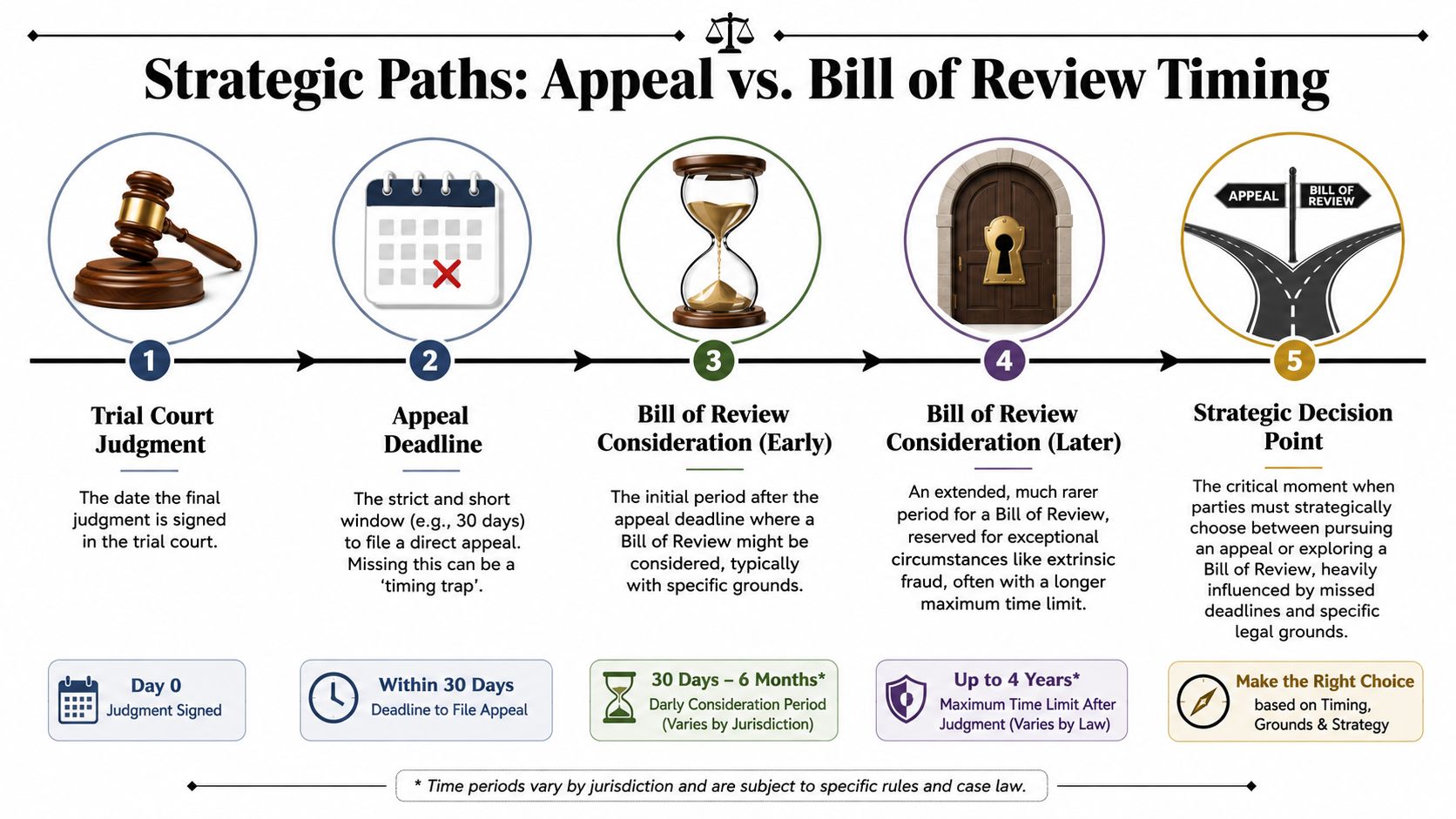
The hardest part of this decision is usually not legal theory. It's timing.
Texas guidance highlights the timing trap. A bill of review is generally used when appeal deadlines have expired and requires proof of a meritorious defense plus fraud or wrongful act, unmixed with the petitioner's negligence. That means the fundamental issue is often not “appeal or bill of review” in the abstract, but which deadline has been missed and why, as discussed in this overview of timing and strategy in Texas bills of review.
Ask these questions first
When a client calls after a family court loss, these are usually the first decision points:
- Is the judgment final? Some orders are final and appealable. Others are temporary or require a different response.
- Is the ordinary appellate deadline still open? If yes, counsel should evaluate an appeal immediately.
- What caused the unfair result? A legal mistake points toward appeal. A lack of notice or outside interference may point toward a bill of review.
- Can the problem be shown from the existing record? If not, an appeal may be the wrong tool.
- Did the client contribute to the problem? That question matters sharply in bill-of-review cases.
When an appeal is usually the better tool
Appeal is usually the better path when the complaint is that the judge got the law wrong. That includes issues like applying the wrong burden, misreading a statute, entering relief unsupported by the pleadings, or making a harmful evidentiary ruling.
If the problem happened in the courtroom and was preserved in the record, that is appellate territory.
When a bill of review may be the only realistic option
A bill of review often enters the picture after the appellate clock has run out and the client later learns there may have been a due-process problem. Examples include defective service, a hearing that went forward without proper notice, or extrinsic fraud that kept a party from presenting a defense.
A missed appeal deadline does not automatically create a bill-of-review case. It only shifts the analysis to whether equity allows the judgment to be reopened.
One practical caution
Some litigants spend valuable time arguing over labels. That's a mistake. The better approach is to reconstruct the timeline, gather the signed orders, notice documents, hearing dates, and service papers, then match the facts to the proper remedy.
That is also where counsel can evaluate options such as appellate review, post-judgment motions, restricted appeal issues, or a bill of review. The Law Office of Bryan Fagan, PLLC handles Texas family law appellate matters, including review of records and post-judgment strategy, but any lawyer assessing these issues should begin with the same task. Pin down the dates, the record, and the reason the client was denied a fair chance.
Real-World Scenarios When to Appeal or File a Bill of Review
A few examples make the distinction clearer.
The judge misclassified property
In a divorce, the court awards one spouse property that the other spouse believes was separate property under Texas law. The complaint is that the court applied the law incorrectly based on the evidence presented at trial.
That is usually an appeal issue. The argument focuses on legal error in the judgment and the evidence in the trial record.
A parent never received proper notice
A parent learns later that conservatorship orders were entered after papers were sent to an address where the parent no longer lived. The parent did not appear because the parent did not know the case was moving forward.
That may support a bill of review if the facts and proof show a true notice or service problem, and if the parent was not negligent in failing to appear.
A spouse says the other side lied under oath
During a divorce trial, one spouse believes the other gave false testimony about assets. Both sides were present, both had counsel, and both had the chance to question witnesses.
That is often a hard case for a bill of review. If the complaint is that the other party lied during the hearing, courts often treat that as the wrong kind of fraud for this remedy. The proper path may have been a direct appeal, depending on the record and timing. In some cases, neither path is strong.
A party just dislikes the result
A parent says, “The judge believed my ex and not me.” There is no clear legal error, no preserved objection, no notice defect, and no outside conduct that prevented participation.
That may be neither an appeal case nor a bill-of-review case. Family law litigants deserve honesty here. Not every painful result is reversible.
A hearing proceeded without a fair chance to respond
A party did appear in the case at times but was deprived of a meaningful chance to present a defense because of a serious procedural failure outside ordinary trial disputes.
That fact pattern requires close review. It could fall on either side depending on the timeline, the record, and whether the conduct qualifies as the kind of wrongful act that equity recognizes.
How an Appellate Attorney Can Help You Seek a Fair Outcome
Post-judgment work in family court is technical. Small procedural details can control the outcome. The right attorney doesn't just ask whether the ruling was unfair. The attorney asks whether the law provides a remedy, whether the issue was preserved, and whether the facts support that remedy now.

What counsel actually does
An appellate lawyer typically helps by:
- Reviewing the record carefully: Orders, transcripts, exhibits, objections, and docket events often reveal whether a reversible issue exists.
- Testing the timeline: Deadlines under the Texas Rules of Appellate Procedure and related post-judgment rules can change the entire strategy.
- Evaluating remedy fit: A strong appeal issue may be weak as a bill of review, and the reverse is also true.
- Writing the argument: Good briefing turns a client's story into a legal claim a court can act on.
Why early review matters
Many clients wait because they hope the other side will agree to fix the problem. Sometimes that happens. Often it doesn't.
What does help is getting an honest legal assessment quickly. If the issue belongs in the appellate court, counsel needs time to secure the record and prepare briefing. If the issue belongs in a bill of review, counsel needs time to gather evidence showing both a meritorious claim and the reason the client was prevented from presenting it.
The most useful consultation is rarely the one held months later. It's the one that happens while options still exist.
If you believe the court made a mistake in your family law case, an appellate attorney can help you identify whether the law points toward a direct appeal, a bill of review, or a different post-judgment remedy entirely.
If you believe the court made a mistake in your family law case, our appellate attorneys can help you seek a fair outcome. Contact The Law Office of Bryan Fagan, PLLC today for a free consultation.