Skip to content
If a protective order has been issued against you in Texas, you may feel that your case was handled unfairly and that the decision was unjust. These court orders are powerful legal tools designed to prevent family violence, but they can dramatically alter your life in an instant, often based on a one-sided story presented in court. A protective order can affect everything from where you live to when you can see your children.
You may feel like the ground has fallen out from under you. This is a common and understandable feeling. While these orders are crucial for protecting people from genuine harm, the reality is that sometimes they are issued based on incomplete evidence, a misunderstanding of the law, or as a strategic move in a contentious divorce. The consequences are immediate and severe, fundamentally altering your family dynamics and personal freedom. If you believe the court made a mistake, the appellate process exists to restore balance and ensure a just result.

Understanding the Impact of a Texas Protective Order on Your Case
When a judge signs a protective order, it can feel like the system has already passed judgment. Suddenly, you might be removed from your home, legally barred from contacting your children, and left to deal with the damage to your reputation. Protective orders are a serious part of the broader field of family law, and because they carry so much weight, it is essential that they are based on solid, credible evidence and a correct application of Texas law.
To understand what you may be facing, it helps to see the different types of orders and what they do.
Quick Guide to Texas Protective Orders
| Type of Order | Typical Duration | What It Does |
|---|---|---|
| Temporary Ex Parte Order | Up to 20 days | Issued quickly without a full hearing, based on an allegation of an immediate threat of family violence. Sets a court date for a final hearing. |
| Final Protective Order | Up to 2 years | Issued after a full hearing where both sides present evidence. Can be extended under certain circumstances. |
| Magistrate's Order of Emergency Protection (MOEP) | 31 to 91 days | A criminal court order issued after an arrest for family violence, stalking, or certain sexual offenses. |
As you can see, even a temporary order has an immediate and powerful effect, which is why it is critical to understand the full scope of the consequences and your options for appeal.
The Overwhelming Impact of a Protective Order
A protective order is not just a piece of paper; it creates a ripple effect that touches every part of your life and your family law case. It is a powerful legal instrument that can:
- Restrict Child Custody and Visitation: The court will likely presume it is not in your child's best interest to have unsupervised time with you. This often means supervised visitation or, in some cases, a complete (though temporary) loss of contact.
- Affect Property Rights: You can be ordered to vacate your family home, giving the other person exclusive use of the property while the order is active.
- Limit Personal Freedoms: The order will prohibit you from owning or possessing a firearm. It can also create problems for your job, especially if you hold a professional license or work in a sensitive field.
An unjust protective order can completely unbalance the scales in a divorce or custody battle. It is crucial to remember that the first ruling isn't always the final word. The appellate process exists to correct these exact kinds of legal errors.
Why You Need a Precise Appellate Strategy
If you believe the court made a significant legal mistake in granting the order, you have the right to seek justice through an appeal. An appeal is not a do-over or a chance to introduce new evidence. Think of it as a review of the game film by a higher authority.
The appellate court's job is to carefully review the record from your hearing to see if a reversible error occurred—a mistake so critical that it likely led to the wrong outcome. A reversible error is a legal mistake made by the trial court that is significant enough to have affected the final decision. Our role as appellate attorneys is to comb through every detail—the evidence that was allowed or disallowed, the testimony, and the judge's application of the law—to build a strong, logical argument showing the higher court why the order was legally improper and should be overturned. Restoring fairness begins with a strategic, well-argued appeal.
Understanding the Different Types of Protective Orders
To build a strong appeal, you must first understand the exact type of order that was issued against you. Not all protective orders in Texas are the same. They have different durations, different legal requirements, and most importantly, different standards of proof that a judge must follow. Recognizing these distinctions is the first step in identifying whether a reversible legal error was made in your case.
The system is designed for speed in emergencies, which means the initial bar for obtaining an order can feel surprisingly low.
A Temporary Ex Parte Protective Order (TEXPO) is like an emergency alarm. It’s designed to get immediate attention based on a claim of danger, long before all the facts can be sorted out. A judge can issue a TEXPO without you being present in the courtroom, based only on the other person's sworn statement. All they need to show is a "clear and present danger" of family violence.
These emergency orders are a temporary measure, typically lasting for 20 days. Their main purpose is to schedule a full hearing where both sides can present their case. But, as we detail in our guide to Temporary Ex Parte Protective Orders, the immediate disruption they cause to your life can be overwhelming.
The Three Main Types of Civil Orders
The protective order process unfolds in stages, and each stage has its own rules and evidentiary requirements. A successful appeal often comes down to proving that the court did not apply the correct legal standard at the right time.
Here are the three main civil protective orders you will encounter:
- Temporary Ex Parte Protective Order (TEXPO): This is the emergency order granted without a hearing. The legal standard is low, requiring only a showing that a "clear and present danger of family violence" might exist.
- Temporary Orders After a Hearing: Sometimes, after an initial hearing, a court will put temporary orders in place until a final hearing can be held. This is common when the protective order is part of a larger divorce or custody case.
- Final Protective Order: This is the most significant order. It is issued only after a full evidentiary hearing where both sides can present evidence, cross-examine witnesses, and make legal arguments. The standard here is much higher: the petitioner must prove by a preponderance of the evidence that family violence has occurred and is likely to occur again in the future. A final order can last for up to two years.
A key distinction for any appeal lies in the standard of proof. A judge who grants a final order based on the lower "might happen" standard of a TEXPO, rather than the required "has happened and is likely to happen again" standard, has committed a classic example of a reversible error.
How a MOEP Differs from Civil Orders
It is also critical to know the difference between a civil protective order and a Magistrate's Order of Emergency Protection (MOEP). A MOEP does not originate in family court; it comes from a criminal court.
A MOEP is typically issued immediately following an arrest for an offense like family violence, stalking, or sexual assault. While it functions similarly by restricting contact with the alleged victim, it is an instrument of the criminal justice system. It has its own rules and a specific timeline, usually lasting between 31 and 91 days.
The sheer volume of these orders shows how frequently Texas courts address these issues. Between fiscal years 2021 and 2023, Texas courts issued a staggering 162,497 protective orders of all types. The data, available in the full 2024 report on Texas protective orders, reveals that magistrates are on the front lines. MOEPs alone comprised 68% of all protective orders issued in FY 2023, often granted swiftly to protect victims from immediate harm.
Knowing whether you are dealing with a TEXPO, a final order, or a MOEP is the foundation of your appellate strategy. Each has a different legal playbook, and a procedural mistake by the court could be the very key to a successful appeal.
What to Expect at a Texas Protective Order Hearing
Walking into a courtroom to defend yourself against a protective order can be an intimidating and isolating experience. It is easy to feel that the judge has already made up their mind. However, understanding the procedure of the hearing is the first step toward taking back control. It is also where legal mistakes can be identified, which may become the grounds for a successful appeal.

This is not just an informal discussion with a judge. It is a full evidentiary hearing where a final decision is made. This is your opportunity to present your side of the story, but more importantly, it is a critical moment where the rules of evidence and due process must be followed precisely.
Inside the Courtroom: A Step-by-Step Look
At the hearing, the person who requested the order is the petitioner, and you, the person defending against it, are the respondent. The legal burden of proof is on the petitioner. They must convince the judge that family violence has occurred and is likely to happen again.
The hearing follows a structured process, similar to a mini-trial:
- Opening Statements: Each side briefly outlines for the judge what they intend to prove.
- Petitioner's Case: The petitioner presents their evidence first, which usually includes their own testimony and may involve other witnesses.
- Cross-Examination: As the respondent, you or your attorney have the right to question the petitioner and their witnesses. This is where inconsistencies in their story can be challenged.
- Respondent's Case: After the petitioner rests, it is your turn to present your evidence and testimony to counter the allegations.
- Closing Arguments: Finally, both sides summarize the evidence and argue why the judge should rule in their favor.
This entire process is governed by the Texas Rules of Evidence. A judge cannot admit just any information. When a judge fails to follow these rules—for example, by allowing inadmissible hearsay or refusing to consider your text messages that disprove a claim—they have made a serious procedural mistake that could be grounds for an appeal.
The Importance of Evidence
The outcome of the hearing depends on the evidence presented. It is not about who tells the more dramatic story; it is about who provides credible proof. The petitioner must meet a standard called preponderance of the evidence, which means they must show it is "more likely than not" that their claims are true.
Evidence can include a wide range of items that help prove or disprove the allegations:
- Testimony: What you, the petitioner, and any witnesses say under oath.
- Communications: Texts, emails, voicemails, and social media messages often reveal the true context.
- Physical Proof: Photographs, property damage reports, medical records, and police reports.
Every piece of evidence must be introduced and admitted properly by the judge. This is where many reversible errors occur. If a judge refuses to consider evidence that directly contradicts the petitioner’s claims, or bases a decision on something that should have been excluded, they may have committed what is known as an abuse of discretion.
Abuse of discretion is a legal term for when a trial judge makes a ruling that is arbitrary, unreasonable, or contrary to established legal rules. It is a fundamental error that an appellate court has the authority to correct.
This hearing is your only opportunity to create the official record for the case. An appeal is not a new trial; it is a review of what happened in this hearing. If crucial evidence was mishandled or your due process rights were violated, that record is what our appellate attorneys will use to build a powerful argument that the protective order was unjust and must be reversed.
Identifying Reversible Errors in Your Protective Order Case
If a protective order has been issued against you, it is natural to feel the decision was wrong. However, for an appeal, this feeling of unfairness is not enough. The first step is to pinpoint a specific legal mistake the trial court made. In appellate law, this is called a reversible error.
An appeal is not a new trial. You cannot introduce new evidence or re-argue your case from the beginning. Instead, it is a methodical review of the existing record—from court transcripts to admitted exhibits—to determine if a critical error skewed the final outcome. Identifying that error is the foundation of any successful appeal.
What is an "Abuse of Discretion"?
One of the most common grounds for appealing a family law decision is abuse of discretion. This legal term does not mean the judge was rude or unprofessional. It means the judge made a ruling that was arbitrary, unreasonable, or without reference to any guiding legal principles.
Think of it as a referee applying baseball rules to a football game. The referee is not following the correct set of rules for the contest being played. In a protective order hearing, a judge abuses their discretion when they ignore crucial evidence, misapply the Texas Family Code, or issue an order that the facts do not support. Our job is to show the appellate court precisely where the trial judge went outside the legal playbook.
Common Reversible Errors in Texas Protective Order Cases
While every case is unique, certain legal mistakes appear frequently in appeals of protective orders in Texas. Understanding these common errors can help you determine if the injustice you are facing has a solid legal basis for an appeal. Knowing the specific grounds for appeal in family court is essential.
Some of the most common reversible errors include:
- No Evidence of a Future Threat: The Texas Family Code is clear: the petitioner must prove not only that family violence occurred, but also that it is likely to occur again. A judge who issues an order based solely on a past event, with no evidence of a continuing threat, may have committed a reversible error.
- Misapplication of the "Family Violence" Definition: The law provides a very specific definition of what constitutes family violence. If the judge’s order is based on actions that do not meet that legal standard—such as a heated argument without physical contact or threats of harm—the decision is vulnerable on appeal.
- Violation of Due Process Rights: You have fundamental rights to a fair hearing. These include the right to be properly notified, the right to present your own evidence and witnesses, and the right to cross-examine the other side. If the court denied you any of these basic protections, that constitutes a significant procedural error.
- Improper Handling of Evidence: The judge must follow the Texas Rules of Evidence. If the final decision was based on inadmissible hearsay, or if the judge refused to consider critical evidence you attempted to introduce (like text messages that prove an accusation false), that could be a clear abuse of discretion.
A protective order carries immense weight and long-term consequences. It was not intended to be used as a strategic tool in a divorce or custody dispute. When the evidence fails to meet the legal standard, an appeal is the primary mechanism for correcting that injustice.
The creation of the Texas Protective Order Registry under Monica's Law underscores the seriousness of these orders. With a system now tracking orders for family violence, sexual assault, and stalking, it is more critical than ever that they are issued correctly. For anyone burdened by a wrongful order, an appeal is the main path to correcting trial court errors. To better understand the scope of these issues, you can discover more insights about domestic violence data in the Houston region.
How to Appeal a Protective Order in Texas: The Procedural Steps
A protective order has been issued against you, and you are convinced the court made a legal error. What happens now? It is time for decisive and strategic action. Appealing a protective order is not a simple do-over; you do not get a second chance to tell your story to a new judge.
Instead, an appeal is a highly technical legal process governed by the Texas Rules of Appellate Procedure. It involves a detailed examination of the court record to find specific legal errors that led to an improper outcome. Think of it less as a new trial and more as a formal audit of the original hearing. This process is complex and operates on a strict timeline, which is why having an attorney who specializes in appellate law is so critical.
The First Step: Filing the Notice of Appeal
The entire appeals process begins with one crucial step governed by a strict deadline. As soon as the judge signs the final protective order, a timer starts ticking.
Your first action must be to file a Notice of Appeal. This is the formal document that notifies the trial court and the opposing party that you are challenging the decision in a higher court. As we explain in our guide on what a Notice of Appeal is, this step is mandatory, and you typically only have 30 days from the date the order was signed to file it. If you miss this deadline, your right to appeal may be permanently lost.
Once the notice is filed, the focus shifts to preparing the official case record. This is where the foundation for a successful appeal is built.
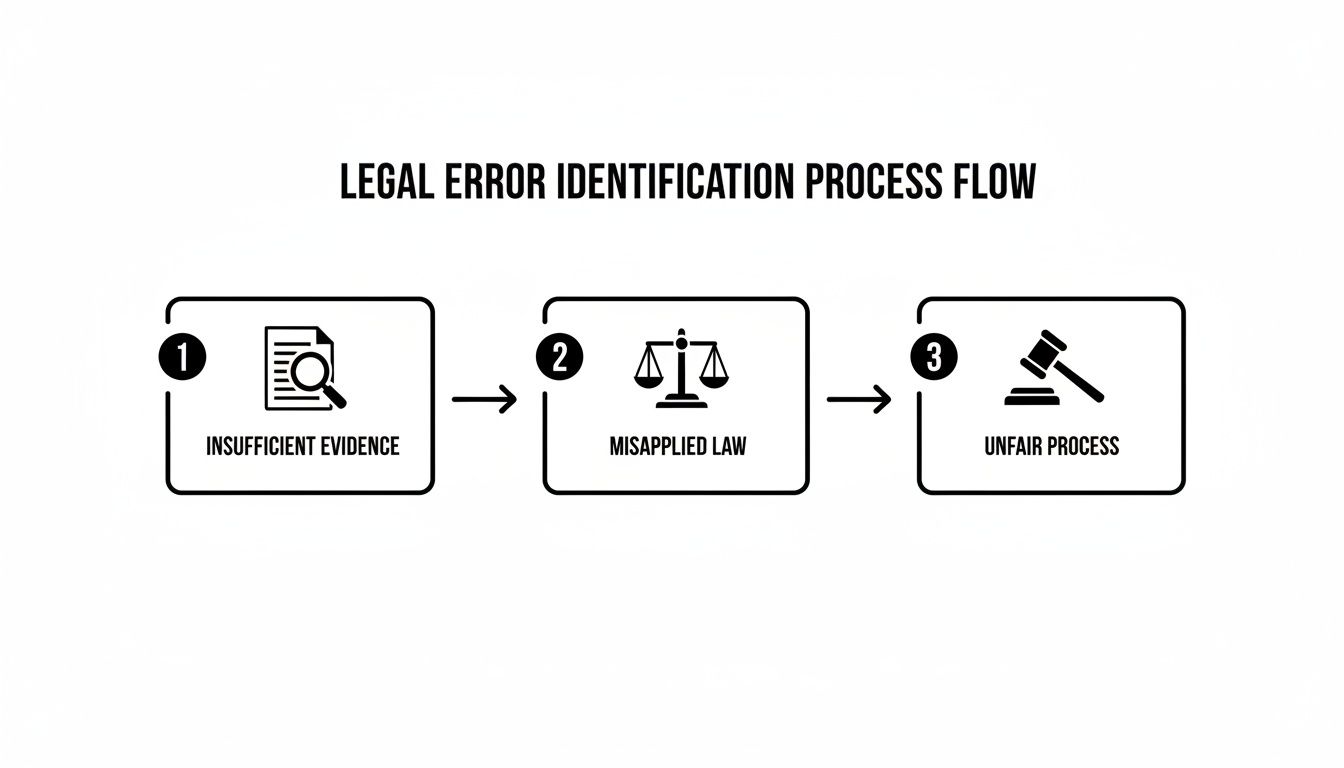
As you can see, a winning appeal is built by identifying a core legal problem in the original hearing—such as insufficient evidence or a misapplication of the law—and making that the central point of your argument to the higher court.
Preparing the Record and Writing the Appellate Brief
The appellate record is the official case file and contains everything the court of appeals will review. It consists of two parts: the clerk’s record (all motions, orders, and documents filed) and the reporter’s record (the word-for-word transcript of the hearing). No new evidence can be added. For the appellate court, the record is the entire universe of the case.
An appeal is won or lost based on what is in the record. The appellate court acts as a reviewer, not a fact-finder. Its only job is to determine if the trial court followed the law correctly based on the evidence presented at that time.
With the complete record assembled, the real work begins: writing the appellate brief. A brief is a formal, written legal argument submitted to the court of appeals. The process of preparing this document is often called briefing. The brief meticulously lays out the facts of the case, identifies the specific legal errors made by the trial judge, and uses statutes and prior case law to persuade the appellate judges that the protective order should be reversed.
This is not simply a complaint about an unfair result. It is a highly structured and persuasive document that must clearly and logically prove that a "reversible error" occurred. Crafting a powerful brief requires the unique skills of sharp legal analysis and compelling writing—the core competencies of an experienced appellate lawyer.
What a Successful Appeal Can Accomplish
Living under the weight of an unjust protective order can feel overwhelming, but a successful appeal can completely change your circumstances. Winning is not just a symbolic victory; it is a powerful legal remedy that undoes the trial court’s mistake. It is the justice system’s built-in mechanism for correction, restoring fairness when the law is skillfully argued on your behalf.

The results of a successful appeal are life-changing, offering a clear path to restoring your rights and rebuilding your life. Depending on the specific errors the appellate court finds, there are two primary outcomes.
Reversal of the Protective Order
The most decisive outcome is a reversal. When an appellate court reverses a protective order, it declares the trial court's decision legally invalid. The order is vacated—or canceled—as if it were never issued. This is the cleanest and most direct path to restoring your rights and clearing your name.
A full reversal accomplishes several critical goals:
- Restores Child Custody and Visitation Rights: The legal presumption against you in a custody case is eliminated, allowing you to seek fair possession and access schedules.
- Removes Firearm Restrictions: Your Second Amendment rights are fully reinstated.
- Clears Your Public Record: The order is removed from public records, which is crucial for employment, housing applications, and professional licenses.
Remand for a New Hearing
Another possible result is a remand. This occurs when the appellate court identifies a major procedural error in your original hearing. Instead of simply voiding the order, the court sends the case back down to the trial court with instructions to hold a new, fair hearing. It is a second chance to present your case, but this time with the legal error corrected.
A remand ensures that your case is decided based on a proper application of the law and a fair evaluation of the evidence—the due process to which you were entitled from the beginning.
Protective orders in Texas are effective tools. Studies show they can reduce the likelihood of future violence by up to 80%. This effectiveness is vital for true victims, but it also highlights the profound damage an incorrectly issued order can cause. When a court restricts your fundamental rights without a sound legal basis, an appeal is the essential path to justice. You can discover more insights about the efficacy of protective orders from Travis County.
Ultimately, a successful appeal is about more than winning a legal argument. It is about correcting an injustice, restoring your reputation, and reclaiming your rightful place in your children’s lives.
Frequently Asked Questions About Protective Order Appeals
After a protective order hearing, you are often left with more questions than answers. When you believe the judge made a legal error, the appeals process can feel like a new and confusing maze. Here are plain-English answers to some of the most common questions people have when considering an appeal for a protective order in Texas.
How Long Do I Have to Appeal a Final Protective Order?
Time is of the essence. You have 30 days from the date the judge signed the final protective order to file a Notice of Appeal.
This deadline is strict and unforgiving. If you miss it, you have almost certainly lost your right to challenge the order. This is why it is critical to speak with an appellate attorney immediately if you are considering an appeal.
Can I Introduce New Evidence During an Appeal?
No, and this is a common misconception. An appeal is not a second trial or a "do-over" where you can present new evidence or have new witnesses testify.
The appellate court only reviews what has already happened. Its job is to examine the trial court record—the official transcript of the hearing and all documents filed in the case—to determine if the judge made a legal mistake based on the information they had at the time. Your attorney's job is to find those errors within the existing record, not to add new information.
What Does "Abuse of Discretion" Mean in an Appeal?
Abuse of discretion is a legal term of art, but the concept is straightforward. It means the trial judge made a decision that was unreasonable, arbitrary, or without reference to guiding legal rules and principles.
In simple terms, if the decision does not logically follow from the evidence presented, or if the judge ignored clear legal rules, that could be an abuse of discretion. Proving this is one of the primary ways to win a family law appeal.
It is crucial to remember that the protective order remains active and fully enforceable while the appeal is pending. This process can take many months, and you must comply with every condition of the order, or you could face criminal charges.
While rare, your attorney can file a "Motion to Suspend Enforcement," asking the appellate court to pause the protective order during the appeal. Whether this is granted depends entirely on the specific facts of your case. An experienced appellate lawyer can advise you on whether this is a viable option for you.
If you believe the court made a mistake in your family law case, our appellate attorneys can help you seek a fair outcome. Contact The Law Office of Bryan Fagan today for a free consultation at https://familylawcourtappeals.com.