You may feel your case was handled unfairly if a judge denied your request for a 50/50 possession schedule. Many parents walk into a Texas courtroom believing that an equal parenting plan is the standard, only to receive an order that feels unbalanced and unjust. If you presented a strong case for equal time but the court overlooked the evidence, you may be left wondering if you have any options left. It's a frustrating position, but it's important to know that a judge's decision is not always the final word. The Texas appeals process exists to correct legal errors and seek a fair outcome.
This guide will walk you through the complexities of "50/50 custody" in Texas from an appellate perspective. We will explain how Texas law views equal possession, why judges often default to a different schedule, and what specific legal errors can give you grounds to challenge an unfair custody ruling.
The Truth About Equal Parenting Time in Texas

If you have just come from a Texas family court with a custody ruling that seems fundamentally unfair, you are not alone. Many parents expect a 50/50 arrangement, only to be met with a very different reality. This can leave you feeling that the court failed to recognize your vital role in your child's life.
That sense of injustice often stems from the gap between common assumptions and the actual Texas Family Code. The single most important thing to understand is that Texas courts do not start with a presumption that a 50/50 physical split is in a child’s best interest. This can be difficult to accept, especially if you believe you made a compelling case for being an equally involved parent. Understanding this legal reality is the first step toward evaluating whether the trial court made a reversible error in your case.
Understanding Texas Custody Law from an Appellate View
To determine what happened in your trial—and whether a legal mistake was made that can be challenged on appeal—it is essential to understand the state's unique legal language and framework. An appeal is not a retrial; it is a careful review of the trial record to find specific errors.
Key Texas Custody Terms You Need to Know
The language used in your court order is precise and legally significant. This table clarifies the terms that matter most when analyzing a case for appeal.
| Common Term | Texas Legal Term | What It Really Means in Your Case |
|---|---|---|
| Legal Custody | Conservatorship | This defines who has the legal right to make major decisions for your child, such as those concerning their education, medical care, and religious upbringing. |
| Physical Custody | Possession and Access | This is the court-ordered parenting time schedule. It dictates which parent the child is with and when. The "possession order" is often the focus of a custody appeal. |
| Joint Custody | Joint Managing Conservatorship | This means both parents share the rights and responsibilities of decision-making. Critically, it does not automatically mean a 50/50 split of possession time. |
Understanding these terms is crucial. An appellate attorney will review the record to see if the court correctly applied the law regarding conservatorship and possession based on the evidence presented.
Legal Principles That Guide a Judge's Decision
Every custody ruling in Texas is guided by a few core legal principles. An appellate court will review whether the trial judge properly followed them.
- The Best Interest of the Child: This is the guiding star for every Texas family court judge. It is the only standard they can use. Every decision must be based on evidence showing what will best serve the child’s emotional, physical, and developmental well-being.
- Conservatorship vs. Possession: It's worth repeating: Texas law separates the right to make decisions from the right to have physical possession of the child. It is common for a court to name both parents "Joint Managing Conservators" while ordering a possession schedule that is far from equal. Learn more about the nuances of Texas joint custody in our detailed guide.
- The Standard Possession Order (SPO): Because there is no default 50/50 schedule, the Texas Family Code provides a default schedule called the Standard Possession Order. The law presumes the SPO is in a child's best interest, which means a judge often starts with this framework. This schedule typically results in an unequal division of time.
Understanding the Standard of Review in a Custody Appeal
When a judge issues a custody order that feels lopsided, it is usually based on a core principle of Texas law: the child's need for stability. To achieve this, courts often rely on the Standard Possession Order (SPO), which the law presumes is in the child’s "best interest." This legal presumption sets a high bar for any parent seeking a different arrangement, such as a 50/50 schedule.
For an appeal to succeed, your appellate attorney must show that the trial judge made a legal error. This isn't about simply disagreeing with the outcome. It's about proving that the judge misapplied the law or made a decision that was not supported by the evidence.
The "Best Interest of the Child" Standard and Reversible Error
Every decision a Texas family court judge makes must be justified as being in the best interest of the child. This is a specific legal standard defined by a set of criteria known as the "Holley Factors." A court will weigh evidence related to:
- The child's emotional and physical needs.
- Any potential danger to the child.
- The parenting abilities of each parent.
- The stability of each home environment.
- A parent’s actions or inactions that indicate an improper parent-child relationship.
A common reversible error occurs when a trial judge fails to properly consider evidence related to these factors. For example, if you presented compelling evidence of your stability and deep involvement in your child's life, but the judge ignored it without explanation, that could be an abuse of discretion—a key ground for appeal.
Joint Conservatorship Does Not Mean Equal Time
A major point of confusion for many parents is the difference between sharing legal rights and sharing physical time. The Texas Family Code presumes that naming parents as Joint Managing Conservators is in the child's best interest. This gives both parents a say in major decisions.
However, there is no corresponding presumption that an equal, 50/50 possession schedule is also in their best interest. This is a critical legal distinction. An appellate court will not overturn a decision simply because parents with joint legal rights were not given equal time. The focus will be on whether the possession schedule ordered by the judge was justified by the evidence presented at trial.
A judge can order a 50/50 possession schedule. The key is that they are not required to start from that position. The parent requesting an equal schedule has the burden of proving with specific evidence why that arrangement serves the child’s best interest better than the state's standard plan.
The Role of the Standard Possession Order
To ensure consistency, Texas law provides a default schedule called the Standard Possession Order (SPO). It is a detailed calendar designed to provide regular and continuous contact with both parents. You can explore the details of the Standard Possession Order in Texas to understand its structure.
Typically, the SPO results in a possession split closer to 65/35, not 50/50. Because the law presumes the SPO is in a child’s best interest, a judge who deviates from it—or refuses to deviate when strong evidence supports doing so—must have a clear, evidence-based reason. If the trial record does not contain that justification, the decision may be vulnerable to an appeal.
What You Can Appeal in a 50/50 Custody Case

If you believe a 50/50 custody schedule in Texas is what is truly best for your child, convincing a judge requires more than simply stating your preference. You must build a compelling case with evidence that demonstrates why deviating from the Standard Possession Order (SPO) is the right decision.
From an appellate standpoint, a successful appeal often hinges on showing that the trial court was presented with persuasive evidence supporting an equal schedule but chose to ignore or misinterpret it without a valid reason. To identify a potential reversible error, it's important to understand what a strong case for equal possession looks like.
Presenting Evidence for an Equal Schedule at Trial
Simply telling the judge you are a great parent is not enough. The evidence must create a clear picture of a stable, cooperative co-parenting environment where a 50/50 split is both practical and beneficial for the child.
Judges are more likely to order an equal schedule when presented with proof of specific, favorable circumstances. These facts can make a significant difference:
- Close Proximity: Both parents live near each other and in the same school district.
- History of Cooperation: A documented track record of amicable co-parenting and low-conflict communication.
- High Parental Involvement: Evidence showing both parents have always been deeply involved in the child's daily life, including school, medical appointments, and extracurricular activities.
- Flexible Work Schedules: Both parents have jobs that allow them to be consistently available for the child.
- Child's Preference: For children 12 and older, a clearly expressed desire to spend equal time with each parent can be influential, though it is not the sole factor.
If you presented strong evidence on these points and the court still denied your request for a 50/50 schedule without a clear, justifiable reason on the record, that decision might be an abuse of discretion. This is the core legal standard for a successful custody appeal.
Common 50/50 Possession Schedules in Texas
When Texas courts do order an equal possession schedule, they often use established models that provide stability and predictability.
The goal of a well-designed schedule is to maximize quality time and minimize the stress of transitions. A thoughtful plan can create a rhythm that children can adapt to and feel secure in.
Popular schedules, such as alternating weeks, can reduce exchanges to as few as 12 per year. This is a significant benefit, as it lowers stress while ensuring neither parent goes long without seeing their child. You can explore some sample 50/50 custody schedules to see how these work.
Here are the most common options:
Week-On, Week-Off Schedule
The child spends one full week with Parent A, then the next full week with Parent B.
- Pros: Easy to track and dramatically reduces exchanges, which can lower conflict. It is often a good fit for older children.
- Cons: A full week can be a long time for a younger child to be away from one parent.
2-2-5-5 Schedule
Parent A always has Monday and Tuesday, and Parent B always has Wednesday and Thursday. They alternate the weekend (Friday-Sunday).
- Pros: Guarantees neither parent goes more than a few days without seeing the child and provides week-day stability.
- Cons: Requires more frequent exchanges and a high level of parent cooperation.
3-4-4-3 Schedule
The days rotate weekly. In week one, Parent A has the child for three days and Parent B for four. The next week, it flips.
- Pros: Allows for frequent contact with both parents.
- Cons: The shifting schedule can be difficult to track without a shared calendar.
If your trial included clear evidence that a specific 50/50 schedule was practical, stable, and in your child's best interest, but the judge ordered the SPO without a solid reason, our appellate team can analyze the record for reversible error.
Identifying Grounds for a Custody Appeal
Receiving a child custody order that feels deeply wrong is a difficult experience. However, there is a significant difference between being unhappy with a ruling and having legal grounds to appeal it. An appeal is not a second chance to argue your case; it is a technical review of the trial record to find specific legal mistakes made by the judge. The goal is to prove that an error occurred that was so critical it likely caused an unjust outcome.
Understanding Reversible Error in Custody Cases
Not every mistake a judge makes is grounds for reversal. An appellate court is looking for reversible error—a legal mistake so serious that it almost certainly led to the wrong judgment. It's an error that harmed your rights and likely skewed the court’s analysis of your child’s best interest.
When appealing a denial of 50 50 custody in Texas, these errors often fall into a few key categories. Common examples of reversible errors in custody trials include:
- Misapplying the "Best Interest" Standard: The judge's decision must be based on evidence related to the Holley Factors. If the court ignored critical evidence about a parent's stability or a history of family violence, it could be a reversible error.
- Improperly Excluding Relevant Evidence: If you presented clear proof of a cooperative co-parenting relationship and close proximity—both strong factors for a 50/50 schedule—and the judge refused to consider it for no valid legal reason, the decision is flawed.
- Admitting Improper or Prejudicial Evidence: If the court allowed the other side to present unreliable testimony from an unqualified expert or use unproven accusations to prejudice the case, it can provide grounds for an appeal.
- Showing Clear Judicial Bias: The law requires judges to be neutral. If the trial transcript reveals that the judge was obviously biased, made prejudicial comments, or based the ruling on personal opinions instead of the law and facts, the fairness of the trial is compromised.
The "Abuse of Discretion" Standard of Review
In Texas family law, most custody decisions are reviewed by appellate courts using the "abuse of discretion" standard. This is a high bar, but it is not insurmountable when the trial record shows a judge acted arbitrarily or unreasonably.
- Plain-English Definition: An "abuse of discretion" occurs when a trial court makes a decision without reference to any guiding legal rules or principles. In simple terms, the ruling was not just a judgment call the higher court disagrees with; it was arbitrary, unreasonable, or completely disconnected from the factual evidence or the law.
Think of it like a referee who awards a touchdown to a player who was clearly out of bounds. That is a misapplication of the rules that changes the game's outcome. That is the type of error an appellate court looks for. You can learn more about how our attorneys analyze a case under the abuse of discretion standard to understand how this crucial concept works.
Successfully arguing abuse of discretion requires a skilled appellate attorney to meticulously comb through the record and build a powerful legal argument showing that the trial court's decision was not a reasonable conclusion based on the evidence. It is a precise process, but it is the primary path to correcting an unjust custody order.
The Texas Appeals Process: Step-by-Step Insights
When you receive a custody order that feels profoundly unfair, it's natural to feel that the system has failed you. The Texas appeals process provides a formal, structured path to challenge that outcome. An appeal is not a do-over or a new trial. Instead, it is a focused review of what has already happened. Appellate judges will examine the existing record—every document, exhibit, and spoken word—to determine if the trial judge made a critical legal error that led to an improper result.
Timelines: Your First Steps After Trial
The moment a judge signs a final custody order, a strict timeline begins. The deadlines in Texas appeals are non-negotiable, and you must act quickly to preserve your right to appeal.
Your most urgent deadline is filing a Notice of Appeal. Under the Texas Rules of Appellate Procedure, you generally have only 30 days from the date the judge signed the order to file this document. This notice officially informs the trial court and the other party that you are escalating the case to a higher court. Missing this deadline will likely result in losing your right to appeal permanently.
Record Preparation: The Foundation of Your Appeal
An appeal is different from a trial because no new evidence is allowed. The appellate court can only review what is already in the official record of your case. Preparing this record is a critical step. It consists of two parts:
- The Clerk’s Record: This is a compilation of all documents filed in your case, including petitions, motions, evidence exhibits, and the final order.
- The Reporter’s Record: This is the official, word-for-word transcript of everything said during the trial, including all testimony, arguments, and the judge's rulings.
Our appellate attorneys meticulously review these records page by page, searching for the specific legal mistakes—the "reversible errors"—that will form the basis of your appeal.
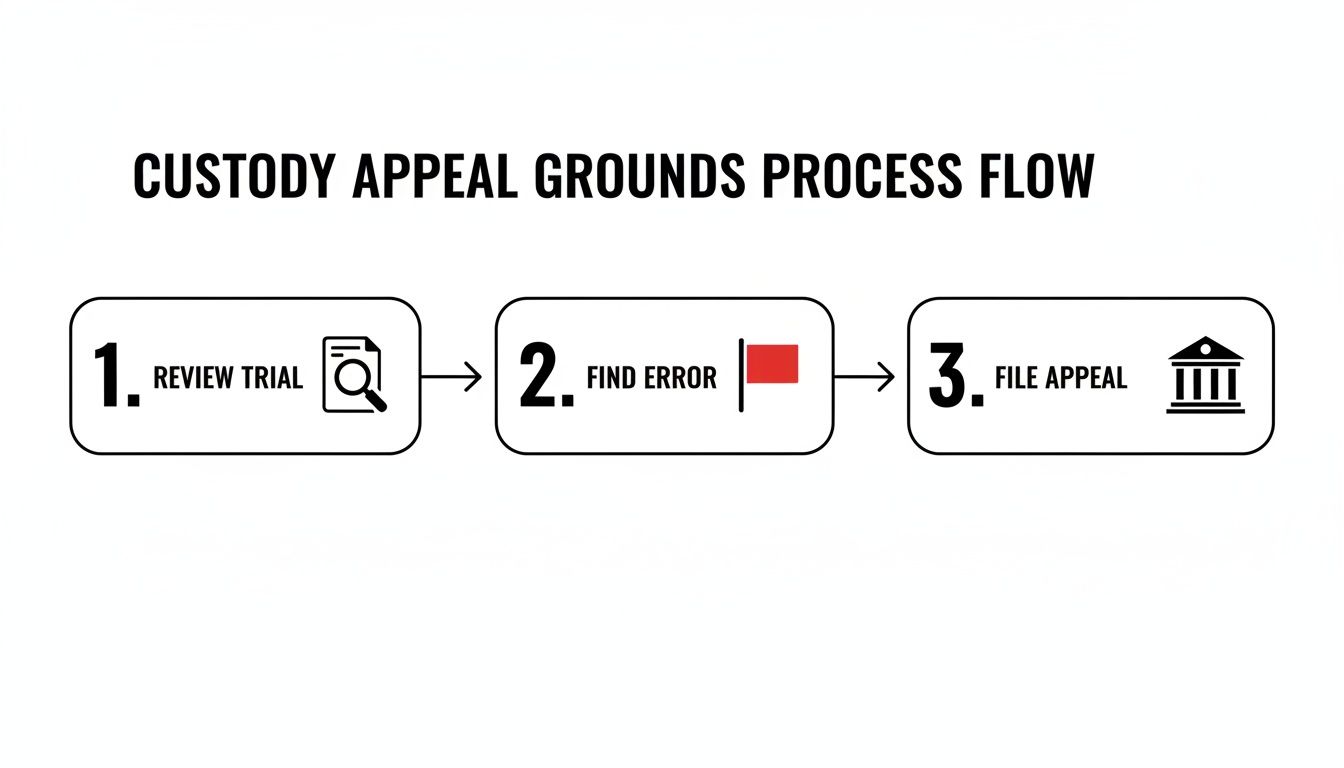
This process is methodical and disciplined. You cannot appeal simply because you are unhappy with the result; you must identify a recognized legal error within the record.
Briefing: Making Your Case to the Appellate Court
The core of an appeal is briefing. This is where we present your case to the appellate judges through formal legal writing.
- Plain-English Definition: An appellate "brief" is a detailed written argument. It explains to the judges exactly what legal mistakes the trial court made, how those mistakes harmed your case, and why the law requires a different outcome.
A brief is a highly technical document that connects the facts in the trial record to the Texas Family Code and relevant case law. For example, we might use the brief to demonstrate how the trial judge abused their discretion by ignoring key evidence that proved a 50 50 custody schedule was in your child's best interest. The other party then files a response brief, and we may file a final reply. The appeal is often won or lost based on the strength of these written arguments, making skilled legal writing and research essential.
How Our Appellate Attorneys Fight for Your Parental Rights

When a court issues an order that you believe is unjust, our appellate attorneys provide a path forward. We begin with a meticulous review of your entire case file—the trial transcripts, the evidence, and every ruling—to identify the specific reversible errors that could form the basis of a successful appeal.
Appeals are not won on emotion; they are won with powerful, persuasive, and precise legal arguments. A successful appeal depends on the strength of the appellate brief, a document that must be flawlessly written and anchored in the Texas Family Code and existing case law. Our team excels at constructing logical, compelling arguments that demonstrate to the appellate court exactly how the trial judge misapplied the law or abused their discretion.
A Calm, Confident Pursuit of Fairness
We understand that this is more than a legal dispute; it is about your relationship with your child. Our approach is calm, confident, and strategic, designed to navigate the complexities of the appellate process and keep the focus on restoring balance and achieving a just outcome for your family.
This fight is particularly important given the realities of some custody decisions. For example, statistics show that Texas fathers, on average, are awarded only about 33% of parenting time. Correcting an unfair imbalance often requires scrutinizing the trial record for every possible error. You can see more data on these divorce and custody trends at familylaw-tx.com.
An appeal is not a second trial. We are not re-arguing the facts. Our job is to prove that a specific legal mistake was made and that this mistake prevented the judge from making a fair decision based on the evidence. We are here to hold the system accountable to the rule of law.
When we take your case, our goal is to restore fairness through appellate advocacy. We work to protect your parental rights by showing the appellate court that the trial judge overlooked crucial evidence supporting a 50/50 custody schedule or another arrangement that was truly in your child's best interest.
Frequently Asked Questions About Custody Appeals
If you believe a court made a fundamental error in your custody case, you likely have many questions. Knowing your options is the first step toward seeking justice. Here are clear answers to some of the questions we hear most often from clients considering an appeal.
Can I Get a 50/50 Schedule if My Ex-Spouse Objects?
Yes, a judge can order a 50/50 possession schedule even if the other parent objects. However, the burden of proof will be on you.
Texas law does not presume that a 50/50 split is in a child's best interest. This means you must prove to the judge with strong evidence why an equal possession schedule is better for your child's well-being than the Standard Possession Order. Compelling evidence often includes:
- Proof that both parents live in close proximity and in the same school zone.
- A documented history of low-conflict co-parenting and effective communication.
- Evidence that both parents have always been deeply involved in the child's daily life.
If you presented powerful evidence supporting a 50 50 custody in texas plan and the trial court ignored it without a valid reason, that could be a strong basis for an appeal arguing an "abuse of discretion."
What Is the Deadline to Appeal a Custody Order in Texas?
The deadlines for appealing a court order in Texas are strict and unforgiving. According to the Texas Rules of Appellate Procedure, you must generally file a Notice of Appeal within 30 days of the date the judge signs the final order.
Missing this critical deadline will almost certainly mean losing your right to appeal, regardless of the merits of your case. It is essential to contact an appellate attorney immediately after receiving a final order you believe is unjust.
In limited circumstances, filing certain post-judgment motions, such as a Motion for New Trial, can extend this deadline to 90 days. However, you should never assume you have this extra time without consulting an experienced appellate lawyer.
What Is the Difference Between an Appeal and a Modification?
Understanding this distinction is vital, as it determines your legal strategy. An appeal and a modification are two entirely different legal actions.
An appeal looks backward. It argues that the trial judge made a significant legal error during the original case and is based only on the evidence and testimony already in the trial record. You cannot introduce new evidence. The appellate court reviews what already happened to see if a mistake was made. Effective legal representation in appeals requires diligent legal research. Tools and strategies for maximizing efficiency in legal research enhance our ability to build strong cases.
A modification looks forward. It is a new court case arguing that circumstances have changed since the original order was made. To modify an order, you must prove a “material and substantial change” in the circumstances of a parent or the child has occurred.
In short, an appeal seeks to correct a legal error from the past, while a modification addresses a new reality for the future.
If you believe the court made a mistake in your family law case, our appellate attorneys can help you seek a fair outcome. Contact The Law Office of Bryan Fagan today for a free consultation.