You may feel your case was handled unfairly and that the final order from the judge was simply wrong. When a Texas family court makes a decision, we expect it to be fair and based on the law. But judges are human, and sometimes they make mistakes. A reversible error is not just any minor slip-up; it's a critical mistake so significant it probably changed the entire outcome of your case.
This isn't about disagreeing with the judge's decision. It's about identifying a legal error that undermined the fairness of the process. If the error hadn't happened, the judge would have likely reached a different conclusion on your child custody, divorce, or property division arrangement. That is the high standard an error must meet to be considered "reversible" and give you grounds for an appeal.
What You Can Do When a Court Ruling is Wrong

Receiving a final order from a judge that feels unjust can be a deeply disheartening experience. It is natural to question the decision and wonder if there is anything you can do to seek a fair outcome. The Texas legal system has a specific process for correcting these kinds of major judicial mistakes, and it all revolves around proving a reversible error through an appeal.
It is important to understand that an appeal is not a second trial or a "do-over." You do not get to introduce new evidence or re-argue your entire case. Instead, an appeal is a formal request for a higher court—the court of appeals—to examine the official record from your trial. The appellate judges review this record to determine if a legal error occurred that led to an improper result. This process is a crucial check on the system, designed to ensure every decision is legally sound and that justice is served.
Your Path to Seeking Justice
Challenging a final order may seem daunting, but it's a structured path focused on fairness and due process. To succeed, you must be able to point to a specific, harmful error that occurred during your trial. This guide will walk you through what qualifies as a reversible error in a Texas family court and how our appellate attorneys work to identify them. Our goal is to provide a clear, strategic path forward and show you that a flawed outcome does not have to be the last word.
If you believe the court made a mistake in your family law case, our appellate attorneys can help you seek a fair outcome. Contact The Law Office of Bryan Fagan today for a free consultation.
Distinguishing Between Reversible and Harmless Errors
After receiving a final order you believe is fundamentally wrong, you might feel frustrated and ready to challenge it. However, in the world of Texas appeals, not every mistake a trial court makes is enough to get that order overturned. Appellate courts draw a clear line between two types of judicial mistakes: reversible error and harmless error. Understanding this distinction is the critical first step in evaluating whether you have a strong case for an appeal.
Think of it like a football game. If a referee makes an incorrect call that negates the game-winning touchdown, that error directly and unfairly changed the outcome. That is a reversible error. But if the referee calls a minor foul far from the play that has no effect on the drive or the final score, that is a harmless error. The game would have ended the same way, mistake or not. The appellate process focuses only on the errors that truly matter.
The Legal Test for a Reversible Error
Under the Texas Rules of Appellate Procedure, a mistake becomes a reversible error only if it probably caused the rendition of an improper judgment.
In plain English, this means we must prove to a panel of appellate judges that the trial court's blunder was so significant that, without it, the outcome of your case would have likely been different. It is not enough to simply say the judge was wrong; we must connect that specific error directly to the unjust result you received.
On the other hand, a harmless error is a technical slip-up that did not change the final decision or prejudice your rights in a meaningful way. Appellate courts will not reverse a judgment over a minor issue that had no real impact on the outcome. The central question is always: Did this error actually cause the damage?
Real-World Examples in Family Law
Let's apply these concepts to Texas family law.
Reversible Error Example: In your divorce case, the court mistakenly classifies rental properties you inherited before the marriage as community property and divides them with your spouse. This is a classic reversible error. The misapplication of the law directly caused you to lose property you were legally entitled to keep as your separate property.
Harmless Error Example: During a child custody trial, a judge allows a witness to briefly mention something they overheard—testimony that should have been excluded as hearsay. However, the testimony was about a trivial detail that had no bearing on the judge's final decision about possession, access, or who was named the primary parent. This would almost certainly be considered a harmless error because it did not influence the final ruling.
Key Takeaway: A successful appeal hinges on showing that the trial judge's mistake was not a mere technicality but a critical fumble that directly caused an improper and unfair final order.
Reversible Error vs. Harmless Error At a Glance
This table simplifies the core distinction between a mistake that can form the basis of an appeal and one that cannot.
| Characteristic | Reversible Error | Harmless Error |
|---|---|---|
| Impact on Outcome | Probably caused an improper judgment and changed the case's result. | Did not affect the final outcome of the case. |
| Effect on Rights | Harmed your substantial rights (e.g., parental or property rights). | Did not prejudice your substantial rights in a meaningful way. |
| Appellate Action | Can be grounds for the appellate court to reverse the decision. | Will not be a basis for overturning the trial court's judgment. |
| Example | A judge mischaracterizes separate property as community property, leading to an incorrect division. | A minor procedural error in admitting an irrelevant document. |
Ultimately, knowing whether a mistake was "reversible" or merely "harmless" is what separates a viable appeal from a losing battle. Our appellate team can analyze the record from your case to determine if a reversible error occurred and advise you on the best path forward.
Understanding the Standard of Review in Family Law

When you believe a significant error was made in your case, it’s natural to want a new judge to hear everything again. However, an appeal is not a second trial. The court of appeals looks only at what already happened, and they do so through a specific legal lens called the standard of review.
Think of the standard of review as the rulebook the appellate judges must follow when evaluating the trial judge's actions. They are not there to ask, "Would we have made the same decision?" Instead, the question is, "Did the trial judge follow the law and make a reasonable decision based on the evidence presented?" This distinction is the foundation of appellate advocacy.
Abuse of Discretion: The Most Common Standard
In Texas family law, the most common standard of review is abuse of discretion. This standard gives significant respect—or deference—to the trial judge’s decisions, especially in matters of child custody and property division. This is because the trial judge was physically present to observe witness testimony and get a feel for the case.
In plain English, a judge commits an abuse of discretion when they act in an arbitrary or unreasonable manner, or make a decision without reference to any guiding rules and principles of law.
Imagine a judge completely ignores undisputed evidence of a parent's recent drug conviction when ruling on what is in a child's best interest. That decision would likely be considered an abuse of discretion because it is not based on the facts or the legal standard requiring the court to protect the child's well-being. Our attorneys are trained to identify these critical moments. You can learn more in our detailed guide on the abuse of discretion standard.
Other Key Standards of Review
While abuse of discretion is the most frequent standard in family law appeals, it is not the only one. The specific error you believe the judge made determines which lens the appellate court will use. Two other important standards are:
- Legal Error (De Novo Review): This standard applies when you argue the judge simply got the law wrong, such as by misinterpreting a statute in the Texas Family Code. The appellate court gives zero deference to the trial judge and reviews the issue "de novo," which is Latin for "from the new" or completely fresh. For example, if a judge incorrectly defines what constitutes separate property, that is a pure legal error reviewed de novo.
- Evidentiary Sufficiency: This standard asks whether there was enough evidence to support the judge's factual findings. This breaks down into two types. Legal sufficiency asks if there was any evidence to support the finding. Factual sufficiency asks if the evidence supporting the finding was so weak that the decision is clearly wrong and unjust.
Understanding which standard of review applies is key to building a successful appeal. Your argument is not just that you disagree with the outcome; it's that the judge failed to meet the proper legal standard, and the process used to reach that outcome was flawed.
Common Reversible Errors in Texas Family Law Cases
A reversible error in a Texas family court is a specific, significant mistake by the judge that almost certainly led to an unfair final judgment. Knowing how to spot these errors is the first step toward seeking justice through an appeal. While every family's situation is unique, many judicial errors fall into predictable categories concerning children, property, and financial support.
What You Can Appeal in a Texas Divorce Case: Common Errors
The final orders in a divorce, custody, or other family law matter can be appealed if a reversible error occurred. Here are some of the most frequent mistakes we see.
Errors in Child Custody and Conservatorship
When it comes to children, judges must rule based on the "best interest of the child." While this gives them broad discretion, it is not a blank check. An abuse of discretion—and a reversible error—occurs when a judge’s decision is arbitrary, unreasonable, or ignores crucial evidence related to a child's safety and well-being.
Common custody-related errors include:
- Ignoring Key Evidence: The judge disregards clear, documented proof of a parent's ongoing substance abuse or a history of family violence when making custody orders.
- Misapplying Legal Standards: The court names both parents joint managing conservators but fails to give one parent the exclusive right to designate the child's primary residence, which is required by the Texas Family Code.
- Improperly Restricting a Parent's Rights: A judge imposes a geographic restriction on a parent, dictating where they can live, without any evidence showing it is necessary for the child’s welfare.
These are not minor technicalities; they are fundamental errors that can unjustly strip a parent of their rights or fail to protect a child.
Errors in Property Division
Dividing property in a divorce is governed by strict legal rules. Texas law presumes that anything acquired during the marriage is community property. An asset can only be classified as separate property (like an inheritance or gift) with clear and convincing evidence.
A reversible error in property division often happens when a court mischaracterizes a major asset. Forcing a spouse to give up their rightful separate property is one of the most clear-cut examples of a reversible error.
Common property division errors include:
- Mischaracterizing Separate Property: The judge treats a business you owned long before the marriage as community property and divides its value with your ex-spouse.
- Ignoring Reimbursement Claims: The court overlooks a valid claim for reimbursement after you prove community funds were used to pay down the mortgage on your spouse's separate property house.
- Unequal Division without Basis: A judge orders a grossly disproportionate split of the community estate—for example, 80/20—without providing any factual basis or legal reasoning to justify it.
For anyone with significant assets, these kinds of mistakes can be financially devastating. Our appellate team has extensive experience with appeals involving complex property division.
Errors in Financial Support and Other Rulings
Mistakes are also common in orders for child support, spousal maintenance, and even protective orders. These errors often involve incorrect calculations, a failure to apply statutory rules, or a ruling made without the required evidence. For example, ordering spousal maintenance without any evidence that the receiving spouse lacks the property to provide for their own minimum reasonable needs is a reversible error.
Pinpointing a reversible error requires a deep knowledge of the Texas Family Code and the rules of appellate procedure. It's about finding the critical flaw in the judge's logic that tipped the scales toward an unjust result.
Navigating the Texas Family Law Appeals Process
Identifying a potential reversible error is the first step. What follows is the appellate process—a methodical, deadline-driven journey that is very different from a trial. It demands precision, patience, and a firm grasp of the Texas Rules of Appellate Procedure.
The clock starts ticking the moment the judge signs the final order. The first step is to file a Notice of Appeal. This formal document notifies the court and the opposing party that you are challenging the decision. If you miss this deadline—typically 30 days after the judgment is signed, or 90 days if a post-trial motion was filed—the door to your appeal can close permanently.
Assembling the Record for Review
After the Notice of Appeal is filed, the focus shifts to preparing the appellate record. This is the official story of your case as it happened in the trial court, and it is the only information the court of appeals is allowed to consider.
The appellate record consists of two key parts:
- The Clerk's Record: A compilation of all documents filed in your case, such as the original petition, motions, and the final order.
- The Reporter's Record: The official, word-for-word transcript of everything said in the courtroom, prepared by the court reporter.
Your appellate lawyer will meticulously review this record, searching for the specific moments where a reversible error occurred.
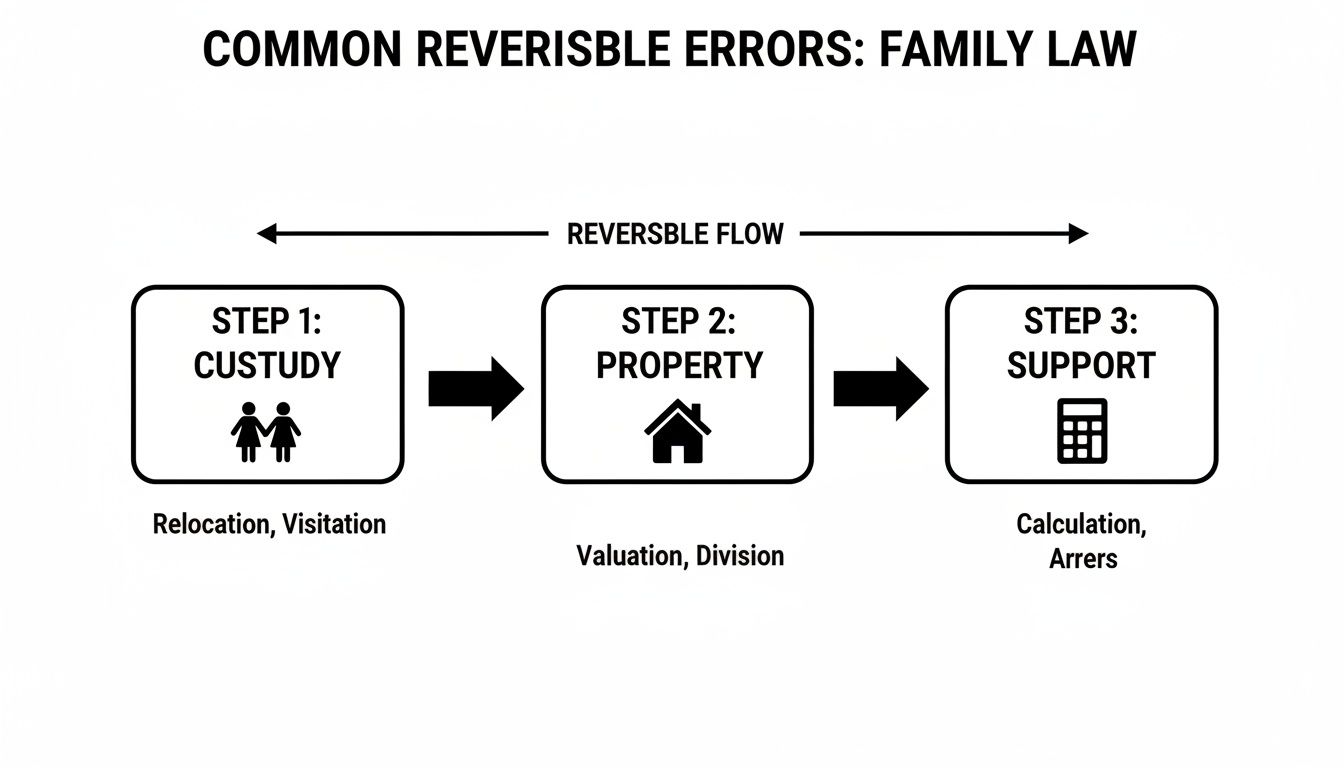
As the flowchart illustrates, errors can arise in any major part of a family law case, which is why a thorough review of the entire record is essential.
Crafting the Argument Through Briefing
Once the record is complete, the work of legal research and drafting the appellate brief begins. This document is a powerful, persuasive legal argument that connects the facts from the record to established law.
The brief is where we tell your story to the appellate judges. It carefully explains what the trial judge did, why it was a legal mistake (a reversible error), and how that mistake led to an improper judgment that harmed you.
This is a highly specialized form of legal writing that must be clear, convincing, and perfectly cited, following the strict formatting rules of the appellate courts. After your attorney files the opening brief, the other side (the "appellee") files a response. Your attorney may then file a reply brief to have the final word. You can learn more about the complete Texas family law appeal process in our guide.
The Final Step: Oral Argument
In some cases, the process includes an oral argument. This is a formal hearing where your attorney stands before a panel of three appellate justices to argue the case. It is an intense question-and-answer session where the judges probe the arguments made in the briefs. It provides a valuable opportunity to address complex points and persuade the court directly.
This entire process is intricate and requires an attorney who excels at deep analysis and compelling advocacy to correct an unjust result and restore a fair outcome.
How to Preserve an Error for a Future Appeal

One of the most important rules in appellate law is this: you cannot complain about a mistake on appeal if your lawyer did not object to it during the trial. This is called preserving error, and it is the absolute foundation for any successful appeal. Without it, even the most obvious reversible error in a Texas family court is typically waived, meaning you lose the right to challenge it.
Think of it as challenging a bad call in a sports game. If you don't act in the moment, you lose the right to protest after the final whistle. The law is just as strict. Your trial attorney must act in real-time to protect your right to appeal later. This is why having a trial lawyer who understands appellate procedure is so critical.
The Three Steps to Preserving an Error
Preserving error is a three-part process that must happen during the trial. According to the Texas Rules of Appellate Procedure, your lawyer must:
- Make a Timely Objection or Request: The objection must be made the moment the error occurs. Any hesitation can waive your right to appeal the issue.
- State the Specific Grounds: It is not enough to simply say, "I object." The attorney must tell the judge exactly what legal rule is being violated (e.g., "Objection, Your Honor. That testimony is inadmissible hearsay.").
- Get a Ruling from the Judge: Your lawyer must press the judge for a clear ruling—either "sustained" (the judge agrees) or "overruled" (the judge disagrees). That ruling must be on the record, giving the appellate court a specific decision to review.
Proving What Was Kept Out
What happens if the judge’s mistake is not about letting bad evidence in, but about keeping good evidence out? If a judge refuses to allow your witness to testify or admit a key document, your attorney must take an extra step.
This is called an offer of proof (or a "bill of exceptions"). Your lawyer must state on the record—away from the jury—exactly what the excluded testimony or document would have shown. This creates a record for the appellate court, demonstrating what was lost and how its absence harmed your case.
Key Insight: Without an offer of proof, the appellate court has no way of knowing what the excluded evidence was or if it would have changed the outcome. It is an absolutely essential move for preserving this type of error.
Ensuring every objection, ruling, and offer of proof is officially documented through proper legal docketing is crucial. After the trial, filing post-trial motions like a Motion for New Trial in Texas family law can also be a vital step in preserving issues for appeal.
How an Appellate Attorney Can Help You Seek Justice
An unfair court ruling can feel like a final, devastating blow, but it does not have to be the end of your journey. A reversible error in a Texas family court provides a specific path for challenging a judgment built on a serious mistake. It is your opportunity to correct the record and fight for the just outcome you deserve.
Navigating the appellate system alone, however, is an extremely difficult task. Winning on appeal requires a completely different skill set than winning at trial. It demands an intricate understanding of the Texas Rules of Appellate Procedure, a sharp eye for legal detail, and the ability to craft a powerful written argument that can persuade a panel of experienced judges.
The Role of Your Appellate Advocate
An appellate attorney is part legal detective and part master strategist. Their first job is to conduct a deep analysis of the entire trial record—every transcript page, every exhibit, and every motion—to pinpoint where a critical, reversible error occurred.
Next, they conduct a systematic review of legal precedents, searching for established case law to prove the trial judge’s mistake warrants a different outcome. This intensive research forms the backbone of the appellate brief, the core document that explains to the higher court precisely how the error happened and why it led to an improper judgment.
The core function of an appellate lawyer is to transform a feeling of injustice into a compelling legal argument, grounded in the facts of the record and the letter of the law. They advocate for fairness and due process, ensuring your rights are protected.
We understand the deep sense of frustration that comes with an unjust result in a divorce, child custody, or property division case. The appellate division at The Law Office of Bryan Fagan is ready to put our experience to work for you, pursuing the fair and correct result you were denied.
If you believe the court made a mistake in your family law case, our appellate attorneys can help you seek a fair outcome. Contact The Law Office of Bryan Fagan today for a free consultation.