You may feel your case was handled unfairly and that the judge got an important part of your family law case wrong. That reaction is common after a ruling on custody, property division, support, or a protective order. What matters now is preserving your options.
An appeal is not a second trial. It’s a rule-based review of what happened in the trial court, using the written record, the reporter’s record, and carefully framed legal arguments. If you’re searching for extension of time to file appeal texas family law, you’re already dealing with the most urgent part of the process: the deadline.
The law gives very little room for delay. But in some cases, there is still a path forward if you act quickly and present the right explanation in the right form.
The Unforgiving Clock of Texas Appellate Deadlines
Texas family law appeals move fast for a reason. Courts want finality. Children need stability, parents need enforceable orders, and former spouses need to know whether a decree will stand. That policy shows up immediately in the filing deadlines.
The starting point is usually the final judgment. In plain English, that’s the order that disposes of the issues before the trial court and leaves nothing significant for the court to decide except enforcement. In a divorce, it may be the final decree. In a custody case, it may be the final modification order. In a protective order case, it may be the signed order the court entered after hearing evidence.

Under Texas family law appellate procedure, the standard deadline to file a notice of appeal is 30 days from the date the trial court signs the final judgment, and that deadline can extend to 90 days if a party timely files a motion for new trial. Even then, any additional extension is limited to 15 days and requires good cause and reasonable diligence under the rules, as explained in this discussion of the Texas appeal deadline after judgment.
What starts the clock
The most common mistake is assuming the clock starts when you receive the order in the mail or when your lawyer explains it to you. Usually, it starts when the judge signs the final judgment.
That means the first practical step is simple:
- Get the signed order
- Confirm the signing date on the face of the order
- Check the docket sheet
- Calendar every possible appellate deadline immediately
If you're unsure how long the appeal window lasts in a divorce case, this guide on how long you have to appeal a divorce in Texas is a useful starting point.
Practical rule: Never calculate an appellate deadline from memory, from a hearing date, or from what someone said in the hallway. Calculate from the signed order.
The difference between 30 days and 90 days
A lot of clients hear “you have 30 days to appeal” and think that’s the full story. It isn’t.
Some post-judgment filings can extend the notice-of-appeal deadline. The most familiar one is a motion for new trial. When it’s filed on time, the notice-of-appeal deadline moves from the standard deadline to the longer deadline recognized by the appellate rules.
That extra time can be valuable if you need to evaluate whether the trial court made a legal error, order transcripts, assess whether findings of fact are needed, or determine whether the case involves a real appellate issue rather than understandable frustration.
Why these deadlines matter so much
Texas appellate deadlines are not casual scheduling targets. They are tied to the appellate court’s power to hear the case at all. If the notice of appeal is late and no valid extension applies, the court may never reach the merits.
In family cases, that has immediate consequences. A parent may remain bound by a possession schedule the court should not have entered. A spouse may remain stuck with a flawed property division. A party subject to a protective order may lose the chance to challenge serious legal mistakes.
A short timeline doesn't mean you should panic. It means you should act with precision.
Here’s the practical sequence after an unfair ruling:
- Secure the final order quickly: You need the exact signed language.
- Preserve the deadline: File the notice, or if needed, evaluate whether an extension motion is still available.
- Assess the true appellate issues: Not every unfair result is a reversible error.
- Protect the record: Appeals are decided from the record, not from new testimony.
The earlier you shift from emotional reaction to deadline management, the more options you usually preserve.
Understanding Your Lifeline The Motion for Extension of Time
If the original notice-of-appeal deadline has passed, the next question is narrow but critical. Are you still within the grace period that allows the appellate court to consider an extension?
In some family law cases, the answer is yes. Texas Rule of Appellate Procedure 26.3 gives a limited opportunity to ask for more time. This is not an open-ended reset. It is a short, technical lifeline, and the details matter.
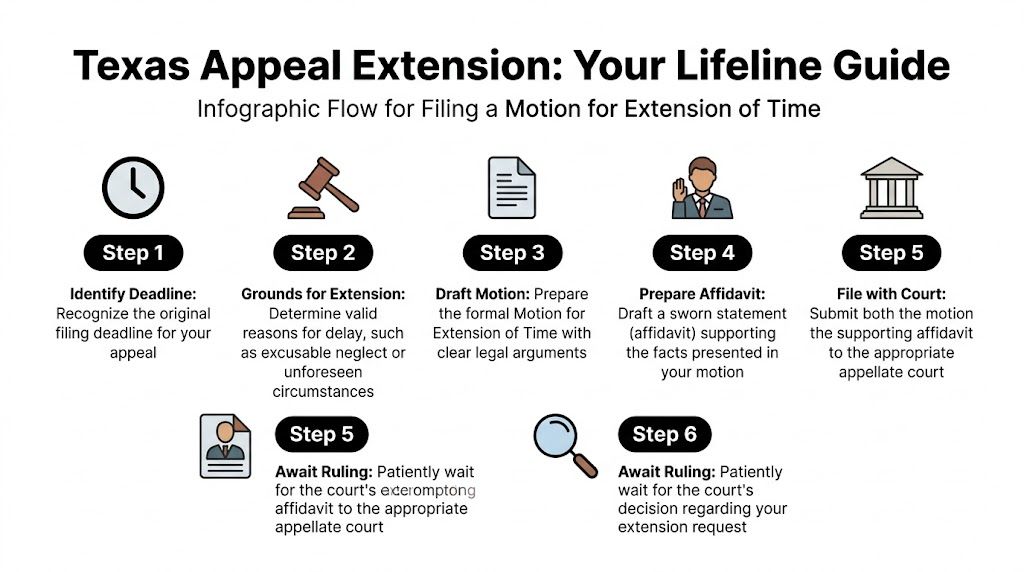
What the motion does
A motion for extension of time asks the appellate court to accept a notice of appeal that was not filed by the original deadline. Under Rule 26.3, the grace period is 15 days, and the motion must be filed timely with a bona fide reason. Courts also focus on whether the explanation is centered on the appellant’s own circumstances, and poorly supported motions may face denial rates as high as 30 to 40 percent in some appellate courts, as discussed in this analysis of Texas Rule 26.3 extension practice.
That last point matters. Courts do not want general frustration. They want a specific, sworn explanation for why the deadline was missed and why the party still acted diligently.
Filing within the window means exactly that
Lawyers often say there is a “15-day grace period,” but clients sometimes hear that as a general cushion. It isn’t. The grace period only helps if the required filings are made within it.
In practice, that usually means:
- the Notice of Appeal must be filed during that grace period, and
- the Motion for Extension of Time must also be filed during that same period.
A notice without the motion can create problems. A motion without the notice can create problems. The safer practice is to file both together.
If you need a plain-English explanation of the document that starts the appeal, review this article on what a notice of appeal is in Texas family cases.
What the court expects to see
A strong motion usually does a few things well. It doesn’t wander. It doesn’t argue the whole appeal. It doesn’t attack the judge. It focuses on the missed deadline and the reason for it.
A practical motion should include:
The judgment date
State when the trial court signed the appealable order.The original deadline
Identify the original due date for the notice of appeal.The date the notice was filed
Be precise. Appellate courts care about dates.The reason for the delay
This is where “good cause” begins to matter.A request for relief
Ask the court to permit the late-filed notice.A supporting affidavit or verified facts
If the facts are outside the record, put them in sworn form.
A weak extension motion says, “I need more time.” A useful one says, “Here is what happened, here is when it happened, here is why it prevented timely filing, and here is how I acted once the problem was known.”
What good cause usually means
“Good cause” is not a magic phrase. Courts look for a real reason connected to the missed deadline, supported by details, and consistent with reasonable diligence.
That often means the court wants to understand two things at once:
- why the deadline was missed, and
- why the appellant still acted as soon as reasonably possible.
This is why timing after the missed deadline matters almost as much as timing before it. If someone discovers the problem and then waits again, the motion becomes harder to defend.
What doesn’t usually work
Some explanations almost always weaken the request:
- General stress: Family litigation is stressful, but stress alone usually isn’t enough.
- Anger about the ruling: Disagreement with the result does not explain delay.
- Being busy: Courts expect deadlines to be handled despite work and family obligations.
- Blaming the other side: The extension motion should focus on the appellant’s reason, not the opponent’s conduct, unless that conduct directly caused the missed filing and can be proved.
- Vague references to confusion: If confusion is the issue, the affidavit needs facts, dates, and context.
The trade-off clients need to understand
There is a strategic choice here. Filing the motion preserves a possible route to appellate review. But it also puts your explanation under a microscope. The motion has to be accurate, restrained, and supported.
Some people rush out a short filing because they think “something is better than nothing.” In extension practice, that can backfire. A hurried, unsupported explanation may frame the case badly from the start.
A better approach is to move quickly, but with discipline. Get the dates right. File both documents. Use sworn facts. Attach proof when appropriate. Keep the explanation honest and narrow.
Crafting a Persuasive Motion and Supporting Affidavit
The motion asks for relief. The affidavit gives the court a reason to trust the request.
That’s where many extension efforts succeed or fail. A judge can only work with the facts you present. If the affidavit is vague, argumentative, or unsupported, the motion feels like an excuse. If the affidavit is specific, sworn, and tied to the missed deadline, the motion looks like a serious request grounded in rule-based fairness.

Why judicial discretion matters
Texas courts do have room to act with fairness in the right case. In In the Interest of M.N., the Texas Supreme Court recognized that trial courts may grant extensions for certain appellate filings beyond the standard period when good cause is shown, emphasizing that the law should expedite family appeals without sacrificing fairness. You can read that discussion in this summary of the Texas Supreme Court’s decision in In the Interest of M.N..
That doesn’t mean every late filing will be forgiven. It means courts are not blind to real obstacles when the record shows diligence and a legitimate reason for delay.
What a persuasive affidavit sounds like
A good affidavit is usually simple. It is not dramatic. It does not retell the entire trial. It does not accuse everyone in the case of bad faith. It sticks to provable facts.
The most effective affidavits usually answer these questions:
- Who missed the deadline
- What event caused the delay
- When that event occurred
- How the event interfered with timely filing
- What steps were taken once the problem was discovered
For readers unfamiliar with the formality of sworn statements, this practical guide to notarized affidavits is a helpful overview of why verification matters and how these documents are commonly handled.
Examples of what tends to work
The strongest affidavits use facts that can be checked. They often attach supporting records. They explain the delay without sounding rehearsed.
Consider the difference in approach:
Documented medical emergency
If counsel or the party experienced a sudden hospitalization near the deadline, say when the medical event occurred, how it affected the ability to prepare and file the notice, and when filing became possible again. If available, attach records that confirm the event without disclosing unnecessary private information.Late actual notice of the signed judgment
If a party did not receive timely notice that the court signed the order, the affidavit should identify the exact date the party learned of the judgment, how that knowledge was acquired, and what happened next. Dates matter.Clerical or transmission problem tied to proof
If a filing issue arose from a verifiable office or transmission failure, explain the sequence carefully and own the mistake. Courts respond better to candid detail than to evasive language.Counsel error with prompt correction
Lawyer error is not ideal, but candor still matters. If the deadline was miscalculated and corrected quickly, the affidavit should explain the mistake directly and show immediate action after discovery.
The court does not need a perfect story. It needs a believable one, supported by facts that show the delay was real and the response was prompt.
Examples of what usually fails
Weak affidavits often share the same problems. They are broad where they should be specific. They are emotional where they should be factual. They ask for sympathy without showing diligence.
These explanations usually underperform:
- “I was overwhelmed by the outcome.”
- “I had a lot going on.”
- “I was trying to decide what to do.”
- “I couldn’t get organized.”
- “The other side kept causing problems.”
Those statements may be sincere. They usually are not enough. Appellate courts expect a reason that explains the missed deadline itself, not just the stress of litigation.
Structure matters as much as content
A persuasive affidavit is also well organized. Judges and clerks should be able to follow it in one pass.
A practical structure looks like this:
| Part of affidavit | What it should do |
|---|---|
| Opening identification | Identify the affiant and role in the case |
| Key dates | List the order date, deadline, and filing date |
| Cause of delay | Explain the event that prevented timely filing |
| Diligence facts | Show what happened once the issue was known |
| Verification | Confirm the statement is sworn and true |
If you’re handling a family appeal, it also helps to understand the larger procedural setting. This overview of Texas appellate procedure in family law cases gives useful context for how the motion fits into the full appeal.
What judges tend to find credible
Judges are persuaded by discipline. A credible affidavit usually has these characteristics:
- Specific dates instead of estimates
- First-hand facts instead of assumptions
- Short exhibits that support the story
- No unnecessary attacks on the trial judge or opposing party
- A clear explanation of prompt action after the obstacle passed
One practical point often gets overlooked. The affidavit should not become a disguised appellate brief. Save the merits for the appeal. In the extension motion, the court is deciding whether to excuse lateness, not whether the trial court got the custody ruling or property division wrong.
That focus often improves the tone and the result.
Common Reversible Errors in Texas Family Law Appeals
An extension only matters if there is an appeal worth preserving. That requires a different question: did the trial court make a legal error the appellate court can correct?
Clients often say, “The judge was unfair.” Sometimes that feeling points to a real appellate issue. Sometimes it reflects a hard discretionary ruling that the law will likely leave in place. The difference matters.
Plain-English definitions that matter
A reversible error is a mistake that likely affected the outcome enough to justify appellate relief. Not every error is reversible. Courts look for mistakes that matter.
An abuse of discretion happens when the trial court acts without guiding legal principles or reaches a decision the law and record cannot support. In family law, many rulings are reviewed through that lens because trial judges have some room to make judgment calls. But that room is not unlimited.
Briefing is the written advocacy filed in the appellate court. It explains the facts from the record, identifies the legal error, cites authority, and asks for a specific remedy.
An appeal is not about whether the result felt wrong. It is about whether the record shows a legal mistake the appellate court can address.
Where reversible issues often appear
Texas family appeals commonly involve these kinds of problems:
Property characterization errors
A court may treat separate property as community property, or divide property based on a legally incorrect classification.Support rulings based on the wrong legal standard
Child support or spousal maintenance decisions may be challenged if the court applied the wrong rule or ignored required legal factors.Custody and possession rulings without adequate support in the record
In conservatorship disputes, a party may argue the court lacked sufficient support for a ruling tied to the child’s best interest. For readers trying to understand the broader role of custody terminology, this overview of conservatorship in family law cases provides a helpful explanation of how these arrangements are commonly described.Procedural due process problems
A party may not have received fair notice, a real opportunity to be heard, or a ruling based on the evidence admitted.Evidentiary rulings that likely affected the judgment
Some evidentiary mistakes preserve appellate points, especially when the record shows the excluded or admitted evidence mattered.
Appeals differ from trials in a few crucial ways
Trial courts hear live testimony and weigh credibility. Appellate courts do not. They review the paper and transcript record.
That means your appeal depends on what was preserved and what made it into the appellate record. A strong legal point can still fail if the necessary document, exhibit, objection, or reporter’s record is missing.
Strict compliance matters here too. Late notices of appeal are dismissed in about 95% of cases when no valid extension is granted, and common pitfalls include failing to pay the filing fee with the notice or submitting an incomplete appellate record, which can leave the appeal unreviewable, as noted in this article on how to appeal a family court decision in Texas.
Texas Family Law Appeal Timelines At-a-Glance
| Action | Standard Deadline | Deadline with Post-Judgment Motion | Potential Extension |
|---|---|---|---|
| Notice of Appeal | 30 days | 90 days | Up to 15 days with a proper extension request |
| Clerk’s and reporter’s records | Governed by appellate rules and case posture | Governed by appellate rules and case posture | Limited, rule-based relief may be available |
| Appellate briefing | Set by appellate rule or court notice | Varies by case type | Courts may grant extensions, but scrutiny has increased |
What works and what does not
A practical appeal begins with issue selection. Good appellate work narrows the case to the strongest preserved errors. It doesn’t raise every complaint from trial.
What tends to work:
- A focused issue tied to the record
- A clear standard of review
- A legal error that likely affected the outcome
- A complete appellate record
What usually does not:
- Relitigating witness credibility
- Arguing facts outside the record
- Raising unpreserved complaints
- Treating the brief like a second closing argument
When clients understand these distinctions early, they make better decisions about whether to pursue the appeal at all, whether to seek an extension, and how much effort to invest in preserving the right case for review.
The High Cost of Delay Why You Need an Appellate Attorney
Family law appeals are technical in ways that trial litigation often is not. A trial lawyer may know the facts cold and still need appellate help once the case moves into deadline calculations, preservation questions, standards of review, and record-based briefing.
That is especially true when the issue is an extension request. Courts are looking not only at whether the filing was late, but also at the quality of the explanation, the timing of the correction, and the credibility of the supporting materials. A small drafting mistake can damage a motion that might otherwise have been granted.
Why this is harder than it looks
Many people assume the first extension is routine. That assumption is getting riskier. Recent amendments and advisories under the Texas Rules of Appellate Procedure reflect increased scrutiny of extension requests, especially for appellate briefs, and 2025 data indicated an 18% increase in denied brief extensions in family law dockets, as discussed in these Texas appellate rule materials and related advisories.
That number relates to briefing extensions, not notice-of-appeal extensions, but the broader lesson is important. Courts expect precision. They expect diligence. They expect lawyers and parties to respect the schedule.
A family appeal can be lost before the appellate court ever considers whether the trial judge made a mistake.
What appellate counsel adds immediately
An appellate attorney usually starts by doing three things at once.
First, the lawyer confirms jurisdictional deadlines and determines whether the appeal is still alive. Second, the lawyer reviews preservation issues, because some strong arguments disappear if they were not properly raised below. Third, the lawyer studies the record with the standard of review in mind, because that shapes every serious appellate decision.
That review is not mechanical. It involves judgment calls about which issues are legally viable, which issues are distractions, and which remedy is appropriate for the case. In a custody appeal, for example, the practical goal may differ from the goal in a property division appeal or protective order appeal.
The real trade-off
Some clients hesitate because they want to save money or they believe the extension motion is simple enough to handle alone. That instinct is understandable. The risk is that a do-it-yourself filing may preserve nothing.
A denied extension can end the appeal. A poorly framed notice can create avoidable motion practice. A thin affidavit can turn a fixable problem into a fatal one. Even when the notice is timely, weak issue selection or an incomplete record can undermine the case before briefing begins.
The practical value of appellate counsel is not just writing. It is triage, judgment, and timing. Good appellate work protects the client's parental rights, financial position, and procedural footing at the same time.
If you believe the court made a mistake in your family law case, don’t wait to find out whether the deadline has already closed. A prompt review can identify whether there is still time to act, whether an extension request is available, and whether the ruling presents a real appellate issue.
If you believe the court made a mistake in your family law case, our appellate attorneys can help you seek a fair outcome. Contact The Law Office of Bryan Fagan, PLLC today for a free consultation.