You may feel like the court made a life-changing decision without ever really hearing you. That feeling is common in Texas family cases, especially after a default divorce, a surprise custody order, or a property division that seems to come out of nowhere.
A parent may open the mail and find an order limiting possession. A spouse may learn that a divorce decree was signed after a hearing they didn't attend. Someone facing a protective order may discover that the court entered relief that affects housing, parenting, or daily life. In moments like that, people often assume the case is over.
Sometimes it is not.
Texas appellate procedure includes a narrow remedy called a restricted appeal. It isn't available in every case, and it doesn't excuse every missed hearing. But when it fits, it can be a powerful way to challenge a family court judgment entered after a party did not participate in the proceeding that produced the judgment.
That matters because family court orders affect real things. Where your child lives. When you see your child. How property gets divided. Whether support must be paid. Whether a judgment stays in place even though the record itself shows a serious legal problem.
A restricted appeal texas family court case usually begins with one central question. Not "Was the result unfair to me?" but "Does the court record itself show a reversible error, and do I meet the procedural rules that let an appellate court review it?" That sounds technical, but it is often the clearest path toward justice.
An Unfair Outcome Does Not Have to Be the Final Word
A common pattern looks like this. One party knows a case was filed but doesn't fully understand what will happen next. Maybe service was confusing. Maybe there was a hearing date they didn't realize would decide everything. Maybe work, childcare, illness, or fear kept them from appearing. Then the signed order arrives, and the consequences are immediate.
In family law, that shock is different from almost any other civil case. A default judgment in a contract dispute is serious. A default judgment involving your children, your home, or your paycheck feels personal.
The law recognizes that courts can make orders in a party's absence, but it also recognizes that some absent parties may still have a legal path to challenge what happened. That's where a restricted appeal can matter. It is a rule-based appellate remedy for a very specific situation. It doesn't reopen the whole case just because someone is upset. It gives an appellate court a way to review whether the judgment can stand based on the existing trial court record.
A restricted appeal is often most important when a person feels they never truly had their day in court, yet the paperwork from the case may itself show why the judgment should not remain in place.
That distinction is important. The appellate court won't hear brand-new testimony from you in a restricted appeal. It won't act like a second trial judge. Instead, it will look closely at what was filed, recorded, and signed in the trial court.
For many people, that's the first surprise. The same absence that caused the problem may also create the legal opening. In other words, non-participation, which usually feels like a failure, can become a key procedural requirement for relief.
That doesn't mean every missed hearing leads to a winning appeal. It means there may still be a disciplined, lawful way to ask for review. If the judgment was entered in a Texas divorce, custody, support, property division, or protective-order setting, and you did not participate in the hearing that produced it, a restricted appeal may deserve immediate attention.
What Is a Restricted Appeal in Texas Family Law
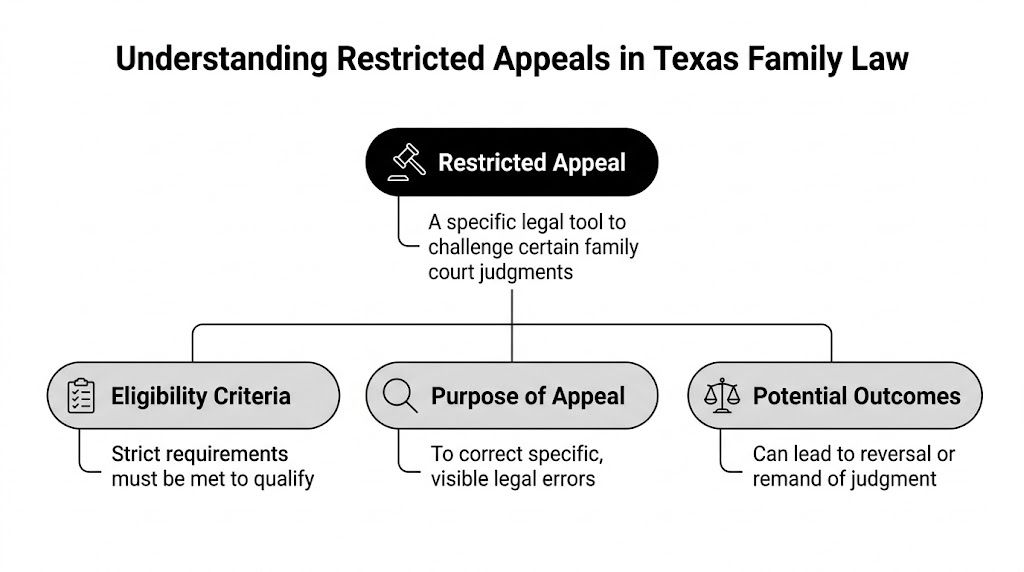
A restricted appeal is a direct appeal to a higher court, but it is much narrower than an ordinary appeal. It exists for parties who were part of the lawsuit, did not participate in the hearing that resulted in the judgment, and can show reversible error from the record itself.
One way to understand it is to think of a referee reviewing a disputed call using only the official replay available at the moment of decision. The referee cannot interview new witnesses later. The referee cannot consider extra footage from someone's phone. The review is limited to the official record. In a restricted appeal, the appellate court does something similar. It reviews only the face of the record.
The rule in plain English
Under Texas Rule of Appellate Procedure 30, a restricted appeal has four required parts.
“In Texas family courts, a restricted appeal under Texas Rule of Appellate Procedure 30 serves as a narrow jurisdictional mechanism for non-participating parties to directly attack a judgment, requiring strict compliance with four elements: (1) filing the notice within six months of the judgment's signing; (2) the appellant was a party to the underlying suit; (3) no participation in the hearing resulting in the judgment, coupled with no timely post-judgment motions, requests for findings of fact/conclusions of law, or standard notices of appeal under TRAP 26.1(a); and (4) reversible error apparent on the face of the record, defined as all papers before the trial court at judgment rendition, excluding extrinsic evidence.” (Freeman Law discussion of restricted appeals in Texas)
Those four requirements are strict. The first three determine whether the appellate court even has authority to hear the case. The fourth asks whether the record shows a legal error serious enough to justify reversal.
What the face of the record means
This phrase confuses many people. In everyday speech, people think "the record" means anything related to the case. In appellate practice, it means something narrower. Usually that includes the clerk's record and, if one exists, the reporter's record from the relevant proceedings. It does not include new explanations, new exhibits gathered after judgment, or facts outside what the trial court had before it when judgment was rendered.
That narrow focus is the reason restricted appeals are both powerful and limited.
- Powerful because a clear defect in the record can be enough to undo a judgment.
- Limited because a strong story alone won't help if the necessary error doesn't appear in the official record.
- Strategic because the entire case often turns on careful review of filings, orders, returns of service, hearing transcripts, and whether evidence was presented.
How restricted appeals differ from a new trial
A restricted appeal is not a do-over. You do not call witnesses again. You do not ask the appellate court to decide credibility. You do not get to fill gaps in the evidence after the fact.
That is why people often need to shift their thinking. In trial court, the focus is persuasion through testimony and exhibits. In appellate court, the focus is legal error shown by the record and framed through written argument.
Practical rule: A restricted appeal is about whether the judgment can legally stand on the record that already exists, not whether you could tell a better story now.
Why this remedy exists
The law balances two competing ideas. Courts need finality. Cases cannot stay open forever. But fairness also matters. If a party did not participate in the dispositive hearing and the official record reveals a legal defect, Texas law allows a narrow path for review.
In family law, that can matter in cases involving child custody, visitation, divorce decrees, property division, child support, spousal maintenance, and protective orders. The restricted appeal texas family court process is technical, but its underlying purpose is simple. It preserves due process when a judgment may have been entered on an inadequate or legally defective record.
The Four Critical Requirements for a Restricted Appeal
The four requirements sound simple when listed together. In practice, each one has traps. A person may feel certain they qualify, only to learn that one procedural detail blocks the appeal.

The notice must be filed within six months
This is a hard deadline. The notice of restricted appeal must be filed within six months after the judgment is signed. That timing requirement is one of the jurisdictional prongs described in the rule discussed earlier.
The strategic reason is finality. Texas courts give people a limited extra window for this special kind of appeal, but not an open-ended one. If that window closes, the restricted appeal route usually closes with it.
What this means for you is practical. Find the signed judgment immediately. Don't rely on memory. Don't count from the hearing date unless the judgment was signed that same day. The signature date on the order matters.
You must have been a party to the underlying case
This requirement sounds obvious, but it matters. A restricted appeal is available to someone who was a party in the trial court, such as a spouse in a divorce, a parent in a SAPCR, or a respondent in another family proceeding.
If you were affected by the order but were never formally made a party, different procedural questions may arise. Restricted appeal isn't a catch-all remedy for anyone disappointed by a judgment.
No participation in the hearing that resulted in the judgment
This is often the most misunderstood element.
Many people assume that if they filed an answer, they are disqualified. Not necessarily. The rule focuses on whether the appellant participated in the hearing that resulted in the judgment, and whether the appellant also avoided certain post-judgment filings that would place the case on a different appellate track.
Participation can be nuanced. Showing up and taking part in the decisive hearing is different from being named in the suit or filing an initial response earlier in the case. But this area is fact-sensitive, and small details matter.
Consider these examples:
- Likely problem for restricted appeal: You appeared at the final hearing, argued your position, and then lost. That usually points away from restricted appeal and toward a traditional appeal.
- Possible fit: You were a party to the suit, but you did not appear at the final default hearing, did not file a timely post-judgment motion, and did not file a regular notice of appeal.
- Needs close review: You participated in an earlier temporary-orders hearing but not the later final hearing that produced the judgment. Whether that counts can require careful analysis of what hearing resulted in the judgment being challenged.
A related issue is preservation. In ordinary appeals, lawyers often ask whether error was preserved in the trial court. That concept still matters broadly in appellate law, and readers trying to understand that topic can review preserving error for appeal in Texas family court. Restricted appeals are different because the qualifying party, by definition, did not participate in the dispositive hearing. The case often rises or falls on what the record already shows without the usual trial-level objections.
Non-participation is not simply an accident the law excuses. In a restricted appeal, it is one of the reasons the law allows review at all.
Reversible error must appear on the face of the record
This final requirement decides the merits. Even if the first three prongs are satisfied, the appeal won't succeed unless the record itself shows a reversible error.
Three terms often matter here:
- Reversible error means a legal mistake serious enough that the judgment should not stand.
- Abuse of discretion means the trial court acted unreasonably or without following guiding legal principles. Family law appeals often use this standard of review.
- Briefing means the written argument filed in the appellate court explaining the facts, the law, and why the judgment should be reversed or remanded.
The "face of the record" requirement is why restricted appeals are document-heavy. Lawyers examine:
- Service documents to see whether notice was legally proper
- The final order or decree to identify relief unsupported by pleadings or proof
- The reporter's record, if there is one, to see what evidence was or was not introduced
- Clerk's record materials such as affidavits, returns, motions, and docketed filings
Why these rules are so strict
Texas appellate procedure separates cases into lanes. Restricted appeal is a special lane for parties who did not participate and whose claims can be proven from the record alone. That is why courts insist on precision. The remedy is available, but only if the case fits the lane exactly.
For distressed clients, that can feel frustrating. For appellate judges, it is the structure that keeps the remedy fair and workable. The right question isn't just "Was I wronged?" It is "Can I show, through the existing record and within the procedural rules, that this judgment cannot legally stand?"
Restricted Appeal vs Other Appellate Options
A restricted appeal is only one way to challenge a family court judgment. The right remedy depends on what happened in the trial court, whether you participated, and what deadlines still remain.
The easiest way to see the difference is side by side.
Texas Appellate Remedies Compared
| Factor | Restricted Appeal | Traditional Appeal | Bill of Review |
|---|---|---|---|
| Who typically uses it | A party who did not participate in the hearing that resulted in the judgment | A party who participated and wants ordinary appellate review | A party seeking equitable relief after ordinary appellate deadlines and remedies are no longer available |
| Filing timeline | Notice must be filed within six months of the signed judgment, as noted in the rule discussed earlier | Shorter post-judgment deadlines apply under ordinary appellate procedure | Separate equitable proceeding with different timing and pleading issues |
| Participation allowed | No participation in the hearing resulting in judgment, and no timely post-judgment filings that shift the case into ordinary appeal practice | Participation is expected and does not disqualify the appeal | Used when direct appellate routes are not available |
| Evidence reviewed | Limited to the face of the record | Appellate court reviews the appellate record created in the case | Can involve issues outside the original record |
| Core question | Does the existing record itself show reversible error, and do the strict rule requirements fit | Did the trial court commit reversible error under the applicable standard of review | Is equitable relief justified despite the final judgment |
| Strategic use | Best for defaults and non-participation situations | Best when trial counsel preserved issues and ordinary deadlines are still open | Best viewed as a separate, last-resort type remedy in the right case |
Why the distinctions matter
A traditional appeal is the normal path when someone participated in trial court and wants review of an adverse final order. If you appeared, testified, objected, filed post-judgment motions, or otherwise followed the usual litigation track, that route usually makes more sense.
A restricted appeal serves a much narrower niche. Its value comes from a combination of two facts: the party did not participate in the decisive hearing, and the record itself may expose the problem. That combination doesn't exist in most ordinary appeals.
A bill of review sits in a different category. It is not just a late appeal. It is an equitable proceeding with its own requirements and risks. It can matter in some family law situations, but it is not a substitute for a restricted appeal when the six-month window remains open and the case fits Rule 30.
For readers trying to place these remedies within the larger system, this overview of Texas appellate procedure in family law cases helps explain how appellate deadlines, records, and briefing work together.
The best appellate option is rarely the one that sounds strongest emotionally. It is the one that matches the exact procedural posture of the case.
That is why early analysis matters. If someone chooses the wrong remedy, they may lose time that cannot be restored. In family law, where orders can affect children and finances immediately, choosing the proper appellate lane is often the first strategic decision that shapes everything that follows.
Common Reversible Errors Found in Restricted Appeals
The phrase error on the face of the record becomes easier to understand when you see what it looks like in real family law situations.

Problems with service and notice
One common issue is defective service. If the record does not show proper service, or if the return of service is legally insufficient, a default judgment may be vulnerable. Courts cannot enter binding relief against a party unless the legal requirements for notice are satisfied.
This matters in divorce, SAPCR, and protective-order settings. A person may know a case exists in a general sense, but the appellate question is narrower. Did the official record show legally valid service and proper notice in the way Texas law requires?
Orders entered without sufficient evidence
Another recurring problem is a judgment that grants major relief without enough evidence in the record to support it. In family law, that can happen when a court signs a decree dividing property, setting conservatorship terms, or ordering support after a short default hearing with little or no meaningful proof.
The provided legal materials describe a restricted appeal in which reversal occurred because the record contained no evidence on matters such as the marital estate, the parties' incomes and debts, and child-related best-interest facts. That kind of defect is important because family court decisions still require an evidentiary basis, even when the other side is absent.
The overlooked power of a missing reporter's record
A missing reporter's record can be one of the strongest issues in a restricted appeal involving sufficiency-of-the-evidence complaints.
“A frequently unaddressed gap is handling missing reporter’s records in restricted appeals raising sufficiency-of-evidence claims, particularly for default custody or property division judgments where no testimony was recorded. Unlike traditional appeals, restricted appeals place no burden on appellants to object to unrecorded proceedings; the absence alone can support facial error for evidentiary insufficiency, as appellate courts cannot consider extrinsic evidence and must presume harm from silent records. Success rates can spike with missing records in family cases, such as a 2025 divorce reversal for no evidence of property valuation.” (UNT Dallas discussion of restricted appeals and missing reporter's records)
Many readers are often surprised to learn this. In a normal appeal, people often assume they had to object during the hearing if the proceeding was not being recorded. In a restricted appeal, the absent party did not participate in that hearing. The missing record itself may become a central appellate issue.
Composite examples from family court
These examples show how the concept works in everyday terms.
Default divorce decree with unsupported property division
The court awards one spouse major assets and debts, but the record contains no real valuation evidence. If no reporter's record exists and the clerk's record does not show adequate proof, the judgment may face a serious appellate challenge.Custody order without best-interest evidence
A final order names conservators and sets possession, yet the record does not show evidence addressing the child's best interest. In family law, that absence can matter because custody decisions must rest on legally sufficient proof.Child support set on a thin or silent record
If the record lacks evidence supporting income findings or support calculations, the resulting order may be vulnerable.Protective-order relief exceeding what the record supports
Even urgent proceedings require a legally adequate record. An order that goes beyond the pleadings or the evidence may be challenged.
The strongest restricted appeal issues are often not dramatic courtroom moments. They are missing steps, missing proof, missing recordings, or missing compliance that the record quietly reveals.
That is why appellate review in these cases is so detail-driven. A person may think the main problem is that the judge was unfair. Sometimes the more effective argument is narrower and stronger. The record does not show service. The testimony was not recorded. The decree grants relief without evidentiary support. The order rests on a legal foundation the appellate court can see is incomplete.
How to Evaluate and Pursue Your Restricted Appeal
When a judgment feels wrong, the immediate desire is to act quickly. That instinct is understandable, but the first step should be organized, not reactive. A restricted appeal depends on timing and record quality, so early case evaluation matters.

Start with the signed order and a timeline
Find the judgment or final order. Confirm the date the judge signed it. Then build a short timeline that answers these questions:
- When were you served, if at all?
- Did you file an answer or any other paper?
- Did you attend the hearing that led to the judgment?
- Did you file a motion for new trial, request findings, or file a regular notice of appeal?
- Is there a court reporter's record?
This isn't busywork. It helps determine whether the case fits the restricted appeal lane at all.
Gather the actual record materials
A restricted appeal lives or dies on the official record. That means collecting documents, not just memories.
Focus on obtaining:
- The petition and any amended pleadings
- Returns of service and notices
- The final judgment, decree, or order
- Any reporter's record, or confirmation that none exists
- Docket information and file-stamped motions
- Any findings of fact or conclusions of law, if they were requested and signed
If you're unfamiliar with how these materials fit together, this guide to the appellate record in a Texas family law case gives a useful overview.
Get appellate analysis early
Many people wait too long to speak with an appellate lawyer because they think they should first "see what they can figure out." In restricted appeals, delay can be costly. The issues are technical, and the deadline structure is strict.
An appellate lawyer will usually ask different questions than a trial lawyer. Not just what felt unjust, but whether the first three Rule 30 requirements are satisfied and whether the record reveals a reversible issue worth briefing.
That review matters because appellate courts do reverse serious errors. According to Texas Supreme Court statistics for the 2024 to 2025 term, the Court's overall affirmance rate was 27.7 percent, which means it reversed or vacated lower court decisions in over 72 percent of the cases it heard. Those statistics don't guarantee a result in any individual family case, but they do show that appellate courts can and do correct lower-court errors when the legal basis is there.
What happens after the case is accepted for appeal
The process usually includes several major pieces.
Notice of appeal
This is the formal filing that tells the appellate court you are pursuing review. In a restricted appeal, the content and timing matter because the court's authority depends on compliance with the rule.
Record preparation
The clerk's record and any reporter's record are assembled and sent to the appellate court. If there is no reporter's record, that fact itself may become important depending on the issues.
A short overview may help before you read further:
Briefing
Briefing is the written argument, in which appellate counsel explains the facts shown by the record, identifies the legal errors, applies the standard of review, and asks for the proper relief. In family law, that relief is often reversal and remand rather than the appellate court rewriting every term of the order itself.
Possible result
If the court agrees there is reversible error apparent on the face of the record, it may reverse the judgment and send the case back to the trial court for further proceedings. That does not always end the dispute, but it can restore a fair process.
A good restricted appeal is built long before the brief is filed. It starts with dates, documents, and a disciplined reading of what the record actually shows.
Taking the First Step Toward a Fairer Outcome
A restricted appeal is not a broad escape hatch. It is a precise legal tool for a precise problem. When a Texas family court entered judgment after a party did not participate in the hearing that produced it, and the official record shows a serious error, this remedy can reopen the path to fairness.
That is why details matter so much. The signature date matters. Participation matters. The contents of the clerk's record matter. The existence or absence of a reporter's record matters. In many cases, the difference between a viable appeal and a dead end is not emotion. It is procedural fit.
For parents and spouses living under an order that feels fundamentally wrong, that can still be encouraging. Appellate courts exist to review legal error. They do not retry the case, but they do enforce rules that trial courts must follow. In family law, those rules protect due process, preserve the requirement of proof, and help ensure that orders affecting children and property rest on a lawful foundation.
If your case may fit the restricted appeal texas family court process, the most useful next move is to get the order, gather the record materials, and have the case evaluated quickly. A calm review now can prevent a rushed mistake later.
If you believe the court made a mistake in your family law case, the appellate attorneys at The Law Office of Bryan Fagan, PLLC can help you seek a fair outcome. We handle Texas family law appeals involving custody, visitation, divorce decrees, property division, child support, spousal maintenance, protective orders, and related judgments. Contact The Law Office of Bryan Fagan today for a free consultation.