You may feel like the judge made a decision that changed your life too quickly and too harshly. In family law, that feeling often comes after a ruling on custody, property division, support, or a protective order. The order is signed, the consequences are immediate, and you’re left asking whether anything can stop the damage while an appeal moves forward.
That’s where many people get tripped up. An appeal can challenge legal mistakes, but it usually doesn’t freeze the trial court’s order by itself. In a supersedeas bond texas family law appeal, the most important question often isn’t just whether you can win on appeal. It’s whether you can keep the order from being enforced before the appellate court has a chance to review it.
The Fight for a Fair Outcome After an Unjust Ruling
A family court ruling can feel final even when it isn’t. You may have spent months preparing for trial, gathering records, testifying, and trying to explain your side clearly. Then the court signs an order that you believe misread the facts, applied the law incorrectly, or gave too little weight to critical evidence.

That moment is overwhelming because family law orders don’t stay on paper. They change possession schedules. They trigger payment obligations. They can shift control of property, accounts, or daily parenting decisions. If you’re considering appealing a family court decision, the first practical concern is often simple: what happens while the appeal is pending?
Appeals review legal mistakes, not the whole case again
An appeal isn’t a second trial. The appellate court doesn’t call witnesses back to the stand or start fresh with new evidence. Instead, the court reviews the record, meaning the clerk’s papers and the reporter’s transcript, to decide whether the trial court made a legal error that affected the outcome.
Some common issues include:
- Misapplying the law: The judge used the wrong legal rule.
- Abuse of discretion: The judge had discretion, but used it in a way the law doesn’t support.
- Procedural error: The court excluded important evidence, admitted improper evidence, or handled the case unfairly.
- Insufficient support in the record: The ruling doesn’t line up with the evidence that was admitted.
Practical rule: An appeal is about whether the court made a reversible legal mistake, not whether the appellate judges would have decided the facts differently.
The hidden problem during an appeal
The biggest surprise for many families is that the trial court’s order can remain enforceable while the appeal moves ahead. That means the other side may still try to collect money, enforce transfer obligations, or rely on the order in daily life unless you take separate action to suspend enforcement.
That’s why supersedeas matters. In the right situation, it acts like a legal pause. It gives the appellate process room to work before your finances or family arrangements are disrupted beyond repair.
What Is a Supersedeas Bond in a Texas Family Law Appeal
A supersedeas bond is a form of security used to suspend enforcement of certain trial court judgments while an appeal is pending. In plain English, think of it as a pause button for some parts of the judgment.
That “some parts” language matters. Many readers assume that filing a notice of appeal automatically stops enforcement. It doesn’t. Filing the appeal and obtaining supersedeas are separate steps. One starts appellate review. The other is what may stop collection or enforcement.
The pause button analogy
If a divorce decree orders one spouse to pay a property equalization amount, the winning party may try to enforce that money judgment unless enforcement is suspended. A supersedeas bond gives the court and the other side security while the appeal is underway. In exchange, collection efforts are paused for the covered portion of the judgment.
This is why supersedeas often matters most in cases involving:
- Property division payments
- Child support arrears reduced to a money judgment
- Other monetary awards tied to a family case
- Enforcement judgments with a financial component
The governing framework comes from Texas Rule of Appellate Procedure 24, which sets out how a judgment may be superseded and what kind of security may be required.
The key people in the process
These terms appear often in appellate matters, and they’re easier to follow once translated into plain language:
- Appellant: The person asking the appellate court to review the trial court’s ruling.
- Appellee: The person defending the ruling on appeal.
- Judgment debtor: The person who owes money or must satisfy the judgment.
- Surety: The company or entity that backs the bond.
- Security: The protection posted to suspend enforcement. This may be a bond or another approved form.
Why people get confused
Family law mixes financial orders with child-related orders. A bond can be effective for money judgments, but that doesn’t mean it automatically pauses custody, visitation, or protective-order provisions. Many litigants hear the word “supersedeas” and assume it works the same way across the entire decree. It doesn’t.
That’s why a smart appellate strategy starts with sorting the order into categories.
| Term | Plain-English meaning |
|---|---|
| Notice of appeal | The filing that begins the appeal |
| Supersedeas bond | Security that may suspend enforcement of covered parts of the judgment |
| Record | The trial court papers and transcript reviewed on appeal |
| Briefing | Written arguments explaining why the trial court should be affirmed or reversed |
The appeal asks, “Did the trial court make a legal mistake?” Supersedeas asks, “Can enforcement be paused while that question is being answered?”
Why timing matters
A supersedeas issue is often urgent. If you wait too long to address enforcement, the other side may begin collection or other post-judgment action before the appellate court reviews anything. That’s why lawyers often evaluate supersedeas at the same time they evaluate the merits of the appeal.
In a supersedeas bond texas family law appeal, the practical first step is to identify what part of the order is monetary, what part is child-related, and what kind of relief is available for each.
When a Bond Is Required and How the Amount Is Calculated
When the order includes a money judgment, the next question is usually, “How much bond is required?” Texas gives a specific formula for that.
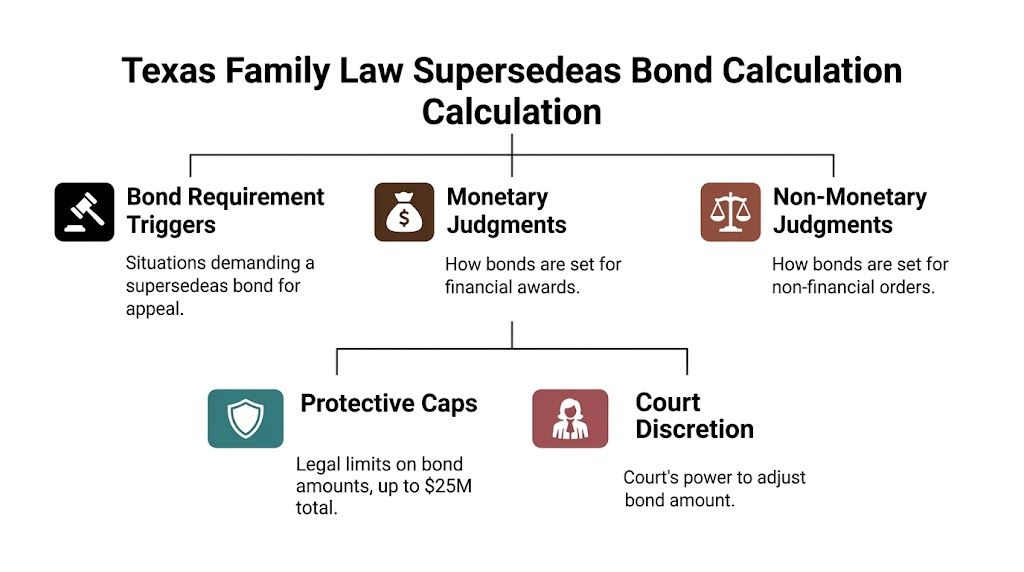
Under Texas Rule of Appellate Procedure 24.2(a)(1), the bond must equal compensatory damages, estimated interest for the appeal period, and awarded costs, subject to a protective cap. The cap is the lesser of 50% of the judgment debtor’s current net worth or $25 million, and that limit was enacted in 2003 through House Bill 4 to protect appellants from financial ruin during appeal, as described in the explanation of Texas appeal bond requirements.
The basic formula
For a monetary judgment, the calculation generally works like this:
Start with compensatory damages
This is the amount the court awarded as the underlying money obligation.Add estimated interest
The bond must account for interest expected to accrue during the appeal.Add court costs awarded in the judgment
If the judgment includes taxable costs, those are included too.
That total is then compared against the statutory cap.
Why the cap matters so much
Without a cap, a person appealing a large financial award might have to post security so high that the right to appeal becomes meaningless. The cap prevents that outcome in many cases.
The reform matters in family law because divorce decrees sometimes include substantial equalization payments or high-value property division awards. The rule gives the appellant a path to seek review without automatic financial collapse.
Key point: The bond is not always the full face amount you fear. The net-worth cap can change the analysis dramatically.
A practical family-law example
Take a divorce decree that orders one spouse to make a property equalization payment. The judgment may operate like any other money judgment for supersedeas purposes. The legal question becomes whether the bond should track the full amount under the rule’s formula or be limited by the net-worth cap.
The verified material gives one concrete figure that illustrates this calculation approach: a $371,802.90 equalization amount in Top Cat Ready Mix, used as an example of how these calculations work in practice under the Texas framework already discussed in the source above. The same source also notes a Dallas Court of Appeals ruling in which debtors successfully argued that a $25 million joint bond was enough across multiple parties, rather than allowing excessive security demands.
Documents that usually matter
Bond disputes often turn on proof, not assumptions. Courts want a grounded picture of what the judgment requires and what the appellant is able to post. That usually means gathering:
- The signed judgment or decree
- A clear breakdown of the monetary portions
- Financial records showing current net worth
- Any proposed bond form from the surety
- A motion asking the court to set or review the amount if needed
Court power to revisit the amount
The amount isn’t always fixed forever. The verified data states that courts retain jurisdiction to adjust supersedeas under Rule 24.3 if circumstances change, including changes tied to asset valuation issues in divorce matters. That can matter in complex estates where ownership interests, business values, or liquidity are disputed.
Where people make mistakes
The most common errors are practical:
- Treating every decree provision as bondable
- Ignoring the net-worth cap
- Posting security without checking whether the amount is challenge-proof
- Forgetting that interest and costs are part of the formula
A careful bond analysis often protects both the appeal and the appellant’s finances.
Critical Exceptions and Non-Bondable Orders in Family Law
Family law differs from ordinary civil cases in this respect. A supersedeas bond can suspend enforcement of many monetary obligations. It does not automatically suspend child-related rulings just because an appeal has been filed.
For child custody or visitation issues, Texas treats the problem differently. The verified rule summary states that TRAP 24.1 does not automatically suspend enforcement via supersedeas bond in these cases. A party must obtain a specific trial court order to supersede child-related provisions, and the court focuses on the child’s welfare rather than preserving the status quo, as explained in this discussion of supersedeas bonds in Texas and child-related exceptions.
Why custody orders are treated differently
The law assumes that child-centered rulings require immediate attention to the child’s best interest. A financial bond doesn’t answer that concern. Money can secure a money judgment. It can’t guarantee emotional stability, safety, or continuity in a child’s daily life.
So if your appeal challenges conservatorship, possession, access, or similar relief, the question isn’t just “Can I post security?” The critical question is whether the court will order suspension after a proper showing of harm.
The split between money and non-money relief
A single decree can contain both types of orders. That creates confusion fast.
Here’s a simple way to see it:
| Type of Order | Automatically Suspended by Bond? | Required Action |
|---|---|---|
| Property equalization payment | Often yes, if proper security is posted | File supersedeas security under TRAP 24 |
| Money judgment for arrears | Often yes, if the monetary portion is properly secured | Calculate and post the required security |
| Child custody order | No | Seek a specific court order suspending enforcement |
| Visitation or possession terms | No | File a motion and show why suspension is justified |
| Protective-order related non-monetary restrictions | No automatic suspension | Request specific relief from the court |
| Mixed decree with money and custody terms | Only the monetary part may be bondable | Use a combined strategy with bond plus motion practice |
What a proper showing usually means
When asking to suspend child-related provisions, the focus shifts from economics to harm. The court is looking for concrete reasons why immediate enforcement would threaten the child’s welfare or create serious prejudice before appellate review is complete.
That argument may involve concerns such as:
- Instability in the child’s routine
- A sudden transfer that may be hard to reverse later
- A visitation loss that may damage the parent-child relationship
- Procedural problems at trial that make immediate enforcement unfairly risky
Courts don’t use supersedeas in custody cases the way they use it for money judgments. They ask whether suspension protects the child, not the bank account.
Child support and mixed orders
Some family cases involve support, custody, and property issues all at once. That doesn’t mean one tool covers everything. The financial piece may require security. The custody piece may require a separate motion and a different legal showing.
The verified material also notes a family-law cap for certain monetary components in family cases under TRAP 24.2(b), but the strategic point for clients is this: if the decree mixes financial obligations with child-related directives, you need a hybrid plan.
Where trial lawyers and clients often stumble
A few recurring misconceptions cause serious problems:
“I filed the appeal, so custody can’t change yet.”
That’s often wrong.“If I buy a bond, the whole decree is paused.”
Usually not.“If the order is unfair, the appellate court will fix it before anything happens.”
Appeals take time, and interim relief requires separate action.
Reversible error still matters
Even though custody supersedeas requires a separate showing, the appeal itself still depends on identifying legal error. In family appeals, common allegations include excluding key evidence, misapplying the best-interest standard, using the wrong legal standard, or making a decision outside the zone of reasonable discretion.
That’s why the supersedeas question and the merits question have to be analyzed together. One protects you while the appeal is pending. The other determines whether the judgment ultimately stands.
Alternatives and Strategies If You Cannot Afford a Bond
Not every appellant can obtain a conventional surety bond quickly or comfortably. Even when the amount is legally capped, the practical burden can still be heavy. The good news is that a bond isn’t always the only path, and in some family-law settings, it may not be the central tool at all.

Other forms of security
Depending on the judgment and the court’s approval, alternatives may include:
- Cash deposit with the court: Some appellants use cash in place of a surety-backed bond.
- Alternative security by agreement: In some cases, the parties can agree on another form of protection.
- A motion to lower the amount: If the proposed security doesn’t reflect true net worth or overstates the monetary exposure, that issue can be challenged.
- Targeted relief for non-monetary orders: In custody or visitation disputes, the focus may shift away from bond economics and toward equitable suspension.
A cost discussion matters here too, especially if you’re trying to budget for the full appellate process. This guide on how much an appeal costs can help you see the bigger picture beyond the bond itself.
When the best strategy isn’t a bond at all
For custody and visitation issues, the stronger approach may be a request for temporary supersedeas without a bond. The verified data states that emerging 2025-2026 trends show a 22% increase in appellate courts granting temporary supersedeas in custody appeals without a bond, and that courts are waiving bonds in nearly 30% of certain family-law appeals when the appellant shows potential irreparable harm, such as loss of a parent-child bond, as described in the source discussing historical Rule 364 and recent waiver trends.
That matters because it points to a growing recognition that in child-related appeals, the most important security may be the child’s best interest, not a financial undertaking.
If the real danger is disruption of the parent-child relationship, the strongest supersedeas argument may sound less like finance and more like child-centered equity.
Building a practical strategy
A strong response usually begins by sorting the order into categories and then choosing the right tool for each one.
- If the decree is mostly monetary: Focus on accurate valuation, net-worth proof, and workable security.
- If the decree is mostly custody-related: Focus on irreparable harm, stability, and the best-interest standard.
- If the decree is mixed: Use both tracks at once. Secure what is bondable, and move separately on what is not.
The mistake is treating every appeal like a one-form process. Family-law appeals rarely work that way.
The Procedural Steps for Filing and Challenging a Bond
Deadlines shape everything in appellate practice. If you wait until enforcement begins, your options may narrow quickly. In many cases, the pressure starts soon after the judgment is signed, which is why clients need a clean roadmap.
A useful starting point is understanding Texas appellate procedure in family law, because supersedeas sits inside that larger process.
The usual sequence
Most cases follow a pattern like this:
The trial court signs the final order
This might be a divorce decree, SAPCR order, enforcement judgment, or protective order.The notice of appeal is filed
This preserves appellate rights if done on time. It does not, by itself, suspend enforcement.The record is prepared
The clerk’s record and reporter’s record are assembled for appellate review.Supersedeas is addressed
If the judgment includes a bondable monetary component, the appellant arranges security and files the proper paperwork. If the order concerns custody or visitation, motion practice may be needed instead.The other side may object
An appellee can challenge the amount, form, or sufficiency of the security.Briefing begins
The parties submit written arguments to the appellate court.
The terms clients need to know
Appellate language can sound dense, but the core ideas are manageable.
| Term | Plain-English definition |
|---|---|
| Abuse of discretion | A ruling that falls outside the range the law allows |
| Reversible error | A legal mistake serious enough to justify changing the result |
| Briefing | Written arguments filed in the appellate court |
| Record preparation | Gathering the papers and transcripts the appellate court reviews |
What briefing actually does
A brief is not a letter and not a summary of your feelings about the case. It is a structured legal argument that identifies the issues, cites the record, and explains why the law requires affirmance or reversal.
A good brief does at least three things:
- Frames the legal issue clearly
- Connects that issue to specific parts of the record
- Explains why the error mattered to the outcome
Challenging the bond
The appellee isn’t required to accept the bond amount or form without question. Bond disputes can involve claims that:
- the amount is too low,
- the net-worth evidence is incomplete,
- the judgment includes more than the appellant counted, or
- the proposed security doesn’t comply with procedural requirements.
The court may hold a hearing or require supporting proof. In family law, that proof often includes financial statements, affidavits, and the actual wording of the decree.
Small filing mistakes can create large consequences in appellate practice. Timing, wording, and record support all matter.
Frequent procedural mistakes
These are the errors that cause avoidable damage:
- Missing the deadline to perfect the appeal
- Assuming a notice of appeal stops enforcement
- Posting security without testing whether the decree has non-bondable provisions
- Filing a motion without a clear evidentiary foundation
- Ignoring challenges from the other side
The process is technical, but it isn’t random. When handled carefully, it gives the appellate court a stable framework to review the case fairly.
How Our Appellate Attorneys Can Help You Seek a Fair Outcome
Appeals ask for precision. Supersedeas asks for urgency. Family law often requires both at the same time.
If you believe the trial court ruled unfairly, the first step is a careful review of what transpired below. That means reading the judgment closely, identifying what parts are monetary and what parts are child-related, reviewing the record for reversible error, and deciding whether immediate relief is needed to prevent enforcement while the appeal is pending.
What skilled appellate help looks like
In a family appeal, legal help often includes work on several tracks at once:
- Record analysis: Reviewing transcripts, exhibits, rulings, and objections to identify appealable issues.
- Error framing: Determining whether the problem is legal error, abuse of discretion, or a harmful procedural ruling.
- Supersedeas planning: Calculating monetary security where appropriate and preparing motions for non-monetary relief where needed.
- Brief writing: Drafting persuasive appellate briefs focused on judges, the record, and controlling law.
This is also where practical discipline matters. Even strong arguments can be weakened by poor filings, incomplete attachments, or avoidable formatting errors. If you want a plain-language resource on filing court documents correctly, that guide can help you understand why appellate paperwork has to be exact.
Family cases need tailored appellate strategies
Different kinds of family appeals require different priorities:
- Child custody appeals: The focus may be preserving stability and challenging best-interest findings that weren’t properly supported.
- Divorce appeals: Property division and reimbursement issues often require careful analysis of the decree’s financial mechanics.
- Protective order appeals: These cases may turn on procedure, evidentiary rulings, and the scope of relief entered.
- Support and enforcement appeals: The legal issues may involve calculation methods, arrears rulings, or the wording of the order itself.
You may also want to learn more about related areas such as child custody appeals, divorce appeals, property division appeals, and protective order appeals through the resources available on the firm’s website.
Why clients need a calm plan
Many people come into the appellate process exhausted. They’ve already been through hearings, mediation, trial preparation, and a painful final ruling. What helps most at that stage is a clear plan, not more confusion.
That plan usually starts with four questions:
- Was there a legal mistake worth appealing?
- What part of the order can still be enforced right now?
- Is a bond, alternative security, or court-ordered suspension available?
- What needs to be filed first to protect your position?
A strong appellate approach answers those questions early and acts on them quickly.
If you believe the court made a mistake in your family law case, our appellate attorneys can help you seek a fair outcome. Contact The Law Office of Bryan Fagan, PLLC today for a free consultation.