You may feel like the judge heard your case, saw your evidence, and still reached the wrong result. That reaction is common in Texas family law. A custody order may not reflect what you believe serves your child. A property division may seem legally off balance. A child support ruling may ignore what was proved in court.
An appeal is where that feeling of unfairness gets tested against the law. But appeals don't work by telling the court, in general terms, that the outcome was bad. They work by showing that the trial court made a specific legal mistake, that the mistake was preserved, and that it mattered.
That is why the statement of issues on appeal texas family case matters so much. It tells the appellate court what error you are asking it to review. If it is vague, emotional, or disconnected from the trial record, the rest of the brief usually struggles. If it is precise, preserved, and framed under the right legal standard, the appeal has direction.
Your Path to Justice After an Unfair Family Court Ruling
A family court ruling can change where your child lives, how often you see them, how support is calculated, or how your marital estate is divided. When that ruling feels wrong, many people assume the appeal will be a second trial. It won't.
An appeal is narrower and more disciplined. The appellate court looks for legal error in what already happened. It reads the clerk's record, the reporter's record, the orders, and the briefing. Then it decides whether the trial court made a reversible mistake.

The good news is that appellate courts do reverse when a case is properly presented. The Texas Supreme Court reversed 72.3% of argued state court cases in the 2024-2025 term, according to Reverse & Render's review of 2025 Texas Supreme Court statistics. That doesn't mean every disappointed party has a strong appeal. It means courts will correct error when lawyers identify it with precision.
Why the statement of issues matters so much
The statement of issues is the roadmap of the appeal. It tells the court, in a concise form, what the trial judge allegedly did wrong. In family cases, that might involve:
- Custody rulings that applied the wrong legal standard
- Child support decisions entered without required findings
- Property division errors based on mischaracterization or legal misapplication
- Protective order or enforcement rulings entered despite procedural defects
Practical rule: A strong appeal doesn't start with "the judge was unfair." It starts with "the court committed this legal error, in this part of the record, under this rule or statute."
That shift changes everything. It moves the case from frustration to analysis. It also forces discipline early, which is often where viable appeals separate themselves from appeals that only feel compelling.
Understanding the Texas Appellate Process
Texas appeals follow a different logic than trial court litigation. No one calls new witnesses. No one adds new exhibits. No one gets to improve weak testimony after the fact. The appellate judges review the existing record, then apply the controlling law to decide whether the trial court should be affirmed, reversed, or sent back for further proceedings.
Appeals are about the record, not a redo
The record is the written account of what happened in the trial court. In plain English, it usually includes the filed papers, admitted exhibits, hearing transcripts, and signed orders. If something isn't in that record, the appellate court generally can't consider it.
That is why clients are often surprised by the limits of appellate review. A strong witness who never testified cannot help on appeal. A document you found later usually can't become part of the case at that stage. Appellate judges work from a cold record, not from fresh storytelling.
A Texas family appeal also turns on whether the order is appealable and whether the required deadlines were met. In most cases, timing and record preparation start immediately after the judgment is signed. Delay at this stage can damage options before the legal arguments are even drafted.
Plain English definitions that matter
Several terms appear in almost every family appeal. They sound technical, but the core ideas are manageable.
- Briefing means the written legal argument submitted to the appellate court. The brief explains the facts from the record, identifies the issues, cites the law, and argues for a remedy.
- Reversible error means a mistake serious enough to justify appellate relief. Not every mistake qualifies. The error must be one the appellate court can review and one that likely affected the judgment.
- Standard of review means the rule the appellate court uses when evaluating the trial court's decision. This is one of the most important concepts in the whole appeal.
The same trial ruling can look very different on appeal depending on whether the issue is framed as a factual disagreement or a legal error.
What abuse of discretion really means
Many family law rulings are reviewed for abuse of discretion. That phrase doesn't mean the appellate court asks whether it would have decided the case differently. It asks whether the trial court acted without guiding legal principles or reached a decision the law cannot support on the record.
That is a deferential standard. Trial judges receive room to make judgment calls, especially in areas like conservatorship, possession, and visitation. If the appeal only argues, "the judge should have believed me instead," that usually isn't enough.
By contrast, a legal error gets a different kind of review. If the trial court misread the Texas Family Code, used the wrong burden of proof, ignored a required finding, or applied the wrong legal framework, the appellate court gives less deference. That difference often shapes the entire strategy.
What the appellate court is actually looking for
An appellate judge reading your brief is trying to answer a focused set of questions:
- Is the order properly before the court
- Was the complaint preserved in the trial court
- Did the brief present a clear issue tied to the record
- Did the trial court commit error under the governing law
- Did that error likely affect the outcome
This is why effective appellate work feels more like architecture than argument alone. Each piece has to support the next. If preservation fails, the issue may never be reached. If the issue statement is too broad, the standard of review may become harder than it needs to be. If the law is right but the record citation is weak, the argument can stall.
A practical way to think about the process
Clients often understand appeals better when they stop comparing them to trial. A trial asks, "What happened?" An appeal asks, "Did the court decide the case in a way the law permits, based on the record that was made?"
That distinction matters in every family law category, from child custody appeals to divorce decree appeals and property division disputes. The strongest appeals respect that difference from the start.
How to Preserve Your Right to Appeal During Trial
Many people believe they preserved an issue because it appeared in a petition, motion, or proposed order. Texas appellate courts often reject that assumption. A claim isn't preserved just because it was mentioned somewhere in the file.

A recurring trap is this: a party asks for relief in pleadings, but never develops the issue through evidence or legal argument at trial. Appellate courts frequently treat that issue as waived. This discussion of inadequate briefing and failure to preserve appellate issues in a Dallas family law context highlights the point clearly. Preservation requires active trial participation, not just filed paperwork.
What preservation means in real life
Under Texas appellate practice, the trial judge usually must have been given a fair chance to correct the alleged error. That normally requires a timely and specific objection, request, or motion. General dissatisfaction isn't enough. Silence isn't enough either.
If a lawyer says only "objection" without explaining the legal basis, the appellate court may conclude nothing meaningful was preserved. If the issue concerns omitted findings, excluded evidence, an improper legal standard, or a defective order, the record should show exactly what was brought to the trial court's attention and when.
For a deeper look at the mechanics, see this guide on preserving error for appeal in Texas family court.
Three things people confuse
A large part of the preservation problem comes from mixing up three different acts.
| Trial step | What it does | What it does not do |
|---|---|---|
| Filing a pleading | Identifies requested relief | Does not by itself preserve appellate complaint |
| Offering evidence | Builds the factual record | Does not replace a needed legal objection |
| Making a legal argument or objection | Alerts the judge to the claimed error | Does not fix missing evidence |
That distinction matters. A parent may request modified support in the pleadings, but if that issue isn't presented through proof and argument at the hearing, the court of appeals may have nothing to review. Likewise, a spouse may complain after judgment that an asset was mischaracterized, but if no timely objection or request for findings targeted the problem, the issue can become much harder to pursue.
Raising an issue is not the same as preserving it. Preservation happens in the courtroom record.
Bench trials and jury trials are not always the same
Preservation rules can differ depending on how the case was tried. The verified materials note that sufficiency challenges are treated differently in some bench trials than in jury trials, and parental termination cases can involve strict preservation requirements even when the stakes are extremely high. That is one reason appellate review should begin with the trial record, not with assumptions about what "must have been preserved."
What clients should look for after trial
If you're considering appeal, review the case with these questions in mind:
- Was the complaint made clearly: Can you point to the hearing transcript where the objection, request, or argument appears?
- Was the basis specific: Did trial counsel identify the legal reason, not just the frustration?
- Did the judge rule or refuse to rule: The record usually needs to show a ruling, or a refusal after a request for one.
- Was the issue developed: If the complaint depended on facts, were those facts proved?
Preservation is not a technical side issue. It is often the gatekeeper to appellate review. A strong statement of issues begins with a preserved complaint and nowhere else.
Strategically Selecting and Phrasing Your Issues
Not every trial court mistake should become an appellate issue. Some are too minor to affect the result. Others are buried under a deferential standard of review that makes reversal unlikely unless the argument is reframed. Appellate strategy thus proves its worth.
The central question is not merely, "What upset you?" It is, "What legal error can the court of appeals review, under a standard that gives your argument traction?"
Framing often matters more than the raw complaint
A weak issue statement usually sounds like a disagreement with the outcome. A stronger one identifies the legal lens through which the appellate court should review that outcome.
That distinction is especially important in family law, where many rulings are reviewed for abuse of discretion. This discussion of standards of review in Texas family appeals explains a key strategy: a geographic restriction issue may be hard to win as a pure factual challenge, but it may become stronger if the appeal argues the trial court improperly shifted the burden of proof, which is a legal error reviewed without deference.
That is the kind of reframing that changes an appeal from "the judge was wrong" to "the judge used the wrong legal rule."
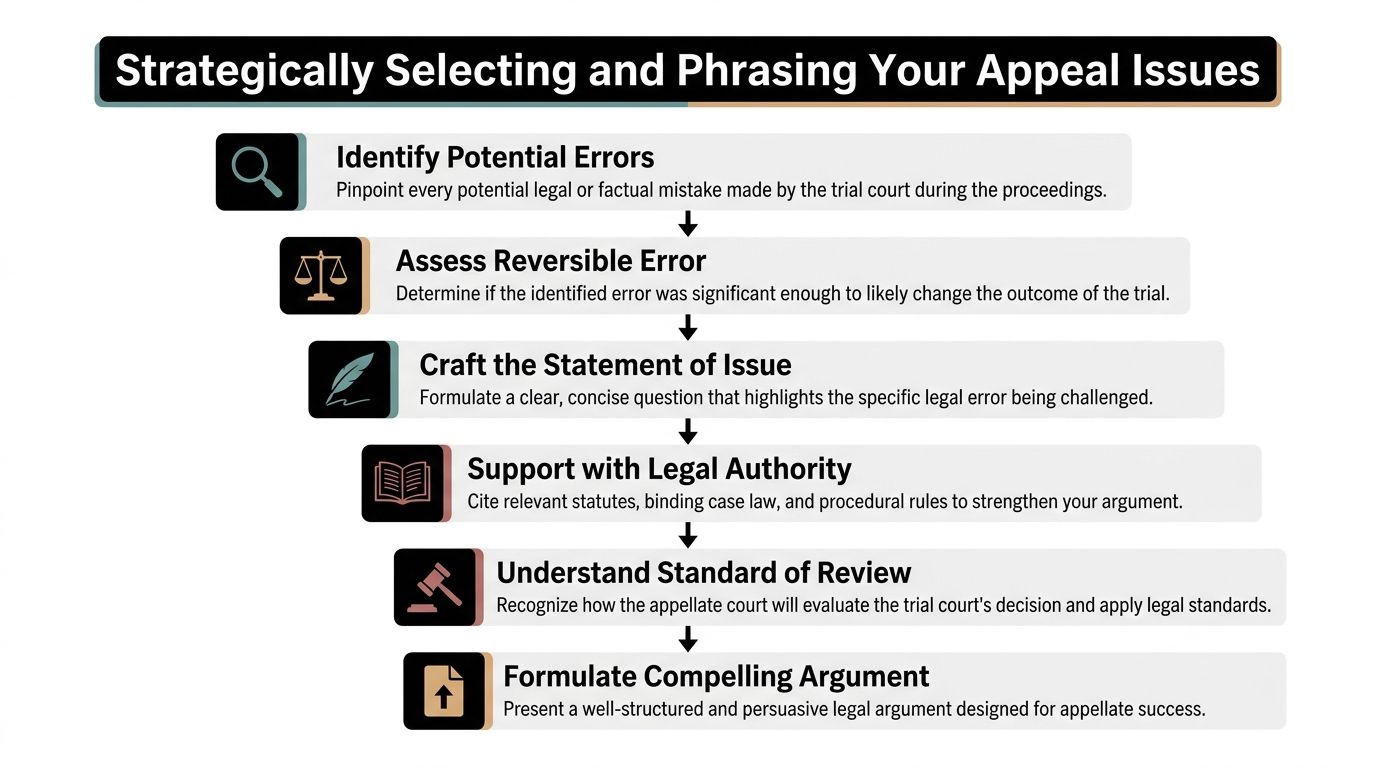
A working framework for issue selection
When evaluating a possible statement of issues on appeal texas family case, a disciplined sequence helps.
Identify the ruling that caused actual harm
Focus on the trial court action that changed rights or obligations. If the complaint wouldn't alter the judgment even if won, it may not deserve space in the brief.Tie the complaint to a rule, statute, or required procedure
Good issue statements rarely float in general fairness language. They connect the complained-of act to something concrete, such as the Texas Family Code, the Texas Rules of Appellate Procedure, or a required finding.Check whether the issue was preserved
If the record doesn't show a timely objection, request, or argument, the issue may need to be abandoned or rethought.Choose the better standard of review when the record supports it
If the dispute can be framed as a legal misapplication rather than a bare factual disagreement, the appeal often becomes cleaner and more persuasive.State the issue concisely
Texas Rule of Appellate Procedure 38.1(f) calls for a concise statement of issues. Concise doesn't mean skeletal. It means direct, focused, and tied to the trial court's actual ruling.Make sure the issue fits the record you can cite
If the statement sounds strong but the reporter's record does not support it, revise it. Appellate judges notice overstatement quickly.
For a related discussion about building the factual foundation of the brief, this article on the statement of facts in a Texas family appeal is useful alongside issue drafting.
What works and what doesn't
Here is the practical trade-off. Broader issues may feel emotionally satisfying, but they often become blurry. Narrower issues can feel less dramatic, yet they often give the appellate court a clean path to decision.
| Approach | Why it struggles or succeeds |
|---|---|
| "The judge ignored everything in my favor" | Too broad, too emotional, and usually unclear about the legal error |
| "The trial court abused its discretion in naming the other parent primary" | Better, but still may be too outcome-focused without the legal basis |
| "The trial court misapplied the governing best-interest standard by failing to link its ruling to the evidence required under the Family Code" | Stronger because it identifies a legal framework, not just dissatisfaction |
Case evaluation lens: The best issue statements identify the court's mistake in a way that tells the appellate judges how to review it.
Good issue statements do three jobs at once
A well-phrased issue statement usually handles three tasks in one sentence or two short sentences.
- It identifies what the court did
- It signals why that act was legally wrong
- It points toward why the error mattered
For example, in a custody appeal, saying the evidence favored your position may not get far. Saying the trial court applied the wrong burden, ignored a required statutory analysis, or entered findings unsupported under the governing standard gives the court something it can review.
This is why issue selection is rarely mechanical. The strongest appellate lawyers don't just gather complaints. They edit, combine, narrow, and reframe until each issue can survive both the record and the standard of review.
Examples of Strong and Weak Issue Statements
The difference between a weak issue and a strong one is often the difference between complaint and advocacy. Weak statements sound like frustration. Strong statements sound like judicial questions the court can answer from the record and the law.
In Texas family appeals, that usually means grounding the issue in the ruling, the preserved complaint, and the legal standard. It also means avoiding loaded wording. Your brief should sound controlled, not offended.
Comparing weak and strong issue statements
| Family Law Scenario | Weak Phrasing (Likely to Fail) | Strong Phrasing (More Persuasive) |
|---|---|---|
| Child custody | The judge was wrong to let the children live with the other parent. | Whether the trial court misapplied the child's best-interest standard under Texas Family Code §153.002 by disregarding record evidence relevant to the challenged conservatorship ruling. |
| Geographic restriction | The residence restriction was unfair and made no sense. | Whether the trial court committed legal error by applying an incorrect burden of proof in resolving the geographic restriction dispute. |
| Property division | The property division was unequal and unjust. | Whether the trial court mischaracterized property under the governing legal standards, resulting in an improper division of the marital estate. |
| Child support deviation | The support amount was not based on the evidence. | Whether the child support order should be reversed because the court deviated from statutory guidelines without the written findings required by Texas Family Code §154.130, after a proper request for those findings. |
Why the stronger versions work better
The stronger examples do not merely say the result was bad. They identify the legal reason the result may be reversible. They also give the appellate court a manageable question.
In custody appeals, issue statements become stronger when they connect the complained-of ruling to the governing law, such as the child's best interest under Texas Family Code §153.002, and then tie that law back to record evidence. In support cases, the issue must reflect any added preservation steps that applied in the trial court.
The verified materials specifically note that, for a child support order deviating from statutory guidelines, Texas Family Code §154.130 requires written findings supporting the deviation, and failure to provide those findings can be reversible if the issue was properly preserved through a request. That guidance appears in the Texas Children's Commission presentation on preserving your record for appeal.
A drafting habit that improves issue statements
Write the issue once as your client would say it. Then rewrite it as an appellate judge would need to read it.
Client version: "The judge ignored my evidence."
Judge-ready version: "Whether the trial court abused its discretion by entering a conservatorship ruling after misapplying the governing legal standard to the evidence admitted at trial."
The second version doesn't guarantee success. It does something more important. It gives the court a legal question tied to appellate review.
Common Pitfalls That Can Derail Your Appeal
Some family appeals fail before the court meaningfully considers the merits. The reason is not always the lack of a legitimate complaint. Often, it is a procedural problem that could have been avoided.

One of the clearest examples is briefing failure. Verified data states that up to 25% of dismissals in perfected family law appeals are caused by briefing deficiencies, including failure to present a concise statement of issues that corresponds to a properly preserved error under TRAP 38.1(f). That point appears in the Texas Rules of Appellate Procedure materials cited in the verified data.
The most common derailers
Some mistakes are fatal. Others don't end the appeal immediately but weaken it so severely that recovery becomes difficult.
Late notice of appeal
Deadline mistakes are among the harshest errors in appellate practice. If the notice is untimely, the appeal can be barred.Briefing that doesn't match the preserved complaint
The issue presented on appeal must align with what was raised in the trial court. If the brief evolves into a different complaint, waiver problems appear quickly.Trying to add new evidence
Appeals review the existing record. New documents, new witnesses, and post-trial explanations generally don't repair the original case.Failing to secure necessary findings
In some family law contexts, findings of fact and conclusions of law are essential to meaningful review. Without them, a valid complaint may become harder to isolate and argue.
Why issue statements often trigger the problem
Clients sometimes assume that if the body of the brief explains everything, a loosely drafted issue statement can be forgiven. That is risky. Judges and staff attorneys often turn to the issues first to understand the case. If those issues are vague, argumentative, or disconnected from preservation, the brief starts at a disadvantage.
A statement of issues is not a headline. It is the court's map to the reversible error you want reviewed.
A common example is this shift: the trial objection challenged a missing statutory finding, but the appellate issue complains generally that the result was unfair. The broader argument may feel stronger emotionally, yet it can be legally weaker because it no longer mirrors the preserved error.
Jurisdiction and finality are not technicalities
Another recurring problem is appealing the wrong order. Not every order in a family case is immediately appealable. Finality matters. If the order is interlocutory when no interlocutory appeal is allowed, the appellate court may lack jurisdiction.
That review should happen early. Before drafting arguments, confirm what order was signed, whether it disposed of the issues necessary for appeal, and what deadlines flowed from that signing date.
A short video can help make these traps more concrete:
A practical pre-filing screen
Before moving forward with a family appeal, run a disciplined check:
| Question | Why it matters |
|---|---|
| Is the order final and appealable | Without appellate jurisdiction, the court cannot reach the merits |
| Was the deadline calculated correctly | A strong argument cannot rescue an untimely notice |
| Does each issue match a preserved complaint | Misalignment creates waiver risk |
| Does the record support the issue as phrased | Unsupported assertions damage credibility |
| Are required findings or requests in the file | Missing procedural steps can limit review |
Procedural discipline does not make an appeal less persuasive. It is what gives the court permission to hear the persuasive part.
Your Appellate Strategy Checklist and Next Steps
If you're considering an appeal, clarity at the beginning saves time and frustration later. The strongest consultations usually start with organized facts, key dates, and a realistic understanding of what an appeal can and can't do.
A checklist to prepare your case review
Confirm the order you want to challenge
Bring the signed order or judgment. The first question is whether it is final and appealable.Write down the critical dates
The signing date matters immediately. So do dates for any post-judgment motions, findings requests, or notices.Identify the exact ruling you believe was wrong
Avoid broad summaries. Pinpoint the specific custody, support, property, enforcement, or protective-order ruling at issue.Gather the trial materials
Relevant pleadings, proposed orders, findings, hearing notices, and transcripts help show what was argued and preserved.Note what was said at trial
If you remember an objection, request, or disputed ruling, flag that part of the hearing. Even rough notes can help locate the key passage in the reporter's record.Separate unfairness from legal error
Your frustration is real, but the appeal depends on identifying a legal problem in the record. That is the pivot point in every serious evaluation.
For readers trying to understand what the appellate court expects from the written submission itself, this guide to appellate brief requirements in Texas family law is a helpful next step.
What a useful consultation should accomplish
A good appellate review should answer a short list of hard questions. Is there a preserved issue. Is the issue framed under the right standard of review. Does the record support it. Did the error likely affect the outcome. And is the cost and time of appeal justified by the strength of the available arguments.
The best case evaluations are candid. Some cases should be appealed. Some should be defended. Some should not move forward at all.
That kind of clarity protects clients. It also keeps the appeal grounded in the decisions appellate courts render, not in what everyone wishes had happened at trial.
If you believe the court made a mistake in your family law case, the appellate attorneys at The Law Office of Bryan Fagan, PLLC can help you evaluate whether a viable path to reversal exists. We handle Texas family law appeals involving custody, child support, property division, divorce decrees, protective orders, enforcement, and related post-judgment disputes. Contact our team today for a free consultation and a strategic review of your options.