Skip to content
You may feel like the judge heard your words, watched your witnesses, and still signed an order that reads as if your side never mattered. That reaction is common in Texas family law cases, especially when the ruling affects your child, your home, your finances, or your future parenting time.
That feeling matters. But in an appeal, the legal question is narrower. Texas appellate courts don't hold a second trial. They review the trial court record to decide whether the judge made a legal mistake that can justify relief. In many cases, the hardest part is separating a painful outcome from an actual appealable error.
Addressing appealing a case where testimony was ignored in Texas court often involves two very different problems. Sometimes the judge heard the testimony and did not believe it. Other times the judge kept the testimony out, cut it off, or applied the wrong legal rule. One of those is usually much harder to appeal than the other.
If you're trying to understand whether your case fits a real appellate issue, start with the difference between being unheard and being harmed by legal error. For a broader look at how appellate review works, visit our Texas family law appeals page.
My Testimony Was Ignored What Now
The order is signed. You read it twice and still have the same reaction: Did the judge even hear me? In Texas family court, that reaction is common, especially after a hearing about conservatorship, possession, support, or property division.
The next question is the one that matters on appeal. Did the judge hear your testimony and reject it, or did the court make a legal mistake in the way the testimony or evidence was handled?
That difference decides whether you may have an appealable issue or only a hard result.
An appeal does not give you a second chance to tell the story better. The court of appeals studies the clerk's record and reporter's record to decide whether the trial court made a reversible legal error. That is why the first job is to identify the problem with precision, not just describe the outcome as unfair.
Practical rule: "The judge should have believed me" is rarely enough. "The court excluded admissible testimony, applied the wrong rule, or prevented me from making a record" is the kind of issue appellate courts can review.
Clients usually use the word "ignored" to describe several different problems. Those problems do not carry the same weight on appeal.
- The judge heard the testimony but believed the other side instead. That is usually a credibility dispute.
- The judge cut off testimony or refused to hear a witness. That may raise an evidentiary or due process issue.
- The court excluded a document, recording, text message, or other exhibit. That can matter if the evidence was admissible and the record shows why it mattered.
- The ruling rested on the wrong legal standard. In family law, that can happen even when everyone was allowed to testify.
- Your lawyer could not finish an offer of proof or state the objection clearly. Then the problem may be preservation as much as the ruling itself.
Clients often lose time focusing on proving the judge reached the wrong result, when the better question is whether the record shows a legal error the appellate court can correct.
For example, if a judge listened to both parents testify about missed exchanges and then believed one parent over the other, an appeal is usually difficult. If the judge refused to let a parent testify about a recent safety incident, or kept out evidence based on the wrong rule, the analysis changes. For a closer look at that kind of issue, see our guide on appealing the improper admission or exclusion of evidence in Texas.
Good appellate strategy starts with a disciplined review of the hearing record, the objections, the excluded evidence, and the wording of the order. That is how you separate a painful ruling from a real appellate issue.
Was Testimony Disbelieved or Improperly Excluded
This is the fork in the road. If the judge heard the testimony and chose not to credit it, an appeal is difficult. If the judge wrongly prevented admissible testimony from being heard or considered, that's a different conversation.
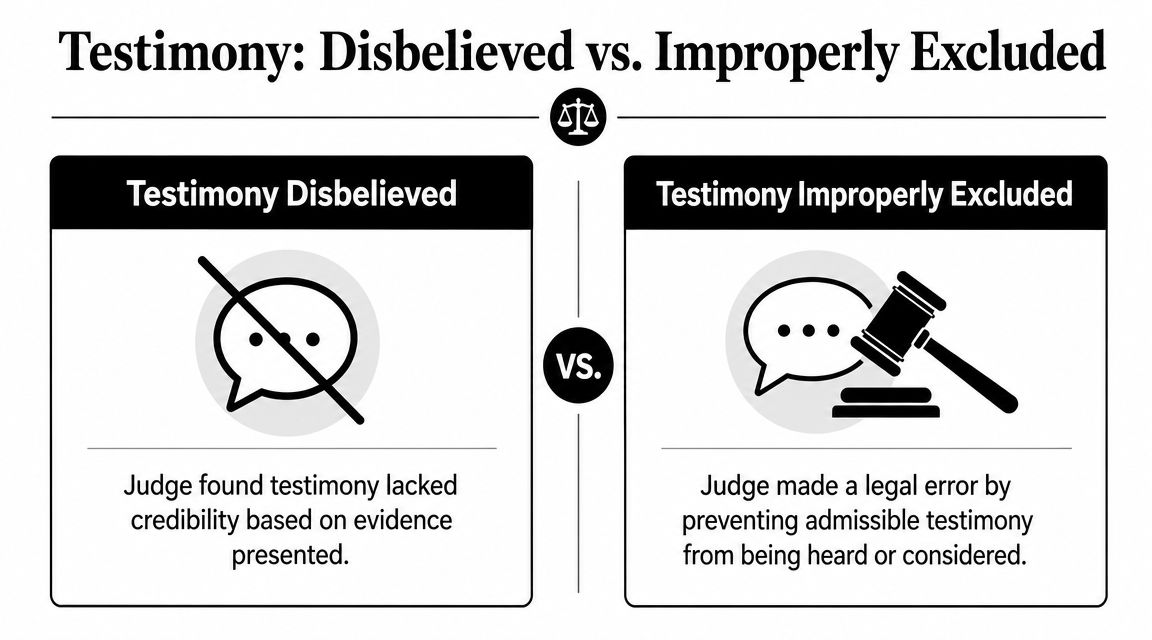
Credibility disputes are usually uphill
In many family law hearings, both parties testify. One says the child is thriving under the current schedule. The other says the child is struggling. The judge watches both witnesses, hears cross-examination, and makes a call.
That is usually a credibility determination. Appellate courts generally defer to the trial court's fact-finding, which makes "the judge ignored my testimony" a weak appeal theory unless the appellant can show legal error, abuse of discretion, or a record-supported due process problem. That point is especially important in child custody cases, where rulings often turn on witness credibility, as discussed in this analysis of testimony and credibility issues.
A court of appeals doesn't sit in the courtroom. It doesn't watch faces, hear tone, or assess pauses. That's one reason appellate judges are reluctant to second-guess live fact findings.
Exclusion problems can be appealable
Now consider a different example. Your lawyer calls a school counselor, therapist, or family member with firsthand information. Opposing counsel objects. The judge sustains the objection based on a mistaken view of the rules, and the witness never gives the testimony.
That may be a true appellate issue. The same is true if the judge limits cross-examination in a way that prevents a party from developing critical facts, or excludes evidence that should have come in under the governing rules.
For a deeper look at this category, read about improper admission or exclusion of evidence in a Texas appeal.
| Scenario | What It Means | Appealable? |
|---|---|---|
| The judge heard both sides and believed the other witness | Fact-finding and credibility call | Usually weak on appeal by itself |
| The judge allowed testimony but gave it little weight | Disagreement with how evidence was weighed | Usually difficult |
| The judge refused to admit testimony under the wrong legal rule | Potential evidentiary error | Potentially yes, if preserved |
| The judge cut off proof and the record shows what the witness would have said | Possible harmful exclusion | Often worth close review |
| The testimony was never formally admitted and no record was made | Appellate court may have nothing to review | Usually a major problem |
The question to ask yourself
Don't ask only, "Did the judge listen to me?"
Ask these instead:
- Was the testimony admitted?
- Did counsel object when it was blocked or limited?
- Did the judge make a clear ruling?
- Can the appellate court see the exact testimony in the record?
- Did the ruling likely affect the outcome?
A strong appeal rarely starts with "the judge was unfair." It starts with "the judge made this specific legal ruling, on this page of the record, and that ruling mattered."
How to Preserve Error for a Texas Appeal
Many appeals are won or lost in the trial court, long before the notice of appeal is filed. If the alleged error wasn't preserved, the appellate court may never reach the merits.
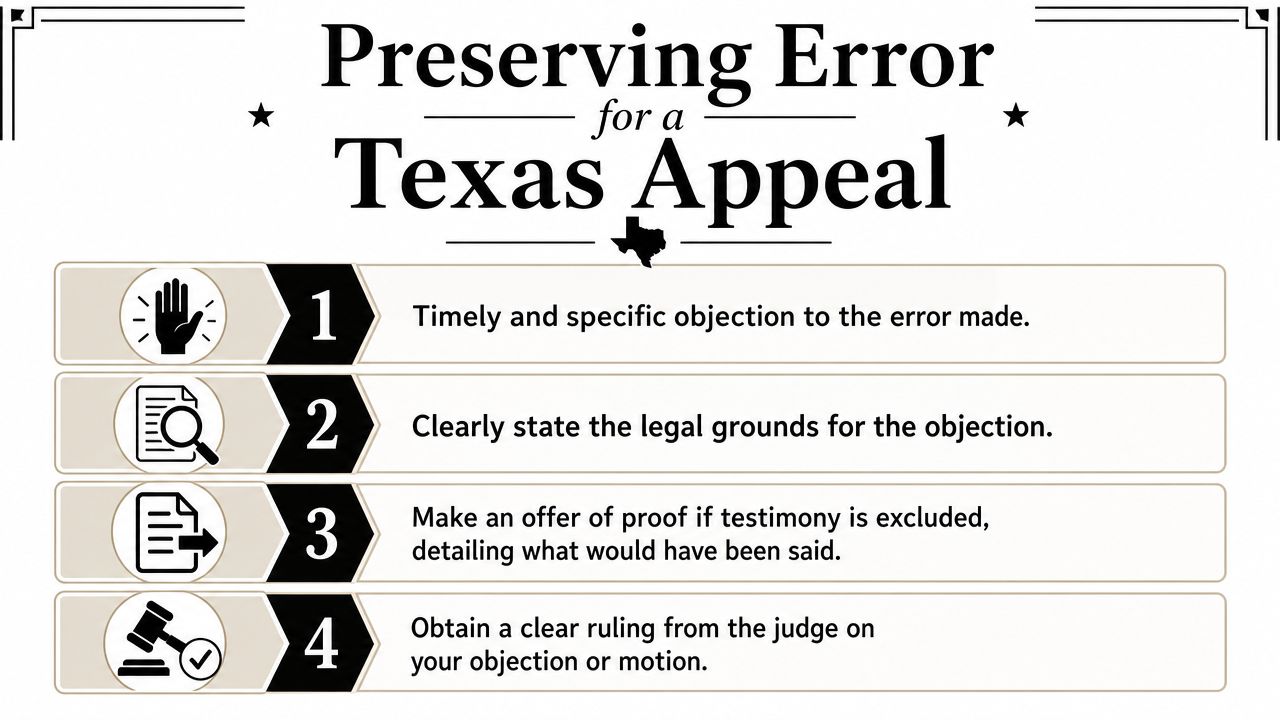
Texas appellate courts review only what was preserved below. The decisive record is the reporter's record and the clerk's record. If testimony was allegedly ignored or excluded, the appellant must show the testimony was part of the record and that a timely objection, offer of proof, or other preservation step was taken under the Texas Rules of Appellate Procedure. Missing or incomplete transcripts are a common reason appeals fail, as explained in this discussion of why no transcript often means no appeal.
Four preservation moves that matter
Make a timely objection
The objection has to come when the problem occurs, not later when everyone is frustrated about the result.State the legal ground clearly
"Objection" by itself usually isn't enough. Counsel needs to tell the judge what legal rule is being violated.Make an offer of proof if testimony is excluded
If the witness wasn't allowed to testify, the appellate court still needs to know what the testimony would have been.Get a ruling
A complaint without a ruling often doesn't preserve anything.
For a more detailed breakdown, review preserving error for appeal in Texas family court.
What an offer of proof does
An offer of proof is one of the most misunderstood parts of trial practice. If the judge excludes testimony, counsel should place the substance of that testimony into the record. That can happen through questioning outside the presence of the fact finder or by a clear statement of what the witness would have said.
Without that step, the appellate court may agree with you emotionally but still say it can't evaluate harm because it doesn't know what was excluded.
Record reality: If the excluded testimony isn't reflected in the appellate record, the reviewing court often has no way to measure whether the ruling mattered.
Post-judgment steps that may help
In family law cases, post-judgment filings can sharpen the issues for appeal. Depending on the case, counsel may need to consider:
- A request for findings of fact and conclusions of law
- A motion for new trial
- A motion to modify, correct, or reform the judgment
- Requests related to the preparation of the reporter's record
These aren't automatic in every case. But when testimony issues are tangled up with fact findings, evidentiary rulings, or unclear reasoning, post-judgment practice can make the appellate path much cleaner.
Understanding the Standard of Review
A lot of people assume the appellate judges will read the record and decide what they would have done. That isn't how it works. The appellate court applies a standard of review, which is the legal lens that controls how much deference the trial judge receives.
Abuse of discretion in plain English
In Texas family law, one of the most common standards is abuse of discretion. In plain English, that means the appellant must show more than a bad outcome. The ruling must fall outside the range of decisions a trial judge could reasonably make under the law.
A useful way to think about it is a replay review in sports. The reviewing official doesn't reverse every close call. The call has to be clearly wrong under the rule being applied.
If you'd like a deeper discussion, see how the abuse of discretion standard works in Texas family law appeals.
What reversible error means
A reversible error is a mistake that likely led to an improper judgment. Not every mistake qualifies. Some errors are real but harmless.
That matters in testimony cases. Even if a judge wrongly excluded a witness, the appeal still turns on whether that exclusion probably affected the outcome. If the same information came in through other witnesses, or if the excluded point was minor, the court may still affirm.
Why preservation and deference matter together
Texas appellate courts are highly deferential to trial judges when the complaint is that testimony was ignored or weighed incorrectly. One Texas appellate source states that in 90% of direct appeals, if trial counsel did not object when the error occurred, the issue is treated as waived and can't be raised on appeal, according to this explanation of appealable error and waiver.
That combination is what makes these cases challenging. First, the appellant has to clear the preservation hurdle. Then the appellant has to overcome deference. That's why the best appellate issues are usually narrow, documented, and tied to a specific legal ruling rather than a general feeling that the judge got it wrong.
The Texas Family Law Appeal Process and Timeline
You walk out of a family court hearing convinced the judge ignored what you said. Then the written order is signed, and the appeal clock starts running whether you feel ready or not.
That first reality surprises many clients. An appeal does not give you a new chance to testify, add missing documents, or explain what the judge "should have understood." The court of appeals reviews the existing record and decides whether the trial court made a legal error that was preserved and harmful.
That distinction matters here. If the trial judge found your testimony unpersuasive, an appeal is usually difficult. If the judge kept testimony out, cut off questioning in a way that broke the rules, or relied on a legal standard the law does not allow, the issue may be much stronger. By the time the order is signed, the job shifts from proving your facts to identifying the exact ruling the appellate court can review.
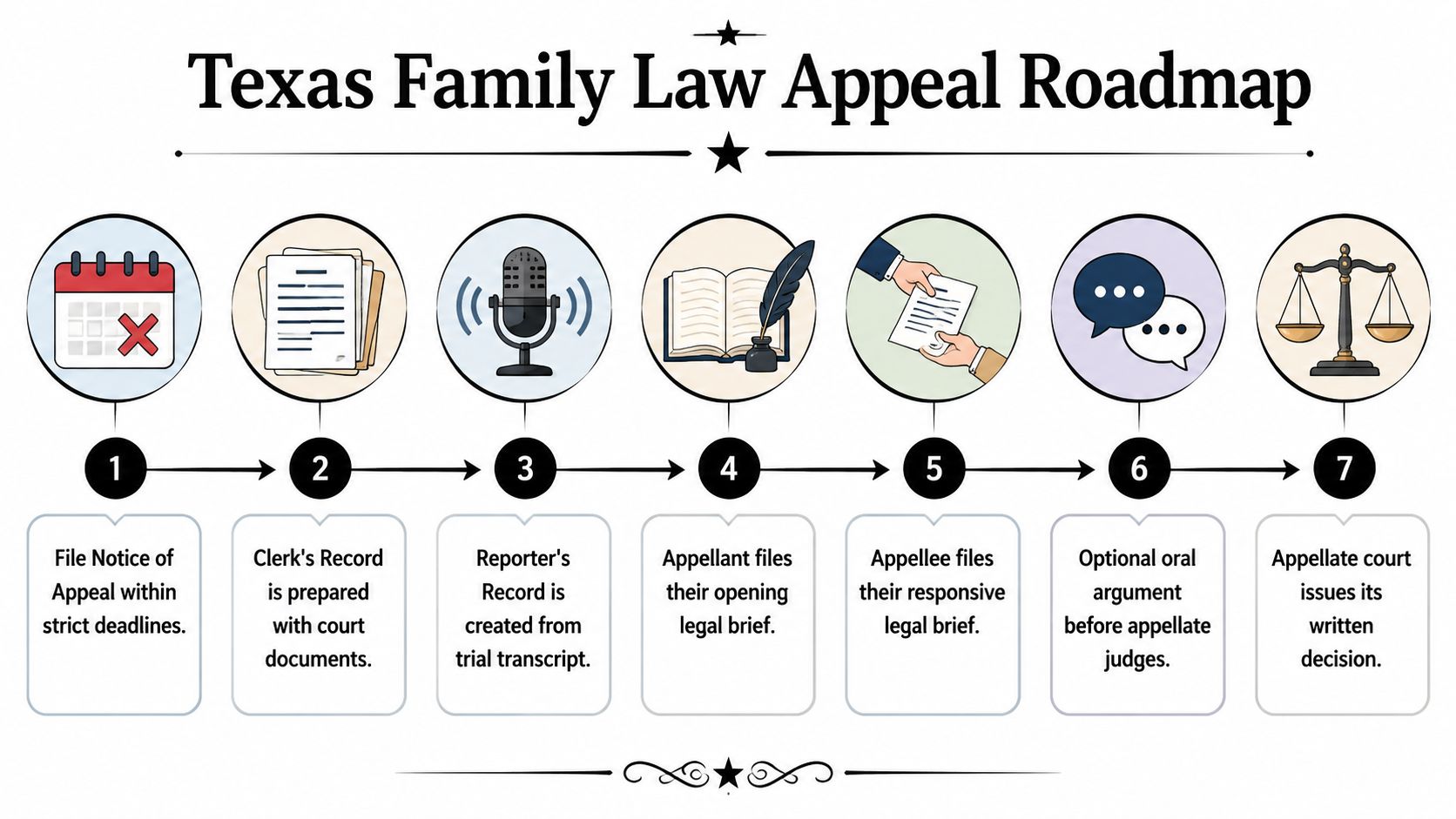
The usual sequence
Notice of appeal is filed
This starts the appellate process and protects your right to seek review. In Texas family cases, the deadline can arrive fast, and post-judgment motions can affect it. Do not guess on timing.The clerk's record is prepared
This record includes the pleadings, motions, exhibits filed with the clerk, docketed orders, and the final judgment or decree.The reporter's record is prepared
This is the transcript of the hearings and trial. In testimony-based appeals, this part of the record often decides whether a complaint is viable at all.The appellant files the opening brief
This is the most important written filing in the case. It must point to specific places in the record, identify the legal error, explain how the issue was preserved, and show why the mistake probably affected the result.The appellee files a response brief
The other side usually argues one of three things: there was no error, the issue was not preserved, or any error was harmless.The court may set oral argument
Some cases are decided on the briefs alone. If oral argument is granted, the justices usually focus on the weak points in each side's position, not on broad fairness concerns.The appellate court issues an opinion
The court may affirm the order, reverse and send the case back, or less often render the judgment that should have been entered.
Here's a short video that gives a practical overview of the appellate path:
Timing and expectations
Appeals are rarely quick. Even a well-prepared family law appeal usually takes months, not weeks, because the record has to be completed, briefs have to be filed, and the court needs time to consider the case.
The court of appeals is usually the main event. Review after that is discretionary, and as noted earlier, petitions for review are granted only a small percentage of the time, often described as around 10%. That is one reason experienced appellate lawyers focus hard on the first appeal instead of treating it as a warm-up round.
What the appellate court can and can't do
The court of appeals decides legal issues from the record that already exists. It does not hear new testimony, consider documents that were never admitted or filed, or retry the facts from scratch.
Possible outcomes include:
Affirming the judgment
The trial court's order stays in effect.Reversing and remanding
The case goes back to the trial court for further proceedings. In a testimony issue, that may mean a new hearing or trial on the part of the case affected by the error.Reversing and rendering
In narrower situations, the appellate court enters the judgment the trial court should have entered.
Family law appeals require precise issue selection
This is especially important when the judgment involves divorce, protective orders, parenting rights, or property division. I often tell clients that "the judge ignored me" is a starting point, not an appellate issue by itself. The real question is whether the record shows a reviewable ruling. If the answer is yes, the appeal may have a path. If the answer is no, the better strategy may be a targeted post-judgment motion, a modification case, or a realistic cost-benefit decision about whether to proceed.
Your Immediate Next Steps A Checklist
If you believe the court made a serious mistake, act promptly and organize your file before memories fade and deadlines pass.

Start here
- Find the signed final order or decree: Note the exact date the judge signed it.
- Request your file from trial counsel: Ask for pleadings, hearing notices, exhibits, correspondence, and any post-judgment filings.
- Ask about the record immediately: Confirm whether the reporter's record has been requested and whether key hearings were transcribed.
- Write out the testimony issue clearly: Identify who was speaking, what the testimony was, when it happened, and whether it was admitted, limited, or excluded.
- List each objection and ruling you remember: Even an imperfect memory helps appellate counsel know where to look first.
- Save every court notice and email: Small details often matter in appellate timelines.
Bring facts, not just frustration. The strongest consultation starts with the order, the hearing date, and a short list of the rulings you believe were wrong.
Don't rely on memory alone
Clients often remember the emotional high points of trial, but appeals turn on documents, transcripts, and rulings. If you're considering appealing a case where testimony was ignored in Texas court, treat the case file like evidence. Because it is.
Frequently Asked Questions About Testimony-Based Appeals
When reviewing these cases, a useful workflow is to build an issue-to-record map. That means identifying each disputed witness statement, tying it to the exact transcript page and exhibit number, and connecting it to the legal standard and the ruling being challenged. That approach comes from practical appellate method discussed in this Texas appellate scholarship resource.
Quick answers to common concerns
| Question | Answer |
|---|---|
| Can I appeal just because the judge didn't believe me? | Usually not by itself. A disagreement over credibility is often hard to reverse unless it connects to a legal error or due process problem shown in the record. |
| What if my witness wasn't allowed to testify? | That may be appealable if the ruling was legally wrong and the substance of the testimony was preserved through an offer of proof or similar record-making step. |
| Can I add new evidence on appeal? | No. Appeals are based on the trial court record. New evidence usually belongs, if anywhere, in a different procedural vehicle, not a standard direct appeal. |
| What is briefing? | Briefing is the written argument filed in the appellate court. It explains the facts from the record, the controlling law, and why the judgment should be affirmed or reversed. |
| What does abuse of discretion mean? | It means the trial court had some room to decide, but not unlimited room. The appellant must show the ruling fell outside the bounds of reasonable judicial decision-making under the law. |
| If the court excluded only part of my testimony, does that matter? | It can. The key questions are what was excluded, whether the issue was preserved, and whether the limitation likely affected the judgment. |
A final reality check
Some cases feel unfair but don't present a strong appellate issue. Others look ordinary at first and contain a clean, reviewable legal error once the record is studied closely.
Good appellate work starts with discipline. Match each complaint to a page in the transcript, an exhibit in the file, a ruling from the court, and a legal standard that fits.
If you believe the court made a mistake in your family law case, our appellate attorneys can help you seek a fair outcome. Contact The Law Office of Bryan Fagan, PLLC today for a free consultation.