Skip to content
If you are considering a divorce in Texas, one of your first and most pressing questions is likely about the cost. The financial uncertainty can be a significant source of stress. The truth is, the price for a divorce can range dramatically, from a few hundred dollars for a simple, agreed-upon case to tens of thousands for a contested one. But what happens if you’ve already been through this process and feel the financial outcome was fundamentally unfair?
You may feel your case was handled incorrectly, leading to an unjust division of property or an unsustainable support order. In these situations, understanding the initial costs is only part of the story; knowing your options for seeking a fair outcome through the appellate process is equally critical.
Uncontested vs. Contested Divorces: How Conflict Dictates Cost
The path your divorce takes—cooperative or contentious—is the single biggest factor determining the final cost. When you and your spouse agree on all major issues, the process is streamlined. When you disagree, the legal work, and therefore the expense, multiplies.
If you have completed your divorce but believe the trial court made a significant legal error in its decisions, you may have grounds for an appeal. An appeal isn't a second trial but a review of the trial court's record to determine if a serious mistake, known as a reversible error, occurred that likely led to an improper judgment.
The Financial Gap: A Look at the Numbers
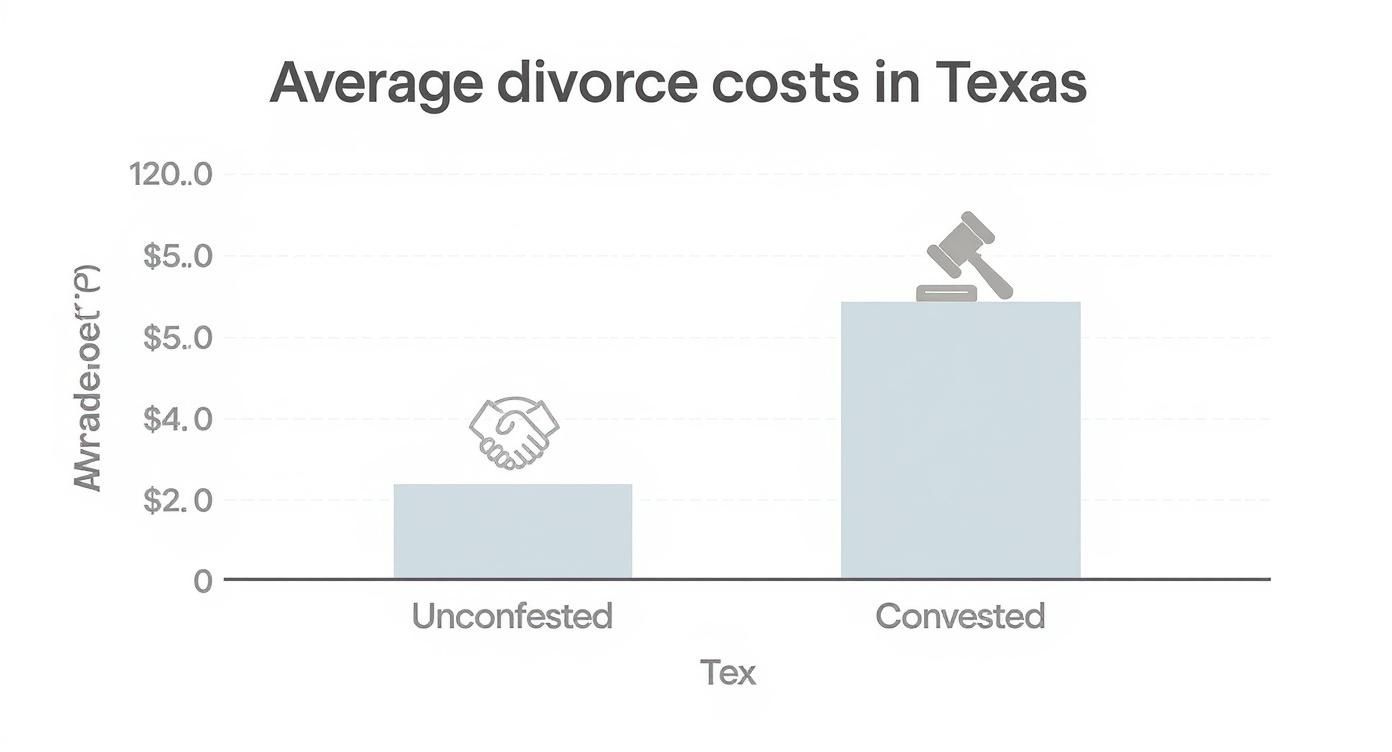
The difference in cost between an amicable and a litigated divorce is substantial. A litigated divorce in Texas involving children averages a staggering $23,500. Without children, the average is still significant at $15,600. In contrast, a simple, uncontested divorce might only cost between $300 and $5,000. For a deeper dive into these numbers, you can find more information on Texas divorce budgeting on familyresolve.ai.
This table breaks down the estimated average costs for different divorce scenarios in Texas.
| Divorce Type | Average Cost Without Children | Average Cost With Children |
|---|---|---|
| Uncontested/Amicable Divorce | $300 – $5,000 | $300 – $5,000 |
| Contested/Litigated Divorce | $15,600 | $23,500 |
As you can see, the path you choose—cooperation versus conflict—has a direct and substantial effect on your wallet.
When a case proceeds to trial, the risk of a judicial mistake increases. If you feel the financial outcome of your completed divorce was unjust due to a legal error, our team is here to help you understand your appellate options.
If you believe the court made a mistake in your family law case, our appellate attorneys can help you seek a fair outcome. Contact The Law Office of Bryan Fagan today for a free consultation.
What You Can Appeal in a Texas Divorce Case

While the cost of a divorce is often driven by the level of disagreement, an unfair outcome can result from legal errors made by the trial court. An appeal is not a chance to re-argue the facts of your case. Instead, it is a formal request for a higher court to review the trial record for mistakes of law or an abuse of discretion—a legal term meaning the trial judge made a decision that was arbitrary, unreasonable, or without reference to any guiding rules and principles.
Common reversible errors in Texas family law cases often involve:
- Property Division: Mischaracterizing separate property as community property (or vice versa), or an unequal division that is not "just and right."
- Child Custody: Making custody or visitation orders that are not in the child's best interest based on the evidence presented.
- Child Support: Incorrectly calculating child support by misinterpreting income or failing to follow the Texas Family Code guidelines.
- Spousal Maintenance: Improperly awarding or denying spousal support.
The cost of a simple, uncontested divorce can run from $300 to $5,000. But once you step into contested territory, the average cost jumps to between $15,000 and $27,000, with highly complex cases easily topping $50,000. You can find more details about the cost of a simple divorce in Texas on bryanfagan.com. If a contested trial led to an unfair result, an appeal may be your only remedy.
The appeals process is governed by strict deadlines under the Texas Rules of Appellate Procedure. For most cases, a Notice of Appeal must be filed within 30 days of the final judgment being signed. This makes it critical to act quickly if you suspect an error was made in your case.
If you believe the court made a mistake in your family law case, our appellate attorneys can help you seek a fair outcome. Contact The Law Office of Bryan Fagan today for a free consultation.
Understanding the Standard of Review in Family Law Appeals
When you are thinking about the cost of a divorce, it helps to understand where the money goes. The two primary expenses are attorney fees and court filing fees. In an appeal, the costs are similarly structured around attorney fees for highly specialized work and court-related costs.
An appellate attorney’s work is very different from a trial lawyer's. It involves an exhaustive review of the trial record, legal research, and writing a persuasive legal document called a brief. This brief argues why the trial court committed a reversible error.
Attorney Fees and Appellate Costs
Most family law attorneys charge an hourly rate, secured by an upfront retainer. Hourly rates can range from $250 to over $600, depending on the lawyer's experience and the case's complexity. Get familiar with the average retainer fee for a lawyer to know what to expect.
In an appeal, the cost is tied to the complexity of the legal issues and the size of the trial record. Preparing the official record for the appellate court also has associated costs. The key factor for success in an appeal is the standard of review, which is the level of deference the appellate court gives to the trial court’s decision. For many family law issues, like property division and custody, the standard is abuse of discretion. This means you must show the judge’s decision was legally and factually unreasonable.
Court Filing Fees and Other Mandatory Costs
Just as a divorce requires a filing fee to begin (typically $250 to $350 in Texas), an appeal also has its own set of administrative costs. These include filing fees with the court of appeals and costs for preparing the official reporter's record (the trial transcript) and the clerk's record (all the documents filed in the case). These are mandatory and essential to budget for.
If you believe the court made a mistake in your family law case, our appellate attorneys can help you seek a fair outcome. Contact The Law Office of Bryan Fagan today for a free consultation.
Uncovering Hidden Costs and the Path to a Fair Outcome

Many people focus only on attorney retainers and court fees when budgeting for a divorce. However, numerous other expenses often arise, such as fees for mediation, expert witnesses (like appraisers or forensic accountants), and mandatory parenting classes. These hidden costs can significantly inflate the total price.
If an unfair outcome at trial forces you to live with an unjust financial reality, the "cost" of the divorce extends far beyond legal fees. An improper property division or support order can impact your financial stability for years. This is why considering an appeal is not just about correcting a mistake—it's about restoring balance and securing your future. The appellate process has its own costs, but it provides a structured path to seek justice when the trial court gets it wrong. Understanding how major life changes like divorce impact your taxes is also crucial, as a corrected judgment on appeal can have significant tax implications.
How Errors in Child and Property Rulings Justify an Appeal
The most expensive and emotionally charged aspects of a divorce are almost always related to children and property. These are also the areas where a trial court is most likely to commit a reversible error. Disagreements over custody, child support, and the division of assets are what drive up litigation costs and increase the potential for judicial mistakes.
An appeal does not re-examine your entire case. It focuses on specific legal errors.
The Complexity of Texas Property Division and Grounds for Appeal
Texas is a community property state, meaning assets acquired during the marriage must be divided in a "just and right" manner. This process is complex and prone to error, especially with assets like:
- A Family Business: Requiring expert valuation.
- Retirement Accounts: Needing a specialized court order (a QDRO).
- Real Estate: A professional home appraisal for divorce is critical to establish fair value.
A trial court commits reversible error if it mischaracterizes property (e.g., calling your separate inheritance "community property") or divides the estate in a way that is legally unjust. Similarly, correctly navigating mortgage details during a divorce is a detail that, if handled incorrectly in the decree, could be grounds for review.
Child-Related Rulings and the "Best Interest" Standard
When it comes to children, all decisions must be based on the "best interest of the child" standard. A judge commits an abuse of discretion if their custody, visitation, or support order is not supported by the evidence presented at trial. If you believe the court ignored crucial facts or misapplied the law in a way that harms your child's best interest, an appeal may be necessary to protect your family.
If you believe the court made a mistake in your family law case, our appellate attorneys can help you seek a fair outcome. Contact The Law Office of Bryan Fagan today for a free consultation.
Seeking a Fair Outcome Through Appellate Advocacy

While cooperation is the best way to manage initial divorce costs, that option is gone once a judge has issued a final order. If you feel that order is unfair due to a legal mistake, your only path forward is the appellate process. This is a strategic, detail-oriented legal proceeding focused on law and procedure, not emotion.
The goal of an appeal is to persuade a higher court that the trial judge made a reversible error. This requires a deep understanding of the Texas Rules of Appellate Procedure and the Texas Family Code. The process involves preparing the official record, conducting in-depth legal research, and writing a comprehensive legal brief that methodically lays out your argument.
The Steps in a Texas Family Law Appeal
- File a Timely Notice of Appeal: This is the first and most critical step, with a strict deadline.
- Prepare the Appellate Record: We gather the clerk’s record (all filed documents) and the reporter’s record (the trial transcript).
- Briefing: Our attorneys draft the appellant's brief, outlining the facts, issues, and legal arguments. The other side (the appellee) then files a response brief.
- Oral Argument: In some cases, attorneys present their arguments directly to a panel of appellate judges.
- The Decision: The court of appeals will issue a written opinion that either affirms the trial court's decision, reverses it, or reverses and remands it back to the trial court for further proceedings.
Navigating this process requires a calm, confident, and strategic approach focused on achieving a just result based on the rule of law.
If you believe the court made a mistake in your family law case, our appellate attorneys can help you seek a fair outcome. Contact The Law Office of Bryan Fagan today for a free consultation.
Common Questions About Texas Divorce Appeals
After a difficult trial, you may feel the final orders were unfair. Understanding your post-trial options, particularly the appellate process, can provide a clear path forward.
Here are answers to some of the questions we hear most often from clients who believe their case was decided incorrectly.
Can I Make My Spouse Pay My Attorney Fees on Appeal?
In Texas, a trial court can order one spouse to pay the other's attorney fees, especially if there is a large income disparity. While less common, it is also possible to seek attorney's fees for the cost of an appeal. An appellate court can award "just damages" if it determines the appeal was brought for a legitimate purpose and was successful. The goal is to ensure that a person with a meritorious appeal is not prevented from seeking justice simply because they cannot afford the cost.
Can I Appeal a DIY Divorce Outcome?
While a DIY divorce may seem like a way to save money, it often leads to mistakes in the final decree. You can appeal a judgment from a DIY divorce, but it can be challenging. An appeal is based on errors made by the judge, not mistakes made by the parties. However, if the final decree contains provisions that are legally unenforceable or resulted from a judicial error during the final hearing, there may be grounds for an appeal to correct a fundamentally unfair outcome.
How Long Does an Appeal Take?
Unlike a trial, which may conclude in a matter of days, the appellate process is methodical and takes time. From filing the Notice of Appeal to receiving a final decision from the court of appeals, the process typically takes from nine months to over a year, depending on the complexity of the case. While it is a lengthy process, it is the designated legal path to correct errors and fight for a just result when the trial court has failed to provide one.
If you believe the court made a mistake in your family law case, our appellate attorneys can help you seek a fair outcome. Contact The Law Office of Bryan Fagan, PLLC today for a free consultation.