Skip to content
You may feel your case was handled unfairly after a Texas divorce bench trial. When you read a final divorce decree and believe the judge just got it wrong, it can be a deeply frustrating and disheartening experience. Perhaps they ignored key evidence, misunderstood the facts of your case, or misapplied the law when dividing your property or deciding custody of your children.
It's crucial to understand that an unjust ruling from a bench trial—where a judge makes the final call without a jury—does not have to be the end of the road. An appeal after a bench trial in a Texas divorce is a specific, structured process designed to correct significant legal errors made at the trial court level. This is not a second trial or a chance to introduce new evidence. Instead, the focus of an appeal is narrow and strategic: you must prove that the judge made a harmful legal error that led to an improper outcome.
What is an Appeal in a Texas Divorce?

The purpose of a divorce appeal is to ensure the law was applied correctly and fairly. Simply being unhappy with the result is not enough to win. To succeed, you must demonstrate a “reversible error”—a mistake so substantial that it likely caused the court to issue an improper judgment. The appellate process acts as an essential safeguard, holding trial courts accountable to the Texas Family Code and the rules established by previous court decisions.
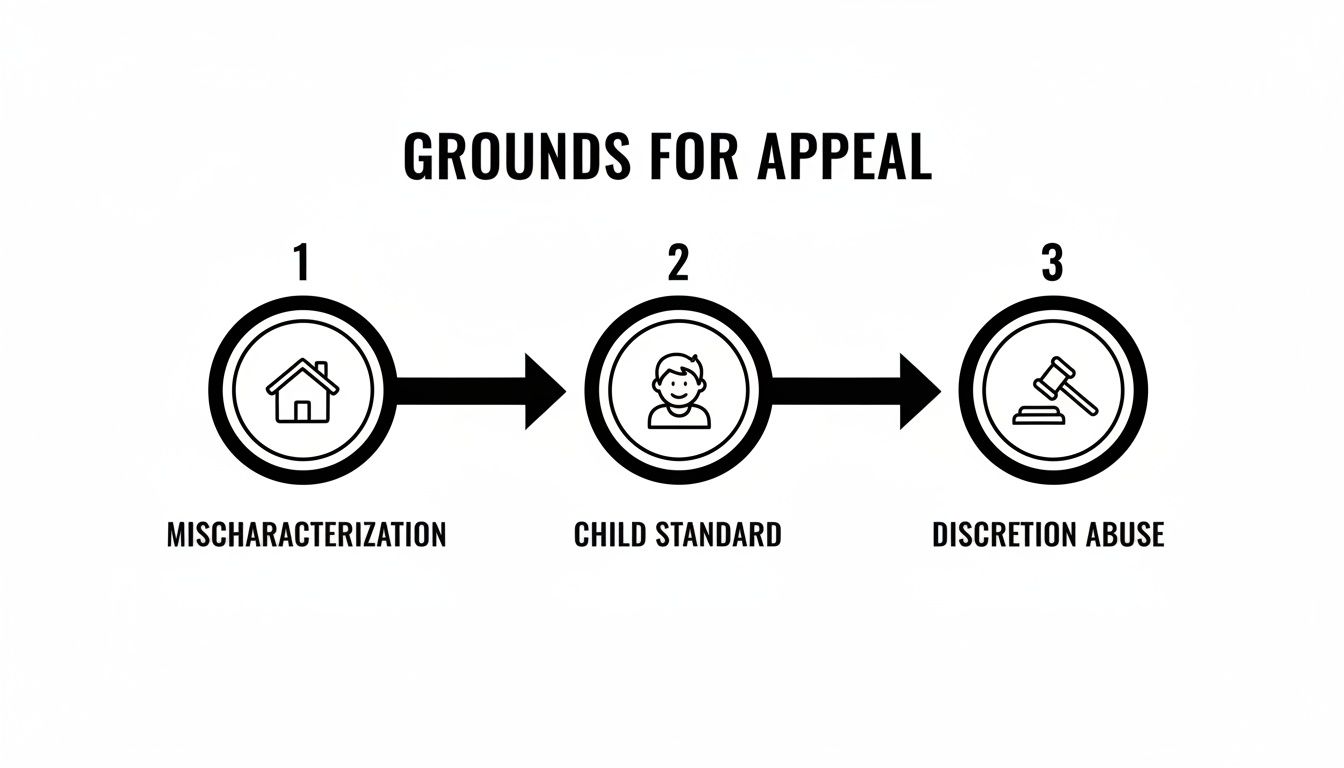
Common reasons for filing an appeal include:
- Correcting a major error in property division, such as when a judge mischaracterizes separate property as community property.
- Challenging a child custody or visitation order that is clearly not in the child’s best interest.
- Overturning a decision that was an "abuse of discretion," which means the ruling was arbitrary, unreasonable, or made without regard for the facts or law.
In a bench trial, a single judge holds all the power to decide your case's outcome. Because one person’s judgment can have such a profound impact, the appellate process becomes a vital tool for ensuring fairness and restoring balance. It offers a chance for a panel of experienced appellate judges to review the trial record for legal mistakes and help you fight for the just outcome you were denied. Navigating this path requires a deep knowledge of the Texas Rules of Appellate Procedure, and acting quickly is essential, as the clock starts ticking the moment the decree is signed.
If you are looking at a divorce decree that feels fundamentally unfair, our experienced appellate attorneys can evaluate your case for potential errors and help you understand your options.
Identifying Valid Grounds for a Texas Divorce Appeal
To build a successful appeal, your case must rest on a solid legal foundation, not just emotion. An appeal is not a do-over or a second chance to argue the facts. Your appellate attorney's job is to meticulously review the trial record—every word of testimony, every exhibit, and every ruling—to find specific, harmful legal mistakes known as reversible errors.
This requires shifting your perspective from "I don't like this outcome" to "This is the legal error that caused this outcome." An experienced appellate lawyer is trained to spot the kinds of mistakes that can lead to a reversal of the trial court's judgment.
Understanding "Abuse of Discretion"
One of the most common grounds for an appeal in a family law case is abuse of discretion. In plain English, this legal term means the trial judge’s decision was so arbitrary, unreasonable, or out of step with the facts and law that it cannot be allowed to stand.
A judge has a certain amount of leeway—or discretion—to make decisions. However, that discretion has limits. For example, if a judge ignores credible, undisputed testimony about a parent's ongoing substance abuse and still names that person the primary conservator, it could be an abuse of discretion. Similarly, if a judge divides a community estate 90/10 in one spouse's favor without any legally recognized justification, that decision may be an abuse of discretion. Proving this is a high hurdle, but when you can, it provides a powerful basis for getting an unfair ruling reversed.
Misapplication of the Law
Another significant ground for appeal is when the trial judge simply got the law wrong. Texas family law is complex, and if a judge misunderstands a statute or fails to apply the correct legal standard, their entire decision can be flawed.
Common areas where this occurs include:
- Property Division Errors: A classic example is the mischaracterization of property. If a judge mistakenly treats an inheritance—which is typically separate property—as community property and divides it, that is a clear legal error.
- Child Custody Standards: In every Texas child custody case, the judge must base their decision solely on the "best interest of the child." If a ruling is based on personal bias or fails to consider all the required factors, it can be challenged for misapplying this fundamental standard.
- Procedural Mistakes: Sometimes the error is not in the final outcome but in how the trial was conducted. If the judge wrongly excluded a crucial piece of evidence, like a forensic accounting report, that could have unfairly skewed the entire case.
These are not minor technicalities; a misapplication of the law can fundamentally alter the outcome, affecting your financial security and your relationship with your children for years.
Common Reversible Errors in a Texas Divorce Bench Trial
| Type of Error | Plain-English Explanation | Example Scenario |
|---|---|---|
| Mischaracterization of Property | The judge incorrectly labels separate property (like an inheritance) as community property, or vice-versa. | A judge rules that a business started by one spouse years before marriage is community property and divides its entire value, instead of only the value that accrued during the marriage. |
| Abuse of Discretion in Property Division | The judge's division of community property is grossly unfair and not based on recognized legal factors like fault or earning capacity. | The community estate is worth $1 million. With no fault alleged, the judge awards one spouse $900,000 and the other $100,000 without explaining the lopsided division. |
| Failure to Apply "Best Interest" Standard | The judge's child custody decision is based on personal bias or ignores key evidence about the child's well-being. | A judge grants custody to a parent with a documented history of neglect, stating a preference for the "mother figure" despite evidence that this is not in the child's best interest. |
| Improper Exclusion of Evidence | The judge refuses to allow crucial, legally admissible evidence that would have changed the outcome. | The judge blocks your attorney from presenting a vocational expert's report showing your ex-spouse's true earning potential, leading to an unfair spousal support award. |
| Incorrect Application of Child Support Guidelines | The judge calculates child support without following the statutory guidelines or deviates without proper legal justification. | A judge orders child support based on the paying parent's minimum wage income, even though evidence proved they earn a six-figure salary from their own business. |
Evidentiary Sufficiency Challenges
Finally, an appeal can challenge a ruling based on flimsy or nonexistent evidence. You can argue there was either no evidence (legal insufficiency) or factually insufficient evidence to support the judge's decision.
- Legal Insufficiency: This argument asserts that even if all the evidence is viewed in the light most favorable to the ruling, there is a complete absence of proof on a key fact.
- Factual Insufficiency: This argument concedes there is some evidence but argues it is so weak—or the contrary evidence is so overwhelming—that the finding is clearly wrong and unjust.
For example, if a judge finds you are intentionally underemployed to reduce child support, but the only evidence was your ex-spouse’s vague testimony, that finding might be vulnerable to an evidentiary challenge. An appeal provides a critical opportunity to show the higher court that the trial judge's decision was built on an unstable foundation.
Preserving Your Right To Appeal: The Critical First Steps
When a judge’s final ruling in your divorce feels wrong, the clock starts ticking. Loudly. In the highly technical world of Texas appellate law, deadlines are absolute. Missing a single one can permanently close the door on your right to appeal, no matter how serious the trial court’s error.
To have any chance at a successful appeal after a bench trial in a Texas divorce, you must take specific, calculated steps to protect your rights. This begins the moment the judge signs the final decree. These initial moves, such as sending a formal letter of preservation to ensure evidence is not lost, form the foundation of your entire appeal.
The Power of Post-Trial Motions
Before you ask a higher court to review your case, you must first give the trial judge a chance to fix their own mistakes. This crucial step is called "preserving error." The two most important tools for this are the Motion for New Trial and the Request for Findings of Fact and Conclusions of Law.
These motions serve as your official, on-the-record complaint, formally telling the judge, "Here are the specific legal or factual errors I believe you made." This accomplishes two things: it gives the judge an opportunity to correct the judgment and, more importantly, it preserves your arguments for the appellate court to review. If you fail to raise an issue in a post-trial motion, the court of appeals will likely refuse to consider it. Understanding the importance of objections required to preserve an appeal in Texas is fundamental to this process.
Buying Yourself Time to Appeal
Normally, you have only 30 days from the day the final decree is signed to file your Notice of Appeal. This is an extremely short window to find an appellate attorney and have them perform the deep analysis needed to determine if you have a valid case.
This is where a timely Motion for New Trial becomes your most valuable asset. Filing a proper Motion for New Trial automatically extends your appeal deadline from 30 days to 90 days. That extra 60 days is critical, providing the breathing room your appellate team needs to do their job right. It gives them time to order and meticulously review the trial transcript, pinpoint reversible errors, and begin crafting the persuasive legal arguments that will form the backbone of your appeal.
Making the Judge Show Their Work
Another non-negotiable step is filing a Request for Findings of Fact and Conclusions of Law. This is a formal demand that the judge writes down the specific facts they relied on and the legal principles they applied to reach their decisions.
This is critical because it forces the judge to show their work. Without these findings, the appellate court is left to guess why the judge ruled as they did and will often presume there was a valid reason. Requesting findings can expose flawed logic, making an error obvious to the appellate court and preventing them from inventing a valid reason for the trial judge's decision when one may not have existed. The deadline for this request is tight—usually just 20 days from the judgment date.
The Anatomy of a Texas Divorce Appeal
An appeal is not a new trial. You will not call witnesses or introduce new evidence. Instead, the case moves to a panel of appellate judges who will review the entire trial through a legal microscope. The process is a scholarly, written debate over whether the trial judge followed the law.

Building the Appellate Record
Before any arguments can be made, your lawyer must assemble the appellate record. This is the official history of your case sent to the court of appeals, and it is strictly limited to what happened in the trial court. Nothing new can be added. The record consists of two parts:
- The Clerk's Record: Every document filed in your case, from the original petition to the final decree.
- The Reporter's Record: The official, word-for-word transcript of everything said during the trial.
For the appellate court, if it's not in the record, it didn't happen.
Crafting the Argument: The Appellate Brief
With the record in hand, the real work begins: writing the appellate brief. This document is the heart of your appeal. It is a meticulously crafted legal argument that tells your story to the appellate judges, explains the errors the trial judge made, and shows them precisely why, under Texas law, the decision must be changed. A winning brief weaves together facts from the record, relevant statutes, and legal precedents into a persuasive narrative that demonstrates not only that the judge was wrong, but that the error was harmful and requires correction.
Understanding the Standard of Review
The appellate court does not simply substitute its own judgment for the trial judge's. It examines each alleged error through a specific legal lens called the standard of review, which determines how much deference is given to the trial court's decision.
- Abuse of Discretion: Used for most family law decisions like property division and custody. You must show the decision was arbitrary, unreasonable, or without reference to guiding legal principles.
- Legal and Factual Sufficiency: Used for challenges to the evidence.
- De Novo: Latin for "from the new," this standard applies to pure questions of law. The appellate court gives zero deference and decides the issue for itself.
Knowing which standard applies is crucial. A skilled appellate lawyer frames each point of error within the correct standard to maximize the chances of persuading the court. For more details, our guide to Texas appellate procedure in family law offers deeper insights.
Potential Outcomes of Your Divorce Appeal
When considering an appeal, a key question is: What can I realistically achieve? An appeal is not a simple win-or-lose proposition. The court of appeals has several options, and the one it chooses will determine the final outcome of your case.
The Spectrum of Appellate Rulings
After all briefs are filed, the court of appeals will issue a decision, which typically falls into one of three categories:
Outcome 1: Affirm
This is the most straightforward outcome. If the court affirms the trial court’s judgment, it means they found no reversible error. The original divorce decree remains in effect exactly as it was written.
Outcome 2: Reverse and Render
This is often the best-case scenario for an appellant. A Reverse and Render decision means the appellate court not only found a serious error but is confident it can fix the mistake itself without sending the case back for a new trial. For instance, if a judge wrongly divided your separate property, the appellate court could "render" a new judgment correctly classifying it, ending the dispute on that issue.
Outcome 3: Reverse and Remand
This is the most common result of a successful appeal. With a Reverse and Remand, the court agrees a reversible error occurred and overturns the problematic part of the ruling. It then "remands" (sends back) the case to the trial court with specific instructions on how to correct the error. This usually leads to a new, limited trial or hearing focused only on the issue that was successfully appealed.
Why Appellate Experience Matters
Winning at trial and winning on appeal require completely different skills. Trial work is a live performance; appellate work is a battle fought on paper. The victory is found in the meticulous details of the appellate brief—a document built on deep legal research and compelling written arguments. An experienced appellate lawyer knows how to construct this argument to show the higher court not just that an error occurred, but why it matters and how it must be fixed.
If your case is reversed and remanded for a new hearing on an issue like property division, the trial judge is now required to follow the appellate court's instructions. They must rehear the issue within the new legal boundaries set by the higher court, which often leads to a fairer and more just resolution.
Common Questions About Texas Divorce Appeals
If you've been through a Texas bench trial and believe the judge got it wrong, you likely have many questions. Here are answers to some of the most common ones.
How Long Does a Divorce Appeal Take in Texas?
You must be prepared for a lengthy process. A typical family law appeal in Texas can take anywhere from nine months to well over a year to receive a final decision. During this time, the official court record is prepared, both sides write and file detailed legal briefs, and the court of appeals reviews everything before issuing a formal opinion.
What Is the Difference Between an Appeal and a Modification?
The distinction is crucial. An appeal looks backward. It argues that the trial judge made a legal mistake based on the law and evidence presented at the time of your trial. You are asking a higher court to fix an error that has already been made.
A modification, on the other hand, looks forward. It is a new case filed to change an existing order (like for child custody or support) because of a "material and substantial change in circumstances" that has occurred since the original order was signed. For example, you would appeal an incorrect property division, but you would file a modification to adjust child support if you lose your job two years later.
Do I Have to Follow the Decree During the Appeal?
Yes, absolutely. Your final divorce decree is a binding court order and remains in full effect while the appeal is pending. You must comply with every part of it to avoid enforcement actions or contempt of court charges. While there is a mechanism to pause enforcement of certain financial parts of a judgment by posting a supersedeas bond, it is rarely used for custody or visitation orders.
Can I Get a New Judge if My Case Is Sent Back?
This is a common question, but the answer is almost always no. If the court of appeals "remands" your case for a new hearing, it goes right back to the same trial judge. However, the judge is now bound by the appellate court's written opinion and must follow its specific instructions. The appellate ruling acts as a new set of rules for that judge, often forcing a completely different—and fairer—outcome.
If you believe the court made a mistake in your family law case, our appellate attorneys can help you seek a fair outcome. Contact The Law Office of Bryan Fagan today for a free consultation.