Skip to content
When the judge’s signature dries on your final divorce decree, it is supposed to bring closure. But what happens when the outcome feels deeply and fundamentally unfair? You may feel your case was handled unfairly—that the judge overlooked key evidence, misunderstood Texas law, or handed down a ruling that jeopardizes your financial stability or your relationship with your children.
It is a frustrating and surprisingly common position to be in after a draining family law case. When the dust settles and you are left with an unjust decree, your next move is critical. The Texas legal system offers two primary avenues for relief: a Petition to Modify the order or filing a Notice of Appeal. These paths are not interchangeable, and choosing the wrong one can be a costly mistake in both time and money, potentially closing the door on your chance for justice.
Here's the crucial distinction:
- A modification is the right tool when life changes significantly after the judge has signed the decree. It looks forward, asking to update the court's orders because of new events.
- An appeal is the only option if you believe the judge made a legal mistake during the trial itself that led to an improper outcome. It looks backward, arguing that the original trial was flawed and the result was unjust.
This decision is one of the most important you will make post-divorce. To help clarify which path is right for you, let’s break down the key differences and help you understand how to seek a fair outcome.
| Factor | Modification | Appeal |
|---|---|---|
| Purpose | To change an order based on new facts or changed circumstances. | To correct a legal error made by the judge during the trial. |
| Focus | Forward-looking: Addresses what has changed since the decree. | Backward-looking: Reviews what happened in the courtroom. |
| Legal Standard | "Material and substantial change of circumstances." | "Reversible error" or "abuse of discretion." |
| Evidence | New evidence about new events is presented to the court. | No new evidence; review is limited to the original trial record. |
| Timeline | Can be filed anytime after the decree if a major change occurs. | Strict 30-day deadline to file a Notice of Appeal (90 with a motion). |
Understanding the Difference: New Facts vs. Legal Errors
When a divorce decree doesn't feel right, you’re often left at a critical fork in the road. Do you file for a modification, or do you pursue an appeal? This is one of the most important post-divorce decisions you will face. Choosing the correct path requires a clear understanding of what each process is designed to fix.
At its core, a petition to modify is about adapting to the future. It argues that a material and substantial change in circumstances has happened since the judge signed the final order, making the current order unworkable or no longer in the children's best interest. An appeal, on the other hand, looks backward. It is a formal challenge arguing the trial court made a significant legal error during the original proceedings that led to an improper and unjust outcome.
The Deciding Factor: New Facts or Old Errors?
The fundamental question you must answer is this: Is my problem based on something new that has happened, or was the original decision itself flawed from the start? A modification is forward-looking; you get a new hearing and can present fresh evidence about what has changed. An appeal is entirely backward-looking, confined strictly to the evidence and arguments made at the original trial. You do not get a do-over or a new trial.
This decision tree can help you visualize which path makes sense for your situation.
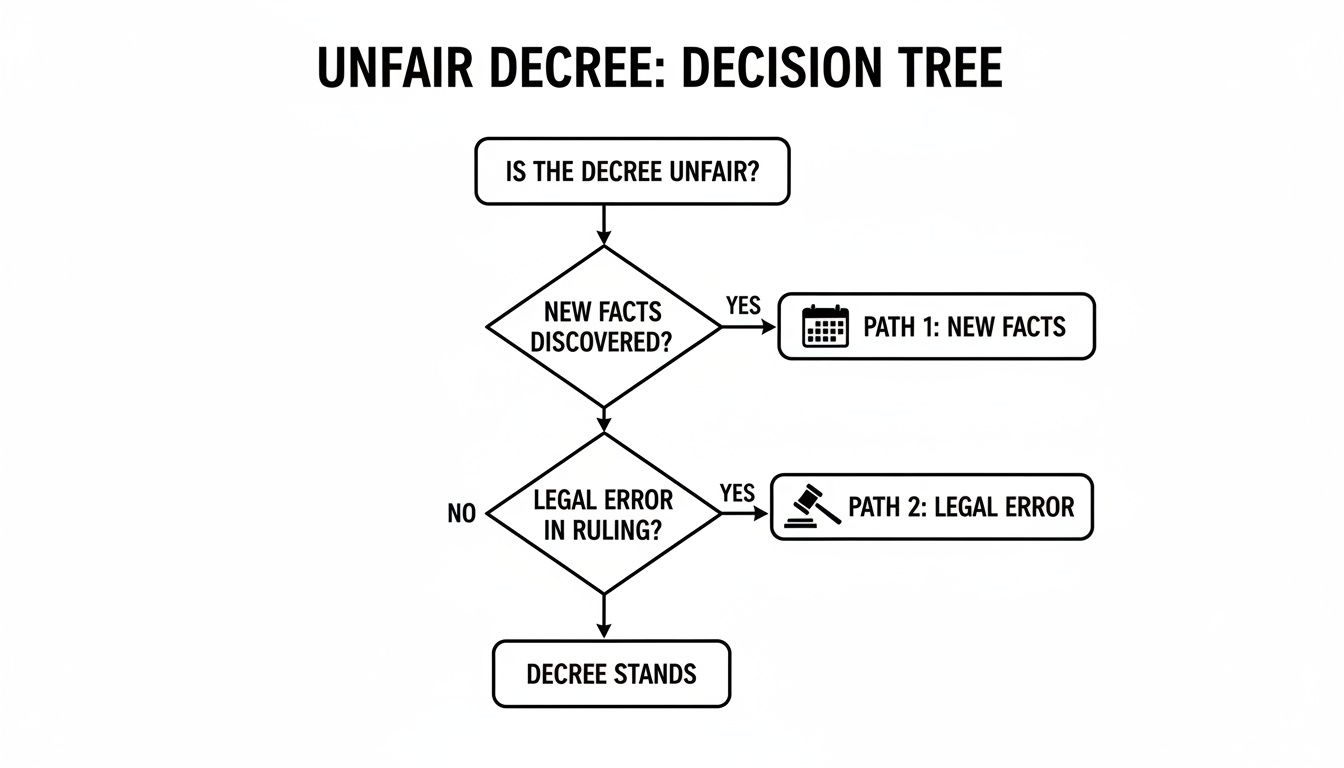
If your circumstances have genuinely changed—a major career shift, a long-distance move, or a child’s evolving needs—a modification is your path. But if you believe the judge misapplied the law, ignored crucial evidence, or made a ruling unsupported by the facts presented at trial, an appeal is the proper remedy to seek justice.
To put it simply, a modification says, "My life is different now, so the orders need to be different." An appeal says, "The judge made a legal mistake then, and that mistake needs to be corrected to ensure a fair outcome."
Understanding this distinction is everything. It shapes your legal strategy, your budget, and your expectations. While a modification to a custody order is a common proceeding in family law, an appeal is a much more technical and demanding legal battle that requires specialized appellate expertise.
At a Glance: Modification vs. Appeal in Texas Family Law
This table highlights the core differences between filing a petition to modify a divorce decree and filing an appeal of the final judgment.
| Factor | Modification | Appeal |
|---|---|---|
| Purpose | To change an order based on new life circumstances. | To correct a legal error made by the judge in the original trial. |
| Legal Standard | Material and substantial change in circumstances. | Abuse of discretion or a reversible error of law. |
| Timeline | Can be filed any time after the decree, once circumstances change. | Strict deadline: Notice of Appeal is due 30 days after the final judgment is signed. |
| Evidence | New evidence is presented in a new hearing. | Limited to the original trial record; no new evidence is allowed. |
| What Can Be Changed | Custody, visitation, and child support. Property division is not modifiable. | Potentially any part of the decree, including property division. |
| Cost & Complexity | Generally less expensive and procedurally simpler. | Significantly more expensive, technical, and time-consuming. |
Ultimately, choosing the right path requires a careful analysis of your case. A modification offers a practical solution for life's inevitable changes, while an appeal provides a critical check on the legal process itself to ensure fairness and due process. An experienced appellate attorney can analyze your original trial record to determine if a genuine legal error occurred that would make an appeal a worthwhile endeavor.
Understanding the Standard of Review in Texas
When you are unhappy with a court's decision in your divorce, you have two potential routes forward: a modification or an appeal. These paths are not interchangeable. The legal hurdle you must clear for each—your "burden of proof"—is dramatically different, and understanding that difference is the key to choosing the right strategy.
The Standard for Modification: A "Material and Substantial Change"
If you need to change an order dealing with child custody, visitation, or support, you will be filing a petition to modify. To succeed, you must prove there has been a “material and substantial change” in circumstances since the judge signed the original order.
This standard, laid out in the Texas Family Code, is intentionally forward-looking. It recognizes that life goes on after a divorce. The goal is not to re-litigate the past but to show the court how the present and future look different. A minor or temporary inconvenience will not be enough. You must demonstrate that something significant has happened, such as an involuntary job loss, a serious long-term illness, or a new career opportunity that requires a move. Proving this change is only half the battle; you must also show that modifying the order is in the child's best interest.
The Standard for Appeal: "Reversible Error" and "Abuse of Discretion"
An appeal is a completely different proceeding with a much higher, more technical standard. When you appeal, you are not presenting new facts or telling your story again. Instead, your appellate attorney must comb through the trial record and prove the judge made a “reversible error”—a legal mistake so significant that it likely led to an improper and unjust outcome.
This is not about whether you liked the judge’s decision; it is about whether the judge followed the law. A common ground for appeal is an “abuse of discretion.”
Abuse of Discretion (in plain English): This legal term means the trial court judge acted unreasonably, arbitrarily, or without referencing guiding legal rules and principles. For instance, if a judge ignored clear evidence of family violence when making a child custody decision or misinterpreted a statute in the Texas Family Code during a property division case, that could be an abuse of discretion and a basis for a successful appeal.
The numbers tell a stark story. In Texas, with roughly 80,000-90,000 divorces a year, post-judgment disputes are common. While many cases may qualify for modification, fewer than 4% of cases proceed to an appeal. You can dig deeper into the landscape of Texas divorce statistics and their implications on CentralTexasLawyers.com.
The "abuse of discretion" standard is tough to meet, which is why the reversal rate in Texas family law appeals hovers around 18.7%. A modification hearing feels like a mini-trial focused on what is new. An appeal is a formal legal debate over what happened in the original trial. Knowing which standard of review applies to your situation is the first and most critical step in charting a course toward a fair outcome.
The Critical Difference In Timelines And Deadlines
In family law, timing isn't just important—it is everything. When you are looking at your options after a divorce decree is signed, the paths of modification and appeal are governed by wildly different clocks. Understanding these deadlines is the first and most critical step in protecting your rights.

The Unforgiving Clock of an Appeal
For an appeal, the clock starts ticking the moment the judge signs the final decree. The Texas Rules of Appellate Procedure are notoriously strict and demand absolute compliance. You have an incredibly narrow 30-day window to file a Notice of Appeal. If you miss this deadline, even by a single day, the courthouse doors will close on your right to challenge the judge's decision.
While it is sometimes possible to extend this deadline to 90 days by filing a motion for a new trial, this is a strategic move that requires immediate legal action. Courts rarely grant exceptions for missing these deadlines.
The rigid nature of appellate deadlines is where many people lose their rights. If you believe the court made a serious legal mistake in your divorce, you cannot afford to wait. The opportunity to appeal is fleeting, and acting quickly is essential to preserve your right to seek justice.
Knowing these tight timelines is crucial. You can learn more about the process of appealing a family court decision to see just how structured and demanding this path is from the very start.
The Flexible Timeline for a Modification
A petition to modify, on the other hand, operates on a completely different schedule. It is built for life's unpredictability. Under Texas Family Code Chapter 156, you can file a request to modify a prior order dealing with children—like custody, visitation, or child support—at any point after the divorce is finalized.
The trigger for a modification is not a fixed date on a calendar. Instead, the requirement is proving a “material and substantial change” in the circumstances of the child or one of the parents. This open-ended timeline makes it a practical tool for handling real-world changes that happen long after the ink on the decree is dry.
You might pursue a modification months or even years down the road for reasons like:
- A parent involuntarily loses a job or has a major income shift.
- One parent needs to relocate for a significant career opportunity.
- A child's needs evolve as they get older.
- New safety concerns arise in a parent's home.
This flexibility is a stark contrast to the finality of an appeal deadline. It is why knowing how long you have to appeal a divorce in Texas is one of the most vital pieces of post-divorce information you can have. These different timelines reflect the core purpose of each action. An appeal is about correcting a past legal error, so it must be done quickly. A modification is about adapting to a new future, so it remains available as life changes. A 2026 statistical review showed that in Texas family law appeals, only 18.7% led to a reversal, underscoring just how critical it is to choose the right path and act within its non-negotiable time limits.
Presenting Evidence: New Facts vs. the Trial Record
One of the most critical differences between a modification and an appeal in a Texas divorce case comes down to a single question: are we talking about new facts or old mistakes? The answer completely changes your legal strategy, the evidence you can use, and the story you can tell the court.

Modification Hearings: The Door is Open for New Evidence
Think of a modification hearing as a brand-new, focused mini-trial. Its entire purpose is to address significant changes that have happened since your divorce was finalized. The courtroom door is wide open for fresh evidence. You and your attorney are essentially building a new case from scratch to show the judge how circumstances have changed. This can include:
- New Documents: Recent pay stubs, a new job offer, or a child’s latest school report cards.
- New Testimony: You, your ex-spouse, teachers, or new partners can take the stand to testify about current events.
- New Expert Opinions: You might bring in a child psychologist or a financial expert to provide an updated assessment based on today's reality.
The objective is to demonstrate that the old court order is no longer workable or in the child’s best interest because life is simply different now.
Appeals: Limited to the "Record" of the Original Trial
An appeal is the complete opposite. It is absolutely not a retrial or a do-over. You are strictly forbidden from introducing any new evidence, no matter how compelling it might seem. The appellate court's review is chained to the "record" created during your original divorce trial.
The trial record consists of two key parts: the reporter’s record (a word-for-word transcript of everything said in court) and the clerk’s record (all the documents, motions, and evidence filed in the case). If it was not presented and admitted at trial, the appellate court cannot and will not consider it.
An appellate attorney's job is not to present new facts; they act more like a legal detective, poring over the existing record to find legal errors the judge made based only on the information and arguments presented at that time. This is why your trial lawyer’s performance was so incredibly important. If they failed to introduce a crucial document or make a specific objection, that error can be permanently locked into the record. As our guide explains, knowing which objections are required to preserve an issue for appeal in Texas is non-negotiable. A failure to object at trial can mean you forever lose your right to complain about that mistake on appeal.
Real-World Examples: When to Modify vs. When to Appeal
Once the judge signs the final order in your divorce, you generally have two paths forward in Texas family law if the outcome is unworkable: a modification or an appeal.
Choosing the right one is critical, as they solve completely different problems. An appeal is for correcting a legal mistake the judge made in the past, during your trial. A modification is for adapting to significant life changes that happen in the future, after the decree is signed.
When a Modification Makes Sense
A petition to modify is the right tool when life throws you a curveball. You must prove a "material and substantial change in circumstances" has occurred since the judge signed the original decree. An Austin Modification Lawyer can help determine if your situation meets the legal standard.
Here are real-world examples where a modification is the appropriate remedy:
- A Major Financial Shift: You were laid off from your job, and your current child support payment is now unsustainable.
- The Need to Relocate: A significant job opportunity has come up in another state, but your custody order has a geographic restriction holding you back.
- Your Child's Needs Have Changed: A teenager's extracurriculars make the old possession schedule impractical, or a younger child has developed new medical needs.
- Concerns About the Other Parent: Your ex-spouse has developed a substance abuse problem or is engaging in behavior that could endanger your child, requiring a change in custody to protect them.
When You Need to File an Appeal
An appeal is your only option if you believe the trial court judge made a legal error that resulted in a seriously unfair outcome. You are not introducing new evidence. Instead, your attorney argues that based on the law and the evidence that was presented at trial, the judge’s decision was legally wrong and unjust.
An appeal is the right move in these kinds of situations:
- Unjust Property Division: The judge mischaracterized your separate property as community property or relied on a flawed valuation of a family business, leading to an unfair division.
- Crucial Evidence Was Ignored: You provided compelling evidence of family violence, but the judge disregarded it when deciding child custody, violating the Texas Family Code's mandate to prioritize the child's safety.
- The Law Was Applied Incorrectly: The judge made a clear mistake in calculating child support, failing to follow the statutory guidelines based on the income evidence presented in court.
- Your Right to a Fair Trial Was Violated: The court improperly prevented you from calling a key witness or introducing essential evidence, which sabotaged your ability to present your case.
The distinction between these legal actions is more than just academic; it has huge practical consequences. An appeal has strict procedural deadlines and is confined to the existing trial record. A modification to custody order, however, allows you to present new evidence of what has happened since the last order. Getting this wrong can be a costly mistake.
Ultimately, the choice between a modification versus an appeal in a Texas divorce boils down to a simple question: are you trying to fix a mistake from your trial, or are you adapting to a new reality? Your answer will point you toward the correct legal strategy.
Conclusion: Making the Right Choice for Your Future
After your Texas divorce is finalized, you might feel the fight is over. But if the outcome feels wrong or life throws a curveball, you face a critical decision: file for a modification or pursue an appeal?
These two legal paths are often confused, but they could not be more different. Think of it as a fork in the road—one path looks forward, the other looks back, and choosing the wrong one can be a costly mistake with lasting consequences.
A modification is about the future. It’s the tool you use when your life has changed in a major way since the divorce was finalized. It is a practical, forward-looking process that is generally quicker and less expensive than an appeal, focused on adapting the court's orders to your family's new reality.
An appeal is a deep dive into the past. It’s a formal challenge to the trial judge's decision, arguing they made a significant legal mistake. It is not a "do-over" because you disliked the outcome. It is a technical, expensive, and often uphill battle governed by strict deadlines. Winning an appeal requires proving a serious error, which is a high bar to clear.
Which Path Is Right for You?
The answer is always in the specific details of your situation.
- A modification is the correct move if your circumstances have materially and substantially changed.
- An appeal is your only option if the judge made a clear legal error, such as misapplying the law on community property or ignoring critical evidence in a child custody determination.
An appeal is not a second trial. You do not get to present new evidence or re-tell your story. It is a highly technical legal argument, confined to the existing trial record, aimed at convincing a higher court that a reversible error occurred.
This is where having an experienced appellate attorney in your corner becomes invaluable. They can perform a crucial dual analysis—scouring the trial record for a potential reversible error while also assessing whether your current situation qualifies for a modification. This comprehensive review ensures you are not wasting time and money chasing the wrong remedy. It puts you on the most effective path toward the fair outcome you deserve.
If you believe the court made a mistake in your family law case, our appellate attorneys can help you seek a fair outcome. Contact The Law Office of Bryan Fagan today for a free consultation.
Frequently Asked Questions
When your divorce decree does not feel right, it is natural to have many questions. Here are the answers to some of the most common questions about challenging a Texas family law order.
Can I File For A Modification And An Appeal At The Same Time?
Yes, and in some situations, it is the smartest strategic move. An appeal looks backward to correct a legal mistake the judge made at trial. A modification looks forward to adapt the order to new life events. For example, you might appeal an unjust property division while simultaneously filing to modify custody because your ex-spouse announced a cross-country move. One addresses a past error; the other, a new reality. An experienced appellate attorney can guide this dual-track strategy.
What Is "Reversible Error" in a Texas Family Law Appeal?
A reversible error is not just a decision you disagree with; it is a specific, harmful legal mistake the judge made that likely caused an unjust outcome. To win an appeal, we must prove the judge’s error was so significant that it tainted the entire decision. This is a high standard.
Examples of reversible error include:
- Misapplying the Law: The judge ignored the clear formulas in the Texas Family Code when calculating child support.
- Abuse of Discretion: The court heard credible evidence of family violence but ignored it when making a child custody decision, which violates the law’s mandate to prioritize child safety.
- Violating Due Process: The judge refused to let you present crucial evidence or allow a key witness to testify, crippling your ability to make your case.
Proving reversible error requires a meticulous review of the entire trial record by an attorney who understands appellate standards.
How Much Does A Modification Cost Compared To An Appeal?
This is one of the most important practical differences. An appeal is almost always significantly more expensive than a modification.
- Appeals are labor-intensive. There are significant upfront costs for the official court record. Your attorney must then spend dozens of hours reviewing the record, researching complex legal issues, and writing a persuasive legal brief. Costs can range from $25,000 to $50,000 or more.
- Modifications, while still serious legal proceedings, are usually less expensive. They are essentially smaller lawsuits focused on one or two specific issues. A contested modification might cost between $10,000 and $20,000.
For many, the lower cost and simpler process make modification the more practical path for dealing with life's changes.
If you believe the court made a serious mistake in your family law case, you have a limited time to act. Our appellate attorneys are here to help you understand your options and seek a fair outcome. Contact The Law Office of Bryan Fagan, PLLC today for a free consultation at https://familylawcourtappeals.com.