Skip to content
The judge announces the custody ruling, and one piece of evidence keeps bothering you on the drive home. It may be a screenshot no one authenticated, a relative repeating what someone else supposedly said, or allegations that had little to do with your child's current needs. Parents often describe that moment as more than disappointment. They believe the case turned on material that should not have been admitted at all.
Sometimes that instinct is right. Sometimes it is not.
An appeal based on improper admission of evidence asks a narrower question than many parents expect. The court of appeals does not retry the custody case or hear better testimony the second time around. It reviews the trial record and decides whether the trial judge made a legal error, whether that error was preserved, and whether it probably affected the result.
That procedural focus is where many appeals are won or lost. A bad evidentiary ruling may look obvious in hindsight, but Texas appellate courts usually require a timely objection, a clear ground for that objection, and a record showing what happened and why it mattered. If trial counsel did not preserve the complaint, or if the reporter's record and exhibits do not tell the full story, a parent can have a legitimate sense that the hearing was unfair and still have no viable appellate issue.
That is the hard reality. It is also the starting point for a sound strategy.
The strongest custody appeals do not argue that the trial court should have believed one parent instead of the other. They show, from the existing record, that the court considered evidence it should not have considered, or kept out evidence it should have heard, and that the mistake likely affected the conservatorship, possession, or support rulings tied to the child's best interest.
Was Your Texas Custody Case Decided Unfairly
The hearing ends. The judge rules. On the drive home, one point keeps coming back. The decision may have turned on evidence that should not have been admitted in the first place.
That reaction matters, but it needs to be tested against the record. In a Texas custody appeal, the question is not whether the trial felt unfair in a general sense. The question is whether the court admitted evidence over a proper objection, excluded evidence after a proper offer of proof, or relied on material that the rules did not permit the judge to consider.
A custody case can be pushed off course by one damaging ruling or by several smaller ones. I often see the same categories come up: hearsay repeated as fact, text messages or screenshots admitted without a real foundation, records offered in incomplete form, and emotionally charged material with little bearing on the child's best interest. Those problems can support an appeal. They can also fail on appeal if the issue was not preserved correctly at trial.
What unfair often looks like in practice
Parents usually describe the problem in practical terms. The judge heard secondhand accusations. A witness summarized what other people supposedly said. Social media posts came in with no serious proof of who wrote them. School, medical, or counseling records were used without laying the groundwork the rules require.
Those concerns can point to a real appellate issue, but only if the transcript and exhibits show a legal error. Appellate courts work from the record that already exists. They do not reconstruct the hearing from memory or give a party a second chance to present the case more cleanly.
Common examples include:
- Hearsay: A witness repeats an out-of-court statement to prove the truth of what was said.
- Authentication problems: Screenshots, recordings, messages, or photos are admitted without enough proof that they are genuine.
- Relevance problems: The court hears material that has little to do with conservatorship, possession, or the child's best interest.
- Unfair prejudice: Evidence invites an emotional reaction that outweighs its legitimate value.
A bad custody result and an appealable custody result are not always the same thing. The difference is in the legal record.
That distinction is hard for parents, because custody cases are personal and trial courts hear a wide mix of testimony and exhibits. Still, appeals are built on rulings, objections, and record citations. If you are trying to assess whether improper evidence affected the outcome, start by identifying the specific exhibit or testimony, where it came in, what objection was made, and whether the judge ruled. A practical overview of Texas objections required to preserve an appeal can help frame that analysis.
Appeals rise or fall on legal error in the record
Texas appellate courts review the clerk's record, the reporter's record, the admitted exhibits, and the final orders. In custody cases, that means the strongest arguments are usually narrow and disciplined. They show that the judge admitted or excluded evidence contrary to the Texas Rules of Evidence, and that the ruling likely affected conservatorship, possession, or another part of the judgment.
It also helps to separate custody appeals from other family-law appeals. Divorce cases and property disputes can involve different harm analysis and different points of emphasis. Protective order cases can raise their own evidentiary patterns. The basic method is the same, though. The appeal depends on what was said, what was offered, what was objected to, and what the trial court did.
First Steps Preserving the Evidentiary Error for Appeal
The most important question in an evidence-based custody appeal is often not whether the evidence was improper. It's whether the issue was preserved.
In plain English, preserving error means the trial lawyer had to raise the problem properly when it happened. If counsel stayed silent, objected too vaguely, or failed to get a ruling, the appellate court may treat the complaint as waived. That's true even if the evidence should never have been admitted.

What preservation usually requires
A custody appeal based on improperly admitted evidence is usually won or lost on preservation. Trial counsel must make a timely objection, obtain an explicit ruling, and, when evidence is excluded, make an offer of proof so the appellate court can review what the evidence was and why exclusion or admission mattered. Without that record, the error is often not reviewable on appeal, as discussed in this practitioner guidance on preserving appellate issues.
That sounds technical, but the basic workflow is straightforward:
- Object promptly. If the other side offers improper evidence, the objection should come before the evidence is fully admitted and absorbed into the case.
- State the legal basis. “Objection” by itself usually isn't enough. Counsel needs to say why, such as hearsay, lack of authentication, relevance, or unfair prejudice.
- Get a clear ruling. If the judge never says sustained or overruled, there may be nothing for the appellate court to review.
- Make the record complete. If your evidence was wrongly excluded, an offer of proof shows the appellate court what the judge kept out.
- Renew when necessary. If the same evidence comes back in through another witness or another format, the objection may need to be raised again.
For a closer look at how Texas courts treat this step, review objections required to preserve appeal in Texas.
Why the transcript matters so much
The appellate court can't rely on memory, fairness arguments, or what a party says happened outside the written record. It sees the case through the clerk's papers and the reporter's transcript. If the objection isn't there, the appellate court usually won't supply it.
Imagine challenging a referee's call without game footage. You may know the call was wrong. The crowd may know it too. But if the reviewing body only looks at the official recording, anything outside that recording won't help.
Practical rule: In appellate work, “everyone knew what I meant” is not a substitute for a clear objection and a clear ruling.
What parents should ask after trial
If you're considering an appeal, ask these questions early:
- Was there a specific objection? Not just disagreement, but a legal objection tied to the evidence rule involved.
- Did the judge rule? A pending or unclear exchange may create a preservation problem.
- Was excluded evidence described on the record? If not, the appellate court may not know what was lost.
- Is the transcript complete? Missing portions can cripple review.
Many potentially good appeals collapse. This occurs not because the evidence issue lacked merit, but because the record doesn't show the issue in a form the appellate court can act on.
Understanding Key Deadlines and the Appellate Record
Once trial ends, the calendar matters almost as much as the legal issue. Families often spend weeks processing the result, gathering paperwork, or hoping the problem can be fixed informally. In appellate practice, delay can be costly.
The central filing step is the notice of appeal. In several major-market family-law systems, the notice of appeal deadline is commonly 30 days from the final judgment, and missing it can forfeit appellate review entirely, as noted in this overview of evidence challenges on appeal. In Texas, deadlines are governed by the Texas Rules of Appellate Procedure, and the specific timing can depend on post-judgment filings. That makes immediate case review important.
What the appellate record includes
The appellate record is the official package the appellate court reviews. It usually includes two core parts:
- Clerk's Record: Pleadings, motions, orders, exhibits filed with the court, and other official documents.
- Reporter's Record: The transcript of hearings and trial testimony, including objections, rulings, and witness answers.
If the issue involves improper admission of evidence, the reporter's record is usually where the fight lives. That's where the objection appears, where the judge rules, and where the evidence lands in context.
For a deeper explanation of this foundation, see what the appellate record in Texas is and why it matters.
Trial vs. appeal what's the difference
| Feature | Trial Court | Appellate Court |
|---|---|---|
| Main job | Decides facts and enters judgment | Reviews whether the trial court made legal error |
| Evidence | Witnesses testify and exhibits are offered | No new evidence is usually presented |
| Credibility | Judge or factfinder evaluates witnesses directly | Court relies on the written record |
| Focus | What happened and what order should be entered | Whether the law was applied correctly |
| Key materials | Live testimony, exhibits, motions | Clerk's Record, Reporter's Record, briefs |
This difference often surprises parents. They expect a fresh chance to explain what really happened. Appeals don't work that way. The appellate court usually won't hear new witnesses or revisit credibility questions from scratch.
If your best argument starts with “I can prove more now,” you may be describing a post-judgment trial-court remedy, not an appeal.
Early record review can change strategy
A fast review of the record can answer questions that matter right away. Was the final order appealable? Did a post-judgment motion affect deadlines? Is the transcript complete? Was an exhibit formally admitted or only discussed?
Those are not minor housekeeping details. In Texas appellate practice, they shape whether the court can reach the evidence issue at all.
The Standard of Review and What Makes an Error Reversible
Even a preserved error doesn't automatically lead to reversal. The appellate court still asks a harder question. Did the error justify changing the result?
That's where the standard of review comes in. A standard of review is the rule the appellate court uses to evaluate the trial judge's decision. In evidentiary disputes in family cases, the court often applies abuse of discretion review. In plain English, that means the appealing party must show the ruling fell outside the range of reasonable legal choices.
Abuse of discretion in plain English
A judge abuses discretion when the ruling isn't just debatable, but legally unsound or unsupported under the governing rules. It's a demanding standard because appellate courts give trial judges room to manage evidence and make judgment calls in family cases.
That deference is one reason evidence appeals are hard. Guidance on custody appeals repeatedly notes that articles often fail to distinguish harmless error from reversible error, even though that distinction is central in best-interest cases, as discussed in this review of appealing family-court orders.

Harmless error versus reversible error
A harmless error is a mistake that likely did not change the judgment. A reversible error is a mistake serious enough that it probably affected the outcome.
A simple sports analogy helps. If a referee blows a call in the first quarter and the final score is a blowout, the bad call may not have changed the game. But if the referee wrongly awards the deciding points in the final seconds, the call likely mattered. Appellate courts look at evidence errors in a similar way.
Here's how that plays out in custody litigation:
- Likely harmless: The court admitted one questionable statement, but the record also contained extensive admissible evidence supporting the same custody ruling.
- Potentially reversible: The trial judge relied heavily on unauthenticated messages, repeated hearsay, or material that should have been excluded, and that evidence appears central to the result.
- Often overlooked: The judge may have failed to make required findings or may have relied on weak material while overlooking competent evidence already in the record.
For more on that threshold, read reversible error in Texas family court.
What usually works and what usually doesn't
Arguments that tend to work are narrow, record-based, and tied to prejudice. They identify the exact exhibit or testimony, the exact objection, the exact ruling, and the exact way the ruling affected conservatorship, possession, or restrictions in the final order.
Arguments that usually don't work sound like a re-trial. They attack the other parent's credibility in broad terms. They ask the appellate court to believe one witness instead of another. They complain about unfairness in a general way without showing legal error and harm.
A strong appellate issue says, “The court admitted this evidence over a preserved objection, the ruling misapplied the law, and the error likely affected the custody judgment.”
That's the difference between frustration and reversible error.
Building Your Case The Appellate Brief
A parent often comes to this stage convinced the bad exhibit will speak for itself. It will not. In a Texas custody appeal, the brief has to show the court exactly where the error happened, why the trial court's ruling was wrong under the rules of evidence, and why that ruling mattered to the order that was signed.
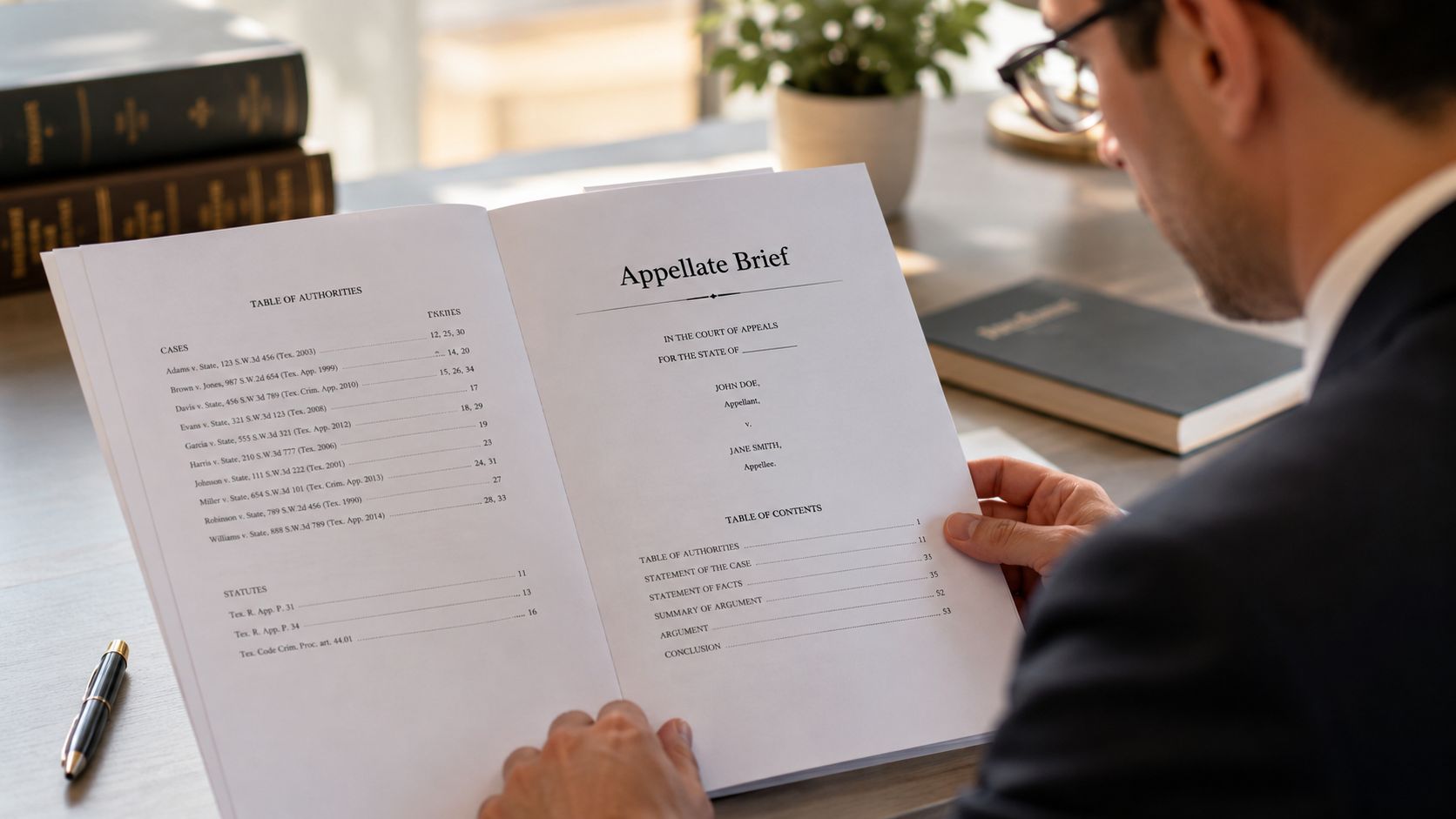
That is harder than many parents expect. The court of appeals reads a paper record. It does not watch the witnesses again, and it does not decide who seemed more believable in the courtroom. The brief must convert a trial objection into an appellate argument grounded in citations to the clerk's record, the reporter's record, and the controlling law.
A persuasive brief usually does four jobs at once:
- States the issue with precision: Identify the exact evidentiary ruling being challenged.
- Builds facts from the record: Support each key point with a record citation.
- Applies the right law to that ruling: Show why the trial court misapplied an evidentiary rule or abused its discretion.
- Shows likely harm: Tie the ruling to conservatorship, possession, supervision, geographic restriction, or another part of the final order.
The briefing process is where preservation becomes practical. If trial counsel objected that text messages were unauthenticated, for example, the brief should not drift into a broad complaint that the other parent lied. It should stay on the preserved ground, cite the pages where the exhibit was offered, quote or summarize the objection, identify the court's ruling, and explain why admitting that exhibit likely affected the best-interest analysis.
That level of discipline separates a strong appeal from a frustrated retelling of trial.
Most effective briefs follow a familiar structure, but the value is in how each section is used:
- Issues Presented: Narrow questions the court can answer with a legal ruling.
- Statement of Facts: A fair account of the case built from the record, with emphasis on the portions tied to the challenged evidence.
- Summary of the Argument: A short explanation of why the preserved error warrants reversal.
- Argument: The core analysis, in which counsel addresses the evidentiary rule, the standard of review, the preservation record, and harm.
- Prayer: The specific relief requested, usually reversal and remand in an evidence-driven custody appeal.
Precision matters at sentence level. If the brief says the court admitted hearsay, it should identify the witness, the statement, the objection, and the ruling. If the brief says the judge relied on improper material, it should point to findings, comments from the bench if they are in the record, or the structure of the final order showing why the evidence mattered.
Tools can help with record review and organization. Materials on using AI for law practice can improve research workflow and document analysis. The judgment call still belongs to appellate counsel, especially in deciding which issue is preserved well enough to carry the appeal and which issue should be left out.
A short overview can also help if you want to see how appellate arguments are presented in practice.
Good briefing is selective. In custody appeals, weaker points often dilute stronger ones. I often see records with five or six possible complaints, but only one or two can be argued cleanly with a preserved objection, a clear ruling, and a believable harm analysis. Those are the points that should lead.
That trade-off is real. Leaving out a complaint that feels important to the parent can be difficult, but appellate courts respond better to a focused argument than to a brief that attacks every adverse ruling from trial. The goal is not to show that the case felt unfair in a general sense. The goal is to prove reversible error from the record that already exists.
If you need a Texas appellate team to evaluate whether the record supports that kind of argument, The Law Office of Bryan Fagan, PLLC handles family-law appeals involving custody, visitation, property issues, support disputes, and related post-judgment challenges.
Potential Outcomes of a Successful Appeal and What to Expect
A successful appeal does not always mean the appellate court awards you custody. The result depends on the type of error and the posture of the case.
What the appellate court can do
In broad terms, the court may:
- Affirm: Leave the trial court's ruling in place.
- Reverse and remand: Send the case back to the trial court for further proceedings consistent with the appellate ruling.
- Reverse and render: Enter the judgment that should have been entered, though that remedy is more limited and depends on the issue.
In evidence cases, a remand is often the practical outcome. The appellate court may decide that the trial judge relied on material that should not have been admitted, or excluded material that should have been considered, and send the case back for a new hearing or additional proceedings under the proper rules.
Why realistic expectations matter
Across civil appeals, reversals are often estimated at only 10% to 20%, which shows how difficult it is to overturn a trial-court result even when the appellant claims an evidentiary mistake, according to this discussion of appeal odds in civil cases. That doesn't mean a custody appeal is hopeless. It means the case has to be built carefully and argued with discipline.
The best appellate cases usually share a few traits:
- A preserved issue: The objection, ruling, and surrounding context appear clearly in the record.
- A legal mismatch: The trial court admitted or excluded evidence contrary to the governing rules.
- A strong harm showing: The error connects directly to the custody judgment.
Most unsuccessful appeals fail long before oral argument. They fail in the record, in preservation, or in the way the issue is framed.
Appeals also take time. You should expect a process measured in months, not weeks. During that time, the appellate court reviews the record, the parties submit briefing, and in some cases the court may hear oral argument before issuing its decision.
If you believe the court made a mistake in your family law case, our appellate attorneys can help you seek a fair outcome. Contact The Law Office of Bryan Fagan today for a free consultation.