Skip to content
You may feel the judge in your family case didn't listen, treated one side unfairly, or crossed a line. That reaction is common, especially in custody, support, property, and protective-order cases where the stakes are personal and immediate.
But appealing a family court decision for judicial misconduct in Texas requires a shift in thinking. The appellate court won't decide whether the trial felt unfair in a general sense. It looks for something narrower and more powerful: a legal error in the record that affected the outcome.
That distinction matters. It often determines whether a case has a real path forward or whether a frustrated parent or spouse spends time and money on the wrong remedy.
Understanding Judicial Misconduct in an Appellate Context
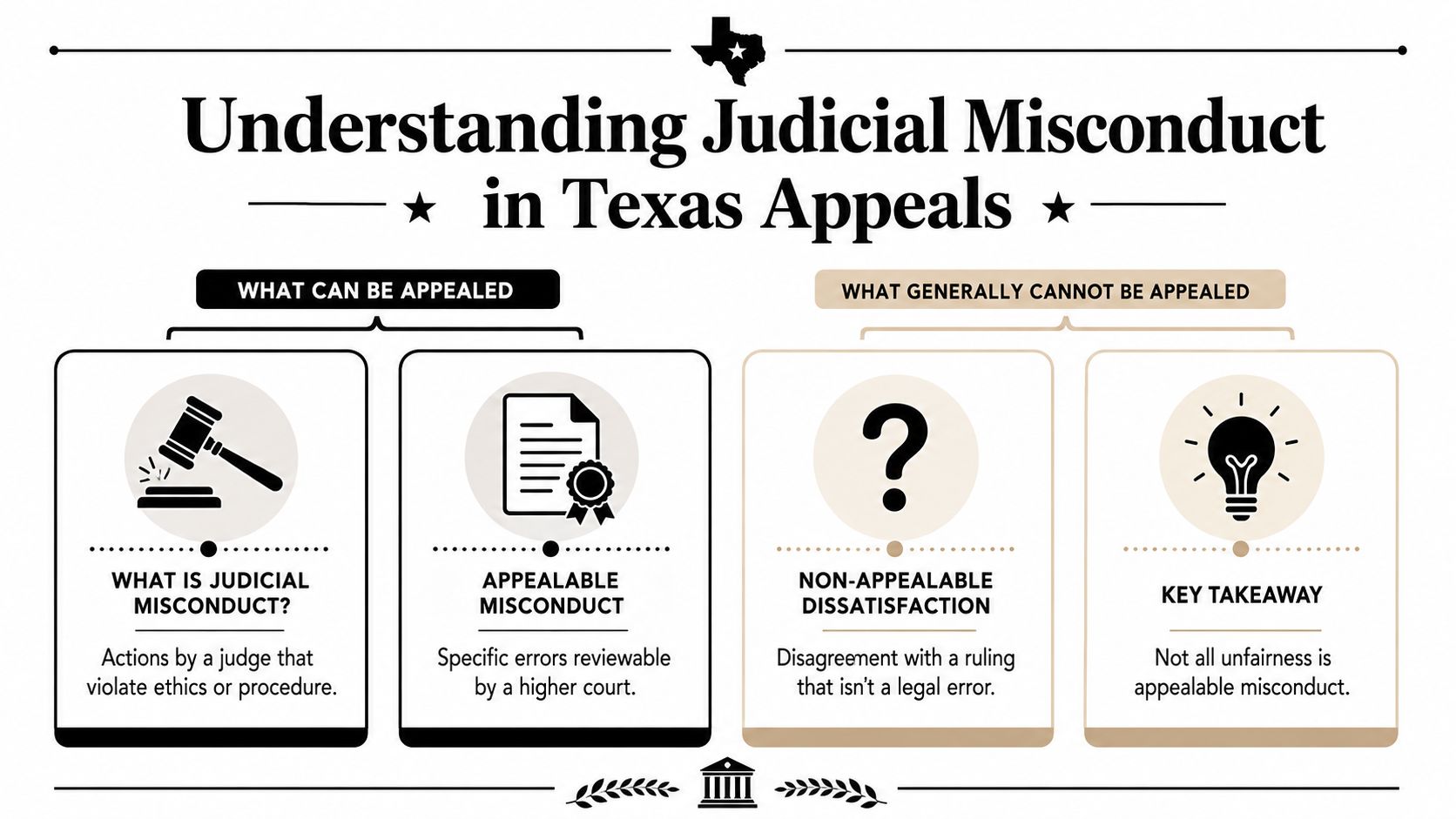
When clients say, “The judge was biased,” they may be describing several different things. Sometimes they mean the judge was rude or impatient. Sometimes they mean the judge made a ruling they strongly disagree with. Sometimes they mean the judge broke a rule, ignored a required procedure, or acted in a way that suggests disqualification or recusal should have been addressed.
Those are not the same problem, and Texas law doesn't treat them the same way.
What an appellate court can actually fix
An appeal is aimed at reversible error. In plain English, that means a legal mistake that matters. The trial court may have applied the wrong rule, used the wrong legal standard, denied a party a fair chance to present a case, or made a decision in a way the law does not allow.
A common phrase in Texas family appeals is abuse of discretion. That does not mean the judge exercised discretion in a way you dislike. It means the ruling was legally outside the range of reasonable choices, often because the judge misapplied the law, ignored required procedure, or reached a result that was arbitrary and unreasonable.
What feels like misconduct and what qualifies as appellate error often overlap, but they are not identical. Appellate courts correct legal error. Disciplinary bodies address ethics.
That's why the first question is never, “Was the judge unfair?” The better question is, “What ruling did the judge make, what rule governed that ruling, and where in the record was the problem preserved?”
Complaint versus appeal
Texas makes this distinction very clear. A complaint to the State Commission on Judicial Conduct can investigate ethics issues, but it cannot change a court's decision. Only an appellate court has the power to review and change a judge's decision, and a direct appeal usually must be filed within 30 days of the order. That practical distinction is explained in the State Commission on Judicial Conduct annual report.
So if a parent believes misconduct affected a custody ruling, filing a misconduct complaint may address the judge's conduct, but it won't reverse the custody order. The legal remedy for the order itself is usually an appeal or another appellate procedure.
Turning frustration into a legal theory
The strongest appeals convert broad complaints into narrow appellate issues. Instead of saying, “The judge favored my ex,” the argument may become:
- The court excluded relevant testimony that should have been admitted.
- The court applied the wrong legal standard in deciding conservatorship.
- The court denied a proper objection without legal basis.
- The court's comments or actions show a procedural problem that affected the ruling.
For a closer look at how bias allegations fit into appellate review, see appealing a judge's bias in Texas family court.
Preserving the Error Your First and Most Critical Step
Many potentially strong appeals fail for one simple reason. Nobody preserved the issue in the trial court.
Appellate judges review what happened below. They do not reconstruct a missing objection, infer an off-the-record problem, or assume the trial judge understood a complaint that was never clearly presented. If the legal issue was not raised in time and in the right way, it may be waived.
What preservation means in real life
Preserving error means making the issue part of the trial record. That can happen through an objection, an offer of proof, a motion, a request for a ruling, or a recusal-related filing, depending on the problem.
If a judge cuts off testimony, the lawyer usually needs to object and make clear what evidence was excluded. If the judge relies on an improper procedure, counsel generally needs to raise that procedural complaint while the trial court can still correct it. If the concern is judicial bias serious enough to require recusal or disqualification procedures, that issue often has to be presented through the proper trial-court mechanism rather than saved for later as a generalized complaint.
Practical rule: A valid issue raised too late is often the same as no issue at all.
A common way good issues are lost
Consider a hearing where the judge repeatedly questions one party aggressively and limits the other side's presentation. A client may leave convinced the judge was biased. That may be true as a personal impression. But on appeal, the court will ask whether trial counsel objected, requested the chance to complete the record, or filed the appropriate motion if the conduct crossed into a justiciable issue.
If the answer is no, the appellate court may never reach the merits.
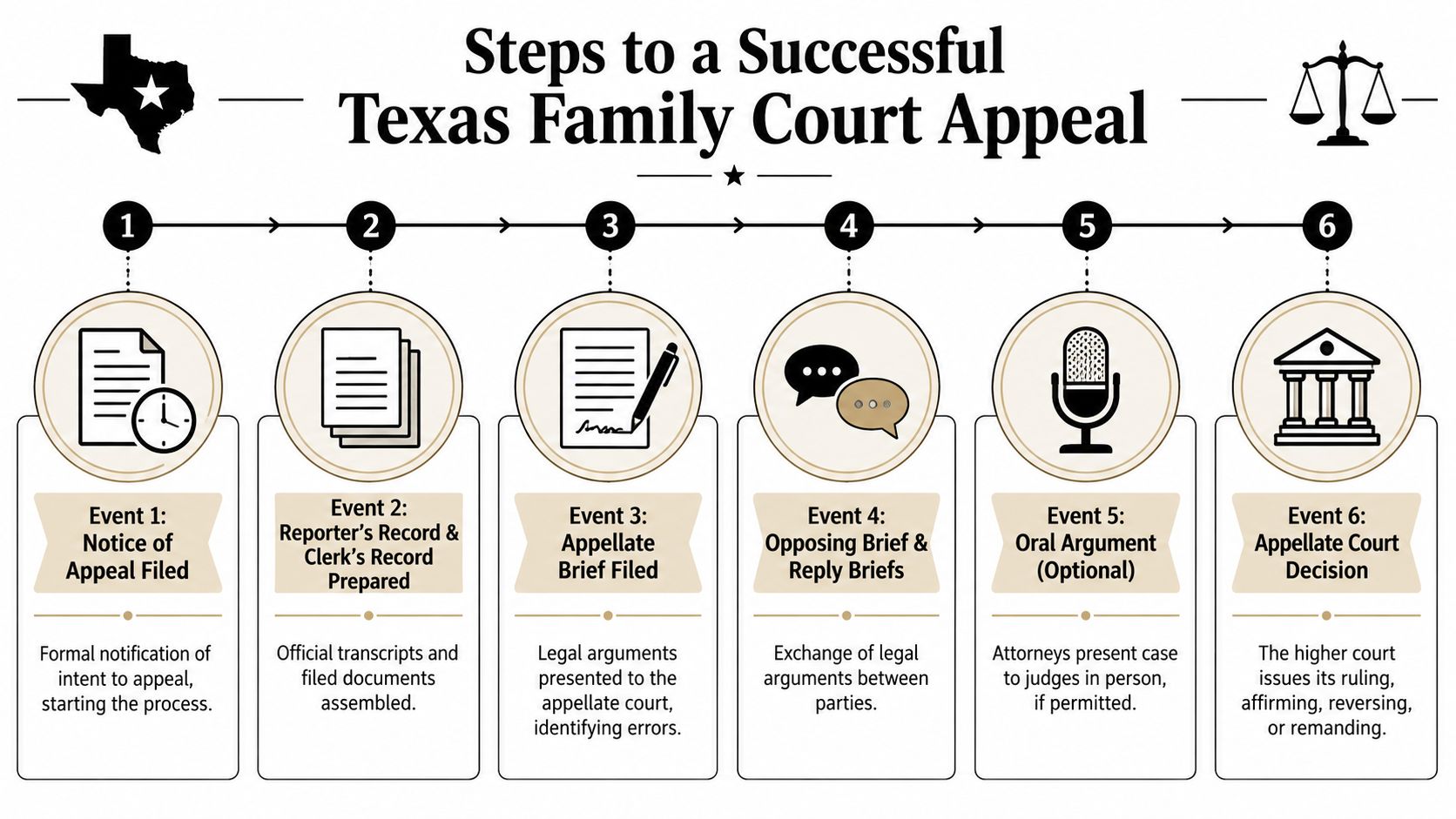
Texas family appeals are also highly deadline-sensitive. A notice of appeal is typically due within 30 days of the judgment, and a timely motion for new trial can extend that deadline to 90 days. The same source explains the major pitfall: waiver, meaning the issue can be lost if the alleged misconduct was not raised by timely objection or another preservation step in the trial court. Appellate review stays confined to the existing record, as discussed in this article on how to appeal a family court decision in Texas.
What to review immediately after trial
When someone contacts appellate counsel after a troubling family-court ruling, these are often the first things to check:
The exact order signed
The appeal deadline usually runs from the signed judgment or appealable order, not from when the hearing ended.The reporter's record
The transcript often shows whether the issue was clearly raised and how the judge responded.Written motions and rulings
Recusal motions, motions in limine, evidentiary objections, and post-trial filings can matter.Any post-judgment options still available
A motion for new trial may help sharpen issues and extend deadlines.
For a deeper discussion of this point, review preserving error for appeal in Texas family court.
Choosing Your Path Appeal Mandamus or Motion for New Trial
Not every bad ruling travels to the appellate court the same way. In family law, choosing the wrong vehicle can waste time that you don't have.

Direct appeal
A direct appeal is usually the path for a final order. If the court has entered a final divorce decree, a final SAPCR order, or another final family judgment, the appeal asks a higher court to review that completed decision for preserved legal error.
This is the standard route when the complaint is that the final custody, support, or property ruling was reached through an abuse of discretion, legal mistake, or harmful procedural error.
Motion for new trial
A motion for new trial goes back to the same trial judge and asks that court to reconsider because something legally significant went wrong. Sometimes this is useful because it gives the trial court one chance to fix an error without full appellate briefing. Sometimes it helps clarify the record. Sometimes it does neither.
Its strategic value often lies in timing and issue development. In Texas family cases, a timely motion for new trial can extend the notice-of-appeal deadline. That doesn't make it mandatory in every case, but it often deserves serious analysis soon after judgment.
A simple comparison helps:
| Option | Best used when | Main limitation |
|---|---|---|
| Direct appeal | There is a final order and a preserved record of legal error | It is not a new trial |
| Motion for new trial | The trial court may still correct an error or the record needs sharpening | The same judge decides it |
| Mandamus | Immediate appellate intervention may be needed before final judgment | It is an extraordinary remedy |
A short overview may also help if you're weighing your post-trial options:
Mandamus
A writ of mandamus is different. It is not a normal appeal. It is an extraordinary request asking an appellate court to direct a trial judge to correct a serious error when ordinary appeal is not an adequate remedy.
This matters in family cases because only final orders are generally appealable. Temporary orders, including many custody or support rulings, usually are not immediately appealable. That can leave a parent dealing with a damaging interim ruling without a standard appeal right at that moment. Texas appellate practitioners often look at mandamus in that gap, as discussed in this overview of Texas appeals and final orders.
What works and what doesn't
What works is matching the complaint to the right procedural tool. What doesn't work is trying to use a direct appeal against a nonappealable temporary ruling, or trying to use a motion for new trial as if it were a substitute for preserving objections during trial.
When judicial conduct is part of the problem, the legal question remains the same. Which remedy fits the stage of the case, the type of order, and the record that exists right now?
The Anatomy of a Successful Appeal From Record to Brief
An appeal is not a second chance to tell the story better. It is a disciplined review of the story already told in the trial court.
That's why appellate lawyers spend so much time on transcripts, exhibits, rulings, and briefing. The work is closer to editing a finished manuscript for legal mistakes than rewriting the plot from scratch.
The key parts of the appellate file
Two parts of the record do most of the heavy lifting:
Clerk's record
This contains the filed papers, orders, pleadings, and written motions.Reporter's record
This is the transcript of what was said in court, including objections, rulings, and testimony.
If misconduct is the client's concern, the appellate question becomes whether the record captures a legal problem tied to an actual ruling. A judge's tone alone may not be enough. But a transcript showing the judge cut off admissible evidence, applied the wrong standard, or made rulings inconsistent with governing law may create a viable issue.
What briefing means
Briefing is the written advocacy stage of the appeal. The appellate brief is the document that tells the higher court what happened, what legal rules apply, where the error appears in the record, and what relief should follow.
Strong briefing is focused. It does not recite every grievance from the trial. It selects the issues with the best legal footing and presents them with precision.
One Texas family-law appellate source puts it well in substance: a successful appeal turns on a reversible legal error, and an effective brief needs a tight issue statement, pinpoint citations to the record, and a narrow request for relief linked to a specific legal mistake. The appellate court can affirm, reverse, modify, or remand only on the record presented. Unsupported allegations of misconduct won't carry the day unless tied to preserved error that probably caused an incorrect judgment, as explained in this discussion of the Texas family-law appeal process.
A persuasive appellate brief usually sounds narrower than the client's frustration. That's a strength, not a weakness.
Standard of review in plain English
The standard of review is the lens the appellate court uses when evaluating the trial court's ruling. In family cases, many issues are reviewed for abuse of discretion. Some legal questions are reviewed more strictly. The standard matters because it shapes how the argument must be framed.
Here is what clients usually need to know:
- Abuse of discretion means the trial court acted outside the bounds the law allows.
- Reversible error means the mistake was significant enough to justify relief.
- Remand means the appellate court sends the case back for further proceedings.
- Modify means the appellate court changes part of the judgment.
- Affirm means the judgment stands.
For readers who want a closer look at how briefing is built in these cases, see appellate brief requirements in Texas family law.
Common Reversible Errors Stemming From Judicial Conduct
Not every troubling courtroom moment becomes an appellate issue. But some forms of judicial conduct do create real reversible-error arguments when they affect the ruling and the record captures the problem.

The case of the cut-off evidence
A parent brings a custody expert to testify about the child's needs, and the judge refuses to hear the witness without a valid legal basis. If the testimony was properly offered, the objection or offer of proof was made, and the excluded evidence mattered to the outcome, that may become a reviewable evidentiary and due-process issue.
The appellate argument is not just, “The judge didn't like my case.” It is, “The court wrongly excluded material evidence and that probably affected the judgment.”
The case of the wrong legal standard
A divorce court has broad discretion in property division, but broad does not mean unlimited. If a judge uses the wrong legal framework, misunderstands what the Family Code requires, or imposes a ruling based on an incorrect legal premise, that can support reversal.
The same idea appears in support and conservatorship disputes. The issue is not that the judge made a harsh call. The issue is that the judge applied the law incorrectly.
The case of comments that matter
Judges are human, and not every sharp comment proves bias. But sometimes statements on the record matter because they reveal that the judge relied on an improper basis, refused to consider required factors, or prejudged the case in a way that tainted the ruling.
When those remarks connect to an actual decision in the record, appellate counsel may be able to frame the issue as abuse of discretion, denial of a fair hearing, or another recognized appellate complaint.
A difficult transcript is not enough by itself. The question is whether the transcript shows a legal error tied to the result.
The case of improper off-the-record influence
Clients sometimes suspect ex parte communications or other improper contacts. Those allegations are serious, but they still must be handled with care. If the problem was raised, supported, and tied to an actual ruling, it may support recusal-related arguments, procedural complaints, or other appellate issues. If it remains only suspicion outside the record, it is much harder to use on direct appeal.
Why this isn't hopeless
Appeals are demanding, but they are not symbolic. Appellate courts do reverse when the record shows significant error. In the Texas Supreme Court's 2024 to 2025 term, the Court reversed 72.3% of the 56 state-court cases in which it heard argument and issued a decision, while affirming 27.7%, according to Texas Supreme Court statistics for the 2024 to 2025 term. For family-law litigants, the practical lesson is not that reversal is easy. It is that appellate courts exist to correct legal error when the record shows a ruling was arbitrary and unreasonable or legally flawed.
Why an Appellate Specialist Is Your Greatest Asset
You leave a family court hearing convinced the judge crossed a line. By the time the written order arrives, the question is no longer whether the conduct felt wrong. The question is whether the appellate record shows a reversible error, and what remedy the law allows.
That shift is where appellate work begins.
Trial counsel and appellate counsel do different jobs. Trial lawyers build the evidentiary record, question witnesses, and make fast decisions in a live courtroom. Appellate lawyers read transcripts, clerk's records, exhibits, and orders with a different purpose. We isolate preserved complaints, match them to the correct standard of review, and assess whether the complained-of conduct probably caused an improper judgment.
That distinction matters in judicial-misconduct cases more than almost anywhere else. Clients often come in focused on ethics, bias, or unfair treatment. Those concerns may be real. But an appeal does not discipline a judge for violating ethical rules. An appeal asks a higher court to reverse, vacate, or remand because the judge made a legal error that affected the outcome. If the problem belongs before the State Commission on Judicial Conduct, I say that directly. If the problem can support appellate relief, I frame it around the record and the ruling.
That usually requires discipline in issue selection. A long list of grievances rarely helps. Appellate courts are more persuaded by a small number of well-framed points, each tied to a specific objection, ruling, harm analysis, and requested remedy. In practice, the strongest argument is often narrower than the client expects and stronger because of that.
I also tell clients something they do not always want to hear. Some troubling conduct will not produce reversal. A judge can be curt, impatient, or even inappropriate in ways that matter greatly on a human level, yet still leave no viable appellate issue if the record does not connect that conduct to an erroneous ruling and resulting harm. Knowing that early can save time, money, and false hope.
In practice, that often means consulting a lawyer who regularly handles Texas family-law appeals or adding appellate co-counsel while trial counsel remains involved. The Law Office of Bryan Fagan, PLLC handles Texas family-law appeals involving custody, support, property division, protective orders, and post-judgment review.
Speed matters. Notice-of-appeal deadlines run quickly. Reporter's and clerk's records must be secured. Decisions about a motion for new trial, mandamus, supersedeas, or direct appeal can shape the entire case before the first brief is ever filed.
If you believe the court made a mistake in your family law case, our appellate attorneys can help you seek a fair outcome. Contact The Law Office of Bryan Fagan, PLLC today for a free consultation.