If you believe the court made a significant error in valuing a business during your divorce, you may feel that the final property division was fundamentally unfair. A flawed business valuation in divorce is not just about numbers on a spreadsheet; it's about whether the court's final order is truly "just and right" under Texas law. When a business is the most significant asset in a marital estate, a mistake in its valuation can have lasting financial consequences.
You are not without options. The Texas appeals process exists to correct serious errors made by a trial court. If you are concerned that the judge misunderstood the evidence or misapplied the law when valuing your family business, it is crucial to understand your appellate rights.
What You Can Appeal in a Texas Divorce Involving a Business
In Texas, a community property state, the value a business gains during the marriage is generally considered part of the community estate, subject to division. This makes an accurate valuation essential for a fair outcome. A trial court’s mistake—whether undervaluing years of hard work or overvaluing a spouse’s company—can create a lopsided result.
An appeal is not a new trial where you can introduce different evidence. Instead, it is a focused review of the trial court record to determine if a reversible error occurred.
A reversible error is a legal mistake so significant that it likely led to an incorrect judgment. In a business valuation case, this could involve the judge accepting a flawed expert report, mischaracterizing separate property as community property, or misapplying Texas valuation law.
Given that a business can represent more than 50% of the estate's total value in high-asset divorces, ensuring the court's valuation is based on sound evidence and proper legal standards is critical. Our appellate attorneys meticulously review trial records to identify instances where a judge may have abused their discretion, resulting in a property division that was not fair and just. You can find out more about the specific challenges of divorcing with a business in our detailed guide. We are here to help restore balance and pursue the fair outcome you deserve.
How Texas Courts Determine a Business's Worth
If you are looking at a court-ordered business value that seems incorrect, the first step in an appeal is to understand how the judge arrived at that number. In Texas, judges rely on established financial methods presented by expert witnesses. Appealing a flawed business valuation in divorce often requires proving the trial court accepted an incorrect methodology or misapplied the law.
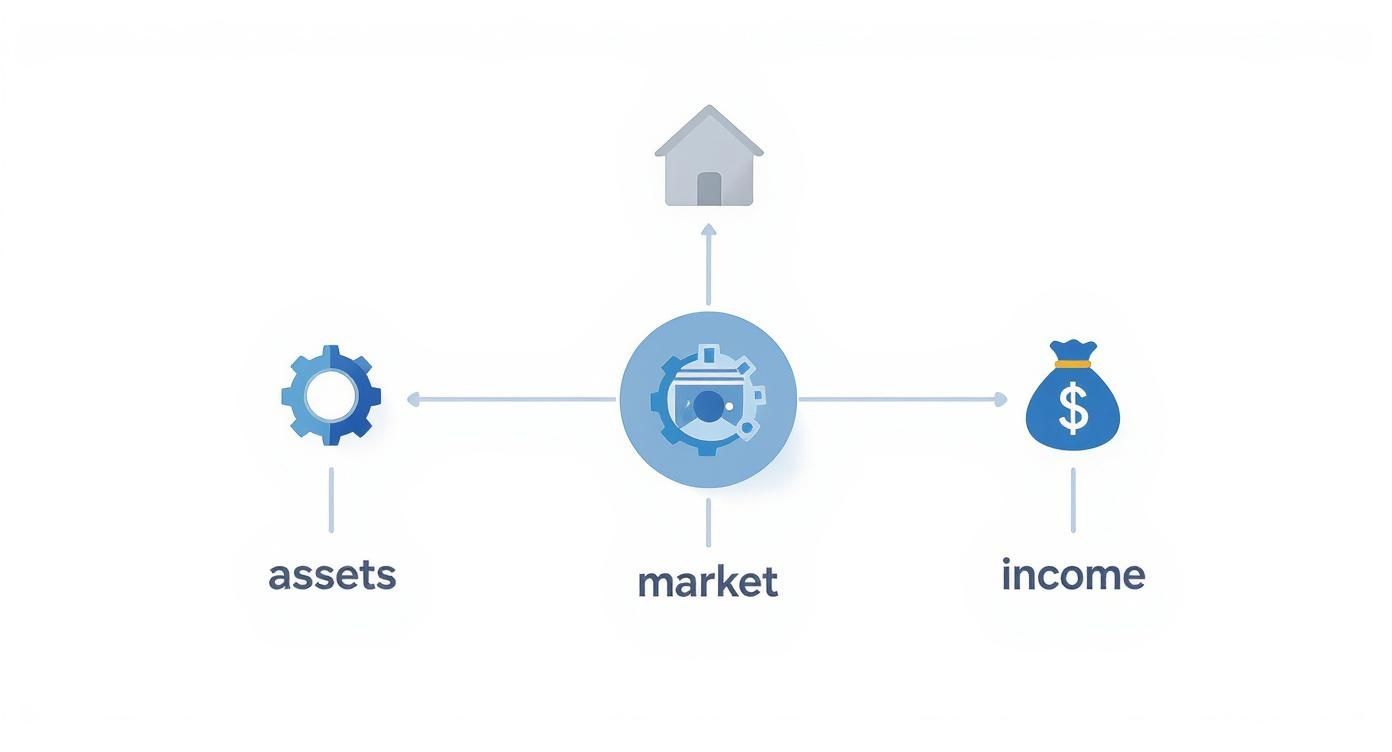
Financial experts typically base their opinion on one of three core valuation approaches. The debate over which method is most appropriate for a specific business can significantly impact the final value.
Three Core Business Valuation Methods
Each valuation method provides a different perspective on a company's worth. An expert's choice is a strategic decision that can dramatically affect the outcome of a divorce.
| Valuation Method | What It Measures | Best Suited For |
|---|---|---|
| Asset-Based Approach | The net value of all assets minus all liabilities. (Assets – Liabilities = Value) | Asset-heavy businesses like manufacturing, real estate holding companies, or investment firms. |
| Market Approach | The price of similar businesses that have recently sold. | Businesses in common industries where good "comps" (comparable sales) are easy to find, like restaurants or retail stores. |
| Income Approach | The business's ability to generate future profits and cash flow. | Service-based businesses, professional practices (doctors, lawyers), or tech companies with strong, predictable earnings. |
The Asset-Based Approach calculates a liquidation value—what would be left after selling all assets and paying all debts.
The Market Approach functions like a real estate appraisal, using the sale prices of comparable businesses as a benchmark. This method can be challenging for unique or niche businesses where comparable sales are scarce.
The Income Approach focuses on future earning potential. An expert analyzes past performance to project future cash flow and determines what a buyer would pay for that income stream. This is often the preferred method for service businesses where value is tied to profitability, not physical assets.
Key Takeaway: The selection of a valuation method is a critical legal issue that can be a point of reversible error. If a judge accepts a valuation based on an inappropriate method—for instance, using an asset-based approach for a thriving tech startup—that decision may be considered an abuse of discretion on appeal.
Understanding these concepts, including things like a 409A valuation which establishes the Fair Market Value (FMV) of a private company's stock, is essential when a business is on the line.
The Importance of the Valuation Date
Timing is critical. Under the Texas Family Code, assets in a divorce must generally be valued as close to the date of trial as is practical. Business values can fluctuate significantly during a lengthy divorce proceeding.
For example, a business valued at $1 million at the start of a case might only be worth $700,000 a year later at trial due to market changes. Using an outdated valuation would lead to an inequitable division of property. An appellate court will review the record to ensure the trial judge relied on current data. If the valuation evidence was stale, that can be a clear, reversible error. You can learn more about how different types of property are valued in our guide to getting a proper appraisal for divorce.
Common Reversible Errors in a Business Valuation
An appeal is not about disagreeing with the outcome; it's about identifying specific, significant legal mistakes the trial court made. These are known as reversible errors, and they are the foundation for seeking a fairer result through the appellate process.
In Texas, the standard for overturning a property division is "abuse of discretion." This legal term does not imply bad faith on the judge's part.
Abuse of Discretion: This is a legal standard of review that asks whether a trial judge's decision was unreasonable, arbitrary, or made without reference to guiding legal rules and principles. In plain English, it means the decision was outside the zone of reasonable disagreement.
If the court's valuation of your business is not supported by the evidence in the record, it may constitute an abuse of discretion and provide strong grounds for an appeal.
Flawed Expert Methodology
One of the most common grounds for appealing a business valuation is when a court relies on an expert opinion built on a shaky foundation. An expert's conclusion is only as reliable as the methods and data used to reach it.
Using the wrong valuation method for a particular business can lead to a deeply flawed result. For example, applying an asset-based valuation to a successful law firm, where the true value lies in future earnings and client relationships, would be inappropriate.
Common errors we look for in the record include:
- Unreliable Data: The expert used outdated financial statements or speculative projections not grounded in historical performance.
- Ignoring Industry Standards: The expert failed to apply valuation principles that are customary for that specific industry.
- Calculation Errors: Simple mathematical mistakes that significantly skewed the final valuation.
If the trial record shows that an expert's methodology was unreliable—and your attorney made the proper objections at trial—the judge’s decision to adopt that valuation could be a clear abuse of discretion.
Mischaracterization of Property and Goodwill
The Texas Family Code clearly distinguishes between separate and community property. A business owned before marriage is separate property. However, any increase in its value during the marriage attributable to the community's time, toil, and talent is community property. When a judge mischaracterizes separate property as community (or vice versa), it is a reversible error.
A related and complex issue is goodwill—the intangible value tied to a business's reputation. Texas law divides goodwill into two types:
- Personal Goodwill: Value tied directly to a spouse’s personal skills, reputation, and relationships. This is separate property and cannot be divided in a divorce.
- Enterprise Goodwill: Value that belongs to the business itself, independent of the owner. This is a community asset that can be divided.
If a court mistakenly includes the value of a surgeon's personal reputation (personal goodwill) in the community estate, it has committed a significant legal error that can be corrected on appeal. You can learn more about what qualifies as valid grounds for an appeal in a Texas family court in our detailed guide.
Failure to "Normalize" Financials
Many small businesses run personal expenses through the company. A credible valuation must "normalize" the financial statements by identifying these non-business or non-recurring expenses and adding them back to the company's true income. Failing to do so artificially depresses the business's profitability and, therefore, its value.
For instance, if a business pays $100,000 annually for a spouse's luxury car, family travel, and personal memberships, that amount should be added back to the business's income to reflect its actual cash flow. When a judge accepts a valuation that ignores these critical normalizing adjustments, the decision is based on a distorted financial picture. This failure is often a clear, reversible error.
The Critical Role of Financial Experts

A business valuation in divorce is only as credible as the expert who performs it. Forensic accountants and certified business appraisers play a crucial role by analyzing financial records to provide an objective, defensible opinion of a business's worth.
The expert's job is to conduct a thorough analysis of tax returns, profit and loss statements, balance sheets, and bank records to form an opinion on value. For a wider view on when this level of analysis is needed, it's worth reading up on when and why your business needs business valuation experts.
How Appellate Courts Review Expert Testimony
It is essential to understand that an appeal is not a second trial. You cannot introduce new evidence or hire a new expert to provide a different opinion. An appellate court is strictly limited to reviewing the trial record—the collection of all testimony, exhibits, and documents presented to the trial judge.
The appellate court's primary function is to determine if a reversible error occurred based on the information the trial judge had at the time.
A key question for the appellate court is whether the trial judge’s decision was supported by sufficient, reliable expert evidence in the record. If the judge based the ruling on an expert whose opinion was speculative or used flawed methods, that decision could be overturned as an abuse of discretion.
An appellate attorney's job is to scrutinize the trial transcript and exhibits, identifying weaknesses in the opposing expert's testimony and demonstrating how the judge’s reliance on it led to an unfair result.
Challenging an Expert's Qualifications and Methods
At the trial level, a primary tool for challenging a questionable valuation is a Daubert/Robinson motion. This legal proceeding argues that an opposing expert is either unqualified or that their methods are unreliable "junk science" and should be excluded from evidence.
A challenge typically focuses on three areas:
- Qualifications: Does the expert possess the necessary credentials and experience to value this specific type of business?
- Methodology: Is the expert's approach recognized and accepted within the financial community?
- Data Reliability: Is the opinion based on sufficient, reliable data, or is it speculative?
If your trial attorney properly raised a Daubert/Robinson challenge and the judge allowed the unreliable testimony anyway, that ruling can become a strong point of error on appeal. The appellate court will review whether the trial judge fulfilled their role as a "gatekeeper" to keep unreliable expert opinions out of the case. Proving this requires a precise, record-based argument showing the expert's testimony was fundamentally untrustworthy and that its admission directly caused an unjust property division.
Understanding the Standard of Review on Appeal
When you appeal an unfair business valuation from your divorce, it is important to understand that the appellate court operates under different rules than the trial court.
An appellate court does not rehear testimony or reweigh evidence. Its role is to review the trial court's record for significant legal mistakes according to a specific standard of review. For property division and business valuations in Texas, that standard is "abuse of discretion."
What Is an Abuse of Discretion?
Abuse of discretion is a legal term meaning the trial court's decision was unreasonable, arbitrary, or made without reference to guiding legal rules and principles. The core question is whether the judge’s decision was within the "zone of reasonable disagreement."
If two qualified experts provide competing but reasonable valuations, a trial judge is generally free to choose one over the other without abusing their discretion. However, an abuse of discretion may occur if the judge adopts a valuation based on clearly flawed data, an inappropriate methodology, or a misapplication of Texas law.
The Error Must Be "Reversible"
Not every mistake made by a trial court will result in a successful appeal. The error must be a reversible error—one that was so significant that it likely caused an improper judgment. A minor procedural issue or a harmless mistake will not be enough. The error must have directly led to an unjust division of your community property.
A classic example of reversible error is a judge mischaracterizing a substantial portion of a business's separate property value as community property. This is a fundamental misapplication of the Texas Family Code that directly creates an unfair outcome. The same is true for a court that accepts a valuation that improperly applies large, unsupported discounts to diminish the business's value.
Courts worldwide grapple with when and how to apply such discounts. Some jurisdictions, for instance, might apply a reduction for lack of marketability. One notable case involved a 30% reduction for valuation uncertainty and illiquidity, which dramatically changed the business's final value. You can learn more about how different courts approach this in business valuation in divorce proceedings.
Our role as appellate attorneys is to conduct a meticulous review of the entire trial record—every exhibit, transcript, and ruling—to find these critical, reversible errors. We then craft a persuasive legal argument, known as a brief, to demonstrate to the appellate court exactly how the trial court abused its discretion and why its decision must be corrected to achieve a just and right division of property.
Questions We Often Hear About Valuation Appeals
If you are certain the court made a mistake in valuing a business in your divorce, you likely have many questions about what comes next. Here are plain-English answers to common concerns about the appellate process.
How Long Do I Have to Appeal a Divorce Decree in Texas?
The deadlines set by the Texas Rules of Appellate Procedure are strict. In most cases, you have only 30 days from the date the judge signs the final divorce decree to file a Notice of Appeal. If you miss this deadline, you will likely lose your right to appeal forever.
Filing certain post-trial motions, such as a Motion for New Trial, can extend this deadline to 90 days. However, it is never wise to rely on an extension. If you believe the judge's decision was unfair, you must consult an appellate attorney immediately. The window to preserve your rights is extremely short.
Can I Bring in a New Business Valuation on Appeal?
No. An appeal is not a new trial where you can present new evidence. The court of appeals is limited to reviewing only what happened in the original trial based on the existing "record"—the collection of all documents, exhibits, and testimony presented to the trial judge.
The goal of an appeal is to prove that the trial judge made a legal mistake with the information they were given at the time, not to introduce a better valuation after the fact. Our job is to use the existing record to show the appellate court precisely why the expert's opinion the judge relied on was unreliable and why accepting it was a clear abuse of discretion.
What Happens If We Win the Appeal?
A successful appeal does not mean the appellate court will re-divide your property itself. Instead, the court will typically "reverse and remand" the case.
This legal term means:
- Reverse: The appellate court invalidates the trial court's flawed property division.
- Remand: The case is sent back to the trial court for a new hearing on the specific issue that was appealed—in this case, the business valuation and related property division.
Winning an appeal gives you a second chance to obtain a fair outcome by requiring the trial court to correct its error and issue a new decision based on reliable evidence and a proper application of Texas law.
My Spouse's Expert Just Didn't Seem Credible. Can We Appeal That?
Yes. While trial judges have broad discretion to determine witness credibility, that power is not unlimited. A judge's decision must be based on evidence that is legally sound and reliable.
If an expert used a questionable methodology, relied on flawed data, or made speculative assumptions, their opinion may not withstand appellate scrutiny. If your trial lawyer properly challenged the expert's testimony (often through a Daubert/Robinson hearing), the judge's decision to rely on it anyway can be a powerful basis for an appeal.
An appellate attorney will dissect that expert's report and testimony to expose its weaknesses. We build a clear argument showing the higher court that the trial judge did not simply choose one expert over another—they relied on an opinion so fundamentally flawed that it led to a grossly unjust division of your property.
If you believe the court made a mistake in your family law case, our appellate attorneys can help you seek a fair outcome. Contact The Law Office of Bryan Fagan today for a free consultation.