If a Texas judge has issued an order restricting where you can live with your child, you may feel your case was handled unfairly. It can be a deeply frustrating and disheartening experience, especially when you believe the ruling is not truly in your child’s best interest. You are not without options. The Texas appellate process was designed to provide a path to justice when a trial court makes a significant legal error.
An appeal is not a second trial or a chance to present new evidence. Instead, it is a focused, technical legal challenge designed to demonstrate that the judge made a mistake that led to an unjust outcome. Understanding this process is the first step toward seeking a fair result.
Understanding Your Options After a Restriction Ruling
When a judge hands down a geographic restriction, it can feel like your world has been turned upside down. You might feel the judge simply didn't listen or failed to appreciate the full picture you presented. That feeling of being misunderstood is exactly why the appeals process exists.
A geographic restriction typically limits a child’s primary residence to the county where the lawsuit was filed and any bordering counties. The court’s intent is to ensure the child maintains frequent and consistent contact with both parents. But what happens when that restriction feels punitive, impractical, or simply not in your child’s best interest? You have two main legal paths forward: a direct appeal or a petition to modify the order later on.
The "Best Interest of the Child" Standard
In Texas, every decision a family court makes about a child hinges on one guiding principle: the "best interest of the child." This isn't a simple checklist; it's a broad and flexible standard that requires a judge to weigh numerous factors based on the specific evidence presented at trial.
While the list isn't set in stone, judges routinely look at things like:
- The child’s emotional and physical needs now and in the future.
- The stability and safety of the home environments each parent can provide.
- The nature of the child's relationship with each parent.
- Any potential danger to the child.
Our job as appellate attorneys is to comb through the trial record and demonstrate that the judge’s decision was not a reasonable application of these factors, given the evidence.
Appeal vs. Modification: What's the Right Path?
Choosing whether to file an immediate appeal or wait and seek a modification is one of the most critical strategic decisions you'll make. They are fundamentally different tools for different situations. An appeal attacks the original ruling, arguing it was legally flawed from the start. A modification accepts the original ruling but asks the court to change it because circumstances have changed.
Before deciding, it's helpful to see a direct comparison of these two legal avenues.
Appeal vs. Modification for Geographic Restrictions
| Factor | Appealing the Ruling | Modifying the Ruling |
|---|---|---|
| Focus | Correcting a legal error made by the trial judge. | Adapting to new facts that have arisen since the order. |
| Timeline | Strict, short deadlines. Notice of Appeal is due 30 days after the final order is signed. | Can be filed at any time, but requires a "material and substantial change" in circumstances. |
| Evidence | Based only on the existing trial record (testimony, exhibits). No new evidence allowed. | Based on new evidence and current circumstances. You'll have a new hearing or trial. |
| Standard | High bar to clear: Must prove the judge committed an "abuse of discretion." | Lower bar: Must prove the modification is in the child's "best interest" due to changed circumstances. |
Ultimately, one path isn't inherently better than the other; the right choice depends entirely on the specifics of your case.
Key Insight: An appeal is about fixing a legal mistake from the past. A modification is about responding to a factual change in the present or future. Getting this choice right from the start can make all the difference.
Geographic restriction cases are some of the most hotly contested issues we see in Texas family law appeals. Appellate courts give trial judges a lot of leeway, but that discretion isn't absolute. A decision can be reversed if the judge committed an "abuse of discretion"—a legal term meaning the ruling was arbitrary, unreasonable, or made without any real reference to the facts and law.
If you feel the judge blatantly ignored crucial evidence or completely misapplied the law, an appeal might be your best bet. On the other hand, if a major life event has occurred since the ruling—like a fantastic job offer in another state or a change in the other parent's situation—a modification is likely the more practical route. For more on this, you can learn more about moving out of state in our related article.
An experienced appellate attorney can dissect your trial record and help you figure out which strategy gives you the strongest chance of success.
Your First Moves After the Ruling
The moment a judge signs an order imposing a geographic restriction, the clock starts ticking. It can feel deeply personal and unfair, as if your family's future has been decided without full consideration of what's best for your child—or for you. This is the moment when the appellate process begins, and in Texas, it’s a process governed by unforgiving deadlines. Moving quickly isn't just a good idea; it's a legal necessity.
Your very first legal step is to file a Notice of Appeal. This is a straightforward but non-negotiable document that officially tells the trial court and the other side you plan to fight the judge's decision. If you miss this deadline, the door to an appeal can slam shut for good, no matter how flawed the original ruling might have been.
Navigating the Critical Appellate Timelines
Under the Texas Rules of Appellate Procedure, you typically have just 30 days from the date the judge signed the final order to file your Notice of Appeal. This is a hard-and-fast deadline.
There is, however, a common strategy we use to buy more time. By filing certain post-judgment motions—most often a Motion for New Trial—you can extend that deadline to 90 days from the signing of the order. Filing a Motion for New Trial does two things: it gives the trial judge a chance to reconsider their own ruling, and just as importantly, it's often required to preserve certain types of legal errors for the appeal itself.
"Perfecting" the Appeal and Building Your Case
Once that Notice of Appeal is filed, you've officially "perfected the appeal." You're in line at the court of appeals. The next immediate job is ordering the appellate record.
Think of the appellate record as the official story of your case. It's the only thing the appellate justices will look at. It includes:
- The Clerk’s Record: This is a compilation of every document filed in your case—petitions, motions, exhibits, and the final order.
- The Reporter’s Record: This is the court reporter's word-for-word transcript of everything said during the trial or hearings. Every piece of testimony, every objection, and every comment from the judge is in there.
This record is everything. You can't introduce new evidence or testimony on appeal. Our job as appellate lawyers is to comb through this record, page by page, looking for the specific reversible errors that will give us a fighting chance.
The flowchart below shows the immediate crossroads you face after a judge issues an order.
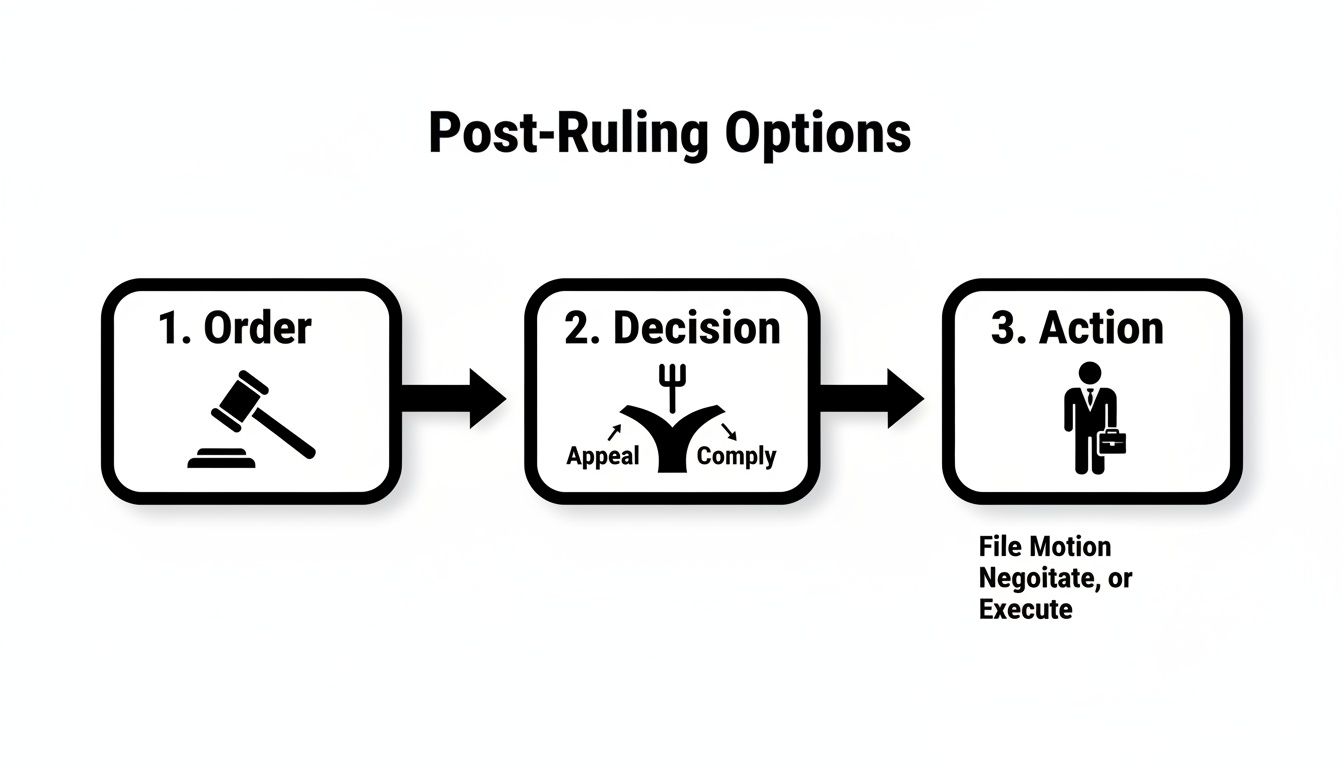
As you can see, the moment that order is signed, you're on a path that requires decisive action.
Can You Hit Pause on the Judge's Order?
One of the most urgent questions we receive is, "Do I have to follow this restriction while the appeal is going on?" Unfortunately, the answer is yes. Filing an appeal does not automatically pause the trial court's order. It remains in full effect unless you take specific legal action to stop it.
To try and suspend the order, your attorney may need to file a motion and post a supersedeas bond. This bond is a financial guarantee to the court, ensuring the other party doesn't suffer financial harm if the order is paused and you end up losing the appeal. Getting a stay on a custody-related order like a geographic restriction is challenging, but it's a critical tool we can use to prevent permanent damage—like a forced move—while the appeal is decided.
Strategic Takeaway: The first few weeks of an appeal are a sprint against a ticking clock, dictated by rigid procedural rules. The best thing you can do is bring in an appellate attorney immediately. This ensures deadlines are met, a strategic Motion for New Trial is considered, and the complete record is ordered without delay—all of which are essential to protect your right to fight the ruling.
How Appellate Courts Review Restriction Cases

One of the first things we explain to clients is that an appeal is not a do-over. You don't get to bring in new witnesses or have another shot at telling your side of the story.
Instead, an appeal is a highly technical review of what already happened. The appellate justices comb through the trial record, looking for one thing: a significant legal mistake made by the trial judge. In family law, and especially in these emotionally charged restriction cases, that mistake is called an “abuse of discretion.”
What Does "Abuse of Discretion" Actually Mean?
That phrase, "abuse of discretion," sounds dramatic. It doesn't mean the judge was malicious or had bad intentions. From a legal standpoint, it simply means the judge's decision was:
- Arbitrary or Unreasonable: The ruling seems to come out of left field, with no clear connection to the evidence or guiding legal rules.
- Lacking Support in the Record: The judge either ignored a mountain of evidence pointing one way or based the decision on something that was never proven in court.
- A Misapplication of the Law: The judge didn't correctly apply the Texas Family Code or the established case law that dictates how to decide a child's best interest.
For example, let's say you presented clear, undisputed evidence that moving would give your child access to a top-tier specialist for a serious medical condition. If the judge completely ignored that fact in the ruling without a good reason, that could be an abuse of discretion. The same goes for a judge who imposes an unusually tight boundary—like a single school district—without any evidence showing why such a severe restriction is necessary.
The Key Takeaway: To win an appeal, you can't just argue that the appellate court would have made a different choice. You have to prove the trial judge's decision was so far off the mark that it was outside the "zone of reasonable disagreement."
A geographic restriction must be reasonable and directly tied to the child's well-being, not just an arbitrary line on a map. You can get a deeper dive into how Texas courts analyze these custody decisions on appeal.
Common Reversible Errors We Hunt for in the Record
When our appellate team gets a trial transcript, we are essentially on a manhunt for reversible errors. These aren't minor slip-ups. They are critical mistakes that likely caused the wrong outcome for you and your child.
Here are some of the most common errors we find in geographic restriction cases:
- Ignoring Key "Best Interest" Factors: The judge must consider a list of items known as the Holley factors. If the record shows the judge blew past crucial evidence related to parental stability, a child's specific needs, or a mature child's stated preference, that’s a major red flag.
- A Ruling that Flies in the Face of the Evidence: This happens when a decision is completely at odds with the testimony. Imagine three different experts testify that a move would be great for your child's development, and the other parent offers no real evidence to the contrary. A ruling preventing the move in that scenario looks a lot like an abuse of discretion.
- Getting the Law Wrong: Sometimes, a judge misinterprets a legal presumption, like the standard rule that says naming both parents as joint managing conservators is usually best for the child.
- An Unreasonably Tight Boundary: This is a big one. If the court strays from the standard "county of residence and contiguous counties" restriction and makes it much smaller, there must be a compelling, evidence-based reason in the record to justify it. Otherwise, it may be an appealable error, especially if it cripples your ability to find a good job or affordable housing.
Our job as appellate attorneys is to find these errors in the trial record and weave them into a compelling legal argument. We connect the dots for the appellate justices, showing them precisely why the original ruling was legally flawed and needs to be corrected.
Your Most Important Weapon: The Appellate Brief

When you're appealing a geographic restriction, the appellate brief is everything. Unlike a trial, where live testimony and personal stories can sway a judge, an appeal is argued almost entirely on paper. The brief is our one shot to persuade a panel of appellate justices, showing them exactly where and how the trial judge got it wrong.
This document, known as a brief, is the culmination of a painstaking process. An appellate attorney’s real work begins by digging into the trial record—combing through every page of testimony, every exhibit, and every order signed by the judge. We're hunting for reversible errors. But we don’t just list them; we build a powerful legal narrative that connects the dots between a judge's mistake and the unjust outcome you’re now facing.
Turning a Cold Record into a Compelling Story
Every strong appeal tells a story, and that story must be built from the facts already in the record. We can’t introduce new evidence. Instead, we have to masterfully use what’s already there.
For instance, in a relocation case, we might find testimony about a fantastic job offer you received in another city—an opportunity that would have dramatically improved your child's financial security and educational prospects. If the trial judge ignored that undisputed evidence without a good reason, we highlight that as a clear abuse of discretion.
Our job is to show the appellate court that the judge's decision wasn't just a judgment call we disagreed with, but that it was legally unreasonable given the specific facts presented at trial.
This involves:
- Pinpointing the specific legal error: Was key testimony ignored? Was the law applied incorrectly? Did the ruling lack any factual support from the record?
- Connecting the error to Texas law: We back up every claim with relevant case law from the Texas Supreme Court and other appellate courts that have faced similar issues.
- Explaining the harm: We demonstrate how the judge's mistake directly harmed your child's best interest, resulting in an unfair and unworkable geographic restriction.
Learning how to write a legal brief is the central skill of an appellate lawyer, turning technical legal arguments into a persuasive case for reversal.
The Rhythm of an Appeal: The Briefing Schedule
Filing the brief isn’t a single event; it's a structured exchange of arguments laid out by the Texas Rules of Appellate Procedure. This back-and-forth gives each side a fair chance to present their case in writing.
First, as the appellant (the one filing the appeal), we file the Appellant's Brief. This is our opening argument. It lays out the history of the case, identifies the legal issues we're challenging, and presents our full argument for why the trial court's order should be overturned.
Next, the other party, now the appellee, gets their turn. They file the Appellee's Brief, where they respond to our points and defend the trial judge’s decision.
Finally, we almost always file a Reply Brief. This is a critical strategic move. It gives us the last word, allowing us to dismantle the appellee's arguments and refocus the court's attention on our strongest points.
This is Our Home Turf. For many, this formal, research-heavy process is intimidating. For an appellate team, it's where we thrive. The deep-dive legal research, the careful construction of arguments, and the strategic writing are precisely the skills that turn a cold trial record into a powerful appeal for justice.
The nuance and complexity of this briefing process are why having a dedicated appellate specialist is so important. We know the written and unwritten rules of the appellate courts and how to frame an argument about an appealing geographic restriction ruling in Texas to give you the best possible chance of success. To see how we approach this critical document, you can read more about it in our in-depth guide on the appellate brief.
The Final Stages and What to Expect
Once the last brief is filed, the case is "submitted" to the court of appeals. This is often the hardest part of the wait. It means your case is now in the hands of the appellate justices who will dissect every argument, review the trial record, and prepare to make a decision.
Now, one of two things will happen. The justices might decide the case based on the briefs alone, or they could schedule an oral argument.
The Role of Oral Argument
Oral arguments are not granted in every case. The court will only schedule one if the justices feel that a live, back-and-forth discussion would genuinely help them understand a tricky part of the case.
Essentially, oral argument is a timed, formal Q&A session with the panel of justices. This isn’t a do-over of the trial—no new evidence is allowed. It's a high-level legal discussion where your attorney clarifies complex points, responds directly to the judges' questions, and drives home the most critical reasons why the trial court’s ruling was wrong.
- When is it likely? We tend to see oral arguments in cases with unique legal questions, conflicting case law, or an unusually complicated set of facts.
- What’s our job? If we get the green light for argument, our work kicks into high gear. We anticipate the justices' toughest questions and prepare to persuasively argue your side, focusing on how the trial judge's error hurt your child's best interest.
Whether the court holds an argument or not, the process ends the same way: with a written opinion that decides the fate of your appeal.
The Three Potential Outcomes of Your Appeal
After all the deliberation, the court of appeals will issue its written opinion. This is the moment of truth. Your case will have one of three possible outcomes.
It's crucial for clients to understand that an appeal isn't about re-trying the facts. The appellate court is there to correct legal mistakes. The outcome will hinge entirely on whether we proved a significant error occurred, not whether the justices would have ruled differently themselves.
1. The Ruling is Affirmed
This is the outcome we work to avoid. An affirmation means the appellate court found no reversible error in the trial judge's decision. The original geographic restriction order remains in place, unchanged.
2. The Case is Reversed and Remanded
This is a major win. A reversal and remand means the appellate court agrees that the trial judge made a serious legal mistake that impacted the outcome. The case is then sent back down to the trial court with specific instructions to hold a new hearing or trial. This gives you a second chance to make your case correctly.
3. The Case is Reversed and Rendered
This is the best-case scenario and the most powerful victory. With a reversal and rendition, the appellate court not only finds a critical error but also concludes that the correct legal result is obvious from the record. Instead of sending the case back for another trial, the court simply issues the correct order itself. This is a complete win, correcting the mistake on the spot.
Remember, even a reversal and remand is a victory because it invalidates the original, flawed ruling. It’s also important to know that no geographic restriction is necessarily permanent. The law provides pathways to change these orders as circumstances evolve, a topic you can read more about on Draperfirm.com. Challenging an unjust ruling through an appeal can be a worthwhile endeavor.
It's Time to Fight for a Fairer Outcome
Walking out of the courtroom with a ruling that you know is wrong is a gut-wrenching experience. You might feel like the judge simply didn't listen or completely overlooked critical facts about your child's best interest. This is precisely why the Texas appellate process exists—to correct those kinds of mistakes.
At The Law Office of Bryan Fagan, our appellate attorneys are wired to dig into the details. We spend our days poring over trial records, transcripts, and evidence, searching for the specific reversible errors that can give you another chance at a just result.
Building Your Case for the Appellate Court
We know your children’s future is what this is all about. That’s why we bring a calm, steady, and highly strategic approach to challenging an unfair court order. Your fight becomes our fight.
Our attorneys are deeply experienced in appealing geographic restriction ruling Texas cases. This means we meticulously review every page of your case file, knowing exactly what to look for based on the Texas Family Code and the Rules of Appellate Procedure. We know how to build a persuasive legal argument that gets the appellate court's attention.
An appeal isn't a "do-over" of your trial. Instead, it’s a focused legal challenge where we must prove that a specific, significant error by the trial court led directly to an unjust judgment. Your feeling that something went wrong is the starting point for our investigation.
Our entire focus is on getting things right. We do this through painstaking legal work and by crafting compelling arguments that leave no stone unturned. If you believe the court made a mistake in your family law case, our appellate attorneys can help you seek a fair outcome.
Contact The Law Office of Bryan Fagan today for a free consultation to have your case evaluated. We're ready to help you pursue the fair outcome that you and your child deserve.
Common Questions About Geographic Restriction Appeals
If you're considering an appeal after a tough family court ruling, you're bound to have questions. It’s a complex and often stressful process. Here are some straightforward answers to the questions we hear most often from clients in your shoes.
What Does It Really Cost to Appeal a Custody Ruling?
This is often the first question people ask, and the honest answer is: it varies. There’s no flat fee for an appeal because the cost is tied directly to the specifics of your original trial.
The total expense will depend on things like how long your trial was, how complex the legal arguments are, and the size of the official court record we need to prepare. The main costs are typically:
- Attorney's fees for the intense legal research and writing involved in the appellate brief.
- Court filing fees.
- The cost of ordering the official reporter's record (the trial transcripts).
We know that budget is a major concern. That's why, after we review the details of your case, we provide a clear and detailed cost estimate. You'll have all the information you need to decide what's right for your family.
Can I Just Move While the Appeal Is in Process?
The short and critical answer is no. Filing a Notice of Appeal doesn't hit a "pause" button on the judge's orders. The geographic restriction remains in full force while the appeal is pending.
If you need to move, we have to ask the court for permission. This usually involves filing a specific motion and potentially posting a supersedeas bond, which is a financial guarantee to the court. Attempting to relocate without this specific approval is a violation of a court order. It's a move that can seriously jeopardize not only your appeal but your entire custody case.
What Are My Real Chances of Winning This Appeal?
Your success depends entirely on one thing: whether a reversible error was made by the trial court. An appeal isn't a do-over or a second chance to argue your side of the story. We are not there to tell the appellate court that the judge should have decided differently. We are there to prove the judge made a significant legal mistake that led to the wrong outcome.
Key Takeaway: An appeal wins when we can prove the trial court broke the rules of legal procedure or misapplied the law, resulting in a decision that was improper and harmful. It's about the law, not the facts.
Our appellate team digs deep into every page of your trial record, looking for those specific errors. From there, we give you an honest and strategic assessment of your chances, grounded in years of experience with Texas appellate law.
If you believe the court made a mistake in your family law case, our appellate attorneys can help you seek a fair outcome. Contact The Law Office of Bryan Fagan today for a free consultation at familylawcourtappeals.com.