Skip to content
When a judge issues an emergency custody order that you believe is unjust, it can feel like your world is collapsing. You may feel your case was handled unfairly and that the court’s decision is not in your child’s best interest. This is a moment for calm, strategic action. An emergency custody appeal in Texas is your path to challenge that decision, but the process is time-sensitive and requires a deep understanding of appellate law. It is not a second trial, but a focused review to determine if the trial court made a serious legal mistake.
Your First Steps After an Unfair Custody Order
The shock of an unexpected custody order can be overwhelming. Your immediate concern is for your child's well-being and what the future holds. While these feelings are valid, it is critical to channel that energy into a methodical response. Remember, temporary orders are powerful, but they are not necessarily the final word if a significant legal error occurred.

The actions you take in the first hours and days are crucial. You are laying the groundwork for an appellate court to see that the trial judge may have acted on incomplete or incorrect information, or misapplied the law. Your careful preparation is the first step toward restoring balance and seeking a just outcome for your family.
Immediately Obtain and Analyze the Order
Your first practical step is to get a complete, file-stamped copy of the signed order from the court clerk. Do not rely on a draft or your memory of what was said in court. You need the official, legally binding document.
Once you have it, read it carefully multiple times. Highlight every restriction, requirement, and deadline. These orders are incredibly specific and often include rules about:
- Who has the exclusive right to designate the child's residence.
- Strict limitations on your possession, access, or communication with your child.
- Mandatory actions such as counseling or evaluations, with firm deadlines.
- The exact date and time of the next court hearing.
Understanding these details is essential. Violating any part of the order—even accidentally—can seriously harm your case in the trial court and on appeal.
Start Documenting Everything
As soon as you have the order, begin a detailed log of events. Record every communication, interaction, and event relevant to your case. This is not busy work; you are building a factual timeline that will become an essential tool for your legal team. A simple notebook or a secure digital document will suffice.
This detailed record becomes invaluable for your appellate attorney. It helps them reconstruct the timeline, identify inconsistencies, and prepare a powerful argument demonstrating how the court's order has impacted your family.
During this initial period, you may need to efficiently e-sign important documents to keep the legal process moving. For more information on challenging these orders, read our guide on how to handle an emergency custody order in Texas.
Understand the Temporary Nature of the Order
It is vital to remember that these orders are, by design, temporary. Under the Texas Family Code, an emergency order issued without prior notice to the other party is typically valid for a very short period, often leading to a more comprehensive hearing within 14 days.
This strict deadline exists to balance the need to protect a child from potential immediate harm with a parent’s constitutional right to due process. The court uses this brief period to gather more evidence and schedule a more thorough hearing. This short timeline is precisely why you must act with urgency if you intend to seek appellate review.
Understanding Your Appellate Options: Appeal vs. Mandamus
When a judge issues a difficult emergency or temporary order, your first question is likely, "What can I do about this right now?" The Texas legal system provides specific, powerful tools to challenge an unjust ruling from a trial court. The key is choosing the correct tool for the situation. This strategic decision is one of the most important you and your appellate lawyer will make, and it hinges on understanding the two primary avenues for relief: an interlocutory appeal and a writ of mandamus.
The Interlocutory Appeal Explained
An interlocutory appeal is a direct challenge to the judge's decision. It is an exception to the general rule that you must wait until the entire case is over to file an appeal. For certain family law temporary orders, the Texas Rules of Appellate Procedure and the Texas Family Code allow you to go directly to the court of appeals.
This is the appropriate path when you believe the judge misapplied the law to the facts presented at the hearing. The focus is not on whether you disliked the ruling, but on whether the ruling was legally correct. The process involves filing a Notice of Appeal and then submitting a detailed legal argument, known as a brief, to a panel of appellate justices.
Your brief is the core of your appeal. It is a carefully written document that guides the appellate court through the facts from the hearing, identifies the trial judge's legal errors, and uses statutes and prior case law to argue why the order must be overturned.
For example, if a judge imposes a geographic restriction preventing you from moving out of the county with your child, but no evidence was presented at the hearing to show the move would be harmful, an interlocutory appeal would be appropriate. The appeal would argue that the judge abused their discretion by imposing such a drastic restriction without the legally required evidence of harm. It is a direct challenge to the legal basis of the order itself.
The Writ of Mandamus: A Powerful Alternative
A writ of mandamus is a different and more extraordinary remedy. With a mandamus, you are not simply appealing a mistake; you are asking a higher court to intervene and command the trial judge to correct a clear and profound legal wrong, particularly when there is no other adequate remedy available.
You pursue a writ of mandamus when the judge's action constitutes a clear abuse of discretion.
In plain English, an "abuse of discretion" occurs when a judge's decision is so arbitrary, unreasonable, or disconnected from guiding legal rules that it cannot be allowed to stand. It is a ruling that goes far beyond a simple disagreement over the facts.
Imagine a judge terminates a parent’s access to their child based solely on unproven allegations, with zero evidence of the immediate physical or emotional danger required by the Texas Family Code. That is a classic scenario for a mandamus action. Your attorney would argue the judge abused their discretion by infringing on a fundamental constitutional right without due process and without the legally required evidence.
Deciding between these two powerful options is a nuanced, strategic decision that depends entirely on the specific error the judge made. A seasoned appellate lawyer will carefully review the hearing transcript and the signed order to determine which path offers the strongest foundation for seeking the relief your family deserves.
The Appellate Record: The Foundation of Your Appeal
When you appeal an emergency custody order, the case as you knew it at the trial level is over. The live testimony, face-to-face arguments, and introduction of new evidence are left behind. You have entered a new phase that revolves around a single, critical element: the appellate record.
An old legal saying is the absolute truth on appeal: "If it's not in the record, it didn't happen." The court of appeals will not hear new testimony or consider new evidence. Its entire review is confined to the official case file created in the trial court. This file contains every motion, every exhibit admitted into evidence, and—most critically—the court reporter's transcript of every word spoken during your hearing. That is the complete universe of information the appellate court will consider.
Building Your Case on Paper: Preserving Error
During the original hearing, your trial lawyer had two jobs. The first was to argue your case effectively. The second, which is vital for an appeal, was to preserve error. This legal requirement involves making timely objections and arguments in the trial court to ensure that any potential mistakes are documented for a higher court to review.
Every time your attorney objected to a question, argued to exclude a piece of evidence, or challenged the judge's reasoning on the spot, they were creating a potential basis for an appeal. They were documenting a possible error in the official record. A successful appeal is built upon these preserved errors. An experienced appellate lawyer can analyze that record like a detective, searching for the precise moments where the legal process went astray.
What Is a True "Abuse of Discretion"?
To successfully challenge a temporary order, you often must prove the judge committed an abuse of discretion. This is a high legal standard. It means you must do more than simply state, “I disagree with the judge’s decision.” You have to prove the judge's ruling was so far outside the bounds of the law that it was:
- Arbitrary and Unreasonable: The decision appears to have no rational connection to the facts or law presented.
- Without Reference to Guiding Rules: The judge completely ignored established legal principles from the Texas Family Code or binding appellate court decisions.
For example, a judge grants an emergency order removing a child based on a single, unverified text message while completely disregarding sworn testimony from a teacher, a counselor, and a grandparent confirming the child is happy and safe. That kind of decision—one that ignores the clear weight of the evidence and established legal standards—is a potential example of an abuse of discretion.
Comparing Your Options to Challenge a Custody Order
When faced with a challenging temporary order, you have several distinct legal paths. Each serves a different purpose and operates on a different timeline. Understanding these differences is the first step in developing a smart appellate strategy.
The table below breaks down the primary avenues for challenging an emergency order, highlighting the purpose and ideal scenario for each.
| Appellate Action | Primary Purpose | Typical Scenario | Key Standard |
|---|---|---|---|
| Accelerated Appeal | To reverse a temporary order that is appealable by statute. | Challenging orders from a Temporary Orders hearing that appoint a non-parent conservator or make other specific, appealable rulings. | Abuse of Discretion. |
| Interlocutory Appeal | To challenge a specific type of order that the law allows to be appealed before a final judgment. | Similar to accelerated appeals, but defined by a specific list of appealable orders in the statutes. | Varies by order type, often Abuse of Discretion. |
| Writ of Mandamus | To compel a trial judge to perform a mandatory duty or to correct a clear abuse of discretion when there's no adequate remedy on appeal. | A judge refuses to rule, makes a ruling that threatens permanent loss of rights (like with a gag order), or clearly misapplies the law in a way a normal appeal can't fix. | Clear Abuse of Discretion with no adequate remedy by appeal. |
Choosing the right tool for the job is critical. Filing a standard appeal when the urgency of a mandamus is required, or vice versa, can be a significant strategic error.
The intense focus on the record exists for a sound reason. The judiciary faces immense pressure to make fast decisions, and sometimes, mistakes happen. The appellate process serves as the system’s primary safety net for correcting those errors and ensuring fairness under the law.
An appeal is not a do-over. It is a technical, forensic process. The goal is to prove to a panel of higher court judges how the law was misapplied, using only the cold, hard facts contained in the official record.
Ultimately, your case hinges on what is in that file and how it is presented. The appellate record is composed of numerous documents, and knowing what makes a document legally binding is fundamental to ensuring each piece of evidence carries the necessary weight.
For a deeper dive into this crucial component, you can learn more about the appellate record in a Texas family law case on our blog.
Understanding the Accelerated Timeline
When a Texas court issues an order that dramatically alters your child's life, the legal system cannot afford to move at its normal pace. An emergency custody appeal in Texas is what is known as an "accelerated appeal," and that word—accelerated—changes everything about how your case proceeds.
This is not a standard appeal. The law recognizes that children need stability and that long, drawn-out court battles are harmful. As a result, the Texas Rules of Appellate Procedure set aside the usual timelines and place these critical cases on a much faster track.
The Clock Starts Ticking—Immediately
The moment a judge signs the temporary order you wish to challenge, an unforgiving clock begins to run. You have an incredibly tight window, often just 20 days, to file your official Notice of Appeal.
Missing this deadline is almost always fatal to your appeal. It will likely extinguish your right to challenge the order. There is no time for a "wait and see" approach. You must move decisively, which means consulting an appellate attorney immediately to evaluate the order and map out a strategy.
This timeline illustrates just how quickly events unfold when you are building your appellate case.
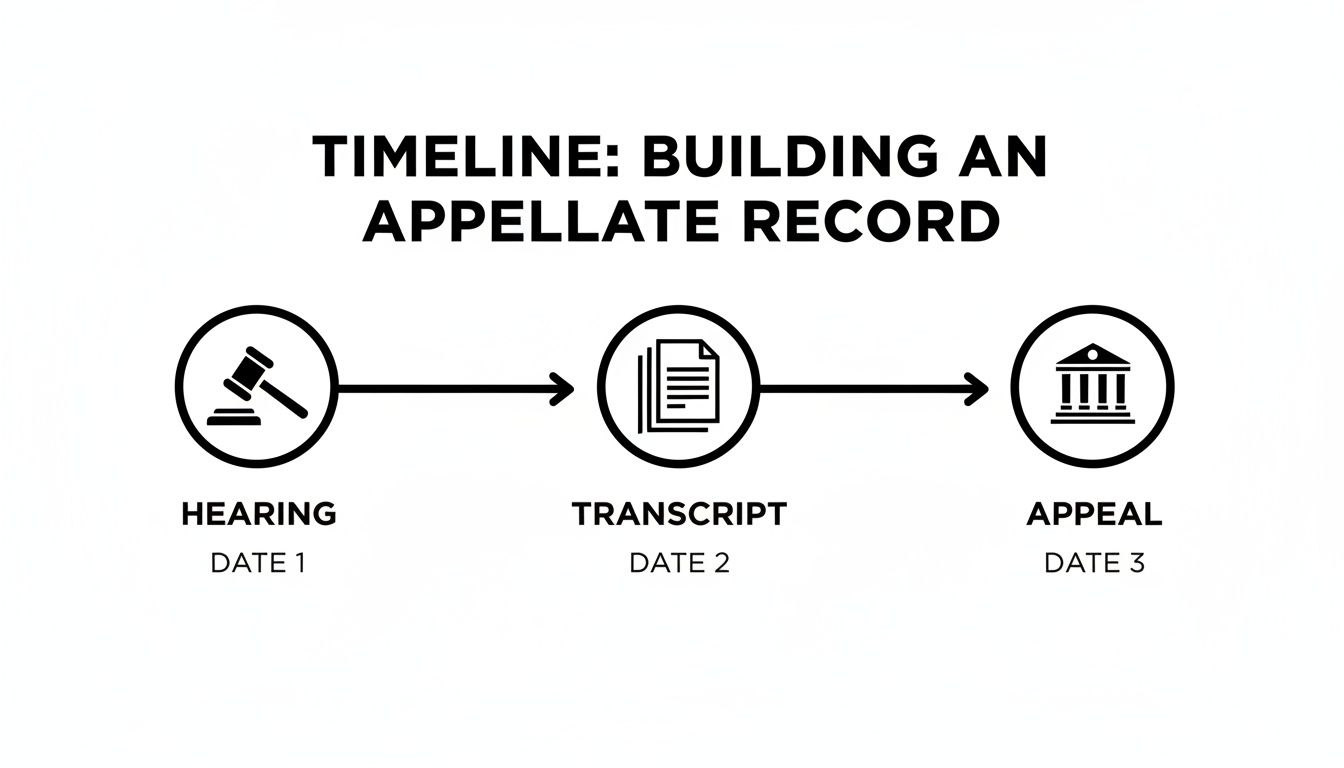
As you can see, the work of obtaining the hearing transcript and drafting the legal arguments happens rapidly, immediately following the filing of your notice.
The Breakneck Pace Continues
Filing the notice is just the first sprint. From that point forward, every deadline is compressed.
- The appellate record, which contains the proof of what happened in the trial court (including the reporter's transcript), must be filed much sooner than in a regular appeal.
- Your lawyer has significantly less time to write the appellate brief, the document that lays out the legal arguments for why the trial court's decision was legally incorrect.
- The court of appeals gives these cases priority, often reviewing and deciding them in a matter of months, a stark contrast to the years a standard appeal can take.
This entire process is designed to bring a swift resolution for the sake of the child’s well-being.
Can You Pause the Order? Filing an Emergency Motion to Stay
While your appeal is pending, the trial court's order remains in effect. This can create an unbearable situation for a parent and child. This is where one of the most critical appellate tools comes into play: the Emergency Motion to Stay.
This motion is a direct request to the court of appeals to pause the trial court's order. If the appellate court grants the stay, it can stop the order from being enforced while your appeal is decided. For instance, a stay could prevent a child from being immediately moved away from their primary parent and out of their home.
A stay is a powerful tool, but it is not granted lightly. Your attorney must demonstrate to the appellate court that you have a strong likelihood of success on appeal and that you or your child will suffer irreparable harm if the order is not paused.
The process is fast, complex, and unforgiving of errors. That's why understanding the deadlines is non-negotiable. For a full breakdown, you can learn more about the deadlines to appeal a Texas family court order in our comprehensive guide. Acting quickly with a knowledgeable appellate lawyer is the single best action you can take to navigate this high-stakes process.
Crafting a Legal Argument That Wins
After an unfavorable custody ruling, it is easy to become caught up in the emotion and injustice of the situation. However, in the world of appellate law, your personal story, while powerful, takes a backseat to legal analysis. Winning an emergency custody appeal in Texas is not about re-telling your story more passionately; it is about crafting a precise, compelling legal argument that persuades a panel of appellate judges that the trial court committed a reversible error.
This entire argument is contained in one critical document: the appellate brief. It is, without question, the single most important part of your appeal.

Our role as appellate attorneys is to translate the courtroom events into the precise legal language the court of appeals requires. We pivot from the emotional narrative to build a case rooted squarely in the Texas Family Code and decades of case law that interpret it.
Finding the "Reversible Error"
The purpose of the appellate brief is to demonstrate that the trial judge made a reversible error. This is not a minor mistake or a ruling you simply disagreed with. A reversible error is a legal blunder so significant that it likely caused an improper and unjust outcome.
So, what does a reversible error look like in a custody case? It often falls into one of these categories:
- Misapplying the Law: The judge may have incorrectly applied a statute from the Texas Family Code, such as the rules for modifying a prior child custody order.
- Improperly Excluding or Admitting Evidence: The court disregarded vital testimony or documents without a sound legal basis, or admitted evidence that was legally improper.
- Abusing Discretion: The judge made a decision that was arbitrary, unreasonable, or completely disconnected from guiding legal principles.
For example, a judge restricting a child’s residence to a specific county simply because the parents were once married there, even though the child has never lived in that county, is a classic potential abuse of discretion. The brief's job is to zero in on that specific error and show exactly how it violates Texas law and legal precedent.
Writing for the Judges
A winning brief is written for one audience only: a panel of busy, analytical appellate justices. This requires a "judge-focused" writing style. We do not just rehash the trial; we anticipate the tough questions the judges will have and answer them persuasively within the brief itself.
Think of an appellate brief as a legal road map. It must guide the justices from the facts established in the trial record, through the relevant laws and past cases, to the one logical conclusion: the trial court's order was legally flawed and must be reversed.
The structure is methodical and relentless. Each section builds on the one before it, weaving together facts from the appellate record with powerful legal precedent. We will point to the exact page and line number in the hearing transcript where the judge made an erroneous ruling, then immediately pair it with citations to other appellate cases that have overturned trial judges for making the same mistake. This approach gives the appellate court the legal authority it needs to step in and correct the injustice.
It’s not about asking for sympathy. It is about showing the court how the law was misapplied and demanding that it be corrected to protect your family and uphold the principles of due process. Building this kind of argument is a specialized skill, but it is what can turn a devastating trial court loss into a just outcome on appeal.
If you believe the court made a mistake in your family law case, our appellate attorneys can help you seek a fair outcome. Contact The Law Office of Bryan Fagan today for a free consultation.
Why a Trial Lawyer Is Not an Appellate Lawyer
When fighting for your child, it is natural to feel a deep sense of loyalty to the trial lawyer who stood by your side in court. They know your story, your family, and the battles you have faced. But when a judge issues an unjust emergency custody order, the fight changes. The battlefield shifts from the trial courtroom to the court of appeals, and you need a different kind of advocate for this new terrain.
The skills that lead to victory at trial are fundamentally different from those required to win an emergency custody appeal in Texas.
Think of it this way: moving from a trial to an appeal is like switching from playing football to playing chess. Both are intense and strategic, but they operate under entirely different rules and demand completely different mindsets to win.
Different Arenas, Different Champions
Your trial lawyer is a master of the live performance. Their job is to build a connection with a single judge, present evidence in a compelling way, and tell your story to persuade that one person in real-time. They excel at thinking on their feet, cross-examining witnesses, and controlling the courtroom dynamic.
An appellate lawyer, on the other hand, is a legal scholar and tactician. Their work is quiet, meticulous, and intensely analytical. They are not there to retry your case or tell your story again. Instead, their sole focus is to dissect the legal architecture of the trial, looking for the precise moment where the law was misapplied or procedural rules were violated.
Here's how the roles break down:
- The Audience: A trial lawyer speaks to one judge or a jury. An appellate lawyer writes for a panel of three to nine highly experienced justices who are scrutinizing the case for legal precision, not emotional impact.
- The Focus: A trial lawyer is focused on building a factual record—presenting testimony and evidence. An appellate lawyer is laser-focused on finding legal errors within that existing record. They cannot introduce new evidence.
- The Core Skill: For a trial lawyer, it’s oral advocacy and courtroom persuasion. For an appellate lawyer, it’s deep legal research and highly structured, judge-focused writing.
The two skill sets are distinct. A brilliant trial lawyer is an expert at building a case from the ground up. A brilliant appellate lawyer is an expert at deconstructing that finished case to expose its legal flaws.
Fresh Eyes on the Record Is a Strategic Advantage
Bringing in an appellate specialist is not an insult to your trial attorney—it is one of the smartest strategic moves you can make. An attorney who was not in the trenches of the original hearing brings a critical level of objectivity. They can review the cold, hard record and spot legal errors or missed arguments that are easy to overlook when you have lived and breathed the case for months.
Choosing an attorney with dedicated appellate experience is not a luxury; it is a strategic necessity. This is your chance for a fresh perspective from an expert who lives and breathes the specific rules and nuances of the appellate courts.
This new lawyer is not there to second-guess your trial team. They are there to perform a completely different function: to hunt for reversible error. This requires an encyclopedic knowledge of complex standards of review, like "abuse of discretion," and a mastery of the Texas Rules of Appellate Procedure.
If you feel the court got it wrong, do not assume the fight is over. The appellate process exists for this very reason—to serve as a vital check on the power of trial courts. Having an appellate specialist evaluate your case is the first and most important step toward challenging an unjust order and restoring fairness for your family.
Common Questions When Appealing a Custody Order
After receiving a difficult custody ruling, your mind is likely racing with questions. It is a confusing and stressful time. Here, we address some of the most common questions we hear from parents considering an appeal in Texas.
Can I Add New Evidence During My Appeal?
This is perhaps the single biggest misconception about the appellate process. The answer is a firm no. An appeal is not a "do-over" or a second trial where you can present new text messages, emails, or witness testimony that was not introduced the first time.
The court of appeals can only review what was presented to the trial judge. Everything the appellate justices consider is contained within the official appellate record—the transcripts and evidence from your original hearing. This is precisely why your trial lawyer’s performance in preserving the record is so critical. If a key piece of evidence was not admitted, it cannot be considered on appeal.
What Does "Abuse of Discretion" Actually Mean?
You will hear this legal term frequently because it is the standard you must meet to win most family law appeals. Proving an "abuse of discretion" means showing the trial judge’s decision was not just wrong, but that it was arbitrary, unreasonable, or made without considering the guiding legal principles of the Texas Family Code and case law.
It is a very high standard. Simply disagreeing with the outcome is not enough. Your appellate attorney must prove, based only on the record, that the judge's decision was so far outside the bounds of the law that it was legally indefensible.
An abuse of discretion isn’t about arguing the appellate court would have made a different decision. It's about proving the trial judge made a decision that was fundamentally outside the boundaries of established law.
What Happens If I Win My Appeal?
Winning an appeal can result in a few different outcomes. The appellate court may "reverse" the trial court’s order, which effectively vacates or cancels it.
More commonly, the court will "remand" the case. This means it is sent back down to the trial court with specific instructions. For example, if the judge improperly excluded crucial evidence, the appellate court might order a new hearing and instruct the judge to consider that evidence. The exact remedy depends entirely on the specific legal error that was made.
If you believe the court made a mistake in your family law case, our appellate attorneys can help you seek a fair outcome. Contact The Law Office of Bryan Fagan today for a free consultation at familylawcourtappeals.com.