Skip to content
If you believe a judge’s final order in your family law case was fundamentally unfair, you may feel that the system has failed you. The feeling of injustice can be overwhelming, but it is important to know that the legal process is not necessarily over. The Texas appellate courts exist to correct legal errors and ensure that judgments are fair and consistent with the law.
However, the path to an appeal is governed by strict, unforgiving timelines. In most Texas family law cases, you have a firm 30 days to start the appeals process. This clock begins ticking the moment the judge signs the final order. Missing this deadline can permanently close the door on your right to seek justice, no matter how flawed the original ruling may have been.
Your First Step After an Unfair Ruling
If the court made a legal error that led to an unjust outcome in your child custody, support, or property division case, you still have an opportunity to restore balance. But the path forward is narrow and the timeline is non-negotiable. Acting with strategic urgency is the only way to preserve your right to challenge the decision.
That 30-day window is your opportunity to act. Missing it almost certainly means losing your chance to appeal. The Texas Rules of Appellate Procedure demand swift action, which is why the steps you take immediately after receiving the order are so critical.
This decision tree helps visualize the first question you must answer: do I have a signed, final order?
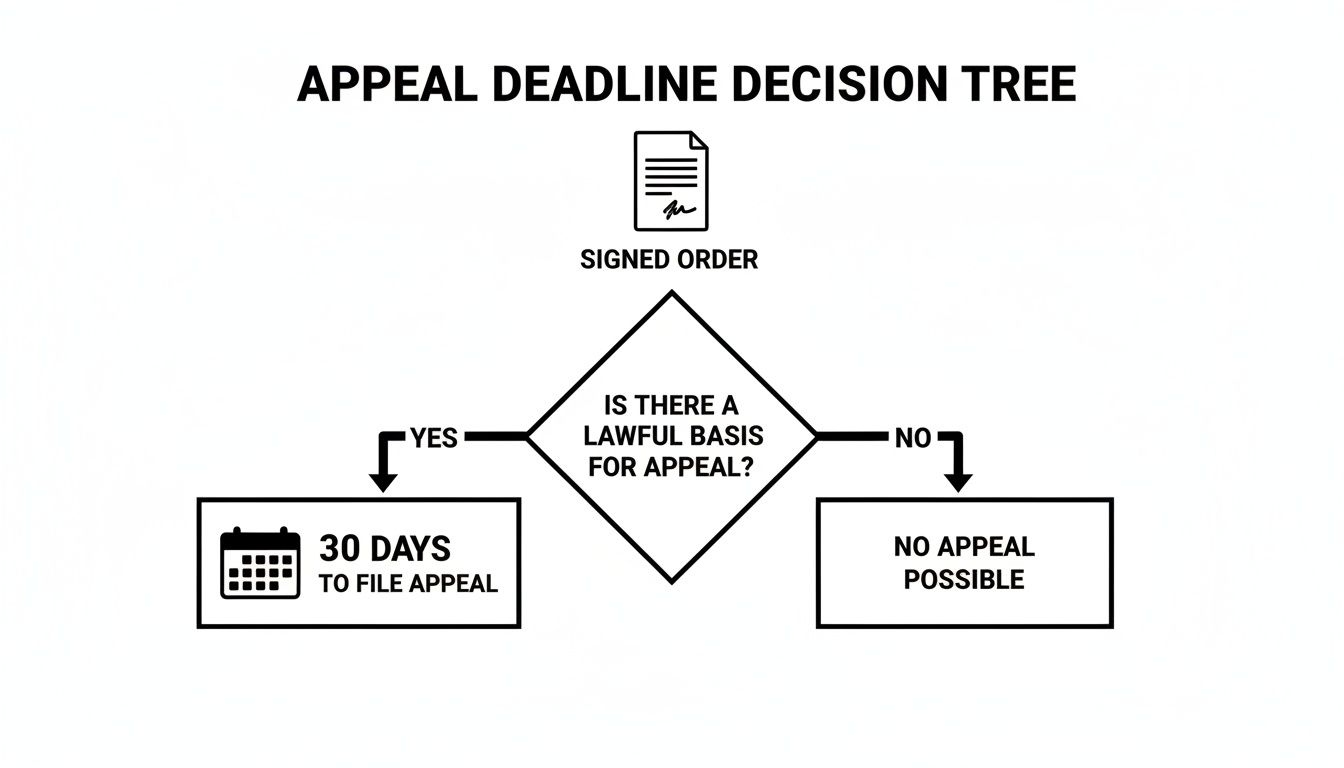
As the chart shows, the entire appellate process hinges on that signed final order. Once it exists, the clock is running.
Why Every Day Matters
The initial 30-day period is your strategic window. It is not a time to wait and see; it is a time to act. In these few weeks, you and your appellate attorney must move with purpose to:
- Obtain the Order: Immediately get a copy of the final judgment signed by the judge.
- Analyze for Reversible Error: Meticulously review the ruling and the case record to identify a "reversible error"—a legal mistake significant enough for an appellate court to overturn the decision.
- Develop a Strategy: Decide if filing certain post-judgment motions is the right move. These motions can extend your appeal deadline while asking the trial judge to reconsider their decision.
- File the Notice of Appeal: Prepare and file the Notice of Appeal, the official document that initiates the appellate process.
Filing a Notice of Appeal is the non-negotiable first step. It simply informs the courts of your intent to challenge the trial court’s judgment. To understand exactly what this document involves, you can review our guide on how to file a Notice of Appeal.
To help you quickly identify your deadline, this table summarizes the most common timelines for filing a notice of appeal in a Texas family law case.
Texas Appeal Deadlines At a Glance
| Filing Situation | Deadline to File Notice of Appeal | Governing Rule |
|---|---|---|
| Standard Appeal | 30 days after final judgment is signed | TRAP 26.1(a) |
| Appeal with Post-Judgment Motion | 90 days after final judgment is signed | TRAP 26.1(a)(1) |
| Restricted Appeal | 6 months after final judgment is signed | TRAP 26.1(c) & 30 |
| Accelerated Appeal | 20 days after final judgment is signed | TRAP 26.1(b) & 28.1 |
These timelines underscore the importance of seeking an expert legal opinion right away. The sooner you act, the more options you have to pursue a just and fair outcome.
Understanding What You Can Appeal in a Texas Family Law Case

When a judge issues a ruling that feels fundamentally wrong, your first instinct is to challenge it. However, in Texas appellate procedure, not every order can be appealed immediately. Understanding the difference between a final judgment and an interlocutory order is critical, as a mistake can waste valuable time and resources.
An appeal is not a retrial. It is a specific legal process designed to correct legal errors made by the trial court, and it is almost always reserved for when the case is completely finished. The crucial deadline to appeal a Texas family court order only begins after a final judgment is signed. This rule ensures the legal system functions efficiently, preventing constant interruptions from appeals of minor, temporary rulings.
Final Judgments: The Green Light for an Appeal
A final judgment is the comprehensive order that resolves all issues for all parties involved in the case. Once it is signed, there should be nothing left for the trial court to decide.
In a Texas divorce, a "final" order must address all matters applicable to your case, including:
- Granting the divorce
- Resolving child custody, visitation, and support
- Dividing all marital property and debts
- Granting or denying spousal maintenance
If the order leaves even one of these issues unresolved, the case is not over, and the clock for your appeal has not started.
A final judgment must be truly final. It must dispose of all claims and all parties. If a judge signs an order that only settles custody but leaves property division for a later date, that is not a final, appealable order.
Texas courts are extremely strict about this rule of finality. Appeals are not a chance to re-litigate your case; they are a focused review for legal mistakes. Only a final judgment opens the door for that review. This means you cannot appeal a partial ruling on just custody or just property; you must wait until every issue is resolved in one final order. That is when the 30-day clock starts, though it can be extended to 90 days if you file the correct post-judgment motions. You can explore this critical jurisdictional rule and its application in Texas family law cases on dallasdivorcelawyer.com.
Interlocutory Orders: Rulings Along the Way
If final judgments are the end of the story, interlocutory orders are the temporary decisions a judge makes while your case is ongoing. These include temporary custody arrangements, temporary support, or who lives in the marital home during the divorce process.
These orders provide stability for the family during litigation. For that reason, with very few exceptions, you cannot appeal an interlocutory order. Attempting to do so will result in the appellate court dismissing your case for lack of jurisdiction, wasting precious time and money.
However, the law allows for rare exceptions called accelerated appeals. These are permitted only in specific situations where waiting for a final judgment would cause irreversible harm, such as:
- An order granting or refusing a temporary injunction
- Certain orders in Child Protective Services (CPS) cases
- An order appointing a receiver
Determining whether your order is final or interlocutory is the essential first step in any appeal. An experienced appellate lawyer can analyze the order, clarify your position, and ensure you do not miss the strict deadline to appeal your Texas family court order.
The Strategic Way to Extend Your Appeal Deadline

The standard 30-day deadline to appeal a Texas family court order is extremely short. It provides little time to process a difficult ruling, let alone find a qualified appellate lawyer and prepare a challenge. Fortunately, the Texas Rules of Appellate Procedure provide a tool that can provide much-needed time.
By filing a specific type of post-judgment motion, you can automatically extend your appeal deadline from 30 days to a more manageable 90 days. This is a fundamental part of the Texas legal process, designed to give the trial judge an opportunity to correct their own mistakes and potentially avoid the need for an appeal altogether.
What Is a Post-Judgment Motion?
A post-judgment motion is a formal request asking the trial judge to reconsider their decision. It is your first and best opportunity to have an error corrected at the trial court level. In family law appeals, two types of motions are most common.
- Motion for New Trial: This motion asks the judge to set aside the final judgment and order a new trial because a significant legal or factual error compromised the fairness of the outcome.
- Motion to Modify, Correct, or Reform the Judgment: This is a more targeted request. Instead of seeking a new trial, you ask the judge to fix a specific part of the order, such as a calculation error in a property division or ambiguous language in a possession schedule.
Filing either of these motions within the original 30-day window is the critical step that automatically extends your appellate deadline to 90 days from the date the judgment was signed.
A timely filed post-judgment motion does more than buy time. It is a crucial strategic move that preserves your right to raise certain issues on appeal. If you fail to raise a specific complaint in a motion for new trial, the appellate court may decide you have waived your right to argue it later.
This deadline extension is outlined in Rule 26.1(a)(1) of the Texas Rules of Appellate Procedure. The rule is clear: if you file a qualifying post-judgment motion on time, your deadline to file the Notice of Appeal is extended to 90 days.
The Strategic Power of a 90-Day Deadline
Tripling your timeline transforms the process from a frantic rush into a thoughtful, methodical effort. This extra time greatly improves your case's chances of success.
1. Time to Obtain the Official Record
An appeal is based entirely on the official court record. This includes the reporter’s record (the word-for-word trial transcript) and the clerk’s record (all documents filed in your case). Obtaining these materials can take weeks. A 90-day deadline gives your appellate lawyer time to secure the complete record for review.
2. Opportunity for Detailed Error Analysis
With the record in hand, the real work begins: a meticulous search for reversible error. Your lawyer will review hundreds, sometimes thousands, of pages of testimony and evidence, looking for specific legal mistakes that give an appellate court a reason to overturn the decision, such as an abuse of discretion by the judge.
3. Space to Build a Winning Argument
Finally, the extended deadline provides the time needed to craft a persuasive legal brief. A successful appeal is built on deep legal research and sophisticated writing. The additional 60 days allow your attorney to construct a compelling argument that clearly explains to the appellate judges why the trial court’s ruling was legally wrong and should be reversed. As we have seen in our practice, a Motion for New Trial can be a cornerstone of your appellate strategy.
The Fast Track: Accelerated Appeal Timelines
While most family law appeals follow a 30 or 90-day timeline, some situations are so urgent that the law places them on a special fast track. These are called accelerated appeals, and they exist to bring stability to a child’s life as quickly as possible.
When a case is designated for an accelerated appeal, the standard rules change. Most importantly, the deadline to file your Notice of Appeal is a non-negotiable 20 days from the day the judge signs the order. This incredibly short window requires immediate and decisive action.
When Does the 20-Day Deadline Apply?
The tight, 20-day deadline is reserved for cases where a child's future is at stake and any delay could cause irreparable harm. The Texas Rules of Appellate Procedure trigger this fast track for orders that fundamentally alter the parent-child relationship.
The primary example is an order terminating parental rights. If a judge signs an order permanently severing your legal ties to your child, any appeal of that life-altering decision must be filed within 20 days.
Other situations that can require an accelerated appeal include:
- Certain orders arising from Child Protective Services (CPS) cases.
- Court orders appointing a receiver to take control of property.
- A few specific types of temporary orders, known as interlocutory orders, which a statute explicitly makes appealable on a faster schedule.
Determining whether your order falls under these rules is the top priority. For instance, if your case involved an emergency custody order in Texas, you need to be on high alert, as the circumstances that led to the emergency may also lead to an order with an accelerated deadline.
The Most Dangerous Pitfall: No Extensions for Post-Judgment Motions
This is the single greatest risk in accelerated appeals. In a standard appeal, filing a Motion for New Trial extends your deadline from 30 to 90 days.
In an accelerated appeal, that extension does not exist. Filing a Motion for New Trial or any other post-judgment motion does not stop the 20-day clock.
This rule is absolute. The courts prioritize permanency for children above all else, so the procedural tools used to gain more time are not available. Your only option is to file the Notice of Appeal within the 20-day window.
Missing this deadline is almost always fatal to your appeal. The appellate court loses jurisdiction—its legal authority to hear your case. No matter how incorrect the trial court’s decision was, you will have lost your right to challenge it forever.
Because the stakes are so high and the time so short, you must contact an experienced appellate attorney the moment you receive an order you believe might be subject to an accelerated timeline. There is no time to waste.
What Happens If You Miss the Filing Deadline?

Realizing you have missed the strict deadline to appeal a Texas family court order can be a distressing moment. While these timelines are firm, Texas law does provide a very narrow, last-resort opportunity for a brief extension.
If your 30-day (or 90-day) deadline has passed, the Texas Rules of Appellate Procedure may allow you to file a Motion for Extension of Time. This is a formal request to the appellate court for a small measure of grace, and it has its own strict deadline.
You must file the Motion for Extension of Time within 15 days of the original missed deadline. So, if your 30-day appeal window closed on a Monday, you have until the Monday two weeks later (plus one day) to file both your Notice of Appeal and your motion requesting more time.
Requesting an Extension
Simply asking for more time is not enough. To have any chance of success, you must provide the court with a “reasonable explanation” for your tardiness. The standard is high, and what is considered "reasonable" is at the discretion of the appellate judges.
A reasonable explanation typically involves a verifiable event that was genuinely outside of your control. Forgetting the date, being too busy, or miscalculating the deadline are almost never accepted.
- A Potentially Reasonable Explanation: You were unexpectedly hospitalized and physically unable to contact an attorney or file documents as the deadline approached.
- An Unlikely Explanation: You forgot to check your mail, or your trial lawyer did not send you a reminder. The courts place the final responsibility for meeting the deadline squarely on you.
Motions for extension are rarely granted. Courts view appellate deadlines as jurisdictional—they are the source of the court’s power to hear your case. This is why preventing filing errors is so critical. Good organization, including strong document version control best practices, can be your first line of defense.
Extraordinary and Rare Remedies
If even the 15-day extension window has passed, other legal tools might offer a final sliver of hope in highly specific and uncommon scenarios. These are not standard appeals and should be considered extraordinary remedies.
These are not substitutes for a timely appeal. They are used for situations where the normal process failed due to circumstances beyond your control or knowledge.
Two such remedies are the Restricted Appeal and the Bill of Review.
Restricted Appeal: This is an option only if you did not participate in the trial—either in person or through an attorney. You have six months from the date the judgment was signed to file, but you must also prove that an error is "apparent on the face of the record," meaning the mistake is obvious from reading the court's file.
Bill of Review: This is a separate lawsuit filed to set aside a prior judgment. It is used when you were prevented from presenting your case due to fraud, an accident, or a wrongful act by the other party, through no fault or negligence of your own. This is an extremely difficult path requiring clear proof of misconduct.
Navigating the aftermath of a missed deadline is incredibly complex. If you find yourself in this situation, it is crucial to seek experienced legal counsel immediately.
If you believe the court made a mistake in your family law case, our appellate attorneys can help you seek a fair outcome. Contact The Law Office of Bryan Fagan today for a free consultation.
What To Do When You Receive an Unfair Ruling
Knowing the deadlines is only the first step; taking strategic action is what matters. When a judge’s order feels unjust, it is easy to feel powerless, but you have options. The key is to move forward with purpose and a clear strategy.
Here is what needs to happen, starting now.
First, do not wait. Whether you face a 20, 30, or 90-day deadline, the clock is ticking. Your first call should be to an appellate attorney who can review the judge’s order and provide a frank assessment of your options. Every day counts.
Next, we must determine exactly what kind of order you have. Is it a final judgment that resolves all issues in your case? Or is it one of the specific interlocutory orders that can be appealed immediately? The answer dictates the timeline and strategy for your case.
Finally, we will consider strategic moves that can secure valuable time. Filing a Motion for New Trial, for example, can extend a standard 30-day appeal deadline to a much more manageable 90 days. That extra time is invaluable for building a compelling argument for the higher court.
An Appeal Is Not a Do-Over
It is critical to understand that an appeal is not a new trial. You will not call witnesses or introduce new evidence. The court of appeals has a specific job: to review the trial record for significant legal mistakes made by the trial judge.
While you will not present new evidence, you will meticulously review the existing record with your attorney. Sometimes, this means revisiting crucial communications. Knowing how to properly export legally admissible text messages for court, for example, can be essential when reviewing the case file and building your appellate argument.
One of the most common grounds for a successful family law appeal is an abuse of discretion. This legal term means the judge made a ruling that was arbitrary, unreasonable, or without reference to any guiding legal rules or principles. Proving it requires a sharp legal eye and deep knowledge of Texas law.
An appeal is your chance to ensure the legal system is held accountable. It is an opportunity to have a higher court correct a serious legal error that resulted in an unjust outcome for your family.
If you believe a mistake was made in your child custody battle, property division dispute, or another family law matter, you do not have to accept the result. Our appellate attorneys can dissect your final order, explain your options in plain English, and guide you through the intricate Texas appeals process.
The window to challenge a Texas family court order is brief. Contact The Law Office of Bryan Fagan today for a consultation to see how we can help protect your rights.
Common Questions About Texas Family Law Appeals
After a trial, it is natural to have many questions, especially if you are facing a disappointing outcome. Much of the uncertainty revolves around the appellate process itself. Let's clarify a few of the most common questions we hear from clients who are considering an appeal and need to understand the strict deadline to appeal a Texas family court order.
Can I introduce new evidence during an appeal?
This is one of the most frequent questions, and the answer is no. An appeal is not a second trial or a "do-over." The appellate court acts like a referee reviewing a replay of the game.
The court is limited to reviewing the existing “record” from the trial court. This record consists of the reporter's record (the word-for-word transcript of court proceedings) and the clerk's record (all documents filed in the case). The court's only job is to determine if the judge made a legal mistake based on the evidence and arguments presented at that time. You cannot introduce new witnesses or submit documents you forgot to present earlier.
What does "abuse of discretion" mean in plain English?
You will hear this legal term often because it is the primary “standard of review” for most family law appeals in Texas. In plain English, an abuse of discretion occurs when a trial judge makes a decision that is arbitrary, unreasonable, or made without considering the guiding legal principles. It is more than just disagreeing with the outcome; you must show the decision was so flawed that it likely led to an improper judgment. Because appellate courts give great deference to the trial judge’s decisions—especially in sensitive child custody cases—proving this requires a powerful and precise legal argument.
An abuse of discretion is more than just a bad call; it's a decision that falls outside the zone of reasonable disagreement. It’s when a judge acts without a legal compass, resulting in an unjust outcome that the law cannot support.
How much does a family law appeal cost?
There is no single price for an appeal. The final cost depends on the complexity of the case, but the most significant factor is often the size of the trial record. A longer, more complex trial will generally result in a more expensive appeal.
The two main costs are:
- Attorney’s Fees: This covers the time our attorneys spend reviewing every page of the record, researching the law, and writing the highly technical legal "brief" that will be presented to the appellate court.
- Cost of the Record: Before work can begin, you must pay the court reporter and court clerk to prepare the official transcripts and case files. For a multi-day trial, this expense alone can be thousands of dollars.
We believe in full transparency. In our initial consultation, we will provide a realistic breakdown of the potential costs so you can make an informed decision.
What happens if I win my appeal?
Winning an appeal does not usually mean the higher court declares you the winner on the spot. The most common outcome is an order to “reverse and remand.” This means the appellate court found a significant legal error and is sending the case back to the trial court for a new hearing or trial. In essence, you get a second chance to make your case, but this time with specific instructions from the higher court on how to apply the law correctly. In some cases, the court might “reverse and render,” which means it issues the correct judgment itself.
If you believe a legal error led to an unfair outcome in your family law case, our appellate attorneys are here to help you explore your options. Contact The Law Office of Bryan Fagan today for a free consultation at https://familylawcourtappeals.com.