You may feel like the judge dropped a financial burden on you without fully hearing your side. That reaction is common when a court orders retroactive child support and the numbers don't match the evidence you thought mattered.
Texas law does allow appeals in the right case. But appealing retroactive child support texas cases isn't about retelling the story from the beginning. It's about identifying a legal mistake, preserving it, and presenting it with precision.
Understanding Your Right to Appeal a Retroactive Support Order

A retroactive support order can feel unfair for many reasons. Sometimes the court used the wrong income figure. Sometimes it brushed past evidence of informal support. Sometimes the ruling seems to punish a parent without carefully applying the law.
An appeal is the process for challenging those legal errors. It is not a new trial.
What an appeal really is
The appellate court doesn't hear new witnesses. It doesn't weigh who seemed more credible in the courtroom. It reviews the existing trial record and asks whether the trial court made a reversible legal or procedural mistake.
In child support appeals, the key standard is usually abuse of discretion. In plain English, that means the trial court acted arbitrarily, ignored guiding legal rules, or based its ruling on an inadequate legal foundation.
A related term is reversible error. That means a mistake serious enough to justify changing the result.
A third term matters just as much. Briefing is the written legal argument filed in the appellate court. In many appeals, the brief does most of the persuasive work.
Why expectations matter
Appeals are difficult. General appellate statistics show that only about 5% to 10% of appeals succeed, and the reason is straightforward: appeals aren't retrials and depend on a preserved record showing the trial court misapplied the law or violated procedure, as discussed in this appellate overview on appeal success rates.
That doesn't mean your case lacks value. It means the fundamental question isn't, "Was the ruling unfair?" The right question is, "Can the record show a legal error the appellate court can correct?"
Practical rule: Strong appeals usually focus on one clear mistake, not ten complaints about how the hearing felt.
What tends to work and what usually doesn't
Some arguments carry weight on appeal. Others rarely do.
| Approach | Usually helps | Usually fails |
|---|---|---|
| Income challenge | Showing the judge relied on unsupported income figures in the record | Saying the judge should've believed your testimony |
| Statutory challenge | Showing the court failed to apply the required retroactive support factors | Arguing the order feels too harsh without tying it to law |
| Procedural challenge | Showing preserved objections, excluded evidence, or lack of legal basis | Raising issues for the first time after judgment |
Texas parents often start with a general sense that the outcome was wrong. The stronger path is narrower. Review the order, the hearing transcript, the exhibits, and any findings. Then identify where the court may have departed from the Texas Family Code or the Texas Rules of Appellate Procedure.
For a broader overview of this process, see appealing a child support order in Texas.
Immediate Steps After Judgment to Preserve Your Appeal
The first days after judgment matter more than many parents realize. A good appellate issue can disappear if nobody preserved it in the trial court.
Error preservation is not a technicality
Under Texas Rule of Appellate Procedure 33.1, the appellate court usually reviews only complaints that were properly raised in the trial court. That means a party must object, request relief, or otherwise make the complaint clear enough for the trial judge to rule on it.
If that didn't happen, the appellate court may say the issue was waived.
That rule can feel harsh, but it's central to family law appeals. Trial judges must have a fair chance to correct an error before a higher court steps in.
A clear example of how appeals are lost
A Texas appellate case shows this problem clearly. In In re Aer, the father challenged a retroactive support award of more than $50,000, but he lost because he failed to object when unpled retroactive claims were raised during closing argument. Because he did not preserve error, the appellate court could not review the complaint, as explained in this discussion of retroactive child support and preservation in Texas.
That is one of the most frustrating outcomes in appellate practice. A parent may have a decent fairness argument, but the court never reaches the merits because the issue wasn't preserved.
The appeal doesn't begin in the court of appeals. It begins in the trial courtroom, often with a timely objection.
What you should do right away
The right steps depend on the order and the procedural posture of the case, but these actions are often critical:
- Read the signed order carefully. Make sure it matches what the judge ruled. Support amounts, dates, findings, and arrearage language should be checked line by line.
- Identify every contested point from the hearing. Was income imputed without support? Did the court ignore proof of prior payments? Did the other side seek relief that wasn't properly pleaded?
- Review objections already made. If your trial lawyer objected, note where that appears in the transcript.
- Consider post-judgment motions. A Motion for New Trial or other post-judgment filing can sharpen the issues, ask the trial court to correct mistakes, and help build a cleaner appellate record.
- Request findings when appropriate. In some cases, findings of fact and conclusions of law help show how the judge reached the retroactive award, which can expose legal gaps.
Why the record matters so much
The record is the universe of material the appellate court can review. It usually includes the clerk's record, which contains filings and orders, and the reporter's record, which contains the testimony and arguments from the hearing.
If something isn't in that record, it usually can't help you on appeal.
That is why trial counsel and appellate counsel often work together quickly after judgment. The goal is to identify preserved complaints, evaluate whether a post-judgment motion is useful, and avoid losing an argument through inaction.
Common preservation mistakes
Some mistakes repeat across retroactive support cases:
- Waiting too long. Parents often focus on the payment burden first and the appellate deadline second.
- Arguing fairness without legal specificity. "This is too much" is not the same as "the court relied on evidence with no support in the record."
- Assuming the appellate court will fix obvious problems on its own. Usually, it won't unless the complaint was preserved and briefed correctly.
A disciplined first review after judgment often tells you whether you have an appeal, a modification issue, or a very limited chance of relief.
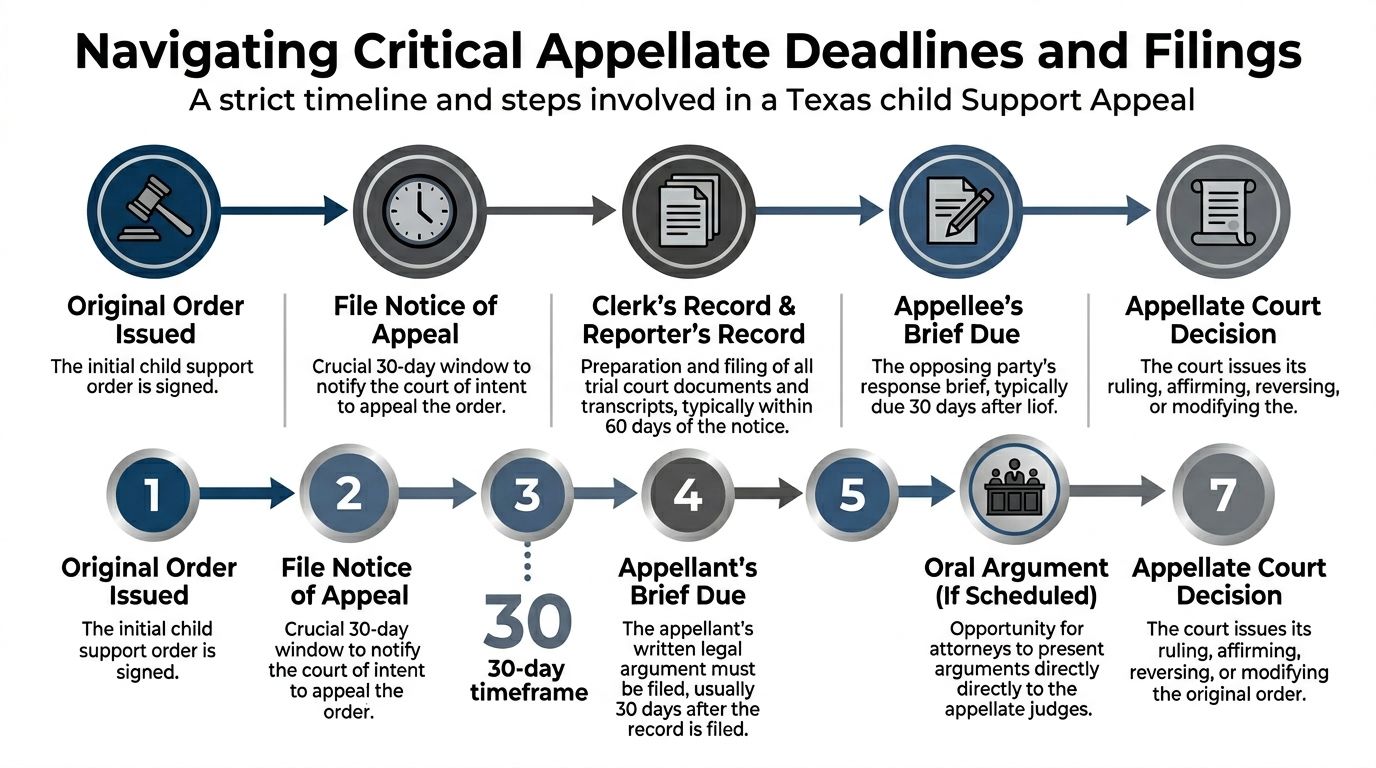
Navigating Critical Appellate Deadlines and Filings
Texas appellate procedure rewards precision. Miss a filing deadline, and the merits of your case may never be heard.
Deadlines that can close the door fast
In some family law settings, the timetable is extremely short. A request for a de novo hearing from an associate judge's ruling must be filed within three business days, and the hearing must occur within 30 days, as noted in this discussion of Texas child support appeal deadlines.
That rule alone tells you how unforgiving this area can be. If your case involves an associate judge, waiting to "think about it" can cost you the chance to challenge the ruling in the trial court.
The core appellate filings
Most retroactive support appeals also involve a sequence of formal filings under the Texas Rules of Appellate Procedure.
Notice of appeal
The Notice of Appeal starts the appellate process. It tells the court and the opposing party that you're seeking review.
Without it, the appellate court generally has no case to decide.
Clerk's record and reporter's record
The clerk's record includes pleadings, motions, orders, and other filed documents.
The reporter's record includes the transcript of hearings and testimony.
These records matter because appellate judges decide the case from the written record, not memory, summary, or new explanation.
The briefs
The appellant files the opening brief. The appellee responds. In some cases, a reply brief follows.
The written briefing is where legal errors are framed and tied to the record.
A practical timeline mindset
Parents often want a simple answer to timing. The better answer is to think in sequence.
- Confirm the date the order was signed
- Determine whether any post-judgment deadlines apply
- Protect the appellate timetable
- Order the necessary records promptly
- Start issue review before the full record arrives
That last point matters. Good appellate preparation doesn't begin after every transcript is delivered. It begins as soon as counsel has enough information to spot likely error and preserve the schedule.
Deadlines in family law appeals don't bend because the order is financially stressful or emotionally difficult.
Why this stage shapes the whole case
Late records, incomplete transcripts, and vague notices create avoidable problems. They also make briefing harder because the legal theory may not line up cleanly with the documents the court can review.
That is why many parents benefit from early appellate consultation. The Law Office of Bryan Fagan, PLLC handles Texas family law appeals, including review of trial records, notices, and briefing strategy, which is the kind of focused post-judgment work these cases often require.
Identifying Reversible Error in Retroactive Support Rulings

The strongest retroactive child support appeals are built around a specific legal defect. The issue isn't whether the appellate judges would have ruled differently in the first instance. The issue is whether the trial court misapplied the law or based its decision on an inadequate record.
The four-factor framework matters
Texas courts use a four-factor test under Texas Family Code section 154.009 when deciding retroactive support. The factors include whether the obligor knew of the child, the custodial parent's efforts to obtain support, the obligor's present ability to pay without undue hardship, and whether the obligor intentionally avoided the obligation, as summarized in this explanation of retroactive child support claims in Texas.
That framework gives appellate lawyers a concrete checklist. If the trial court ignored a factor, misread the evidence tied to it, or gave weight to unsupported assumptions, the ruling may be vulnerable.
How each factor can generate appellate issues
Knowledge of the child
If the record doesn't support a finding that the obligor knew or should have known about the child, a large retroactive award may rest on a weak foundation.
This issue often turns on documents, messages, prior acknowledgments, or the absence of them.
Efforts to obtain support
The court should consider the custodial parent's efforts to seek support. If the record is silent or the trial court treats this factor as irrelevant, that may matter on appeal.
A thin record here won't always produce reversal, but it can strengthen an argument that the required analysis was incomplete.
Ability to pay without undue hardship
This factor often drives the most practical disputes. Trial courts can err when they rely on stale earnings, unsupported imputation, or selective financial evidence.
One appellate example from Texas involved reversal of ongoing support because the trial court used the father's prior $40,000 annual job rather than record evidence showing current income of $2,000 per month, while still upholding the retroactive portion. That example shows a common appellate truth. Courts may correct calculation error without erasing a retroactive obligation entirely.
Intentional avoidance
A court may view a parent harshly if it finds deliberate avoidance of support. But that finding still needs record support.
If the evidence shows employment instability, confusion over paternity, informal assistance, or some other non-evasive explanation, the appellate argument may focus on the gap between the evidence and the court's conclusion.
Common reversible errors in practice
Some appellate points appear repeatedly in retroactive support cases:
- Unsupported income findings. The trial court used earning figures that don't match the admitted evidence.
- Failure to address informal support. The record showed the parent gave help directly, but the ruling treated the case as if no support existed at all.
- Incomplete statutory analysis. The order or findings suggest the court did not weigh the required factors.
- Procedural unfairness. A party was hit with retroactive relief that was not properly presented, and the complaint was preserved.
- Weak findings. The basis for the award is too unclear to support meaningful review.
Record-based advocacy wins appeals. General frustration with the amount does not.
A useful way to evaluate your own case
Ask these questions:
| Question | Why it matters |
|---|---|
| What evidence supported the income number? | Retroactive awards often rise or fall on the earnings figure used |
| Did the judge mention the statutory factors? | Silence can suggest an incomplete legal analysis |
| Was there proof of prior support or hardship? | Ignored evidence can support an abuse-of-discretion argument |
| Was the complaint preserved? | Even a strong point may be waived |
Parents who want to understand whether a mistake is legally reversible often benefit from reviewing the concept of reversible error in Texas family court.
Crafting a Persuasive Appellate Brief and Legal Argument
An appellate brief is not a transcript summary with a strong conclusion. It is a tightly structured legal argument that tells the court three things: what happened, where the legal error occurred, and why that error requires relief.
What a strong brief does
A strong brief starts with disciplined issue selection. If the retroactive support ruling contains one serious legal defect, that issue should lead. Weak side arguments often distract from the point that could move the panel.
The brief then ties every important factual statement to the record. In appellate practice, unsupported assertions don't help, even if everyone involved believes them to be true.
The basic architecture
Most effective briefs in these cases include these core parts:
- Issue presented. A short statement of the legal question.
- Statement of facts. A neutral but strategically organized account taken from the trial record.
- Standard of review. Usually abuse of discretion in retroactive support matters.
- Argument. The section that explains why the trial court's ruling cannot stand under the Family Code or appellate rules.
- Prayer for relief. The exact result requested, such as reversal, remand, or modification.
Tone matters more than many clients expect
Appellate judges usually respond to precision, not outrage. A persuasive brief is calm. It avoids exaggeration. It doesn't accuse the trial judge of bad faith when a narrower legal explanation will do.
That restraint can be hard for clients because the case feels personal. But the appellate court is looking for legal reasoning anchored in the record.
A good brief doesn't ask the judges to feel what you felt at trial. It shows them where the law was misapplied.
What doesn't work in briefing
Certain habits weaken family law appeals:
- Rearguing witness credibility when the core issue is legal sufficiency or statutory application.
- Overloading the brief with every complaint from trial.
- Referring to facts outside the record.
- Using emotional language in place of analysis.
The best briefs narrow the dispute. If the court used the wrong income figure, say that clearly. If it failed to account for the statutory framework, show that step by step. If the issue was preserved through a timely objection or motion, identify exactly where.
Oral argument is secondary to the writing
Some cases receive oral argument, and some don't. Even when argument is granted, the brief usually carries the case. Oral argument gives counsel a chance to answer questions, clear up weak spots, and emphasize the cleanest route to reversal.
That is why experienced appellate counsel spend so much time refining the written presentation. In retroactive support appeals, the brief is often the place where a scattered trial record becomes a coherent legal argument.
Potential Outcomes and Managing Support Payments During an Appeal

Clients usually ask two practical questions. What can the appellate court do, and what happens to the money while the case is pending?
Both questions matter because retroactive support orders affect daily life immediately.
The main appellate outcomes
Affirm
If the court affirms, the trial court's ruling stays in place.
That means the retroactive support order survives as entered, subject to any enforcement already underway.
Reverse
If the court reverses, it overturns the challenged ruling.
In some cases that ends the disputed portion of the order. In others, reversal applies only to a specific part, such as a flawed calculation.
Reverse and remand
If the court reverses and remands, it sends the case back to the trial court for further proceedings consistent with the appellate opinion.
This is common when the appellate court identifies error but further work is needed to recalculate support or apply the correct legal standard.
Paying during the appeal
Many parents assume that filing an appeal automatically pauses enforcement. It usually doesn't.
A retroactive support order may remain enforceable while the appeal moves forward unless the judgment is properly superseded. That is a separate procedural question and must be handled intentionally.
Why delay can be expensive
Texas imposes 6% annual interest on unpaid child support arrears, which means the amount can continue to grow while the case is pending unless the judgment is properly addressed, as explained in this discussion of back child support in Texas.
That financial reality changes strategy. Sometimes the right move is to appeal and address supersedeas promptly. Sometimes the focus is narrower, such as attacking the calculation while managing payment exposure.
A practical comparison
| Scenario | What it usually means |
|---|---|
| Appeal filed, no supersedeas | Enforcement risk often continues while the appellate case proceeds |
| Appeal filed with proper supersedeas steps | Collection pressure may be reduced, depending on the order and procedure |
| No appeal, later modification request | You may address future support issues, but not necessarily correct the original retroactive ruling |
Support tools connected to enforcement
If wage withholding is already part of the order, that may continue to affect your finances while the appeal is pending. Parents dealing with collection pressure often need to understand how an income withholding order interacts with the larger child support framework.
Choosing the right remedy
An appeal is designed to correct legal error in the order that was signed. It is different from a modification, which addresses changed circumstances going forward.
That distinction matters. If your complaint is that the court relied on the wrong evidence or ignored the governing law when it imposed retroactive support, appeal may be the right tool. If your circumstances changed after judgment, a different remedy may fit better.
Common Pitfalls and Strategic Tips for Your Appeal
A disciplined appeal is usually a focused appeal. Parents often want to challenge everything at once. That instinct is understandable, but it can weaken a strong legal issue.
Pitfalls that hurt otherwise good cases
Trying to add new evidence
The appellate court won't retry your case with new documents, new testimony, or a better explanation that never made it into the record.
If the proof wasn't properly presented below, appellate counsel has limited tools to use it later.
Treating the appeal like a fairness petition
Judges on appeal want a legal reason to act. They need a preserved issue, a record citation, and a legal rule that supports relief.
A brief that says the outcome was unjust, without showing why it was legally erroneous, usually won't go far.
Raising too many arguments
Five weak issues can bury one strong one. In retroactive support appeals, the better strategy is often to identify the cleanest reversible error and build around it.
Narrow arguments often read as stronger arguments because they show confidence in the true issue.
Strategic tips that often help
- Start with the record, not the emotion. Review transcripts, exhibits, objections, and findings before forming your appellate theory.
- Separate appeal issues from modification issues. A post-judgment income change may matter, but it does not automatically prove the original retroactive award was legally wrong.
- Watch for calculation flaws. If the court used the wrong earnings baseline, that may be more powerful than broad hardship arguments.
- Think carefully about timing and law changes. Effective September 2025, the Texas child support cap rose to $12,750 in monthly net resources due to inflation, a change that can affect appellate arguments when lawyers compare historical earnings, current guideline limits, and the way retroactive amounts were calculated, as noted in this discussion of retroactive and back child support in Texas.
The larger strategic trade-off
Some clients want a fast resolution. Others want a complete correction, even if it takes longer. The right approach depends on the order, the record, the amount at stake, and whether the appellate issue is narrow or structural.
The central question stays the same. Can you show the trial court made a preserved legal error that affected the retroactive support ruling?
If the answer may be yes, a careful case evaluation is worth doing quickly. The value of that review isn't just finding an argument. It's ruling out weak arguments, protecting deadlines, and choosing the remedy that fits the problem.
If you believe the court made a mistake in your family law case, our appellate attorneys can help you seek a fair outcome. Contact The Law Office of Bryan Fagan, PLLC today for a free consultation to evaluate your case and discuss your options.