You may feel your case was handled unfairly. Maybe the judge seemed ready to sign an order that doesn't fit the law, or maybe a temporary ruling has put your relationship with your child, your property, or your safety at risk.
When that happens, many people assume they have only one option: wait for the final judgment and then appeal. In Texas family law, that's sometimes true. But not always. In a narrow set of situations, the law gives you a way to ask an appellate court to stop a trial court from taking an action it has no authority to take.
That tool is called a writ of prohibition. In the right case, it can restore balance before the harm is locked into a signed order.
Feeling Powerless After a Texas Family Court Ruling
A parent walks out of a hearing shaken. The judge has said something from the bench that doesn't sound right. Maybe the court appears ready to modify custody even though there are serious questions about jurisdiction. Maybe the court is moving forward on an issue that should be decided in another court, or under a different legal standard.
At that moment, people often ask the same question. "Do I just have to let this happen?"
Sometimes the answer is no.
When waiting can make things worse
A standard appeal usually comes after a final judgment. That matters because family law cases often move through temporary hearings, enforcement disputes, discovery fights, and emergency requests before the final order is signed. If the court is about to act outside its lawful authority, waiting can be the wrong strategy.
A writ of prohibition is designed for that narrow problem. It is not a second trial. It is not a chance to re-argue who was more believable. It is a request for an appellate court to step in and say, in substance, "Stop. This court cannot do that."
When a trial court is about to exceed its authority, the legal system does not always require a family to sit still and absorb the damage first.
Why this matters in family cases
Family cases are personal in a way many civil cases aren't. A flawed order can affect where a child lives, who controls property during the case, or whether a protective order proceeding moves forward in the wrong way. Even a short-term error can change daily life immediately.
That is why appellate procedure matters so much in this area. The Texas Rules of Appellate Procedure provide tools for urgent review, but each tool has a different job. Knowing which one fits your situation can make the difference between meaningful relief and wasted time.
What Is a Writ of Prohibition in Texas Family Law
A writ of prohibition is an extraordinary order from an appellate court telling a lower court to refrain from doing some act that the lower court has no legal authority to do. In plain English, it is a stop order.

Think of it like a referee's whistle
A simple analogy helps. If a player is about to make an illegal move, a referee blows the whistle before the play continues. The goal is prevention, not cleanup afterward.
That's how a writ of prohibition works in writ of prohibition texas family law situations. The appellate court is not deciding who should win the divorce or custody case. It is deciding whether the trial court should be stopped from taking a particular action in the first place.
It is governed by Rule 52
In Texas, original proceedings like prohibition and mandamus are governed by Texas Rule of Appellate Procedure 52. The remedy exists to prevent a trial court from exceeding its jurisdiction. It is considered extraordinary because courts do not grant it lightly.
That caution makes sense. Original proceedings ask an appellate court to intervene while the trial court process is still unfolding. Public reporting on these matters shows how demanding that path can be. In 2024, the Texas Supreme Court denied five petitions for writ of mandamus via per curiam opinions, and the court had 124 total dispositions, including 48 per curiam opinions overall, a procedural shift noted in this Texas Supreme Court statistics review. The same review also notes that Texas family law saw a 21% drop in new cases over five years, which helps explain why swift interlocutory relief remains strategically important in the right case.
It is not the same as an ordinary appeal
An ordinary appeal usually asks a higher court to review what already happened after a final judgment. A writ of prohibition asks for action before the challenged judicial act takes place.
That difference causes confusion, especially when someone hears that an appellate lawyer can "challenge the ruling." The timing and target are different:
- Appeal: Reviews a completed judgment or appealable order.
- Prohibition: Stops a future act the lower court allegedly has no power to take.
- Focus: Authority and legality, not a fresh look at disputed facts.
Family law examples where people get confused
A writ of prohibition may come into the conversation when a judge appears ready to:
- Enter an order without jurisdiction
- Proceed on a matter that belongs in another court
- Take an action beyond the court's statutory authority
It is not the usual answer when the complaint is that the judge weighed evidence the wrong way. That kind of complaint often belongs in a standard appeal, where the record, the standard of review, and the briefing process become central.
Prohibition vs Mandamus and Interlocutory Appeals
Clients often use these terms interchangeably. Texas courts do not. The difference is practical, and in family law, that practical difference can shape the entire strategy.
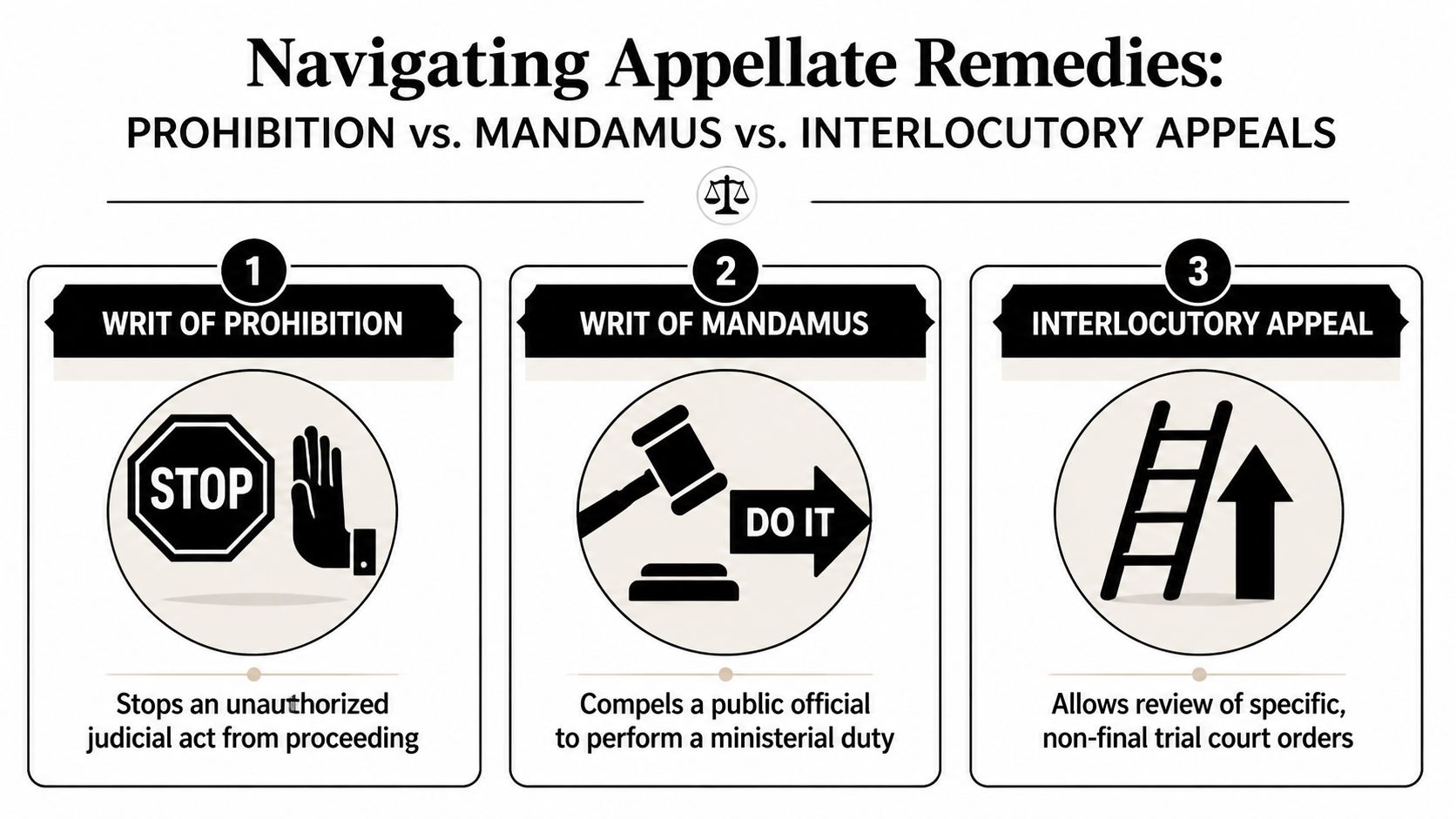
The short version
A writ of prohibition says stop.
A writ of mandamus says act.
An interlocutory appeal says review this order now because a statute allows immediate appeal before final judgment.
Side by side comparison
| Remedy | Core purpose | Timing | Typical family law use |
|---|---|---|---|
| Writ of prohibition | Prevents a lower court from taking an unauthorized action | Before the challenged act is completed | Stopping a court from entering an order it lacks authority to enter |
| Writ of mandamus | Compels a lower court or judge to perform a required act | During the case, when the court refuses a required non-discretionary act | Forcing a ruling, hearing, or ministerial action required by law |
| Interlocutory appeal | Seeks review of a specific non-final order that a statute makes appealable | After the order is signed, but before final judgment | Limited situations where Texas law expressly permits immediate appellate review |
Prohibition and mandamus are close cousins
Texas practice treats prohibition and mandamus under the same substantive standards in important ways. A prohibition writ directs a court to "refrain from doing some act," while mandamus commands a court to "do some act." Both are governed by TRAP 52, and both require a very strong showing that the complained-of action does not involve discretionary judgment, as discussed in this Texas writ analysis.
That last point is important. Family judges often do exercise discretion. They weigh evidence, assess credibility, and decide what the facts support. Extraordinary relief is usually not available just because a party disagrees with that judgment call.
If you want a fuller discussion of when a court may be asked to compel action rather than stop action, see this guide on mandamus in a Texas family law case.
A practical way to choose the right tool
Ask three questions.
Is the trial court about to do something it has no authority to do?
That points toward prohibition.Is the trial court refusing to do something the law plainly requires?
That points toward mandamus.Did the court sign a non-final order that Texas law specifically allows to be appealed now?
That points toward an interlocutory appeal.
Examples that make the distinction clearer
Example one
A court announces it intends to sign a custody modification order, but there is a serious legal argument that the court lacks authority to make that modification in this proceeding.
That is a prohibition problem because the request is to stop entry of the unauthorized order.
Example two
A judge refuses to conduct a hearing the law requires before taking action.
That may be a mandamus problem because the request is to compel the court to perform a required duty.
Example three
A party tries to challenge a temporary order by filing a regular appeal immediately, even though no statute authorizes that appeal.
That may not be an appealable interlocutory matter at all. In that setting, the appellate remedy may be unavailable, or the party may need to examine whether extraordinary relief is appropriate instead.
Practical rule: The right legal issue filed in the wrong procedural vehicle can still lose.
Why clients mix these up
People focus on the unfairness of the result. Appellate courts focus first on the type of order, the timing, the court's authority, and the available remedy. Those are different questions.
That is also why appeals are not retrials. An appeal usually reviews a written record for legal error. A writ proceeding asks whether immediate higher-court intervention is justified under strict standards. Both require careful record preparation, but they serve different purposes.
Understanding the High Standard for a Writ of Prohibition
A writ of prohibition is powerful because it is narrow. Courts reserve it for unusual situations where ordinary process is not enough.

Two ideas usually drive the analysis
First, the trial court must be about to act outside its jurisdiction or lawful authority.
Second, the complaining party must show that waiting for an ordinary appeal would not provide an adequate remedy at law.
Those ideas fit the broader role of extraordinary writs under Rule 52. Their common-law roots continue to matter in modern Texas practice. Texas family law courts handled 216,499 new cases in FY2023, the lowest since 1994, according to the Texas courts statistical report. In that environment, interlocutory challenges still matter because some errors need prompt appellate attention before a final judgment arrives.
What abuse of discretion means
Abuse of discretion does not mean "the judge ruled against me."
In plain English, it means the court acted outside the legal rules that should guide the decision. In appellate work, the question is not whether another judge might have ruled differently. The question is whether the ruling was legally unsound under the governing standards.
In family law, that can be difficult to prove because judges often have broad discretion. That is one reason writ relief is limited.
What reversible error means
A reversible error is a legal mistake serious enough to justify appellate correction. On regular appeal, the appellate court asks whether the record shows such an error and whether it affected the judgment in a meaningful way.
A writ of prohibition is different because the argument comes earlier. Instead of saying, "This completed judgment should be reversed," the party is saying, "This next act should not be allowed because it exceeds lawful authority."
Why disagreement isn't enough
People often feel a ruling was unfair because the judge accepted the other side's story, limited testimony, or made a temporary ruling that changed daily life. Those concerns may be real, but they do not automatically support prohibition.
Courts look for something more concrete, such as:
- A jurisdiction problem that makes the proposed action unlawful
- A statutory limit the court is about to ignore
- A missing adequate remedy if the party is forced to wait
A writ of prohibition is not a shortcut around an unfavorable ruling. It is a shield against unauthorized judicial action.
Standard of review and record still matter
Even in emergency proceedings, appellate courts work from the record. That means your lawyer must identify the complained-of act, tie it to the governing law, and provide the materials needed to show why intervention is justified.
That record-focused approach is a good reminder of how appellate work differs from trial work:
- Trial courts hear witnesses, receive evidence, and decide facts.
- Appellate courts review documents, transcripts, orders, and legal arguments.
- Briefing is the written argument that explains what the lower court did, why it was legally wrong, and what relief the higher court should grant.
In other words, a strong sense that "something isn't right" is the starting point. It isn't the final product. The final product must be a disciplined legal argument supported by the record.
Procedural Steps and Critical Deadlines for Filing
A writ of prohibition is all about timing. If you wait too long, the remedy may disappear.
The most important deadline is practical, not calendar-based
This writ can only prevent a future judicial act. Once the act has happened, prohibition is usually no longer the right tool. As the Cornell Legal Information Institute explains, once the lower court has disposed of the matter, "the case cannot be undone, and the writ should not be granted" in this context of prohibition practice, as summarized in Cornell's writ of prohibition overview.
That is why speed matters. If the judge is about to sign the order, set a hearing beyond the court's authority, or proceed in a way the law does not allow, you may need immediate appellate review.
What filing usually involves under TRAP 52
A Texas original proceeding generally requires careful compliance with Rule 52. While every case is different, the process commonly includes:
Preparing the petition
The petition must clearly identify the challenged act, the legal basis for relief, and the precise order the appellate court is being asked to issue.Assembling the record
Writ practice depends on the written record. That often includes certified or sworn copies of relevant pleadings, orders, and transcript excerpts.Serving all parties
Everyone involved must receive proper notice of the filing.Requesting emergency relief if needed
In fast-moving family cases, the petition may ask the appellate court to act quickly to preserve the status quo while the court considers the merits.
Why this is different from a standard appeal
A normal appeal follows a more predictable path. There is usually a notice of appeal, clerk's record, reporter's record, briefing schedule, and then consideration by the appellate court after final judgment. A writ proceeding is faster and more compressed.
That urgency is one reason people often need guidance on whether a non-final family court order should be challenged through emergency review or must wait for later review. This discussion of an interlocutory appeal in Texas family law helps show how different that path is from a prohibition petition.
Delay can be fatal
A parent may think, "I'll see what happens at the next hearing." That hesitation can close the door.
If prohibition is the right remedy, it is usually a use-it-before-it-happens remedy. Once the challenged act is complete, the strategy may need to shift to mandamus, appeal, or another form of relief depending on the posture of the case.
If you suspect the court is about to take an unlawful step, the safest assumption is that waiting may cost you the one remedy designed to stop it.
Strategic Use of Prohibition in Texas Family Law Cases
The best way to understand this remedy is to see where it may fit in real family law disputes. The common thread is not that the trial court made a hard call. The common thread is that the trial court is allegedly moving beyond what the law permits.

In child custody disputes
A parent may learn that the trial court plans to enter a custody-related order even though there is a serious question about whether that court has authority to do so. In that setting, the central issue is not who is the better parent. The issue is whether the court may legally proceed.
People often confuse prohibition with habeas corpus. They are not the same.
A writ of prohibition challenges the court's authority to act. A writ of habeas corpus in this context addresses wrongful withholding of a child based on a superior right to possession. That distinction is discussed in this explanation of habeas corpus in Texas family law.
A simple custody example
Suppose a court appears ready to modify possession in a way that raises a serious jurisdictional defect. A prohibition petition may seek to stop entry of that order. If the child is later withheld in violation of an existing right to possession, habeas corpus may become part of the picture for a different reason.
One remedy targets authority. The other targets possession.
In divorce property disputes
Property fights generate a different kind of urgency. A party's concern is more than a disagreement with how the judge views the evidence. Instead, the concern may be that the court is about to take a step it has no authority to take before the legal groundwork has been established.
Examples might include a pending judicial act that would effectively decide control over disputed property in a way that exceeds the court's present authority. In that setting, prohibition may be considered because the harm is tied to the court's power, not merely to the wisdom of the proposed ruling.
In protective order litigation
Protective order proceedings can move quickly, and that speed can create real anxiety. If the problem is that the court is about to proceed in a manner not authorized by law, an emergency appellate response may become necessary.
But this is where discipline matters. Not every harsh or painful temporary ruling qualifies. A prohibition petition is strongest when the legal error concerns authority, jurisdiction, or a clearly unauthorized step. If the complaint is instead that the judge reached the wrong conclusion based on conflicting evidence, standard appellate review may be the better path after an appealable order exists.
Common reversible errors and where they fit
Family law clients often ask whether a mistake is serious enough for appellate review. Examples of issues that may matter on appeal or in writ practice include:
Ignoring controlling law
A court may apply the wrong legal standard or fail to follow a required statutory framework.Procedural error
A party may be denied a required hearing, proper notice, or the chance to build the record.Jurisdictional overreach
The court may move to act where its authority is disputed or absent.Misuse of discretion
On ordinary appeal, a ruling may be challenged as an abuse of discretion if it falls outside guiding legal principles.
These categories overlap, but the remedy still depends on timing and posture. Some problems belong in a future appeal. Some demand immediate preventive action.
Good appellate strategy starts by asking not only "Was this unfair?" but also "What kind of unfairness was it, and what remedy fits it right now?"
Why the record is everything
A seasoned appellate lawyer does not file a prohibition petition based on outrage alone. The lawyer looks for the paper trail and transcript support that show exactly what the trial court is about to do and why the law forbids it.
That includes attention to:
- The order or proposed order
- The hearing transcript
- The pleadings framing the issue
- The statute or rule the court is allegedly exceeding
- The absence of an adequate remedy later
This is also why appeals differ from trials in a practical sense. Trial counsel develops testimony and evidence in real time. Appellate counsel studies what is already in the record and asks whether legal error appears there clearly enough to support relief.
When You Must Consult a Texas Appellate Attorney
Some family court mistakes can wait for appeal. A potential writ of prohibition usually can't.
The warning signs are usually procedural
You should seek immediate appellate guidance if you believe:
- The court is about to sign an order it has no authority to sign
- A hearing is moving forward despite a serious jurisdiction problem
- The judge is taking a step that cannot be fixed adequately after final judgment
- You are being told to "wait and appeal later," but the harm will happen now
These are not routine questions. They involve the intersection of family law, appellate procedure, and emergency strategy.
Why specialized counsel matters
Original proceedings under Rule 52 are technical and unforgiving. The petition must be drafted correctly. The record must be assembled quickly. The legal theory must match the remedy. A smart argument brought too late, or in the wrong procedural form, may fail regardless of how unfair the situation feels.
That is why many trial lawyers and clients turn to lawyers who focus on appellate work. If you need help evaluating whether your case calls for prohibition, mandamus, or a standard appeal, a Texas family law appeal attorney can assess the posture of the case, the available record, and the likely path forward.
Fairness in family court often depends on fast action
There is a calm way to respond to an urgent legal problem. It starts with identifying the exact act the trial court is about to take, the rule or statute that limits that act, and whether any ordinary remedy would fix the harm later.
If those pieces line up, prohibition may be the right tool. If they don't, another appellate route may be the better answer.
If you believe the court made a mistake in your family law case, our appellate attorneys can help you seek a fair outcome. Contact The Law Office of Bryan Fagan, PLLC today for a free consultation.