If you are facing a final order on spousal support, you may feel your case was handled unfairly. It’s a stressful position, but a trial court’s decision doesn’t have to be the final word. The Texas legal system provides a clear path to seek justice when a judge makes a significant legal mistake. Understanding the rules that govern spousal support is the first step toward evaluating whether an appeal can restore fairness to your case.
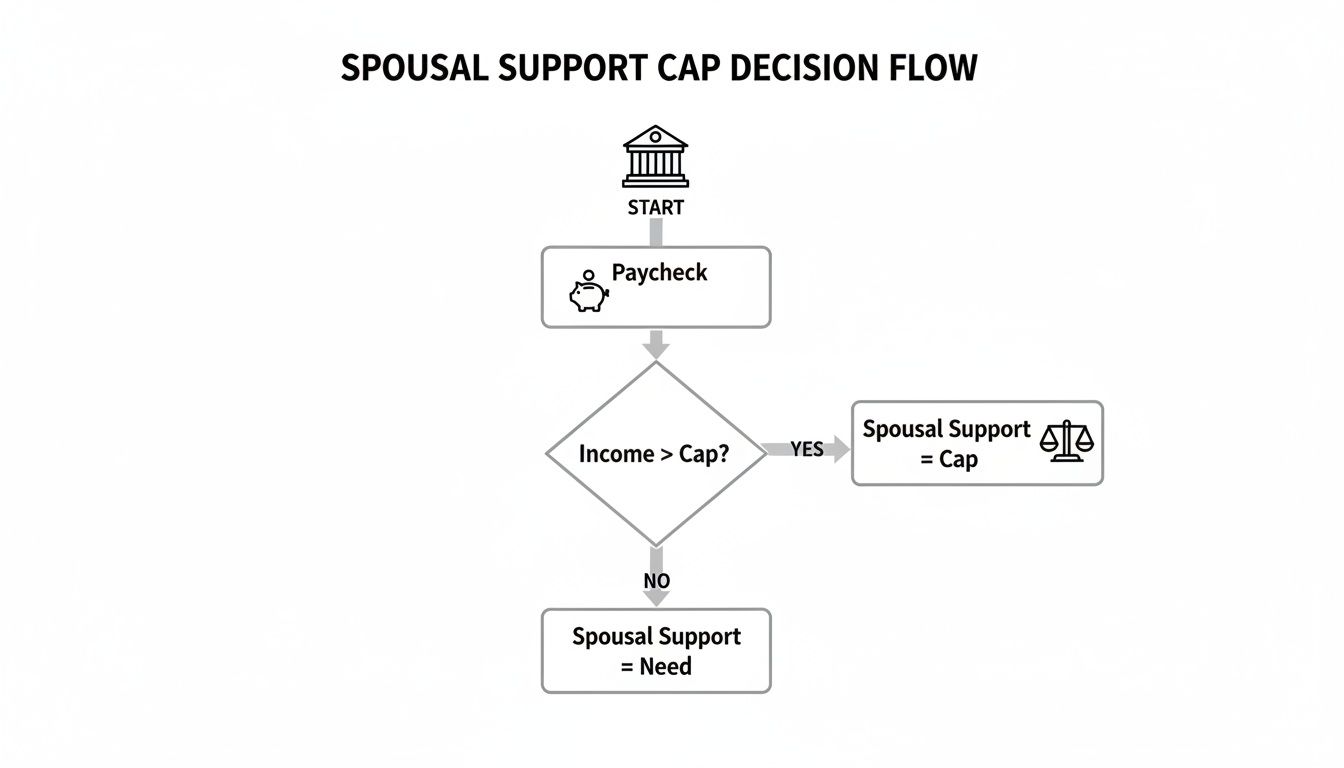
Texas law puts firm limits on spousal support. A court cannot simply choose an arbitrary number; the maximum award is strictly capped at either $5,000 per month or 20% of the paying spouse’s average monthly gross income—whichever is less. This rule exists to ensure financial obligations are predictable and fair. When a judge misapplies this rule, it can be grounds for a successful appeal.
Understanding the Standard of Review for Spousal Support
In Texas, spousal maintenance is intended to provide temporary, rehabilitative support. It is not designed to create a lifelong dependency. The court’s goal is to offer a short-term financial bridge, giving a lower-earning spouse the time and resources needed to gain the skills or education to meet their own “minimum reasonable needs.” When a court order goes beyond this purpose, it may be legally incorrect.
An appeal is not a second chance to re-argue the facts of your case. Instead, it is a focused review of the trial record to determine if the judge made a significant legal error. The appeals court examines the trial judge’s decision through a specific legal lens called the standard of review. For most spousal support decisions, this standard is “abuse of discretion.”
Abuse of Discretion: This legal term means the trial judge made a decision that was unreasonable, arbitrary, or completely disconnected from guiding legal rules. A judge commits an abuse of discretion by ignoring statutory caps, miscalculating income, or ordering support for a duration longer than the law allows.
This standard is critical because it allows an appellate court to correct orders that are not based on a proper application of the Texas Family Code.
The Statutory Caps Explained
The legal limits on spousal support are a critical safeguard. They prevent a judge from ordering an amount that would be an impossible financial burden. The Texas Family Code is very specific: the maximum maintenance award is the lesser of $5,000 per month or 20% of the paying spouse’s average monthly gross income.
This structure ensures payments remain manageable. It’s also important to remember that courts don’t just look at income; they also consider the property each spouse receives in the divorce when tailoring the final amount to the recipient’s actual needs.
Let’s look at how this plays out in practice.
The table below shows how the maximum possible award is calculated based on different income levels. Remember, the final award can never exceed $5,000 per month, no matter how high the income is.
Spousal Maintenance Caps in Texas at a Glance
| Paying Spouse’s Average Monthly Gross Income | 20% Calculation | Statutory Cap ($5,000) | Maximum Possible Monthly Maintenance |
|---|---|---|---|
| $10,000 | $2,000 | $5,000 | $2,000 |
| $15,000 | $3,000 | $5,000 | $3,000 |
| $25,000 | $5,000 | $5,000 | $5,000 |
| $35,000 | $7,000 | $5,000 | $5,000 |
As you can see, once 20% of the gross monthly income hits the $5,000 ceiling, the cap takes over. These figures represent the maximum possible awards—not a guarantee. A judge should award an amount based on a full review of the facts, which often results in a lower figure.
When Legal Limits Are Misapplied
Even though the rules seem straightforward, trial courts can and do make mistakes. A judge might miscalculate the paying spouse’s gross income, fail to properly factor in the assets awarded in the property division, or ignore evidence that shows the receiving spouse can already meet their own needs.
An error like this isn’t just unfair—it can be a reversible error.
Reversible Error: A legal mistake made by a trial court that is so significant it likely led to an incorrect judgment. Misapplying the statutory caps on spousal maintenance is a classic example of a reversible error that can be corrected on appeal.
If you believe the court got the spousal support calculation wrong in your divorce decree, you have the right to challenge that decision. Our guide on what is spousal support in Texas digs deeper into the foundational rules that courts must follow.
What You Can Appeal in a Spousal Support Ruling
You may feel the spousal support decision in your case was fundamentally wrong—either you were unfairly denied support or your ex-spouse received an award they did not legally qualify for. Before a Texas judge can even consider a dollar amount, they must determine if the spouse requesting support is eligible under the Texas Family Code.
Spousal maintenance isn’t an automatic right in Texas. The law sets high hurdles, and if they are not cleared, an award of support is improper. If a trial court gets these eligibility rules wrong, it’s not just unfair—it’s a legal error that can be corrected on appeal. This isn’t about getting a second chance to argue the same facts; it’s about ensuring the court followed the law.
The Law Starts with a Presumption Against Maintenance
Texas law operates on a powerful starting point called a rebuttable presumption. In plain English, this means the court begins with the assumption that spousal maintenance is not necessary. The burden falls entirely on the person asking for support to prove otherwise.
To overcome this presumption, the requesting spouse must prove two key things:
- After the divorce, they will not have enough property (including their share of the marital estate) to provide for their own minimum reasonable needs.
- They also fit into one of the specific eligibility scenarios laid out in the Texas Family Code.
If they cannot prove both points with sufficient evidence, the judge cannot legally award maintenance. A judge who awards support without this required proof has committed a reversible error.
Proving Eligibility in Court
Once a spouse has demonstrated they cannot meet their own basic needs, they still must prove one of the following situations applies:
- The 10-Year Marriage Rule: The marriage lasted for 10 years or more, and the spouse asking for support has made a diligent effort to earn sufficient income or to develop necessary skills to become self-supporting.
- Disability: The requesting spouse has an incapacitating physical or mental disability that prevents them from earning a sufficient income.
- Caring for a Disabled Child: The spouse is the primary caregiver for a child of the marriage (of any age) who has a physical or mental disability requiring substantial care, which prevents the parent from working.
- Family Violence: The other spouse was convicted of (or received deferred adjudication for) an act of family violence against the spouse or their child within two years of filing for divorce or while the divorce was pending.
This flowchart breaks down how a court analyzes these key decision points.
The path to receiving maintenance is narrow and strictly defined. These rules are a major reason why court-ordered spousal support is relatively uncommon in many Texas family law cases.
Common Reversible Errors in Eligibility Rulings
From an appellate perspective, a trial court’s failure to correctly apply these rules creates grounds for a challenge. A judge commits a reversible error if they:
Ignore the rebuttable presumption and award maintenance without sufficient evidence. A judge cannot award support because it “feels fair.” The law demands that the requesting spouse prove their case based on the specific requirements in the Texas Family Code.
Other common errors include awarding maintenance in a marriage shorter than 10 years without a finding of family violence or disability, or failing to consider whether the receiving spouse truly made a diligent effort to find work. If a mistake like this happened in your case, an appeal may be the most effective way to seek a fair and legally correct outcome.
How Judges Calculate Spousal Support Amounts and Duration

Once a judge determines a spouse is eligible for maintenance, the focus shifts to two critical questions: how much and for how long? It is common to feel that the final amount in your decree was decided without a true appreciation for the facts of your case.
Texas law requires a detailed, factor-by-factor analysis to arrive at a fair outcome. If the court ignored key evidence or misapplied these factors, its final order could be legally flawed and subject to appeal.
Factors That Influence the Final Amount
The statutory cap is the absolute ceiling. A Texas judge cannot award more than the lesser of $5,000 per month or 20% of the paying spouse’s average monthly gross income. The final award is almost always lower than this maximum, tailored to the unique circumstances of the family.
To determine that amount, a judge must weigh all relevant factors, including:
- Each spouse’s financial resources after the divorce, including the property and assets awarded to each person.
- The education and employment skills of both spouses and the time necessary for the requesting spouse to obtain training to become self-sufficient.
- The length of the marriage.
- The age, employment history, earning ability, and physical and emotional condition of the spouse seeking support.
- Contributions as a homemaker, recognizing the non-financial value a stay-at-home parent brings to a marriage.
- Any marital misconduct, such as adultery or cruelty, by either spouse.
- Acts of family violence.
A judge’s failure to properly consider this evidence can lead to an award that is legally unsound and vulnerable on appeal.
Duration: How Long Spousal Support Lasts
One of the clearest errors a trial court can make is ordering spousal support for an incorrect duration. Texas law is incredibly specific about how long maintenance can last. These time limits are strict legal boundaries tied directly to the length of the marriage.
Fewer than 10% of Texas divorces involve court-ordered maintenance, partly because of these strict limitations. Under the Texas Family Code, payments are capped based on marriage length and automatically terminate if the receiving spouse remarries or cohabitates with a romantic partner. For more on how these orders work, you can gain insights by reading about temporary vs. ongoing spousal support.
The table below breaks down these maximum payment periods.
Maximum Duration of Spousal Maintenance by Marriage Length
This table outlines the maximum period a person can receive spousal maintenance in Texas, directly tied to the length of the marriage, according to the Texas Family Code.
| Length of Marriage | Maximum Duration of Payments |
|---|---|
| Less than 10 years (with family violence) | Up to 5 years |
| 10 years to less than 20 years | Up to 5 years |
| 20 years to less than 30 years | Up to 7 years |
| 30 years or more | Up to 10 years |
These are the maximums, not guarantees. The court often awards maintenance for a shorter period.
A critical exception exists: if a spouse is unable to be self-supporting due to an incapacitating disability or is the caretaker for a disabled child of the marriage, maintenance can be ordered for as long as those eligibility requirements are met, potentially indefinitely.
Miscalculations and Grounds for Appeal
When a judge orders maintenance for a period longer than the law allows, it is not just an unfair decision—it is a clear reversible error. This is not a matter of judicial opinion; it is a direct violation of a state statute.
For instance, if a couple was married for 18 years, a judge cannot order spousal maintenance for seven years. The absolute maximum allowed by law is five years. Ordering even one month beyond that limit is a legal mistake that an appellate court can correct.
Similarly, if a judge ignores a spouse’s significant separate property or clear earning potential when setting the amount, that could also be an abuse of discretion. These are precisely the types of errors our appellate attorneys are trained to identify when reviewing a trial record. Understanding how much spousal support in Texas is determined by these strict rules is the first step in evaluating whether you have a strong case for an appeal.
Challenging an Unfair Spousal Support Order Through an Appeal
When a judge hands down a decision on spousal support that feels profoundly unfair, it’s easy to feel like the system has failed you. That frustration is understandable, but it is critical to know that the trial court’s order doesn’t have to be the final word. The Texas legal system provides a specific process for these situations: an appeal.
An appeal is not a new trial. You cannot introduce new evidence or make arguments you forgot to make the first time. Instead, it is a focused, strategic review of the trial record—everything from court transcripts to exhibits—to find significant legal errors the judge made.
The Texas Appeals Process: A Step-by-Step Overview
Appealing a family law order follows a structured path governed by the Texas Rules of Appellate Procedure.
- Filing the Notice of Appeal: The process begins by filing a Notice of Appeal. This must typically be done within 30 days of the final judgment being signed. Missing this strict deadline can permanently forfeit your right to appeal.
- Preparing the Appellate Record: Next, the official record is prepared. This includes the Clerk’s Record (all documents filed in the case) and the Reporter’s Record (the word-for-word transcript of the trial). The appellate court can only consider what is in this record.
- Briefing: This is the core of the appeal. Attorneys write persuasive legal arguments, known as briefs, for the appellate court. The brief identifies the trial court’s reversible errors, cites relevant laws and prior case decisions, and explains why the judgment should be reversed.
This methodical process is designed to ensure that Texas law was applied correctly and fairly in your case.
Common Reversible Errors in Spousal Support Cases
When we review a case for appeal, we are looking for specific, outcome-determinative errors. In spousal support orders, these mistakes often fall into clear categories where the judge’s decision directly contradicts the Texas Family Code.
Some of the most common reversible errors we see include:
- Miscalculating Gross Income: The judge incorrectly calculated the paying spouse’s average monthly gross income, resulting in an award that illegally exceeds the 20% statutory cap.
- Ignoring Statutory Factors: A judge is required by law to consider a list of factors when deciding the amount and duration of support. If the court ignores crucial evidence—like a spouse’s ability to support themselves—it can be an abuse of discretion.
- Exceeding Duration Limits: This is one of the most straightforward errors. Ordering maintenance for longer than the law permits based on the marriage’s length is a clear legal mistake. For example, awarding seven years of support after a 15-year marriage is legally improper.
- Improperly Finding Eligibility: A judge awards maintenance even though the requesting spouse never proved they met the strict eligibility criteria, such as the 10-year marriage rule or an exception like family violence.
If you are concerned about an unjust outcome, learning more about the rules for alimony in Texas can help clarify what a legally sound order should look like. Identifying these kinds of mistakes is the first step in building a strong appellate strategy to restore fairness.
Navigating the Texas Family Law Appeals Process

The thought of challenging a judge’s decision can feel daunting, particularly after you’ve just endured the stress of a divorce trial. But appealing a spousal maintenance order isn’t some mysterious, endless process. It’s a structured, methodical review designed to answer one crucial question: did the trial court apply the law correctly?
Think of it as a roadmap. There are specific steps and strict deadlines, but with an experienced guide, it’s a path you can navigate with confidence. This section will walk you through that journey, demystifying the process so you can see it for what it is—a strategic opportunity to seek a just result.
The First Step: The Notice of Appeal
Everything starts with a single, time-sensitive document: the Notice of Appeal. This is the official starting gun for the entire appellate process. It’s a formal declaration to the court and the other side that you intend to challenge the final judgment.
Here’s the critical part: the deadline is non-negotiable. According to the Texas Rules of Appellate Procedure, you typically have only 30 days from the day the final judgment is signed to get this filed. While certain post-judgment motions can extend this window to 90 days, you should never count on that extra time. If you miss this deadline, your right to appeal is usually lost for good, no matter how flawed the original ruling might have been.
An appeal is governed by strict, unforgiving deadlines. The very first one—filing the Notice of Appeal—is arguably the most important. Timely action is absolutely essential to preserve your right to seek a fair outcome.
Assembling the Appellate Record
Once the notice is filed, the next job is to gather the appellate record. This is the complete collection of everything the appeals court judges will see. They weren’t in the courtroom with you, so this record becomes their entire world. Crucially, no new evidence can be introduced; the appeal is decided only on what’s in this record.
The appellate record is made up of two key components:
- The Clerk’s Record: This is a compilation of all the official documents filed in your case—the original divorce petition, motions, discovery responses, and the final order itself.
- The Reporter’s Record: This is the official, word-for-word transcript of the trial. Every question, every answer, every objection, and every ruling from the judge is captured here by the court reporter.
Our appellate team will comb through every page of this record, looking for the specific legal errors that can form the basis of a successful appeal.
The Heart of the Appeal: The Briefing Stage
With the record in hand, we move to the most critical phase: briefing. This is where the real legal fight on appeal happens. A brief isn’t just a summary of events; it’s a meticulously crafted legal argument written directly for the appellate judges, designed to persuade them that a mistake was made.
Briefing: The formal process of submitting written legal arguments to the appellate court. The appellant’s brief outlines the trial court’s errors, and the appellee’s brief defends the court’s decision. This written advocacy is often the most important part of an appeal.
In our brief, we will:
- Pinpoint the exact reversible errors made by the trial judge.
- Support our position with relevant Texas statutes and caselaw (decisions from past appellate cases).
- Clearly explain how the judge’s mistake directly harmed you and resulted in an unjust outcome.
The other side gets a chance to respond with their own brief, arguing why the trial court’s decision was correct. We then usually file a final “reply brief” to counter their points. This back-and-forth written debate is where appeals are most often won or lost, making the skill and precision of the legal writing paramount.
Common Questions About Texas Spousal Support
Once the ink is dry on a divorce decree, you might think all the questions are settled. But when it comes to spousal support, that’s often when new uncertainties pop up. Whether you’re receiving support or paying it, you might be wondering if the initial court order was fair and what happens next.
Let’s walk through some of the most common questions we hear from clients after a divorce is finalized. Getting a handle on these key concepts is the first step toward making sure you have a fair outcome, whether that means modifying an order, enforcing it, or even appealing it.
Can Spousal Support Be Changed After the Divorce?
Yes, but it’s not a simple process. A court will only agree to modify a spousal maintenance order if the person asking for the change can show there has been a “material and substantial change” in circumstances for either party. This isn’t a small thing—think a major life event like an involuntary job loss for the person paying, or a sudden disability affecting the person receiving support.
One critical thing to remember is that any change only applies moving forward. The court can’t go back in time and adjust payments that were already due.
What’s the Difference Between Contractual Alimony and Spousal Maintenance?
This is one of the most important—and often misunderstood—distinctions in Texas family law. Spousal maintenance is what a judge orders one spouse to pay the other. It’s strictly governed by the Texas Family Code, which puts firm caps on how much can be paid and for how long.
Contractual alimony, however, is something entirely different. It’s a voluntary agreement made between the two spouses, usually as part of their divorce settlement. Because it’s a private contract, it doesn’t have to follow the state’s strict limits. But the trade-off is that it generally can’t be modified by a court later unless the original agreement specifically says it can be.
Think of it this way: Court-ordered maintenance can be enforced with the threat of contempt of court (including jail time). Contractual alimony is enforced like any other private debt, which is a much different legal process.
How Does Our Property Division Affect Spousal Support?
The property and assets you walk away with after a divorce are directly tied to any spousal support decision. A judge’s main goal is to make sure the spouse asking for help can meet their “minimum reasonable needs.”
If the assets you receive—like the house, a portion of a 401(k), or investment accounts—are enough to meet those needs on their own, a judge legally cannot order spousal maintenance. In fact, a judge’s failure to properly account for the property division is one of the most common reasons spousal maintenance awards get overturned on appeal.
What If My Ex Stops Paying?
If your ex-spouse is ignoring a court order to pay spousal maintenance, you have powerful tools at your disposal. You can go back to court and file an enforcement action.
A judge can force your ex to pay everything they owe, often with interest, and can even order them to cover your attorney’s fees. Because they violated a direct court order, they can be held in contempt, which could mean fines or even jail time until they get caught up on the payments.
If you believe the court made a mistake in your family law case, our appellate attorneys can help you seek a fair outcome. Contact The Law Office of Bryan Fagan today for a free consultation. Our experienced team, led by a family law appeal attorney who is Board-Certified in Family Law and Civil Appellate Law, is ready to evaluate your case and explain your options for seeking justice through the appeals process. https://familylawcourtappeals.com