If you've received a final custody order that feels unjust, you may be feeling frustrated and powerless. You presented your case, shared your story, and yet the judge’s decision seems to ignore the reality of your family's life. It is a deeply disheartening experience, but it is critical to know that a trial court’s ruling is not always the final word. The Texas appellate process exists to correct legal errors and ensure that justice is served.
An appeal is not a second chance to argue the facts or a do-over of your trial. Instead, it is a focused, strategic review of the trial court record to determine if the judge made a significant legal mistake that led to an unfair outcome.
What is "Shared Custody" in Texas Family Law Appeals?

Before you can challenge an unfair custody order, it is essential to understand the language the courts use. In Texas, the term "shared custody" is legally known as a Joint Managing Conservatorship. While this sounds complex, the principle is straightforward: the Texas Family Code presumes that it is in a child’s best interest for both parents to share in the rights and duties of raising them.
However, "joint" does not automatically mean a 50/50 split of parenting time. Custody is divided into two parts:
- Conservatorship: The legal rights and responsibilities to make major decisions for your child.
- Possession and Access: The physical custody schedule that dictates when the child is with each parent.
An appeal might challenge errors in one or both of these areas. For instance, a judge may have correctly named you a Joint Managing Conservator but made a legal error by ordering a possession schedule that is not in your child’s best interest.
Plain-English Definitions for Texas Custody Appeals
Understanding these key terms is the first step in identifying potential errors in your case.
| Legal Term | Plain-English Definition | Why It Matters in an Appeal |
|---|---|---|
| Conservatorship | Your legal rights as a parent. | A judge stripping you of a key parental right without sufficient evidence may be a reversible error. |
| Joint Managing Conservatorship | The default Texas arrangement where both parents share decision-making. | If the court names one parent a Sole Managing Conservator without proper legal grounds, it is a strong basis for appeal. |
| Possession and Access | The visitation schedule. | An order that deviates from the standard schedule without a clear, evidence-based reason could be an abuse of discretion. |
| Primary Conservator | The parent who establishes the child's primary residence. | This designation carries significant weight, and if it was granted based on an error of law or fact, it can be challenged. |
| Reversible Error | A legal mistake by the trial judge that was serious enough to cause an incorrect outcome. | This is what you must prove to win an appeal. It’s not about disagreement; it’s about a legal breakdown. |
| Abuse of Discretion | The legal standard for most custody appeals. It means the judge’s decision was arbitrary or lacked sufficient evidentiary support. | Proving the judge abused their discretion is the key to demonstrating a reversible error occurred. |
The “Best Interest of the Child” Standard in Appeals
Every decision a Texas judge makes in a custody case must be guided by one principle: the best interest of the child. This is not a vague suggestion; it is the legal standard. To determine what is in a child’s best interest, courts consider the Holley factors, which include:
- The child’s emotional and physical needs.
- The stability of each parent’s home.
- Each parent’s ability to act as a parent.
- Any history of family violence or substance abuse.
If a judge’s final order seems to contradict clear evidence related to these factors, it may signal an abuse of discretion. An appeal is a highly focused legal challenge designed to prove that the trial court made specific mistakes that led to an unjust outcome for you and your child. When a court misapplies the law or ignores critical evidence, the appellate process provides a path toward a fair resolution for your child custody case.
Conservatorship vs. Possession: Finding the Error in Your Order

When you receive a custody order that feels fundamentally unfair, the key to challenging it is to pinpoint exactly where the legal error occurred. In every Texas shared custody case, the court’s order addresses two distinct areas: conservatorship (your legal rights) and the possession order (your parenting time schedule).
A judge can make a reversible error in one part of the order while getting the other part correct. Differentiating between the two is the first step in building a strong foundation for an appeal.
Conservatorship: Challenging Errors in Your Parental Rights
Conservatorship is your legal authority—your power to make critical decisions about your child’s upbringing. Even in a Joint Managing Conservatorship, rights are not always divided equally. A judge assigns specific rights, and if that allocation is legally improper or unsupported by evidence, it may be grounds for an appeal.
Key conservatorship rights that can be subjects of an appeal include:
- The right to make decisions about education or healthcare.
- The right to determine the child’s primary residence (often with a geographic restriction).
- The right to consent to psychological treatment.
If a judge limited or removed one of your fundamental parental rights without clear evidence in the record to justify it, that decision could be an abuse of discretion. This is a specific type of legal error that an appellate court has the authority to correct.
Possession Schedules: When the Calendar Itself is a Legal Error
While conservatorship covers your legal rights, the possession order is the practical, day-to-day schedule. It details the specific days, holidays, and summer weeks your child will spend with each parent.
Texas law provides a default schedule called the Standard Possession Order (SPO), which is presumed to be in the child's best interest. This order typically gives the non-primary parent possession on the first, third, and fifth weekends of a month, and splits holidays and summer vacation. An Expanded Standard Possession Order (ESPO), which adds midweek overnights, is often required if requested and feasible. You can learn more about how courts should apply the Standard Possession Order in Texas and when deviations are permitted.
This presumption is a powerful legal tool in an appeal. If a judge ordered a highly restrictive or customized schedule that departs significantly from the standard, they must state a specific, evidence-based reason in the record. An arbitrary schedule that is not justified by the facts of the case may be a reversible error.
Understanding the Standard of Review in Custody Appeals

When you appeal a custody decision, the appellate court does not rehear the case. Its only job is to review the trial record to see if the judge made a legal mistake. To do this, it uses a legal benchmark called the standard of review.
In nearly all Texas shared custody appeals, the standard is "abuse of discretion." This is a high hurdle. To succeed, we must prove that the trial judge's decision was arbitrary, unreasonable, or made without any consideration of the guiding legal rules and principles.
An abuse of discretion occurs when a judge:
- Makes a ruling without sufficient evidence to support it. For example, restricting a parent’s access based on an unproven allegation.
- Misapplies the law to the facts of the case. For instance, failing to apply the legal presumption that a Standard Possession Order is in the child’s best interest.
Proving this requires an exhaustive review of the trial transcript and all evidence submitted. The goal is not merely to show disagreement with the outcome but to demonstrate that the decision-making process itself was legally flawed.
What is a "Reversible Error"?
Not every mistake a judge makes is grounds for reversal. The error must be a "reversible error," meaning it was so significant that it probably caused an improper judgment. In other words, but for the error, the outcome of your case likely would have been different.
Examples of common reversible errors in shared custody cases include:
- Improperly excluding crucial evidence that would have demonstrated your fitness as a parent.
- Ignoring undisputed evidence of the other parent’s instability or substance abuse.
- Misinterpreting the Texas Family Code regarding conservatorship or possession schedules.
Our role as appellate attorneys is to meticulously search the record for these foundational errors and build a compelling legal argument—known as a brief—that explains to the appellate court precisely how the trial judge’s mistake led to an unjust result.
Even though Texas law favors joint managing conservatorship, statistics show that fathers often receive far less than 50% of possession time. According to recent divorce and custody statistics, this disparity highlights that trial court outcomes can diverge significantly from legal ideals. When that divergence is caused by a legal error, an appeal is the designated path to seek a fair and just correction.
Common Reversible Errors in Texas Shared Custody Appeals
When a judge issues a custody order that feels deeply wrong, it’s natural to feel like they just didn't see things your way. But a custody appeal isn't a do-over or a chance to re-argue your case. It’s about finding and proving that the trial judge made a significant legal mistake.
These game-changing mistakes are called reversible errors. They aren't minor slip-ups; they're errors so serious that they likely led to an unjust outcome. To have any shot at overturning a Texas shared custody order, you must prove one of these occurred. Understanding the intricate procedures of appellate law is the first critical step in this challenging process.
Ignoring Credible Evidence
One of the most frequent reasons for an appeal is when a trial court seems to have completely ignored credible, important evidence that was presented correctly. A judge's decision can't be based on a whim or personal bias; it must be grounded in the facts and evidence from the trial.
For instance, say you submitted a mountain of evidence—report cards, testimony from teachers, and reports from a child counselor—all showing you provide a stable, loving home. But the judge, with no clear reason, gives the other parent primary custody, even though they have documented instability. That’s a red flag. The appellate court will scrutinize the record to determine if the judge’s ruling was an abuse of discretion, meaning it had no rational basis in the evidence presented.
Misapplying Texas Law
Judges don't get to make up the rules as they go. They are bound by the Texas Family Code, and when they get the law wrong, it opens the door for an appeal.
A classic example involves the strong legal presumption for a Joint Managing Conservatorship. Texas law starts with the belief that it’s in a child's best interest for both parents to share rights and duties. If a judge makes one parent a Sole Managing Conservator without solid proof of family violence, substance abuse, or extreme conflict making co-parenting impossible, that decision flies in the face of the law. This isn't a judgment call; it's a legal error.
The same principle applies to geographic restrictions. If a court imposes a ridiculously small geographic area without evidence showing it’s necessary for the child, or fails to create one when there’s a clear flight risk, the decision may be legally flawed and appealable.
Improperly Excluding Key Testimony
The Texas Rules of Evidence dictate what a judge is allowed to hear and consider. If a judge mistakenly blocks critical testimony that could have swayed the outcome, that’s a major problem.
Imagine you had a qualified child psychologist ready to testify about the damaging effects of parental alienation they had observed firsthand. Our guide on Texas parental alienation details just how destructive this behavior is for a child. If the trial judge wrongly refused to let that expert take the stand, an appellate court could decide this error prevented the court from hearing vital information needed to truly act in the child’s best interest.
Despite progressive laws, Texas child custody statistics show gender disparities hang on. Fathers get, on average, just 33% of parenting time—nearly identical to the U.S. average of 35%. This reality shatters the myth that joint conservatorship always means 50/50 time. For parents hit with trial errors, like having solid evidence of their fitness ignored, an appeal is often the only path to justice. You can see more on these trends in these divorce and custody statistics.
Spotting these kinds of errors isn’t easy. It requires a deep dive into every page of the trial transcript, every exhibit, and every motion filed. Our appellate attorneys live in this world of detail, piecing together the evidence to build a compelling argument that shows exactly how a trial court's mistake led to a harmful result for you and your child.
An Overview of the Texas Custody Appeal Process
If you believe a judge made a serious legal error in your Texas shared custody case, the Texas Rules of Appellate Procedure provide a structured path for review. This is not a new trial; it is a formal, deadline-driven process focused entirely on the existing record from the trial court. Understanding this step-by-step procedure is essential to restoring balance and seeking a fair outcome.
Step 1: Filing the Notice of Appeal
The appellate process begins the moment the judge signs the final order. From that date, you typically have a strict 30-day deadline to file a Notice of Appeal. This document formally notifies the courts and the opposing party of your intent to challenge the ruling. Missing this deadline can permanently forfeit your right to appeal. Properly understanding how to file court documents is the first critical step.
Step 2: Preparing the Appellate Record
The court of appeals can only review what happened in the trial court. Therefore, the next step is to assemble the official appellate record, which consists of two parts:
- The Clerk’s Record: A compilation of all documents filed in your case.
- The Reporter’s Record: The word-for-word transcript of all testimony and statements made during hearings and the trial.
This record is the entire universe for your appeal. Our job is to meticulously analyze these documents to identify the reversible errors.
Step 3: Drafting the Appellate Brief
This is the core of the appeal. The appellant's brief is a formal, written legal argument that lays out the facts of the case, identifies the trial judge's errors, and uses case law and statutes to explain why the decision must be overturned. A well-crafted brief tells a persuasive story grounded entirely in the record. A key component of this is learning how to write a compelling Statement of Facts, which sets the stage for the entire legal argument.
After we file our brief, the other side files a response, and we may file a final reply.
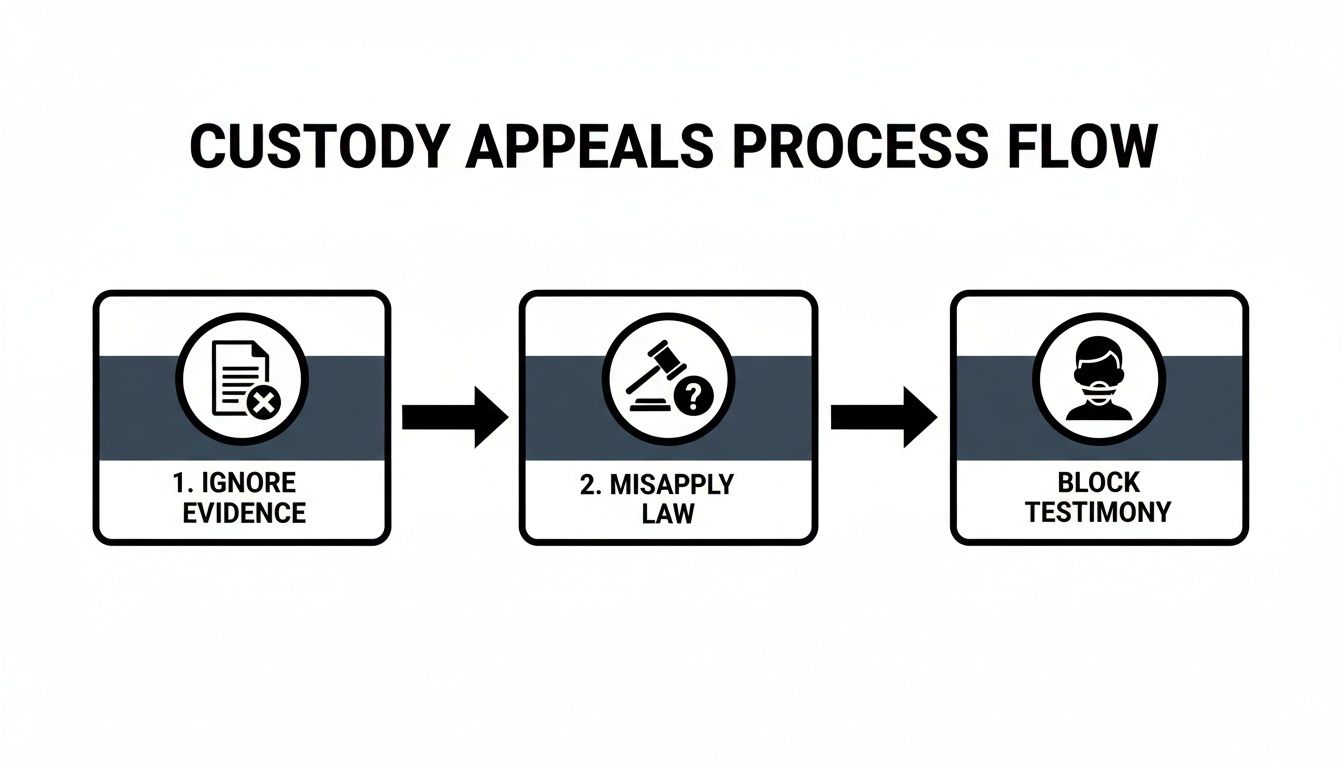
As the chart illustrates, common reversible errors—like the court ignoring key evidence or misapplying the Texas Family Code—disrupt the legal process and lead to unjust outcomes that an appeal is designed to correct.
Step 4: Oral Argument and Final Decision
In some cases, the court of appeals will schedule an oral argument. This allows attorneys to present their case directly to a panel of appellate justices and answer their questions. Afterward, the court will issue a written opinion that either affirms the trial court's decision, reverses it, or sends the case back to the trial court with specific instructions.
Your Questions Answered: Navigating a Texas Shared Custody Appeal
When a judge’s custody decision feels wrong, the future can look uncertain and overwhelming. The idea of an appeal might seem daunting, but getting a handle on the process is the first step toward clarity and control. Let's walk through some of the most pressing questions we hear from parents in Texas who are thinking about appealing a shared custody order.
Our aim here is to give you clear, direct answers so you can understand your options and feel confident about your next move.
How Long Do I Have to Appeal a Texas Custody Order?
This is critical: the deadlines for filing a family law appeal in Texas are brutally strict. In nearly all situations, you have only 30 days from the day the judge signs the final order to file what’s called a Notice of Appeal.
If you miss that 30-day window, your right to challenge the court's decision is usually gone for good. This is precisely why it’s so important to speak with an appellate lawyer the moment you get a ruling you believe is wrong. We can move fast to protect your rights and start the crucial work of digging into your case.
Can I Change My Custody Order Without an Appeal?
Yes, but it's an entirely different legal route. You can always go back to the original trial court and ask to modify the order. To do that, you'd file a "Petition to Modify" and have to prove that there's been a material and substantial change in circumstances for the child or one of the parents since the last order was signed.
An appeal isn't about new circumstances. An appeal argues that the original order was legally flawed from the very beginning because the judge made a reversible error during the process. Think of it this way: a modification says "things are different now," while an appeal says "the judge got it wrong then."
What Are the Chances of Winning a Custody Appeal?
Winning an appeal is tough, and it all boils down to one thing: can you prove the trial judge made a significant legal error that harmed your case? It’s not a do-over where you ask the appellate judges to simply disagree with the trial judge's call. The question is whether the judge abused their discretion or got the law wrong.
Success depends entirely on a fine-toothed-comb review of the trial record and crafting a powerful legal argument in the appellate brief. While no lawyer can ever guarantee a result, a consultation with an appellate specialist will give you a straight-shooting assessment of your case's strengths and weaknesses.
Can I Get a 50/50 Possession Schedule in Texas?
It's a common point of confusion. Texas law presumes that naming both parents as Joint Managing Conservators (giving them shared rights and duties) is best for the child. However, the law does not presume that a 50/50 possession schedule is automatically in the child's best interest.
That said, judges can and often do order 50/50 schedules. It all comes down to the evidence. If you can show that it's the best setup for your child, it’s absolutely possible.
- Factors that help your case for 50/50 include:
- Parents living close by, ideally in the same school district.
- A track record of cooperative and respectful co-parenting.
- Work schedules that realistically support an equal time split.
If you put on strong evidence supporting a 50/50 plan and the judge shot it down without a good, evidence-based reason, that decision could potentially be an abuse of discretion—and a valid basis for an appeal.
If you believe the court made a mistake in your family law case, our appellate attorneys can help you seek a fair outcome. Contact The Law Office of Bryan Fagan today for a free consultation at https://familylawcourtappeals.com.