You may feel your case was handled unfairly or that the judge’s final order is fundamentally wrong. When a Texas family court decision feels like an injustice, it can leave you feeling powerless, especially when it involves your children or your financial future. This is not the end of the road. An appeal is a powerful legal tool designed to correct significant errors made by a trial court, and skilled Texas family law appeals lawyers are the advocates who can guide you through this complex process.
Why You May Need a Family Law Appeals Lawyer
It is natural to believe the judge did not fully understand your side of the story or see the facts your way. While those feelings are valid, a Texas appeal is not a second chance to present your case. It is a meticulous review process where a higher court—the court of appeals—examines the trial court’s record to determine if a serious legal mistake was made. These mistakes are called “reversible errors,” and identifying them is the foundation of a successful appeal.

This is where an appellate lawyer's role is fundamentally different from a trial lawyer's. Your trial attorney focused on presenting evidence, questioning witnesses, and telling your story. An appellate attorney acts as a legal strategist, carefully analyzing the existing trial record to build a compelling argument that the judge incorrectly applied the law or violated a procedural rule, resulting in an unjust outcome.
Understanding How an Appeal Differs from a Trial
It is essential to understand that appeals operate under a completely different set of rules than trials. The focus shifts entirely from proving facts to proving that a legal error corrupted the final decision. An appeal is about fairness, due process, and ensuring the law was applied correctly.
The table below clarifies the distinct roles and procedures of trial courts and appellate courts to help you understand the unique nature of an appeal.
Trial Court vs. Appellate Court: Key Differences
| Aspect | Trial Court | Appellate Court |
|---|---|---|
| Purpose | To determine facts by hearing testimony and apply the law to reach an initial decision. | To review the trial court's record for legal errors that likely caused an improper judgment. |
| Evidence | New evidence is introduced through witness testimony, documents, and other exhibits. | No new evidence is permitted. The court only considers the existing "appellate record." |
| Key Player | A single trial judge (or sometimes a jury) acts as the fact-finder, weighing evidence and credibility. | A panel of appellate justices reviews written legal arguments (briefs) and the record from the trial. |
| Focus | Building a factual narrative based on evidence and witness accounts to persuade the judge or jury. | Identifying and arguing specific legal mistakes made by the trial judge based on the law. |
As you can see, the skills required are fundamentally different. A great trial lawyer is a masterful storyteller in a live courtroom setting. A great appellate lawyer excels at deep legal research, persuasive writing, and navigating the intricate Texas Rules of Appellate Procedure. This specialized expertise is essential when challenging a final divorce decree, a harmful child custody order, or an unjust property division.
If you believe a serious legal error derailed your case, the appellate process is the path to correcting that injustice.
What You Can Appeal in a Texas Family Law Case
Feeling that your case ended unfairly is a difficult emotional burden. However, for an appeal to succeed, that feeling must be backed by a valid legal reason—what lawyers call a "reversible error." This isn't about disagreeing with the judge’s opinion; it's about proving the judge made a specific legal mistake that likely caused the wrong outcome. An appellate attorney’s first step is to scrutinize the trial record for these clear, identifiable legal errors.
"Abuse of Discretion": The Most Common Reversible Error
In Texas family law, the most common ground for appeal is an “abuse of discretion.” This plain-English definition is straightforward: it means the trial judge made a decision that was arbitrary, unreasonable, or without reference to any guiding rules and principles. In other words, the decision was not based on the law and facts presented.
Abuse of Discretion (Plain English): A judge abuses their discretion when they make a ruling that is so far outside the bounds of the law that it is legally indefensible. The appellate court asks not whether it would have made the same decision, but whether the trial judge’s decision had any reasonable basis in law at all.
For example, a judge has broad discretion in making child custody decisions. However, that power is not unlimited. If a judge severely restricts a parent’s access to their child based on a personal bias against their profession—without any evidence that the job harms the child—that is a classic abuse of discretion. The decision was not based on the child's best interest, which is the guiding standard in Texas law.
Misapplying the Texas Family Code
Another major ground for appeal occurs when the trial court misinterprets or misapplies the Texas Family Code. This comprehensive set of laws governs divorce, child custody, and support. When a judge fails to follow these statutes, it creates a direct path for a reversible error.
Common examples include:
- Improperly Dividing Property: A significant error is mischaracterizing property. If a court treats your separate property (like an inheritance) as community property and divides it with your spouse, that is a clear misapplication of Texas law.
- Incorrect Child Support Calculations: The Texas Family Code provides specific guidelines for calculating child support. If a judge deviates from these guidelines without stating a legally valid reason, that decision can be appealed.
- Failing to Make Required Findings: In certain cases, like a request to relocate with a child, the law requires the judge to issue written "findings of fact" that explain the basis for their decision. If they fail to do so, it may be grounds for appeal.
You can learn more by reading about the common grounds for appeal in family court our team frequently identifies.
Errors in Evidence or Courtroom Procedure
Finally, an appeal can be based on serious procedural mistakes that prevented a fair trial. The rules of evidence and procedure are designed to ensure justice. When a judge improperly allows prejudicial evidence (like unsubstantiated rumors) or excludes critical evidence (like a key financial document), that error can be the basis for a successful appeal. Your appellate lawyer’s job is to review the "game tape" of your trial to spot these critical errors and seek a fair outcome.
Navigating the Texas Appellate Process Step-by-Step
After receiving a final order you believe is legally flawed, the path forward is not a new trial but a structured, methodical review process governed by strict rules and deadlines. Understanding these steps can provide clarity and restore a sense of control. The entire journey begins with one critical, time-sensitive action.
The First Step: Filing a Notice of Appeal
Everything begins with filing a Notice of Appeal. This is a formal document filed with the trial court that officially informs all parties of your intent to challenge the judgment. Under the Texas Rules of Appellate Procedure, the deadline is strict: you generally have only 30 days from the date the judge signs the final order.
If your attorney files certain post-judgment motions, such as a motion for a new trial, this deadline can be extended to 90 days. Missing this deadline will permanently close the door on your right to appeal, regardless of how strong your case is. To learn more, it helps to understand what a Notice of Appeal entails.
Assembling the Appellate Record
An appellate court does not hear new testimony or review new evidence. It makes its decision based solely on the Appellate Record—the official collection of all documents and transcripts from your original case. Your family law appeals lawyer will coordinate with the court clerk and court reporter to assemble this record.
The record consists of two main parts:
- The Clerk's Record: This includes all official documents filed in your case, such as petitions, motions, and the final order itself.
- The Reporter's Record: This is the word-for-word transcript of everything said during the trial, including all testimony, objections, and rulings.
This record is the only evidence the appellate court will consider. Your attorney will become an expert on it, searching for the legal errors that form the basis of your appeal.
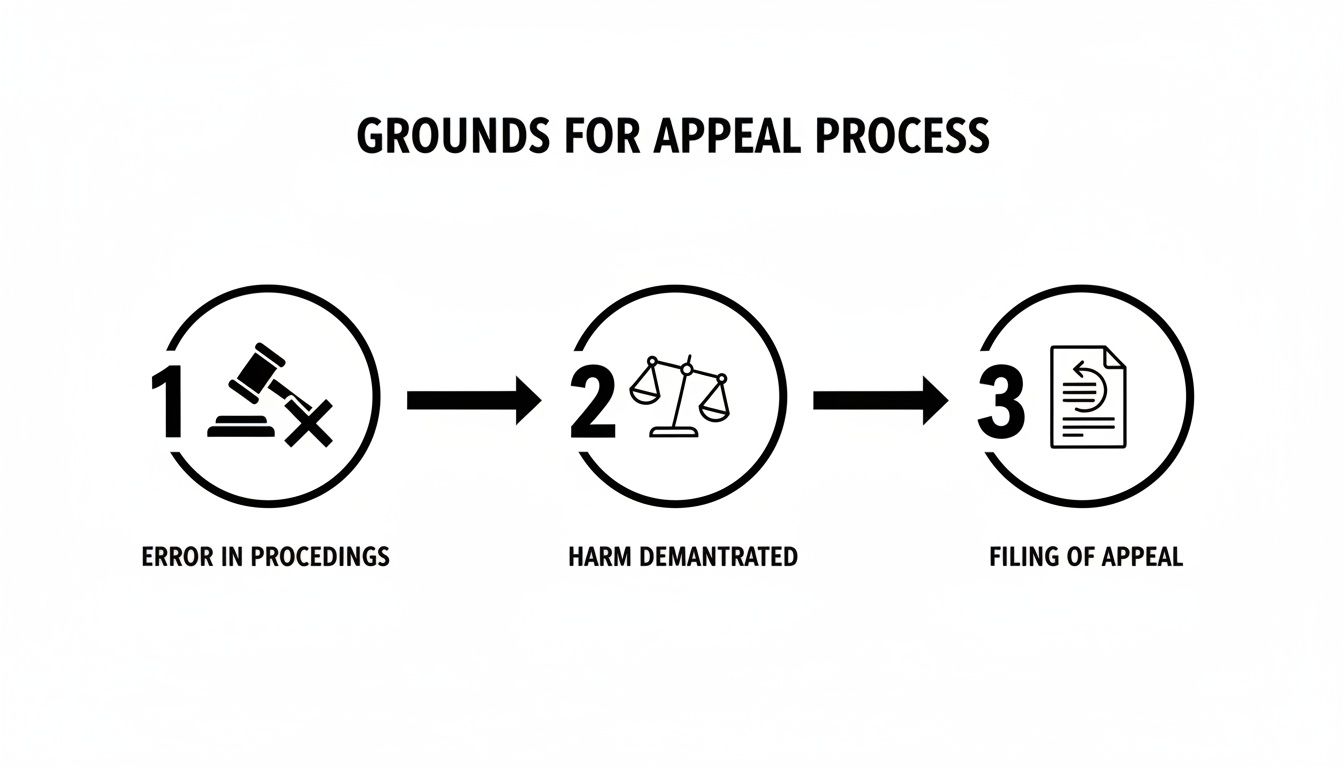
As this illustrates, simply finding an error is not enough. A successful appeal must demonstrate that the error caused a harmful, unjust result.
The Heart of the Appeal: The Briefing Stage
Once the record is complete, the core of the appeal begins: briefing. This is where your attorney’s skill in legal research and persuasive writing becomes paramount.
Briefing (Plain English): This is the process of writing and filing formal legal arguments. The primary document, the "appellant's brief," tells the appellate court what happened, identifies the trial court’s errors, and uses legal authority (statutes and prior cases) to explain why the decision should be overturned.
The other party (the “Appellee”) will file a responsive brief arguing why the trial court’s decision was correct. Your attorney may then file a final “Reply Brief.” The appeal is often won or lost based on the quality of these written arguments.
Oral Argument and the Final Decision
In some cases, the appellate court will schedule an Oral Argument. This is not a new trial. It is a formal session where attorneys for both sides appear before the panel of justices to answer questions and clarify points from their briefs. After reviewing the briefs and holding oral argument (if any), the court will issue a written opinion with its decision. The court can:
- Affirm: Agree with the trial court and uphold the original order.
- Reverse: Overturn the trial court's decision.
- Reverse and Remand: Overturn the decision and send the case back to the trial court with instructions for further proceedings.
If you believe the court made a mistake in your family law case, our appellate attorneys can help you seek a fair outcome. Contact The Law Office of Bryan Fagan today for a free consultation.
Understanding the Language of an Appeal
The appeals process has its own vocabulary. Understanding these key terms will empower you to follow your case with greater confidence and clarity. When you know the language, you can better understand the strategy your family law appeals lawyers are using to seek justice for you.
Appellant vs. Appellee: Identifying the Parties
In the trial court, the parties were likely called the "Petitioner" and "Respondent." On appeal, these titles change to reflect each party's role in the new proceeding.
- Appellant: This is the party who lost at the trial court level and is filing the appeal to challenge the decision.
- Appellee: This is the party who won at the trial court and is now responding to the appeal, arguing that the original decision should be upheld.
Understanding the Standard of Review
The Standard of Review is one of the most critical concepts in an appeal. It is the specific framework the appellate court must use to evaluate the trial judge’s decision. Different types of errors are reviewed under different standards.
Think of it like an instant replay in sports. For some calls, the referee on the field is given great deference, and the call will only be overturned if it was clearly wrong. For other calls, the replay official gets to make a fresh decision from scratch. The standard of review works the same way.
The most common standard in family law is "abuse of discretion." As explained earlier, this standard is highly deferential to the trial judge. Another key standard is "de novo" review. De novo is Latin for "from the new." This standard applies to pure questions of law, such as when a judge misinterprets a statute. The appellate court gives no deference to the trial judge and decides the issue for itself.
Reversible Error vs. Harmless Error: Proving the Mistake Mattered
Not every mistake made by a trial judge is grounds for a reversal. The law distinguishes between two types of errors:
- Reversible Error (Plain English): A legal mistake so significant that it likely caused the trial court to reach the wrong conclusion. Your attorney must prove that without this error, the outcome of your case probably would have been different.
- Harmless Error: A minor technical mistake or slip-up that did not affect the final outcome of the case. The appellate court will not overturn a decision based on a harmless error.
The goal of your attorney is to prove that the mistakes made in your trial were reversible errors that led to an unjust result.
The Appellate Record and Briefing: The Foundation of Your Case
Two final terms describe the essential components of your appeal:
- The Appellate Record: This is the official "game tape" from your trial, consisting of the Clerk’s Record (all filed documents) and the Reporter’s Record (the word-for-word transcript). The appellate court is strictly limited to reviewing what is in this record.
- Briefing: This is the written advocacy stage. Your lawyer writes a formal legal document (a "brief") that uses the appellate record and legal precedent to construct a persuasive argument for why the trial court's judgment was legally flawed and must be overturned.
How to Choose the Right Family Law Appeals Lawyer
Winning at trial and winning on appeal require completely different skills. A trial lawyer excels at live courtroom persuasion, while an appellate lawyer is a master of legal research, strategy, and persuasive writing. Choosing the right family law appeals lawyer is the single most important decision you will make in seeking to correct an unjust outcome. This is not a time for a general practitioner; it is a time for a specialist.
An appeal is not a "do-over" of your trial. It is a highly technical argument focused on legal errors contained within the trial record. You need an attorney who is fluent in the Texas Rules of Appellate Procedure and knows how to craft an argument that will persuade a panel of appellate justices.
Experience Beyond the Trial Courtroom
First and foremost, seek a lawyer with a proven track record in the appellate courts. They should have substantial experience writing appellate briefs and arguing cases before the Texas Courts of Appeals. This specialized experience is vital because the audience is different. Trial judges focus on facts and witness credibility; appellate justices focus on legal precedent and procedural correctness. A seasoned appellate lawyer speaks their language.

Masterful Legal Writing is Paramount
While oral arguments can be important, most appeals are won or lost based on the strength of the written appellate brief. This document is the core of your appeal. It is where your attorney presents the facts, identifies the trial court’s errors, and builds a powerful legal case for reversal. A top-tier appellate attorney is an exceptional writer, capable of distilling a complex record into a clear, persuasive, and legally sound narrative.
A Strategic and Honest Assessment
A reputable appellate lawyer will provide a frank and strategic assessment of your case's strengths and weaknesses after a thorough review of the trial record. They will not simply tell you what you want to hear. Instead, they will set realistic expectations, explain the legal challenges, and discuss the range of possible outcomes.
The right attorney is a strategist who can see the entire chessboard. They will honestly tell you if an appeal has a low probability of success, saving you time, money, and emotional energy. Their primary goal is to secure justice, not simply to file a case.
When evaluating a family law appeals lawyer, it is also wise to consider their professional reputation management and client feedback.
Leveraging Modern Legal Resources
Modern legal practice relies on advanced technology and resources to handle the intensive research and document management required for an appeal. Firms with dedicated appellate divisions often have access to sophisticated legal research databases and tools that can be crucial for building the strongest possible case. This institutional support can be a significant advantage in the demanding world of appellate law.
Ultimately, you are looking for a dedicated specialist. Finding the right family law appeal attorney means partnering with an expert who brings the specific skills, deep experience, and strategic mind needed to give you the best possible chance at a just result.
Common Questions About Texas Family Law Appeals
Facing a potential appeal naturally brings many questions. The appellate process is very different from a trial, and understanding the practical aspects is key to making an informed decision. Here are plain-English answers to the questions we hear most often from clients considering a family law appeal in Texas.
How Long Does a Family Law Appeal Take in Texas?
Patience is essential. A Texas family law appeal is a methodical process that cannot be rushed. A typical appeal can take anywhere from nine months to over a year to receive a final decision from the court.
The timeline depends on several factors:
- The Court's Caseload: The court of appeals has many cases, and yours must take its place in line.
- Case Complexity: An appeal on a single legal issue will move faster than one involving a lengthy trial record and complex property arguments.
- Briefing Schedules: The Texas Rules of Appellate Procedure set firm deadlines for each side to file their written arguments, a process that takes several months.
It is a marathon, not a sprint. Your lawyer will manage all deadlines, but it is important to have realistic expectations for the timeline.
Can I Introduce New Evidence During My Appeal?
This is a firm rule: no new evidence is allowed on appeal. The appellate court's role is not to re-try the case but to review the trial that already occurred for significant legal errors.
The appeal is based entirely on the appellate record, which includes all documents, exhibits, and transcripts from the trial court. Your appellate lawyer’s job is to find the grounds for appeal within this existing record. The case is won or lost based on what has already been presented.
Is the Original Court Order Enforced During the Appeal?
Yes, in almost all cases, the trial court's order remains in full force and effect while the appeal is pending. Filing a Notice of Appeal does not automatically pause the judge's ruling. You must continue to comply with every aspect of the order, including custody schedules, child support, and spousal maintenance payments.
It is absolutely critical to comply with the existing order. Failure to do so can result in contempt of court proceedings, which creates a separate legal problem unrelated to your appeal.
In very specific circumstances, an attorney can ask the court to suspend the order by filing a "motion to supersede." However, this is rarely granted in family law cases and often requires posting a substantial financial bond.
What Is the Cost of a Family Law Appeal?
Appeals are a highly specialized and labor-intensive legal service, and the cost reflects this reality. The total cost can vary significantly depending on the specifics of your case.
The main cost drivers include:
- The Size of the Record: Reviewing the record from a short trial takes far less time than analyzing one from a multi-week trial with numerous exhibits.
- The Complexity of the Legal Issues: An appeal based on a single, straightforward error will be less costly than one involving multiple, complex legal arguments.
Most experienced appellate attorneys work on an hourly basis and require a significant upfront retainer to cover the intensive work of reviewing the record and drafting the initial brief. A reputable attorney will be transparent about their fees and provide a realistic cost estimate after evaluating your case.
If you believe the court made a mistake in your family law case, our appellate attorneys can help you seek a fair outcome. Contact The Law Office of Bryan Fagan today for a free consultation about your legal options.