Skip to content
If you feel that a court’s decision in your family law case was fundamentally unfair, you are not alone. It’s a frustrating and often overwhelming position to be in. The good news is that the legal system provides a path to seek justice: the appeals process. While most Texas family law appeals are governed by state rules, some cases involving federal law must follow the Federal Rules of Appellate Procedure (FRAP).
Think of these rules as a detailed and uniform roadmap for every appeal filed in a U.S. Circuit Court of Appeals. They ensure that every case, no matter where it's heard, follows a consistent, predictable, and fair process. Understanding this structured system is the essential first step toward challenging an unjust outcome and restoring balance.
What You Can Appeal in a Texas Family Law Case

The appellate process isn’t chaos; it’s a highly structured system designed to give your case a second look from a higher court. Grasping the rules that govern this system is the essential first step to taking back control and fighting for the right outcome.
Understanding the Role of Procedural Rules
It's easy to dismiss procedural rules as mere "technicalities," but in the world of appeals, they are the foundation of fairness. These rules dictate every action, from how you start the appeal to the specific font size in your legal brief. Following them isn't optional—a seemingly minor mistake can derail your entire case.
This is especially critical because most family law appeals in Texas fall under the Texas Rules of Appellate Procedure. However, certain cases involve a question of federal law—like an international child abduction case under the Hague Convention, or a claim that a state court violated your constitutional rights—which pulls them into the federal system. In those instances, the federal appellate rules of procedure take over.
What is a “reversible error”? This is a legal mistake made by the trial court that was so significant it likely affected the outcome of your case. It’s not enough that you disagree with the decision; you must prove the judge made a specific error in applying the law or procedure.
Why This Distinction Matters for Your Case
Don't assume the federal and Texas rules are the same. They have different deadlines, filing requirements, and procedures. An attorney experienced only in Texas state appeals can easily get tripped up by the unique quirks of the federal system.
For instance, the Notice of Appeal—the document that officially kicks off the process—is governed by brutally unforgiving deadlines. Miss it, and your right to appeal is likely gone forever. The rules for assembling the trial court record and for writing the legal arguments (briefing) are also distinct. One wrong move based on state court habits could get your federal appeal dismissed before a panel of judges ever hears why the lower court got it wrong.
By understanding the purpose and structure of the federal appellate rules of procedure, you can face your appeal with a clear head. This knowledge is power—it lets you make informed choices and ensures your case is built on a solid foundation.
If you believe the court made a mistake in your family law case, our appellate attorneys can help you seek a fair outcome. Contact The Law Office of Bryan Fagan today for a free consultation.
Why the FRAP Exists and How It Works
Imagine trying to play a high-stakes game where every federal court in the country had its own unique rulebook. It would be a recipe for confusion and unfairness. That’s the world that existed before the Federal Rules of Appellate Procedure (FRAP) were created to bring order and consistency to federal appeals.
The FRAP is a carefully designed system meant to guarantee that every person, no matter which federal circuit they’re in, receives the same procedural protections. This uniformity is a bedrock principle of due process, making sure your case is judged on its legal merits, not on the local quirks of a particular court.
Creating a Level Playing Field
Before 1968, appellate practice in federal courts was a messy patchwork of different local rules. To fix this barrier to justice, a standardized system was developed. The Supreme Court adopted the Federal Rules of Appellate Procedure on December 4, 1967, and they officially went into effect on July 1, 1968.
This landmark moment created a single, uniform set of rules governing federal appeals nationwide. This standardization means your attorney can map out a clear strategy, knowing the procedural steps are the same in the Fifth Circuit (which covers Texas) as they are anywhere else. It keeps the focus right where it belongs: on the legal errors from the trial court.
The Logical Structure of the FRAP
The FRAP is organized to follow the natural flow of an appeal, guiding you and your lawyer through every stage of the process.
The rules are grouped into titles covering specific phases:
- Title I (Applicability of Rules): This section lays the groundwork, defining which courts and proceedings the rules apply to.
- Title II (Appeals from Judgments and Orders of District Courts): This is where the action starts, containing critical rules like the iron-clad deadline for filing your Notice of Appeal.
- Title V (Briefs): Here, you'll find all the requirements for writing your legal arguments—a process we call briefing. It covers everything from word counts to formatting.
- Title VI (Oral Argument): If the court decides to hear from the lawyers in person, these rules dictate how oral arguments are handled.
Understanding this structure helps demystify what can feel like an intimidating process, breaking it down into manageable steps. When you’re looking at the grounds for appeal in your Texas family court case, having this predictable framework is essential.
What is "briefing"? In plain English, briefing is the process of writing and submitting the formal legal documents that explain to the appellate court why the trial court’s decision was wrong. Your "brief" is your written argument, where your attorney meticulously lays out the facts, cites relevant laws, and shows the judges exactly how a reversible error occurred. This document is the heart of your appeal.
The FRAP exists to ensure fairness and order, providing a reliable structure so that your fight for a just outcome is based on the strength of your case.
Understanding the Standard of Review
In the world of appeals, timing isn't just important—it's everything. The process is a series of strict, non-negotiable deadlines. Missing one can be fatal to your case. The clock starts ticking the second the trial court's final judgment is official.
Think of the federal appellate rules of procedure as the rulebook for a high-stakes game where each move has a specific window.
The First and Most Crucial Deadline: The Notice of Appeal
Your entire appeal lives or dies by one document: the Notice of Appeal. It's the formal paper that tells the court system you intend to challenge the lower court's decision. Under the FRAP, you generally have only 30 days from the entry of the judgment to get this notice filed.
This is one of the most unforgiving deadlines in the legal system. If you miss it, the appellate court loses its authority—what we call jurisdiction—to even look at your case. It doesn't matter how strong your arguments are or how obvious the trial court’s mistake was. A late notice almost always means your appeal is over before it begins.
A key concept in appeals is the "record on appeal." This isn't a chance to introduce new evidence. Instead, it’s the complete collection of everything that happened in the trial court: trial transcripts, exhibits, and written orders. Your appellate lawyer’s job is to comb through this record to find the legal errors that will form the foundation of your appeal.
Ordering the Record and Kicking Off the Briefing Schedule
Once your Notice of Appeal is filed, the next race begins: assembling the trial court record. The FRAP lays out the exact steps for preparing the official transcripts and gathering all the documents. This is non-negotiable, because the appellate court is forbidden from considering anything that isn't in that official record.
After the record is compiled, the briefing schedule is set. This is where the real work of your appeal lies.
The visualization below shows the core phases of the appellate journey.
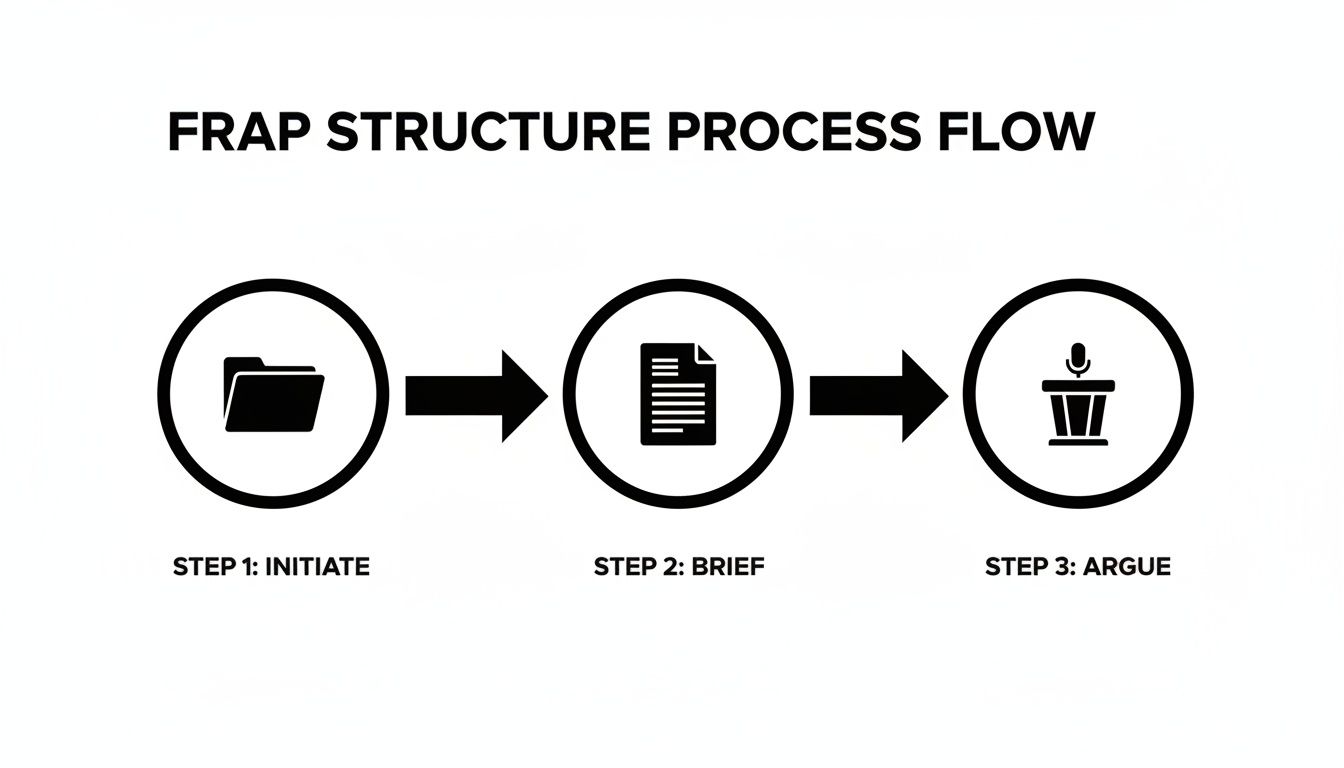
This process shows how an appeal moves from that initial notice, through the critical briefing stage, and finally to oral argument, with every step dictated by strict procedural rules.
Briefing is where your attorney writes a detailed legal argument—the appellate brief—explaining to a panel of judges what mistakes the trial court made. To learn more about this crucial document, see what is in an appellate brief.
Why Professional Guidance Is Essential
When the FRAP were introduced in 1968, they standardized these critical rules across all 13 federal circuits. You can explore the history and text of these foundational rules on Cornell Law School's website.
While this uniformity brought predictability, the rules remain incredibly complex. From filing motions to following rigid formatting requirements, every action is governed by a specific rule. One small misstep can lead to an argument being waived or the entire appeal being dismissed. Navigating this landscape demands an attorney who knows the rules and has the experience to use them strategically.
If you believe the court made a serious error in your family law case, our appellate attorneys can help you seek the fair outcome you deserve. Contact The Law Office of Bryan Fagan today for a free consultation.
When Federal Rules Apply in a Texas Family Law Case
Nearly every Texas family law case, from divorce to child custody, is handled in the Texas state court system. If you need to appeal a decision, you're almost certainly headed to a Texas Court of Appeals, where the Texas Rules of Appellate Procedure apply.
But sometimes, a case involves a "federal question," pulling the dispute into federal court. When that happens, the federal appellate rules of procedure become the law of the land. It’s critical to understand that federal courts aren’t just a higher level of appeal for state court rulings. For a federal court to get involved, there must be a specific legal hook that gives them authority—or jurisdiction—to hear the case.
What Is a "Federal Question" in a Family Law Case?
A "federal question" arises whenever a legal issue involves the U.S. Constitution or a federal law. Here are a few common scenarios in family law:
- Interstate Child Custody Disputes: The Parental Kidnapping Prevention Act (PKPA) is a federal law that resolves jurisdictional conflicts when parents live in different states. If Texas and another state disagree on which one can make custody decisions, the case can end up in federal court.
- International Child Abduction: When a child is wrongfully taken across international borders, the case is governed by the Hague Convention, an international treaty enforced through federal law. These sensitive cases are handled exclusively by federal courts.
- Violations of Constitutional Rights: If a state court’s decision violated your constitutional rights—for example, by denying you the chance to present evidence in a custody hearing (a violation of due process)—you might have a path to federal court.
What exactly is a "federal question"?
Think of it as the ticket required for admission into federal court. The ticket is stamped with an issue that directly involves the U.S. Constitution, a federal statute, or a treaty.
Other Paths to Federal Court
Other situations can bring a family law matter under federal jurisdiction. One of the most frequent examples is bankruptcy. If one spouse files for bankruptcy during a high-asset divorce, federal bankruptcy law takes precedence, and all state court actions related to property division are halted. A federal bankruptcy court must then decide how to handle the marital assets.
Another example could involve a protective order that touches on federal laws, such as those governing firearm possession. The moment a federal statute is implicated, a door to the federal court system may open.
If you believe the court made a mistake in your family law case, our appellate attorneys can help you seek a fair outcome. Contact The Law Office of Bryan Fagan today for a free consultation.
Common Reversible Errors in Texas Family Courts

Navigating a federal appeal requires precision. One wrong procedural step can stop even the most solid case in its tracks. The federal appellate rules of procedure are designed to ensure fairness, but they are also strict. An oversight can bring your case to a screeching halt.
Missing the Notice of Appeal Deadline
The most catastrophic misstep is filing the Notice of Appeal too late. This isn't a minor slip-up; it's what lawyers call a "jurisdictional defect." Under FRAP 4, you typically have just 30 days from the entry of the final judgment to file this critical document. If you miss that deadline, the appellate court has no authority to hear your case, and your appeal will be dismissed.
What is “abuse of discretion”? This is a specific standard of review where an appellate court will only reverse a trial judge’s decision if it was unreasonable, arbitrary, or made without reference to guiding legal principles. Many family law decisions, like property division and custody, are reviewed under this standard.
Failing to Properly Assemble the Record
An appeal is a review of what has already happened. The appellate judges can only consider what’s in the official record on appeal—the transcripts, evidence, and court orders from your original case. A common mistake is failing to order the right transcripts or ensure all necessary documents are included. If a crucial piece of evidence is missing from the record, it's as if it never happened in the eyes of the appellate court.
The FRAP themselves are the product of decades of development. You can learn more about the history of federal rulemaking on FJC.gov.
Submitting a Non-Compliant Brief
Your appellate brief is the centerpiece of your appeal. The FRAP lays out incredibly specific rules for these briefs, covering:
- Word or Page Limits: Exceeding the word count can cause the court to strike your brief, meaning they won't read it.
- Formatting Requirements: The rules dictate font size, margins, and the precise format for citing legal authorities.
- Content and Structure: A brief must contain specific sections, like a statement of the issues, presented in the correct order.
Ignoring these rules signals a lack of diligence and can distract from the merits of your divorce or child custody appeal.
If you believe the court made a mistake in your family law case, our appellate attorneys can help you seek a fair outcome. Contact The Law Office of Bryan Fagan today for a free consultation.
What's Your Next Step? Charting a Path Forward
Understanding the federal appellate rules is one thing, but putting them into action is what can turn your case around. When a trial court gets it wrong, it's natural to feel let down. But the appeals process exists to catch those mistakes and restore fairness.
The Federal Rules of Appellate Procedure (FRAP) provide the official roadmap, but success comes from having a guide who knows every turn and potential roadblock.
The Right Guide Makes All the Difference
A skilled appellate attorney does more than meet deadlines. They see the strategy behind the rules and use that insight to build the most powerful argument for you. They will comb through the trial record, hunting for reversible errors that appellate judges look for, and then translate those findings into a persuasive brief.
This is the art of weaving procedural perfection with compelling advocacy to show the higher court exactly where the trial judge went wrong and why it must be corrected. Winning an appeal isn't just about being right; it's about proving that a serious legal error tainted the outcome. A skilled family law appeal attorney can champion your cause.
If you’re facing the consequences of a judicial mistake, don't just accept it. Our appellate team is here to help you fight for a just result.
If you believe the court made a mistake in your family law case, our appellate attorneys can help you seek a fair outcome. Contact The Law Office of Bryan Fagan today for a free consultation.
Common Questions About the Federal Appeals Process
Facing an appeal brings many questions. The process can feel overwhelming, but clear answers can help you see the path forward.
How Is a Federal Appeal Different From a Trial?
An appeal is not a "do-over" of your trial. The appellate court’s job is to review what already happened in the trial court, not to re-try the case.
Key differences include:
- No New Evidence: The appellate court will not hear from new witnesses or look at new exhibits. The review is based only on the existing trial record.
- Focus on Legal Mistakes: The appeal centers on one question: Did the trial court make a "reversible error"—a serious legal mistake—that unfairly changed the outcome? The judges are looking for errors in procedure or the application of law, not re-weighing the facts.
An appeal is like a building inspection. The inspector isn’t there to add a new room; they are there to see if the foundation was laid correctly and if the wiring follows the code.
Can I Introduce New Evidence in My Federal Appeal?
The short answer is almost always no. The federal appeals process is locked into reviewing only the evidence and arguments that were presented to the trial court. The appellate judges assess whether the trial judge made the right calls based on the information they had at that time.
How Long Does a Federal Appeal Typically Take?
Patience is key. A federal appeal is a marathon, not a sprint. The timeline can stretch from a year to even longer, depending on the complexity of the legal issues and the court's docket. This includes preparing the record, the briefing schedule, and in some cases, oral argument.
What Does Reversible Error Mean in a Federal Appeal?
This is the heart of any appeal. A "reversible error" isn’t just a minor mistake. It must be a significant legal blunder by the trial court—an error so serious that it likely changed the final result of your case. Proving a reversible error could mean showing the judge applied the wrong law, made a ruling that was an "abuse of discretion," or wrongly excluded crucial evidence.
If you believe the court made a mistake in your family law case, our appellate attorneys can help you seek a fair outcome. Contact The Law Office of Bryan Fagan today for a free consultation at https://familylawcourtappeals.com.