Skip to content
You may feel your case was handled unfairly. When a Texas court overlooks the clear signs of parental alienation—one parent’s deliberate campaign to turn a child against the other—the resulting custody order can feel like a profound injustice. This calculated behavior is a form of emotional abuse, and Texas law is supposed to protect your child from it.
If you believe the trial court made a mistake and ignored the evidence, you are not out of options. The Texas appeals process exists to correct legal errors and ensure that family law decisions are fair, just, and truly in the best interest of the child. An appeal offers a strategic path to seek a more balanced and rightful outcome.
How Texas Law Views Parental Alienation

Parental alienation is more than just poor co-parenting or the normal friction that follows a separation. It is a destructive and intentional strategy to damage a child's relationship with a parent. This conduct is in direct opposition to the guiding principle of Texas family law: all custody decisions must serve the "best interest of the child."
Sometimes, a trial court judge gets it wrong. They might fail to recognize the subtle patterns of manipulation or misinterpret the evidence presented. When an unjust custody order results from such a misstep, the fight for a fair outcome isn't over. An appeal is not a new trial; it is a meticulous review of the trial record to identify a "reversible error"—a legal mistake so significant that it likely led to the wrong decision.
Distinguishing Alienation from Normal Conflict
It’s crucial to draw a line between true alienation and everyday friction. A child might be angry with a parent, or you and your co-parent might disagree on rules. That is normal. Alienation, however, is a persistent, malicious campaign designed to make a child reject a parent without legitimate justification.
Here are common behaviors that can serve as evidence of parental alienation in a Texas court:
| Behavior Category | Specific Examples |
|---|---|
| Undermining Authority | Constantly badmouthing the targeted parent to the child. Questioning their decisions and painting them as incompetent or uncaring. |
| Interfering with Contact | Systematically blocking calls, texts, or video chats. "Forgetting" to tell the child about scheduled visits. Creating competing activities. |
| Creating False Narratives | Fabricating stories of neglect or danger. Exaggerating minor flaws to make the child feel fearful, resentful, or unsafe. |
| Forcing Loyalty Tests | Making the child feel they have to choose a side. Using guilt to pressure the child into rejecting the targeted parent. |
| Erasing the Other Parent | Removing photos of the targeted parent. Refusing to talk about them or forbidding the child from mentioning them. |
These manipulative tactics inflict deep and lasting emotional harm on the child. Healthier approaches to separation, like conscious uncoupling, prioritize mutual respect and the child's well-being. Parental alienation is the polar opposite, and Texas courts recognize it as a form of emotional abuse.
When a judge is presented with clear proof of these actions and fails to act—for instance, by refusing to modify a custody order—it can be considered an "abuse of discretion." This is a key legal term meaning the judge’s ruling was so unreasonable or arbitrary that it ignored the facts and the law, providing a solid foundation for an appeal.
Building a Case for a Parental Alienation Appeal

If you are considering an appeal, you likely feel the trial court did not fully understand your side of the story. Proving parental alienation requires more than testimony; it requires a clear, undeniable pattern of behavior documented with evidence. Building a strong case at trial is essential, as this evidence forms the official record that will be scrutinized on appeal.
An appeal is not about presenting new facts. It is about demonstrating that the trial judge made a legal error based on the evidence that was already presented. This is why organized, compelling evidence is the cornerstone of both a strong trial strategy and a successful appeal.
Documenting a Pattern of Interference
The foundation of a parental alienation case is consistent, organized documentation. A single missed visit can be explained away, but a detailed log showing a relentless campaign of interference tells a much more compelling story. A factual, unemotional timeline is crucial.
- Denied Visitations: Log every instance of blocked parenting time. Note the date, the scheduled time, and the excuse provided.
- Blocked Communication: Keep a record of unanswered calls, ignored texts, and other efforts to cut off contact between you and your child.
- Manipulative Messages: Save every email, text, or social media message where the other parent disparages you or attempts to poison your child against you.
This detailed record transforms general claims into a concrete sequence of alienating acts, creating the factual basis needed for an appellate court to review the trial judge’s decision.
Gathering Persuasive Evidence
Beyond your own documentation, Texas courts rely on objective proof. Evidence from neutral third parties and tangible communications can illuminate the alienating parent's true intentions and their impact on the child.
A judge is far more likely to recognize a pattern of parental alienation in Texas when presented with different kinds of evidence from multiple sources. The more your story is supported by outside facts, the more credible it becomes.
Look for these powerful sources of evidence to include in the trial record:
- Written Communications: Emails and text messages often provide direct, unfiltered proof of the alienating parent's mindset, revealing threats, lies, or interference.
- Third-Party Testimony: Statements from teachers, coaches, or therapists can be invaluable. These professionals can testify to sudden changes in your child's behavior or things the child has said that parrot the alienating parent.
- Expert Witness Evaluations: In many cases, the most critical evidence comes from a qualified mental health professional. A child custody evaluator can provide the court with an expert opinion on the family dynamics and the psychological harm being inflicted, which can be pivotal in proving your case.
Understanding the Standard of Review on Appeal
At trial, the standard is a "preponderance of the evidence," meaning you must show it is more likely than not that alienation is occurring. On appeal, the standard of review is different. We are not re-arguing the facts; we are arguing the law. The most common standard in family law appeals is "abuse of discretion." This means we must prove the trial judge’s decision was unreasonable, arbitrary, or made without regard for the law.
When this destructive behavior results in an unfair court order, it is crucial to know your appellate options. You can learn more about challenging custody orders in our guide on child custody modifications.
Common Reversible Errors in Parental Alienation Cases
You presented the evidence—the emails, the missed visits, the expert reports—only to watch the court issue an order that failed to protect your child. If you believe the judge made a legal mistake, the Texas appellate process was designed to provide a remedy.
An appeal is not a new trial. We cannot introduce new evidence. Instead, our appellate attorneys conduct a deep, meticulous review of the official trial record—transcripts, exhibits, and motions—to find the "reversible error" that led to the wrong outcome. A reversible error is a mistake so significant that it likely caused the judge to make an improper decision.
Defining “Abuse of Discretion” in Plain English
In Texas family law appeals, we often argue that the judge committed an “abuse of discretion.”
- Abuse of Discretion (Plain-English Definition): This occurs when a trial judge makes a decision that is arbitrary, unreasonable, or without any regard for guiding legal rules and principles. It is not just a decision we disagree with; it is a decision that is fundamentally unfair or legally incorrect based on the evidence presented.
For example, if a judge has overwhelming evidence of alienation from multiple sources but ignores it and bases a custody decision on a minor, unrelated issue, that could be an abuse of discretion. The decision was not based on a logical application of the "best interest of the child" standard to the facts at hand.
Examples of Reversible Errors in Alienation Appeals
When a judge fails to see the destructive pattern of parental alienation, it often comes down to a specific, identifiable legal misstep. It is our job to find that mistake and demonstrate to the higher court how it skewed the final ruling.
Common examples of reversible errors in these cases include:
- Ignoring Expert Testimony: The judge improperly disregards the findings of a qualified child custody evaluator or psychologist who identified clear signs of alienation.
- Misapplying the Best Interest Standard: The court focuses on one factor while overlooking overwhelming proof that the alienating parent's behavior is causing the child severe emotional harm.
- Excluding Critical Evidence: The judge wrongfully refuses to admit key evidence into the record, such as a log of denied visitations or manipulative text messages that prove interference.
Identifying one of these errors can be the foundation for a strong appeal.
The Appellate Brief: Your Argument to the Higher Court
Once we identify a reversible error, we proceed to the briefing stage.
- Briefing (Plain-English Definition): This is the process of writing the formal legal argument, known as an "appellate brief," which is submitted to the court of appeals.
This document is not simply a complaint that the judge was wrong. It is a persuasive case built piece by piece, using:
- Citations to the Trial Record: We direct the appellate judges to the exact page in the transcript or specific exhibit that proves the error occurred.
- References to Texas Law: We use the Texas Family Code and relevant case law to show how the trial judge failed to follow legal requirements.
- A Clear, Logical Argument: We connect the dots, explaining how the legal error led to an unjust outcome that harmed your parental rights and your child's well-being.
An appeal provides a second chance for justice—a structured, strategic opportunity for a panel of judges to review the case and determine if the law was applied correctly.
Understanding the Texas Appellate Procedure
After an emotionally taxing trial, the idea of an appeal can feel overwhelming. However, understanding the step-by-step process can restore a sense of control. The entire process is governed by the Texas Rules of Appellate Procedure, a specific set of guidelines designed to ensure fairness.
It is critical to remember that an appeal is not a second trial. No new witnesses testify and no new evidence is introduced. The focus is solely on whether the trial judge made a legal mistake based on what is already in the record. This process begins with a deadline that you cannot afford to miss.
Step 1: Filing the Notice of Appeal
Your appellate journey starts with filing a Notice of Appeal. This document officially informs the courts that you are challenging the final order. In most Texas family law cases, you have a strict 30-day deadline from the date the judge signs the order. Missing this deadline will almost certainly prevent you from appealing.
Step 2: Preparing the Appellate Record
Once the notice is filed, the next step is assembling the appellate record. This is the complete official file of your case from the trial court, including every document, exhibit, and the court reporter's transcript of every word spoken. The appellate judges can only consider what is in this record. For them, if it is not in the record, it did not happen.
This graphic outlines the basic steps of a Texas appeal, from preparing the record to the final decision.
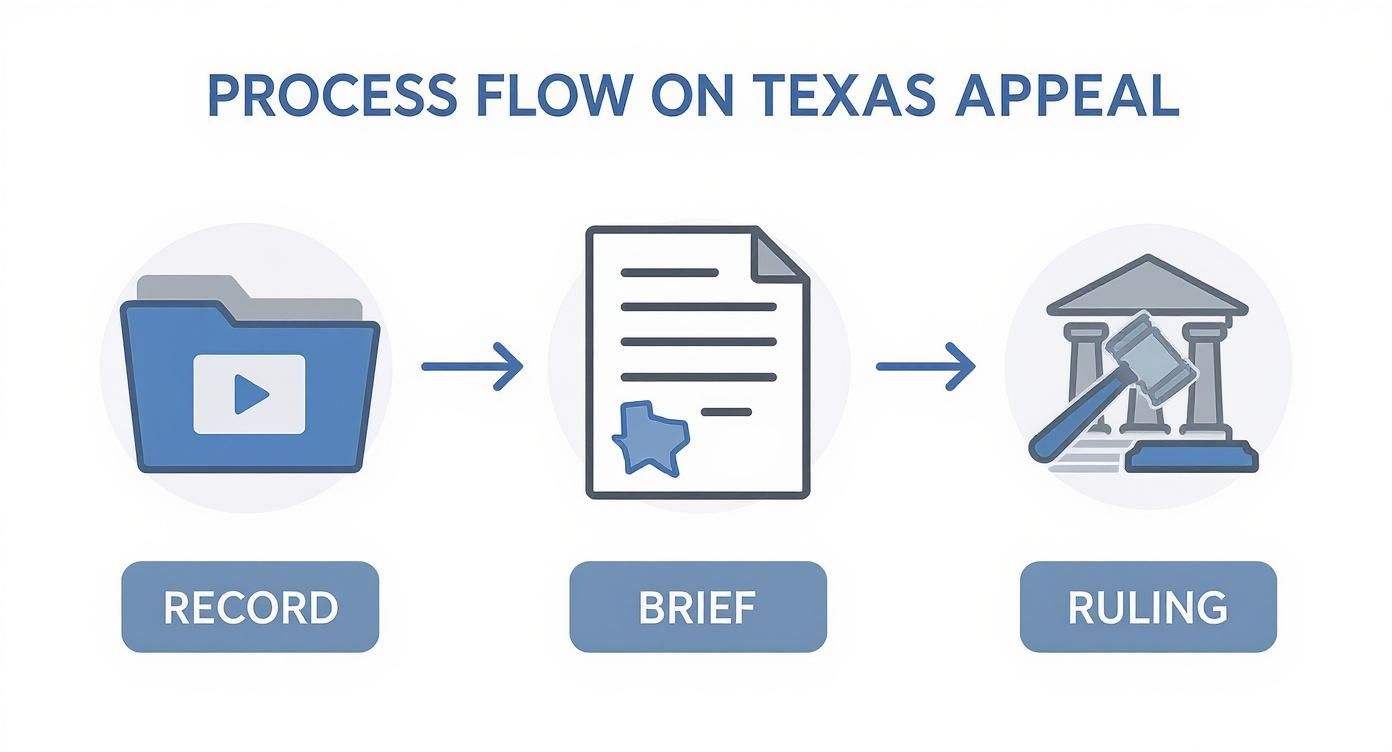
As you can see, it's a linear, fact-based process that relies entirely on written arguments, not new testimony. This ensures the review stays focused on whether a legal or procedural error occurred at trial.
Step 3: The Briefing Stage
With the record prepared, the briefing stage begins. Our appellate attorneys draft your appellate brief—the most important document in your appeal. This is our opportunity to present a detailed, persuasive legal argument to the appellate court, explaining where and how the trial judge erred.
Our brief will:
- Identify the specific reversible errors the judge made.
- Point to the exact page and line in the appellate record that proves the error.
- Use established Texas law and past court rulings to show why the judge's decision was legally incorrect.
The brief connects the dots, demonstrating how the judge’s mistake—such as ignoring clear evidence of alienation—directly led to an unjust outcome.
How an Appeal Differs from a Trial
The trial and appellate processes serve completely different functions. Understanding these differences is key to managing your expectations for an appeal.
| Aspect | Trial Court | Appellate Court |
|---|---|---|
| Purpose | To determine the facts of the case by hearing testimony and reviewing evidence. | To review the trial court's proceedings for legal errors. |
| Evidence | New evidence is presented, and witnesses testify. | No new evidence or testimony is allowed. The review is limited to the existing record. |
| Key Player | A single judge or a jury decides the facts. | A panel of three or more judges reviews the legal arguments. |
| Main Document | Motions, pleadings, and evidence exhibits. | The appellate brief, which argues legal points. |
| Focus | "What happened?" | "Did the judge apply the law correctly?" |
The appellate process provides a critical check on the trial court's power, ensuring that decisions affecting your family are grounded in the facts presented and the established principles of the Texas Family Code. This process is highly technical and requires deep knowledge of its specific rules. Our guide on how to appeal a family court decision offers more detail on this structured path to justice.
Common Questions About the Texas Appeals Process
After receiving an unfavorable family law verdict, it is natural to have questions. When you feel the court failed to recognize the parental alienation that was obvious to you, understanding the appeals process is the first step toward seeking justice.
How Long Do I Have to Appeal a Texas Family Law Decision?
This is the most critical deadline: in most cases, you have just 30 days from the date the judge signs the final order to file a Notice of Appeal. This deadline is extremely strict. While filing certain post-trial motions can sometimes extend this deadline to 90 days, you should not count on an extension. It is essential to speak with an appellate attorney immediately after an unfavorable ruling to preserve your right to appeal.
What Is the Key to Winning a Parental Alienation Appeal?
Success on appeal depends entirely on what is already in the trial record. We cannot introduce new evidence. To win, we must prove the trial judge made a "reversible error" based on that record. In a parental alienation case, this could mean demonstrating the judge:
- Ignored the findings of a professional child custody evaluator.
- Wrongfully excluded your documented proof of the other parent's manipulation.
- Misapplied the “best interest of the child” standard in light of overwhelming evidence of alienation.
Our role is to meticulously review the record, find those legal errors, and build a compelling argument that shows the appellate court why the trial judge’s decision was legally flawed.
If I Win My Appeal, Can I Get My Attorney's Fees Paid?
It is possible but not guaranteed. In some Texas family law appeals, the appellate court has the authority to award attorney's fees, but this is entirely discretionary. The primary goal of an appeal is not to recover costs, but to correct a significant legal error. The best outcome is having the unfair ruling reversed and the case sent back to the trial court for a new, fair hearing based on the proper application of the law.
Take the Next Step Toward a Fair Outcome

You do not have to accept an unjust court ruling that damages your relationship with your child. An unfair outcome, especially one that ignored clear evidence of parental alienation in Texas, is not the final word. The Texas appellate process was designed to correct legal mistakes and ensure the law is applied fairly.
Protecting the bond with your child is paramount. Your case deserves a thorough review by a higher court, and our team is ready to provide the calm, strategic, and confident guidance you need. We understand that taking this next step can feel daunting, which is why it's so critical to connect with the right professionals. To get started, you can Find expert family law firms that truly grasp the delicate nature of these cases.
Your family's future should not be dictated by a trial court's mistake. A meticulous review of the record can uncover the reversible error needed to challenge an unjust decision and seek a fair resolution.
Our appellate attorneys have the specific expertise needed to build the strongest possible argument for you. We dive deep into the record of your case, searching for appealable errors and crafting a persuasive case to present to the higher court. For a closer look at what our team can do, read more about our dedicated family law appeal attorney services.
If you believe the court made a mistake in your family law case, our appellate attorneys can help you seek a fair outcome. Contact The Law Office of Bryan Fagan today for a free consultation at https://familylawcourtappeals.com.