You may feel like the judge missed something fundamental. Maybe the court brushed past testimony that mattered, ruled before key evidence was fully considered, or entered an order that doesn't seem to fit the facts of your family's life.
That feeling matters, but in an appeal, the question isn't only whether the result felt unfair. The question is whether the trial court made a legal error that affected the outcome, and whether that error was properly preserved and presented under Texas appellate procedure. That is the heart of grounds for appeal in family court Texas.
Your Case Was Decided Unfairly What Now
A final order in a family case can change nearly every part of daily life. Parenting time, decision-making rights, property division, support obligations, and protective orders all carry long-term consequences. When the ruling feels plainly wrong, it's natural to want someone to hear the whole story again.
That isn't what an appeal does. An appeal is a structured review of what happened in the trial court. It asks whether the judge followed the law, respected due process, and reached a decision supported by the record already made.
Consider a familiar situation. A parent leaves a custody hearing convinced the court overlooked critical testimony about the child's routine, school stability, or safety. Or a spouse reads a divorce decree and sees property treated in a way that makes no legal sense. In both situations, the path forward isn't to reargue everything from the beginning. The path is to identify the specific ruling, the legal standard that applies, and the part of the record showing why the error matters.
A strong appeal usually starts with one disciplined question: What exactly did the trial court do wrong, and where is that shown in the record?
That shift in thinking is hard, but it's necessary. Appeals are built on precision, not frustration.
An Appeal Is Not a Retrial Understanding the Difference
A common moment in my practice comes right after a hard family court loss. A parent wants the court of appeals to hear the witness the trial judge discounted. A spouse wants to add financial records that were never admitted. Those instincts are understandable, but they point to the wrong forum.
An appeal asks a narrower question. It asks whether the trial court made a legal error based on the record that already exists, and whether that error was preserved in a way the appellate court can review. That difference matters because a strong appellate issue can still be lost if the objection, offer of proof, request, or post-judgment step was missed in the trial court.
What the appellate court actually reviews
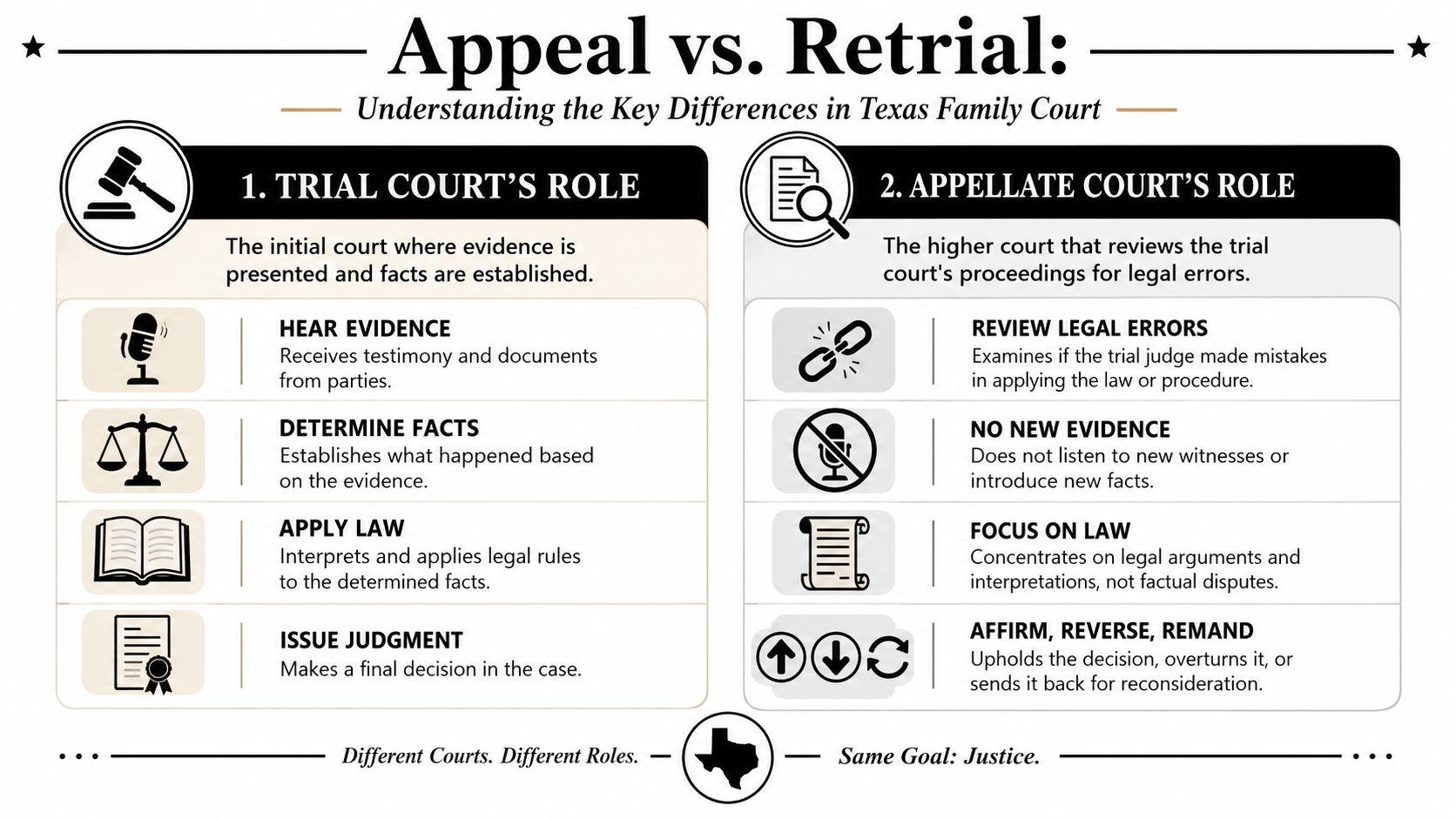
The court of appeals works from a closed file. It reviews the clerk's record, the reporter's record, the exhibits that were admitted, and the written arguments filed on appeal. It does not start over, decide which witness seemed more believable, or let a party repair gaps in the evidence after judgment.
That is the trade-off. Trial court is where facts are built. Appeal is where legal error is tested.
| Trial court | Appellate court |
|---|---|
| Hears testimony and receives evidence | Reviews transcripts, filings, and admitted exhibits |
| Rules on objections and procedure in real time | Decides whether those rulings were legally correct |
| Resolves fact disputes | Defers to many fact findings if supported by the record |
| Evaluates witness credibility in person | Does not re-weigh demeanor or hear new testimony |
| Signs the final order | May affirm, reverse, modify, or remand |
Terms clients need to understand early
The record is the official account of what happened below. It usually includes the clerk's record, which contains pleadings, orders, and filed papers, and the reporter's record, which contains testimony and oral rulings.
Briefing is the written appellate argument. A good brief does more than say the result was unfair. It identifies the ruling being challenged, cites the controlling law, points to the exact place in the record where the issue was preserved, and explains why the error affected the judgment.
Reversible error means more than a mistake. It means a mistake the appellate court can review and that likely mattered to the outcome.
One practical point gets missed often. The strength of an appeal depends not only on what went wrong, but on whether trial counsel made the record needed to show it. The standard the appellate court applies often controls that analysis. For a focused explanation, see the standards of review in a Texas appellate brief.
Appeals are won on preserved legal issues tied to a developed record, not on a stronger retelling of the same facts.
The Standard of Review What Makes an Error Reversible
A parent can leave trial convinced the result was wrong and still have a weak appeal. That gap usually comes down to the standard of review. Appellate courts do not ask which side told the more sympathetic story. They ask whether the trial court made a ruling the law permits on the record that was made.
In Texas family cases, the standard that controls many issues is abuse of discretion. In practice, that is a demanding standard. The appellant must usually show one of two problems: the ruling lacked adequate support in the evidence, or the court applied the wrong legal rule to the facts it had.
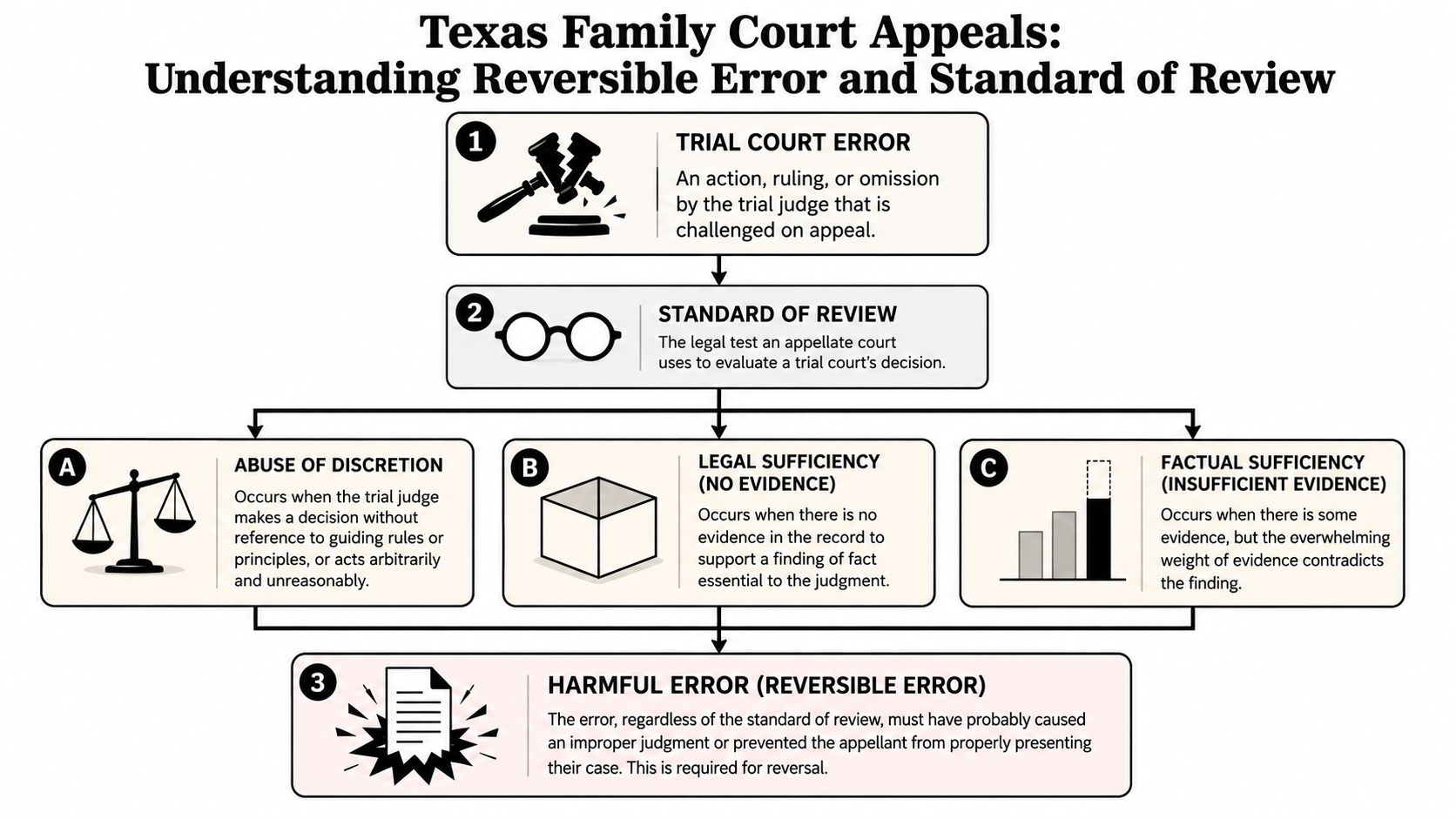
Abuse of discretion has a legal meaning. It does not simply mean the judge seemed harsh, impatient, or unfair from the losing party's point of view.
That distinction matters because it shapes both the argument and the odds. A complaint that feels strong at the kitchen table often fails on appeal if the record shows some evidence supporting the ruling and no preserved legal objection.
Three ways appellate courts examine error
Legal error
Legal error means the court used the wrong rule, misunderstood the governing statute, or reached a decision through the wrong legal framework. In a family case, that can include applying the wrong standard in a conservatorship dispute, misclassifying property under Texas law, or entering an order that does not match the required findings.
These issues can be strong on appeal, but only if the point was preserved and the error likely affected the judgment. A correct objection with a thin record can still be a problem. So can a good legal issue raised too late.
Legal insufficiency
Legal insufficiency is the no-evidence challenge. The argument is that an essential finding has no support that the law recognizes as enough.
This is often misunderstood. The question is not whether the other side's evidence was weak. The question is whether the record contains legally sufficient proof for the finding the judgment depends on.
Factual insufficiency
Factual insufficiency is different. Some supporting evidence exists, but the full record weighs so heavily the other way that the finding cannot stand.
These points require disciplined briefing. Appellate courts will not redo witness credibility calls because one side believes the judge trusted the wrong person. The brief has to tie specific testimony and exhibits to a clear argument about why the finding is against the great weight of the record.
Why the standard of review changes the entire appeal
The standard of review is the link between the trial court mistake and the appellate remedy. It tells you what kind of error matters, how much deference the trial judge gets, and what the briefing must prove. That is why experienced appellate lawyers start here, before drafting issues or promising a result.
The trade-off is straightforward. Deferential review makes reversal harder, but preserved legal error can still be powerful if the ruling turned on the wrong rule or an unsupported finding. For a practical explanation of how this shapes the written argument, see our guide to standards of review in a Texas appellate brief.
A fair appeal depends on more than identifying what went wrong. It depends on matching that problem to the correct standard, the preserved objection, and the part of the record that proves the error mattered.
Common Reversible Errors in Texas Family Court Cases
A parent leaves a final hearing convinced the result was wrong. On appeal, the harder question is whether the record shows a reversible legal error, and whether trial counsel took the steps required to preserve it. That connection between the mistake and the procedure is where many family appeals are won or lost.
Texas family cases tend to produce the same categories of appellate problems. The facts change, but the pattern is familiar. The trial court applies the wrong legal rule, makes findings the record cannot support, excludes or admits evidence in a way that probably affected the outcome, or conducts the hearing in a manner that denied a fair opportunity to be heard.
Child custody and visitation rulings
Custody appeals often start with a client saying the judge ignored what mattered most about the child. Sometimes that is true in a practical sense. The appellate issue, though, is more precise. The question is whether the ruling rests on evidence in the record and the correct best-interest framework.
Problems that can support reversal include:
- Restrictions without evidentiary support: A geographic restriction, supervised access requirement, or possession schedule that is not tied to evidence showing why the limitation serves the child's best interest.
- Use of the wrong legal standard: The court focuses on considerations the law does not permit, or fails to apply the required framework to conservatorship, possession, or modification issues.
- Procedural rulings that affected the hearing: A party was not allowed to present material evidence, cross-examine an important witness, or respond to late-disclosed claims.
Readers comparing these issues with more custody-specific examples often find it helpful to review our work in child custody appeals.
Property division in divorce cases
Property appeals usually turn on classification, valuation, and the reasoning behind a "just and right" division. A trial court has broad discretion, but broad discretion is not unlimited discretion.
A common appellate issue arises when separate property is treated as community property, or the court divides the estate based on a factual premise the record does not support. Another appears when the decree is difficult to enforce because the property award is internally inconsistent or too vague to carry out. In practice, these cases are often less about general unfairness and more about tracing the exact point where the evidence, findings, and decree stopped lining up.
For related disputes, see how these issues appear in our discussions of divorce appeals and property division appeals.
Support and maintenance problems
Support rulings are appealable when the court gets the law, math, or required findings wrong. That may involve child support calculated from the wrong net resources, spousal maintenance ordered without the statutory basis, or a denial that ignores a required legal step.
These cases require disciplined record work. An appellant usually needs to point to the numbers used, the evidence admitted, the findings made or omitted, and the statute the ruling failed to follow. A complaint that the amount felt unfair rarely goes far by itself.
Protective orders and due process concerns
Protective order appeals can move quickly and carry immediate consequences for possession, residence, firearms, employment, and reputation. Given these significant consequences, appellate courts pay close attention to whether the hearing was fair.
Reversible error may exist if a party did not receive adequate notice, had no meaningful chance to present evidence, was prevented from cross-examining the opposing witness, or the court relied on material outside the record. Similar concerns appear in protective order appeals.
Remote hearings can sharpen these problems, but the technology issue alone is usually not enough. The record must show what went wrong and why it mattered. If a witness could not be heard, an exhibit could not be presented, or counsel was cut off during cross-examination, that complaint has to be tied to a specific ruling and preserved in a way the appellate court can review. For a practical discussion of that process, see our guide to preserving trial court complaints for a Texas family appeal.
That is the recurring theme in family appeals. The ground for appeal is the "what." Preservation and procedure are the "how." Without both, even a strong complaint may never reach a decision on the merits.
Preserving Error and Meeting Strict Appellate Deadlines
The order is signed on Friday. By Monday, a parent is asking the question I hear all the time: "The judge got this wrong, so we can appeal, right?" Sometimes yes. Sometimes the problem is not the strength of the complaint, but whether trial counsel preserved it and whether the appellate timetable has already started to run.
That is the part many families miss. The ground for appeal is the "what." Preservation and deadlines are the "how." In practice, the "how" often decides whether the court of appeals will even consider the argument.
Preserving error at trial
Texas appellate courts usually require a timely, specific objection, motion, or request in the trial court, followed by a ruling or a refused ruling that appears in the record. If that step is missing, the complaint may be waived even if the underlying issue feels serious.
Clients are often surprised by that result. Fairness matters, but appellate judges review a record, not a memory of what should have happened. If the record does not show the complaint was raised clearly enough for the trial judge to address it, the argument is much harder to use on appeal.
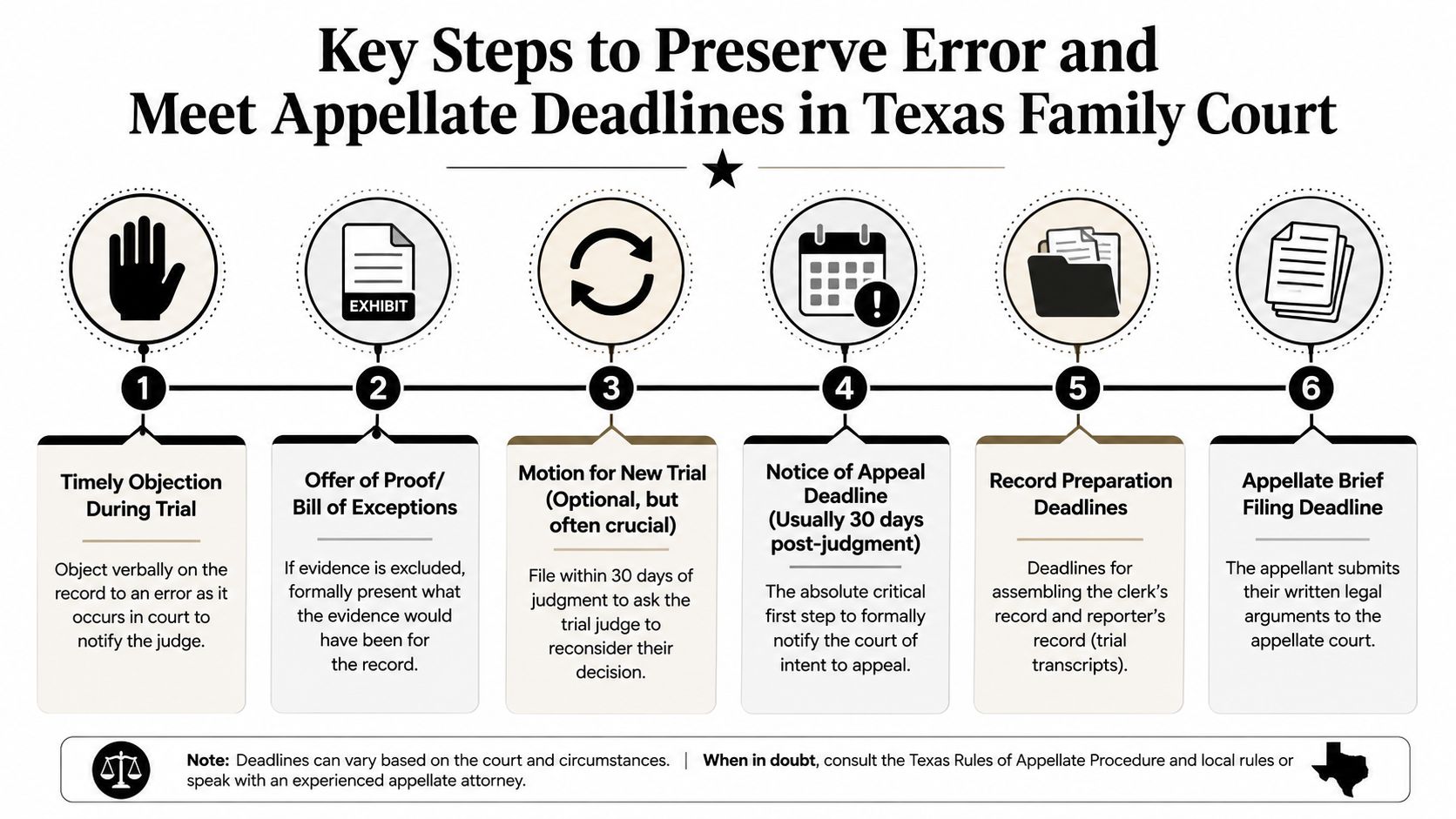
Preservation problems usually show up in familiar ways:
- Excluded evidence: If the court refused testimony or an exhibit, counsel often needs an offer of proof so the appellate court can evaluate whether the exclusion mattered.
- Procedural unfairness: If the hearing moved ahead without adequate notice, enough time to present evidence, or a meaningful chance to cross-examine, the objection usually needs to be made on the record when the problem occurs.
- Problems in the written order: If the final judgment contains defective language, a post-judgment motion may help clarify the complaint, request correction, and sharpen the issue for review.
For a practical explanation of that process, see our guide on preserving trial court complaints for a Texas family appeal.
Deadlines that control the appeal
Deadlines in Texas appeals are rule-driven and unforgiving. Under the Texas Rules of Appellate Procedure, the notice of appeal is generally due within 30 days after the judgment is signed. That deadline is generally extended to 90 days if a timely motion for new trial, motion to modify the judgment, motion to reinstate, or certain requests for findings and conclusions extends the timetable under the rules.
There is also a narrow safety valve. Texas Rule of Appellate Procedure 26.3 allows a short extension period if the party files the notice of appeal and a motion for extension within the additional time allowed by the rule. That does not mean extra time should be assumed. It means counsel should calculate deadlines immediately from the signed order and any timely post-judgment filings.
One practical point matters here. A party may have a strong appellate issue and still lose the right to raise it by waiting too long to get appellate counsel involved. I tell clients to get the signed order, any post-trial motions, and the hearing dates together first. Those documents usually answer the first strategic question, which is not whether the ruling felt wrong, but whether the appeal can still be perfected on time.
Finality matters too. In many family cases, only final orders are appealable, while temporary orders often must be challenged through different procedures, if review is available at all. That distinction affects strategy from the start because the right complaint filed in the wrong procedural posture will not get a merits decision.
The Path of an Appeal From Notice to Decision
Once the notice is filed on time, the case enters a very different phase. The pace is driven by records, briefs, and court rules rather than witness testimony.
A concise overview appears below.
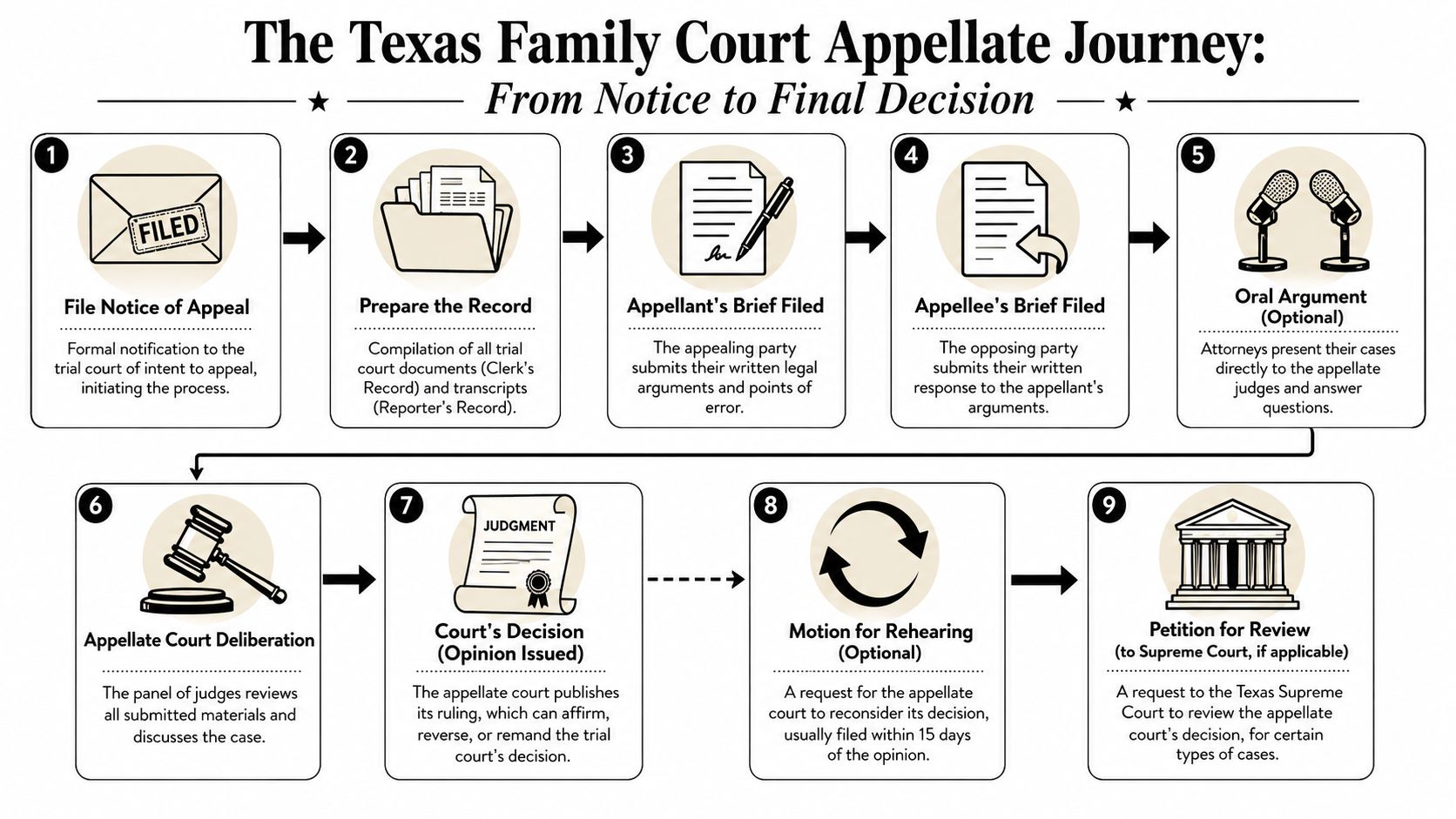
Step one through four
Notice of Appeal
This starts the appeal formally.Record preparation
The clerk's record and reporter's record are assembled. If something isn't in that record, the appellate court usually can't consider it. That's why The Appellate Record: Clerk's and Reporter's Records is so important in practice.Appellant's brief
This is the centerpiece of the appeal. The brief explains the facts from the record, identifies the legal error, states the standard of review, and argues why reversal is justified.Appellee's brief
The opposing party responds and argues why the trial court should be affirmed.
The process requires the moving party to file a Notice of Appeal, serve the opposing party, and submit a detailed brief outlining the legal errors and arguments for reversal. The appellate court then reviews the trial record, the appellant's brief, and any response from the non-appealing party to decide whether to affirm, reverse, modify, or remand the decision, as described by Ramos Law on Houston child custody appeals.
Here is a visual overview of that appellate sequence:
What happens after briefing
In some cases, the court allows oral argument. That doesn't mean the whole case is argued again. The justices ask focused questions about the law, the record, and the consequences of the parties' positions.
The court then issues a written opinion. The result may be:
- Affirmed: The trial court's judgment stands.
- Reversed: The appellate court changes the result in a material way.
- Modified: The appellate court adjusts part of the judgment.
- Remanded: The case goes back to the trial court for further proceedings on the issue identified.
Readers who want a chronological view often find this step-by-step Texas family law appeal process timeline helpful.
Seek a Fair Outcome with an Experienced Appellate Attorney
A family law appeal is a specialized form of advocacy. Trial instincts alone usually aren't enough. The work is different. It requires close reading of the record, command of the Texas Rules of Appellate Procedure, careful issue selection, and persuasive writing directed to a panel of justices rather than a trial judge.
That's why one of the most valuable services appellate counsel provides is an honest evaluation. Some cases involve a painful result but no reversible error. Others contain a viable appellate issue, but only if the argument is framed correctly and filed on time. Good appellate practice means telling those two situations apart early.
The Law Office of Bryan Fagan, PLLC handles Texas family law appeals involving custody, divorce decrees, property division, support, protective orders, and related post-judgment disputes. In a practical sense, appellate counsel reviews the trial record, identifies preserved issues, applies the correct standard of review, and prepares the briefing required for appellate review.
If you believe the court made a mistake in your family law case, our appellate attorneys can help you seek a fair outcome. Contact The Law Office of Bryan Fagan today for a free consultation.
If you believe the court made a mistake in your family law case, our appellate attorneys can help you seek a fair outcome. Contact The Law Office of Bryan Fagan, PLLC today for a free consultation.