A Texas family law appeal often costs $15,000 to $50,000+, and some cases start with a minimum retainer of $5,000 just for drafting the appeal brief in a shorter record. There isn't one fixed price, because the total depends on what the appellate court must review, how long the trial lasted, and how much work it takes to identify legal error and present it clearly.
You may feel your case was handled unfairly. A judge may have limited your time with your child, divided property in a way that doesn't make sense to you, or entered a final order that feels one-sided and hard to accept.
That reaction is common. But an appeal isn't driven by frustration alone. It's driven by the trial record, the Texas Rules of Appellate Procedure, the Texas Family Code, and whether the court made a legal mistake that an appellate court can correct. Cost matters because appellate work is specialized, document-heavy, and deadline-sensitive. If you're asking how much does an appeal cost in Texas, the better question is this: what are you paying for at each stage, and is the likely result worth that investment?
Your Guide to Texas Family Law Appeal Costs
A parent walks out of a final hearing certain the court missed something important. A spouse reads the signed decree and sees a property division that still feels legally wrong. At that point, the practical question is not whether the outcome feels unfair. It is whether the record supports an appeal, and what it will cost to present that appeal the right way.
An appeal asks a higher court to review the trial court record, the transcripts, the orders, and the legal rulings already made. That is why the spending often comes early in the process. The money goes toward collecting the record, identifying legal error, and building a written argument that can survive close scrutiny from the court of appeals.

Why clients are often surprised by the price
First-time appellants often assume the filing fee will be the main expense. In family law appeals, it usually is not. The larger cost usually comes from attorney time spent reviewing the record, researching the issues, and writing the briefs, along with the cost of preparing the clerk's record and reporter's record.
Those costs can rise quickly in matters such as:
- Child custody disputes, where temporary rulings, objections, findings, and final orders may all need close review
- Divorce appeals involving final decrees and alleged legal error
- Property division challenges, especially when a party argues the court ruled beyond the evidence presented
- Protective orders and enforcement rulings, where the consequences are serious and the procedural history may be contested
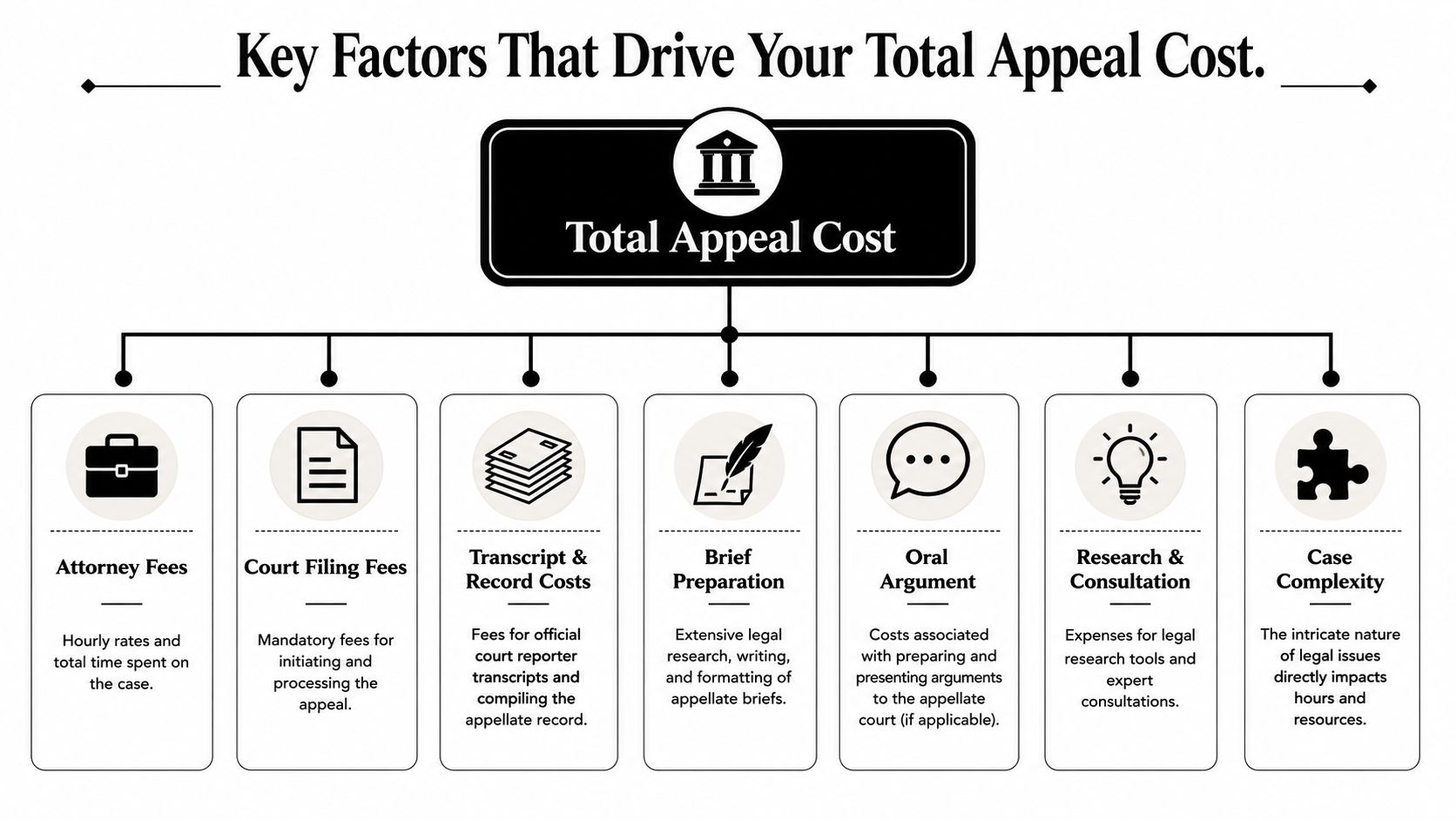
A useful way to budget for an appeal is to match each expense to a task. Filing fees cover getting the case into the appellate court. Record costs cover assembling what the court will read. Attorney fees cover the legal analysis, issue selection, and briefing that give the appeal its real chance of success. If oral argument is granted, that is another stage with its own preparation time and cost.
This is where strategy matters. Some appeals involve one strong issue in a limited record. Others involve a multi-day trial, several possible complaints, and a transcript that takes many hours to review. The total cost follows the amount of work required, so smart planning starts with an honest assessment of the record, the issues worth raising, and the result you are realistically trying to achieve.
Understanding the Appeal What You Are Paying For
You leave the courtroom feeling certain the judge got it wrong. A week later, the practical question arrives. What, exactly, are you paying for if you decide to appeal?
The answer starts with the kind of work an appeal requires. Trial counsel builds evidence and persuades the factfinder in real time. Appellate counsel works from a closed record, identifies legal error, measures the standard of review, and frames a written argument that gives the court a clear reason to reverse, modify, or remand.
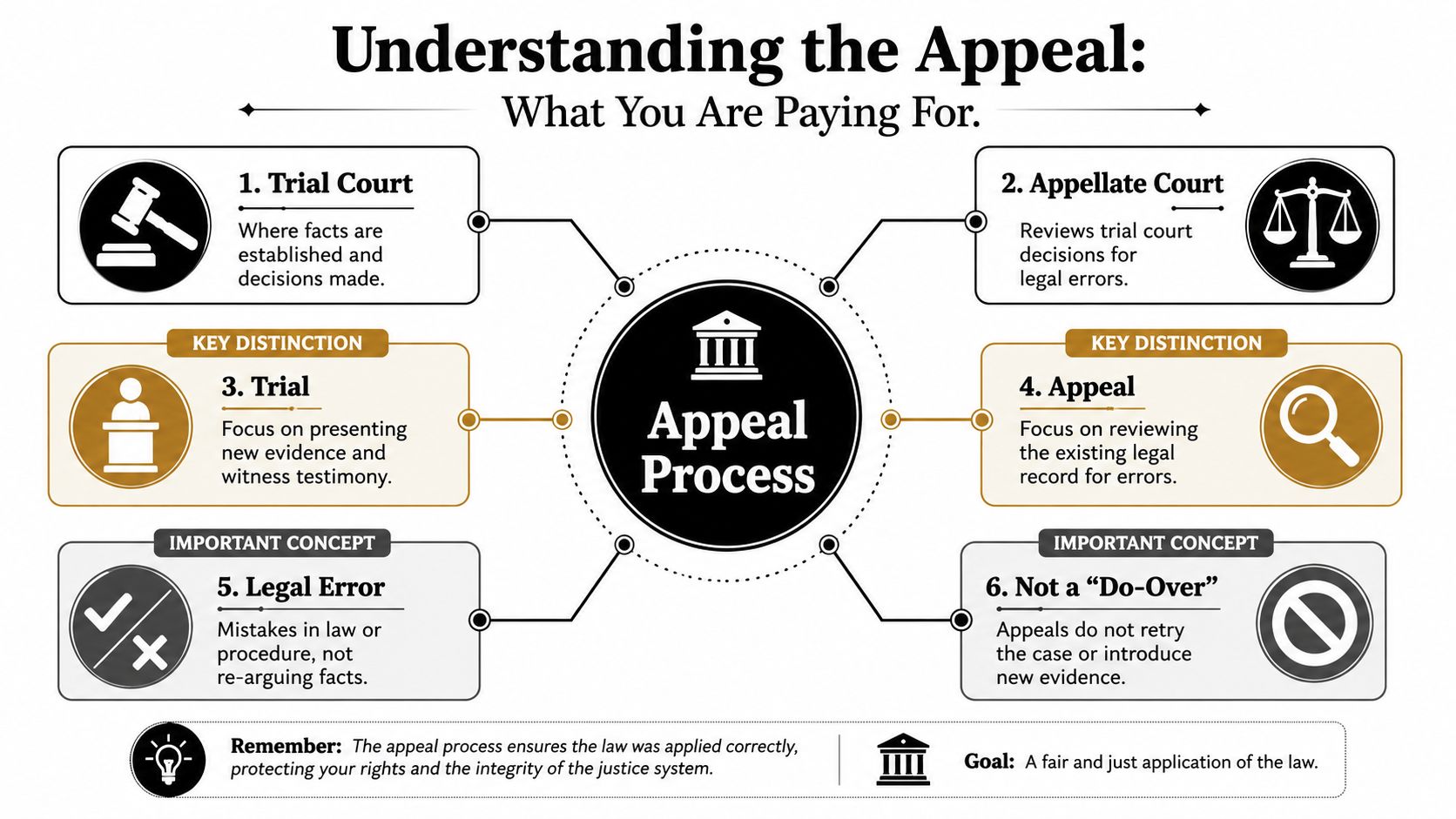
What an appeal is and what you are paying counsel to do
In family law appeals, the money usually follows four tasks.
First, counsel reviews the appellate record with discipline. That means reading the pleadings, orders, exhibits, and reporter's record to find errors that were preserved and that could affect the outcome. A large record costs more because it takes more attorney time to separate a real appellate issue from a bad ruling that is frustrating but unlikely to justify relief.
Second, counsel evaluates the standard of review. That step matters because some issues give the appellate court more room to intervene than others. If you want a fuller explanation of that concept, Standards of Review in Texas Family Appeals explains why it often shapes the value of an appeal before the first brief is filed.
Third, counsel writes the brief. A brief is the written argument submitted to the appellate court. It ties the facts in the record to the governing law and explains why the trial court's ruling should be affirmed, reversed, modified, or sent back for further proceedings.
Fourth, counsel prepares for the court's questions if oral argument is requested or granted. That stage does not happen in every case, but when it does, the work is focused and time-sensitive.
A reversible error is a mistake serious enough to justify appellate relief. In family cases, that usually falls into a few familiar categories:
- Legal error, such as applying the wrong rule under the Texas Family Code
- Procedural error, such as excluding evidence improperly or limiting a party's ability to present a case
- Abuse of discretion, where the ruling falls outside the reasonable range permitted by the law and the evidence
Clients often focus on the last category, because it sounds broad. In practice, it is narrower than people expect. Disagreement with the result is not enough. The record has to show that the court acted unreasonably under the governing law.
That is why good appellate budgeting starts with restraint. The strongest appeals usually focus on a small number of issues that were preserved, supported by the record, and worth the cost of briefing.
If you are trying to estimate what that legal work may require up front, it helps to understand how an average appellate lawyer retainer is structured. The retainer is not just paying for time on a calendar. It is paying for issue selection, record analysis, legal research, drafting, and strategic judgment about whether the appeal has a realistic path to relief.
A Detailed Breakdown of Texas Appeal Costs
A Texas family law appeal usually starts with a hard budgeting question. A parent may feel the trial court got custody wrong, or a spouse may believe the property division was plainly unfair. The next step is not just asking, "How much will this cost?" It is asking what each expense buys you in the appellate process, and whether that spending gives the appeal a realistic chance to succeed.
The total usually falls into three categories. First, there are court charges to open the appeal and move the record into the appellate court. Second, there are record-preparation costs, which matter because the judges decide the case from the written record, not from new testimony. Third, there are attorney fees, which pay for the legal analysis, issue selection, research, and briefing that turn a trial court complaint into an actual appellate argument.
Court costs and filing charges
Some costs are set by the court system and are relatively predictable.
In the Texas courts of appeals, the notice of appeal filing fee is generally modest. If a case continues to the Texas Supreme Court, the Texas Supreme Court fee schedule lists filing fees of $155.00 for a Petition for Review, $205.00 for a Direct Appeal from a state district court, and $75.00 if the petition is granted.
These filing charges rarely drive the overall budget. They matter because they start the process, but they are usually the smallest line item. Clients are often surprised to learn that the actual expense begins after the notice is filed.
Record preparation and transcript expense
The record is where many appeals become more expensive than clients expect.
The clerk's record includes the pleadings, motions, orders, judgment, and other filed documents. The reporter's record contains the hearing and trial transcripts. If the record is incomplete, a good issue can become much harder to prove. If the record is oversized, the lawyer has to spend more time finding where an objection was made, where the court ruled, and why the error was preserved.
According to Busby & Associates' fee information, the district clerk's record fee is approximately $500 and court reporter fees average about $1,500 per day of transcript preparation. Those numbers are useful because they show the strategic point. A one-day hearing and a four-day contested custody trial are not the same appeal to budget. The second file costs more before the first brief is even drafted.
Attorney fees and retainer structure
Attorney fees usually make up the largest share of the total cost because attorney judgment is crucial. The lawyer is not just reading the file. The lawyer is deciding which issues warrant presentation, which arguments are preserved, and which points are likely to persuade a panel of appellate judges.
If you want a practical sense of how an appellate lawyer retainer is commonly structured, start with the scope of the record and the number of viable issues. Busby & Associates' fee information states a minimum retainer of $5,000 for drafting an appeal brief when the trial record covers up to two days, with $2,500 per additional day of trial record. The same fee information also notes that defending an appeal with multiple distinct issues may add $3,000 per distinct issue, depending on the work required.
That kind of pricing reflects real appellate labor. A narrow legal issue from a short hearing is cheaper to analyze and brief than a fact-heavy custody appeal with several hearings, disputed evidentiary rulings, and multiple possible points of error.
Typical Cost Components of a Texas Family Law Appeal
| Cost Component | Typical Range / Amount | Notes |
|---|---|---|
| Notice of appeal filing fee in Texas intermediate appellate court | Generally modest | Administrative charge to initiate the appeal |
| Minimum retainer for drafting appeal brief | $5,000 | Covers attorney time for a trial record of up to two days |
| Additional attorney charge for extra trial days | $2,500 per day | Added when the record exceeds the included trial length |
| District clerk's record fee | Approximately $500 | For compiling the clerk's portion of the appellate record |
| Court reporter transcript fee | Averaging $1,500 per day | Often one of the largest non-attorney expenses |
| Typical attorney fee range for family law appeals | $15,000 to $50,000+ | As explained in this discussion of Texas appellate bills of costs |
| Defending multiple distinct issues | Additional $3,000 per distinct issue | Can increase the total budget significantly |
Budgeting insight: Ask for a cost estimate broken into three parts. Opening court charges, record costs, and attorney work. That format lets you see where the money is going and whether narrowing the issues or limiting unnecessary record designations could reduce the total bill.
In practice, the smartest appeal budgets are built around selectivity. Money spent on a complete record and a focused brief is usually far better spent than money chasing every frustration from the trial court.
Key Factors That Drive Your Total Appeal Cost
Two appeals can both challenge family court rulings and still cost very different amounts. The difference usually comes from scope. The original trial, the number of legal issues, and the type of relief requested all change how much work the appellate team must do.
The size of the trial record
A short final hearing is easier to package for appellate review than a long, contested trial. More hearing days usually mean more transcript pages, more exhibits, and more time spent locating where an error was preserved. That directly affects transcript charges and attorney time.
A custody appeal built on multiple hearings may cost more to brief than a focused dispute over one property ruling because the record is harder to master.
The number and type of appellate issues
A single strong issue can be efficient. Several weak or overlapping issues often increase cost without improving the result.
Examples include:
- One clean legal question that can be briefed directly from the record
- Several procedural complaints that require counsel to track objections, rulings, and preservation
- Abuse-of-discretion arguments that demand careful explanation of why the ruling fell outside reasonable judgment
Later in the process, related issues such as an appeal bond in Texas family law may also affect planning, especially when the judgment has financial consequences.
A brief visual overview can help if you're comparing these moving parts.
Whether you are appealing or defending
The person filing the appeal usually bears the first wave of cost because that side must assemble the record and prepare the opening brief. The party defending the judgment may still face substantial attorney fees, especially if the appeal raises several alleged errors or requires cross-points and a detailed response.
The most expensive appeal is often the one with no disciplined theory. Broad dissatisfaction creates broad invoices.
Example Scenarios Putting the Costs in Context
A cost estimate makes more sense when tied to a real type of case. Not every appeal belongs at the top of the range, and not every appeal stays near the lower end.
A focused property division appeal
A divorcing spouse believes the trial court misapplied the law when dividing a business interest. The trial itself was relatively short. The disputed issue is narrow, and the appellate record is manageable.
In a case like that, the spending is often easier to predict. The record costs are more contained, and counsel can build the brief around a targeted legal argument instead of a long list of complaints. If the issue was properly preserved, this kind of appeal may justify the expense more readily than a case built on general unfairness.
A contested child custody appeal
Now consider a parent appealing custody and visitation rulings after a hard-fought trial with multiple witnesses, evidentiary disputes, and several challenged findings. That appeal may involve legal error, procedural error, and abuse-of-discretion arguments all at once.
That kind of file usually costs more because the lawyer must review a larger record and make strategic choices about which issues deserve space in the brief. The transcript alone can materially expand the budget when the hearing spanned multiple days.
A defensive appeal after winning at trial
Sometimes the issue isn't whether to appeal, but whether to defend a favorable order. A parent who won a custody ruling may still need appellate counsel if the other side files a notice of appeal.
The economics are different, but the pressure is real. Defending the judgment may still require a full review of the record, a response brief, and issue-by-issue analysis. If the opposing party raises multiple distinct complaints, defense costs can climb quickly even when the trial court got it right.
A practical lesson runs through all three scenarios. Clients do best when they ask early whether the likely appellate issue is narrow and supportable, or broad and expensive. That question usually tells you more about cost than raw emotion ever will.
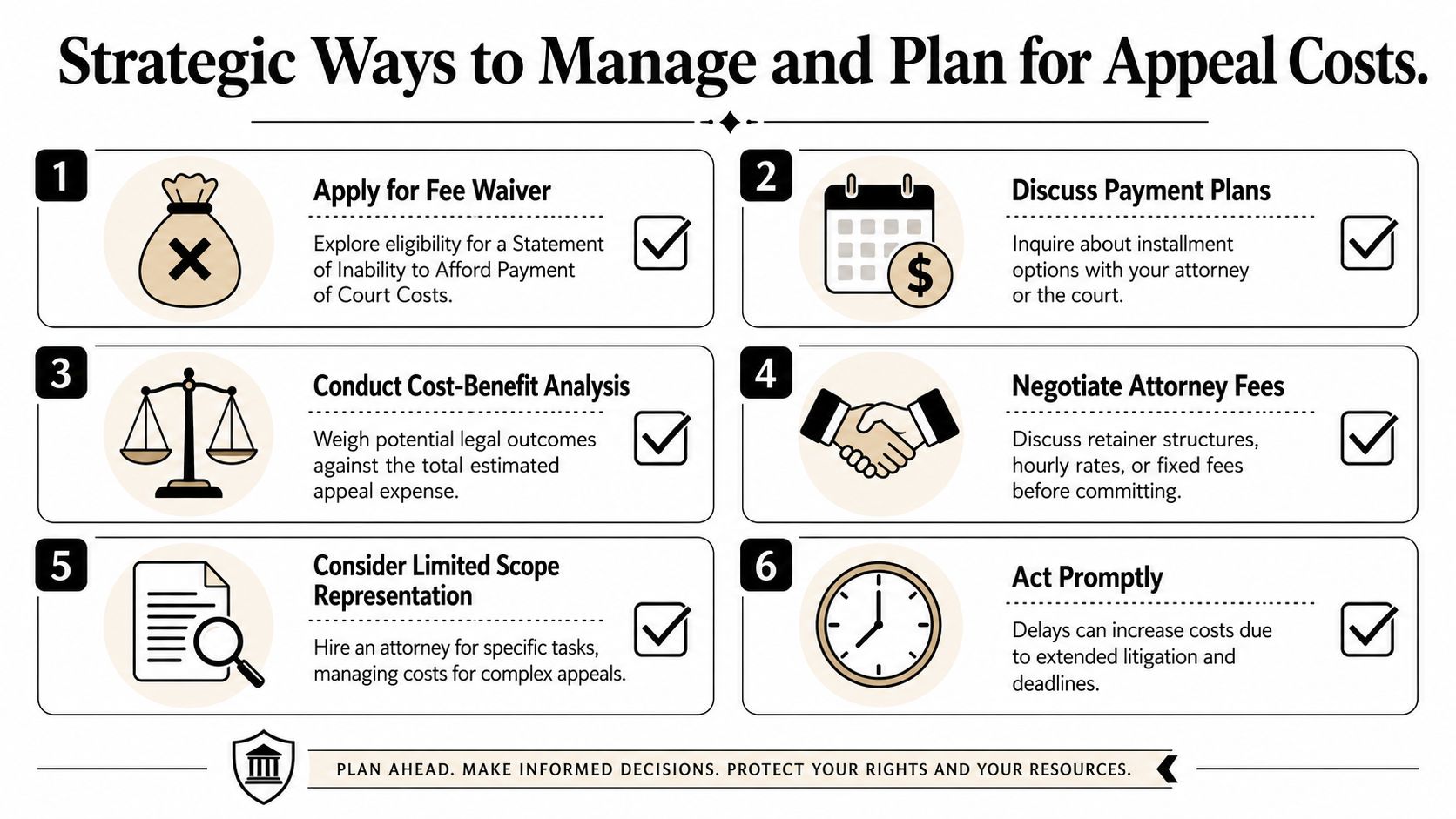
Strategic Ways to Manage and Plan for Appeal Costs
Appeal costs are serious, but they're not unmanageable if you plan early. The strongest financial decisions usually happen before the briefing starts.
Start with timing and reimbursement strategy
The most important early deadline in a Texas family law appeal is the filing deadline. In divorce appeals, the notice must be filed within 30 days from the date the final judgment or decree is signed and entered, and missing that deadline permanently forfeits the right to challenge the ruling, as explained in this discussion of Texas divorce appeal timing.
That deadline has a cost lesson built into it. Delay doesn't save money if it destroys the appeal.
A second planning point is often missed. Under Texas Family Code sections 6.709 and 109.001, a party must request and prove projected appellate fees at the trial level to preserve the chance of having those fees awarded later. That point is explained in this article discussing projected appellate fees under the Texas Family Code. If you wait until the appeal ends to ask, you may lose that reimbursement path.
Smart ways to control the budget
Some strategies are procedural. Others are practical.
- Ask for a focused issue review: A preliminary evaluation can tell you whether the case has a strong appellate issue or only general dissatisfaction.
- Request phased budgeting: Separate the estimate for record review, brief drafting, and any later argument work.
- Explore court-cost relief if needed: Some litigants may seek relief from certain court costs through a statement of inability to afford payment.
- Use cost-benefit analysis early: A realistic review of likely upside helps avoid spending heavily on an appeal with weak legal footing. This is the core question behind cost vs. benefit of appealing a family law case in Texas.
One overlooked advantage: when clients narrow the appeal to the strongest preserved issue, they often improve both clarity and cost control.
You can also ask whether limited-scope appellate help makes sense in your situation. In some matters, clients want a second opinion on viability before committing to full briefing. That won't fit every case, but strategic triage often saves more than last-minute scrambling.
An Experienced Advocate Is Your Strongest Asset
You may leave the trial court feeling certain the judge got it wrong. Then the appeal begins, and the question changes. It is no longer only whether the result felt unfair. It is whether the record shows a legal error the appellate court can correct, and whether that error is worth the cost of pursuing.
That is why experienced appellate counsel matters. Good appellate work is not just strong writing. It is early judgment about where your money should go. A lawyer has to identify the issues that were preserved, match them to the correct standard of review, and decide which arguments deserve full development and which ones will only add pages and fees without improving the odds.
That discipline affects cost at every stage. A careful lawyer can often save a client money by narrowing the appeal before the briefing begins, instead of billing time on weak points that the court is unlikely to reach. In family law appeals, the client who raises fewer, stronger issues is often in a better position than the client who wants to challenge everything.
Timing matters too. Appellate deadlines arrive quickly, and delay can force rushed decisions about notices, records, and briefing strategy. Early review gives you more room to budget intelligently, preserve options, and avoid paying for last-minute work that could have been handled more efficiently.
I tell clients to treat an appeal like a targeted legal project. Ask four questions at the start. Is there a real legal error? Does the record support it? What will it cost to present it properly? What practical result are you trying to achieve if you win?
Those are not abstract questions. They determine whether the appeal is a sound use of resources.
If you believe the court made a mistake in your family law case, The Law Office of Bryan Fagan, PLLC can review the ruling, the record, and the likely cost of an appeal so you can make a clear decision about your next step.