You may feel your case was handled unfairly. A judge may have overlooked key evidence, applied the wrong rule, or entered an order that doesn't match what happened in court. In Texas family law, that feeling matters, but an appeal only moves forward if it follows strict appellate procedure.
A notice of appeal in Texas family law is the document that starts that process. It doesn't argue your whole case. It tells the courts that you are appealing, and it triggers the next steps under the Texas Rules of Appellate Procedure.
That sounds simple. It isn't.
Family law appeals involve short deadlines, rigid filing rules, and a record-based review that is very different from trial court practice. If you're considering an appeal involving child custody, divorce, property division, or protective orders, the path forward depends on getting the procedure right from the start.
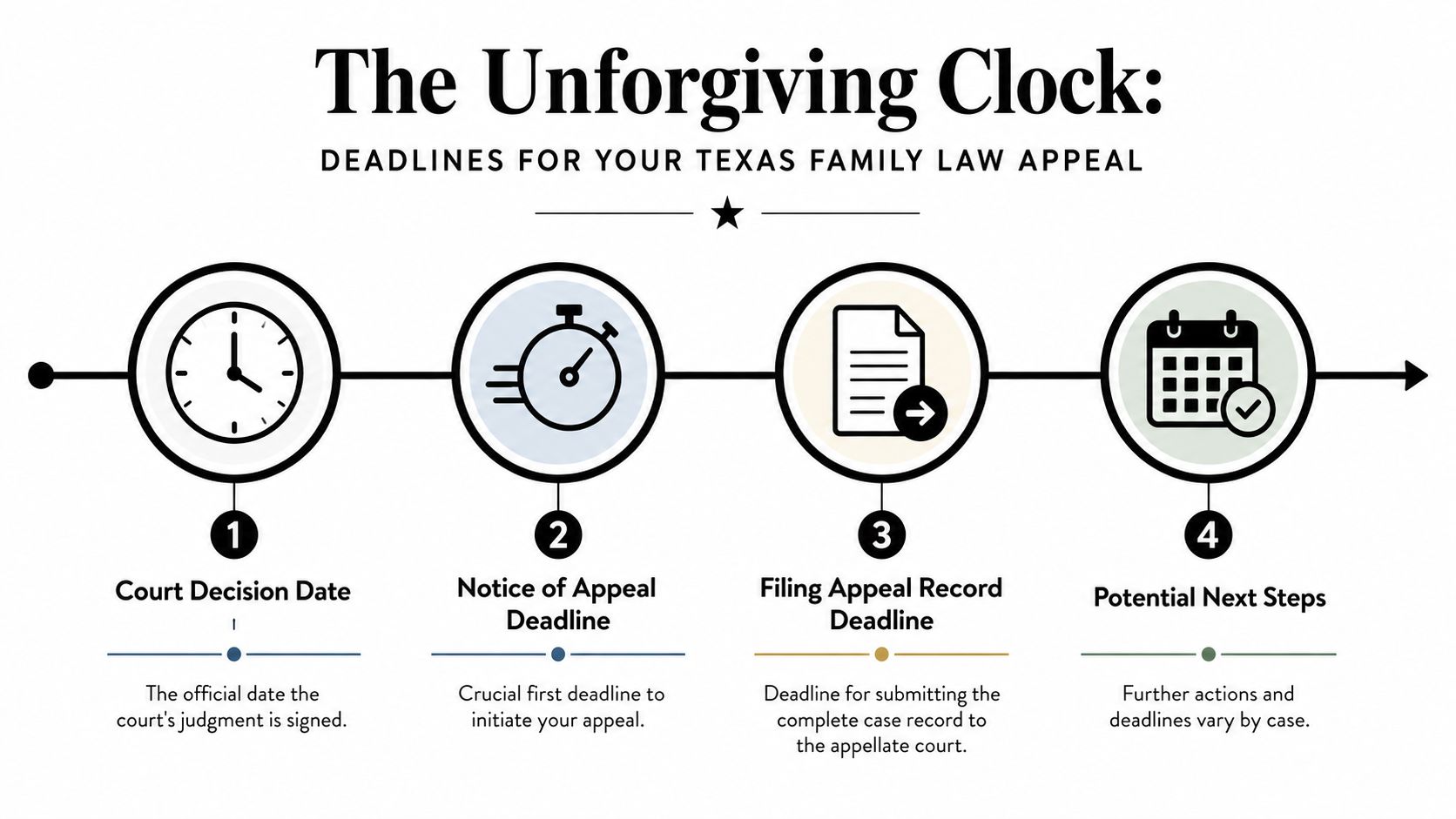
The Unforgiving Clock Deadlines for Your Texas Family Law Appeal
If you believe the court got it wrong, the first issue isn't whether the judge was fair. The first issue is time. Texas appellate deadlines are strict, and a missed deadline can end the case before the appellate court ever looks at the merits.
The standard deadline
In Texas family law cases, the notice of appeal must be filed within 30 days after the final judgment is signed under TRAP 26.1(a). If a deadline-extending motion like a motion for new trial is timely filed, the deadline extends to 90 days after the judgment date. For accelerated appeals, including parental termination cases, the deadline is 20 days and can't be extended by post-trial motions, as explained in Texas appeal deadlines under TRAP 26.1(a).
That means the signing date matters. Not the day you got upset. Not the day you talked to family. Not the day you found a new lawyer.
Practical rule: Calculate from the date the judge signed the final order, then confirm whether any valid post-judgment filing extended the deadline.
For some readers, a deeper review of Texas family appeal deadlines that can destroy a case is helpful because several family orders move on shorter or less forgiving timelines than people expect.
Why deadline analysis is harder than it looks
Two people can leave the same courtroom with very different appellate clocks. A standard divorce decree usually follows the regular deadline. A parental termination order may fall into the accelerated category. Some family code provisions also create unusual timing questions.
One narrow example appears in certain adjudication matters under Chapter 56 of the Texas Family Code, where a statutory exception may allow an appeal even if the adjudication order was signed more than 30 days before the notice of appeal, as discussed in this review of Texas Family Code Chapter 56 appeal timing.
That's why “I still have time” is one of the most dangerous assumptions in appellate work.
- Signed order first: Get a file-marked copy of the order or judgment.
- Classify the appeal: Decide whether it is standard or accelerated.
- Check post-judgment filings: A motion for new trial may change the deadline in a standard appeal.
- Act before arguments are perfect: File on time first. Fine-tune strategy next.
If your appeal later reaches argument, Oral Argument in Texas Courts of Appeals explains what happens if your family appeal is set for argument.
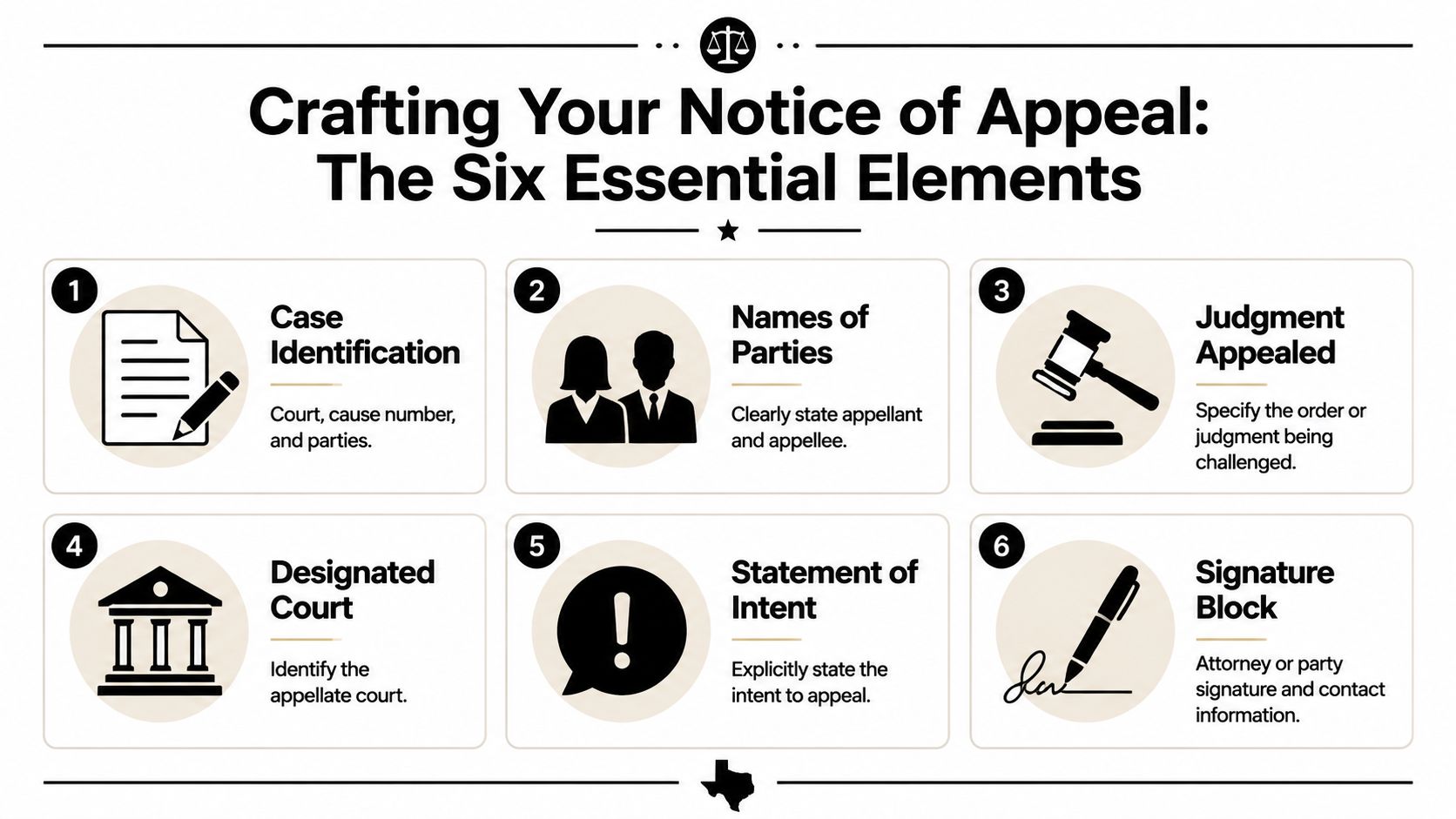
Crafting Your Notice of Appeal The Six Essential Elements
Filing on time is only the first step. The notice itself must contain the required information. A notice of appeal isn't a long brief, and it isn't the place to explain every injustice that happened at trial. It is a formal procedural document.
The six items the rules require
Under TRAP 25.1(d), the notice of appeal must contain six specific elements: (1) identify the trial court and state the case number and style, (2) state the date of the judgment appealed from, (3) state that the party desires to appeal, (4) state the appellate court to which the appeal is taken, (5) state the name of each filing party, and (6) in accelerated appeals, declare the appeal is accelerated, as stated in TRAP 25.1(d) in the Texas appellate rules.
In plain English, the notice answers six basic questions:
- Which case is this
- What order are you appealing
- Who wants to appeal
- Which appellate court should receive it
- Who is filing
- Is this an accelerated appeal
What each element means in practice
Some mistakes look small but create avoidable trouble. Listing the wrong judgment date can create confusion about what order is being challenged. Failing to name all filing parties can affect who is before the appellate court. Omitting the accelerated-appeal language in a case that requires it can cause immediate problems.
A good notice is short, accurate, and boring. If it reads like an emotional closing argument, it is probably doing the wrong job.
Here is a simple sample format:
Sample language
In the ___ Court of ___ County, Texas, Cause No. ___.
Appellant ___ files this Notice of Appeal from the final judgment signed on ___.
Appellant desires to appeal to the ___ Court of Appeals.
The party filing this notice is ___.
This appeal is accelerated. [Use only if applicable.]
What the notice is not
The notice does not explain every legal error. It does not attach new evidence. It does not ask the appellate court to reconsider the facts from scratch.
That work comes later in the briefs. Briefing means the written legal arguments filed in the court of appeals. Those briefs explain what error occurred, where it appears in the record, what legal standard applies, and why the mistake mattered.
Filing and Serving Your Notice The Logistical Steps
A properly drafted notice still has to be filed the right way. In Texas family appeals, the notice is filed in the trial court, not directly in the court of appeals. That point surprises many people.

Where the filing goes
The notice of appeal is the procedural trigger, not the substantive argument, and it must be filed in the trial court with a copy simultaneously transmitted to the appropriate court of appeals to start the record-preparation phase, as explained in this discussion of perfecting the appeal under Tex. Rule App. P. 25.1 and 26.1(a).
That means the clerk who handled the underlying family case is still central to the process. The trial court clerk receives the notice, and the appeal begins from there.
Service matters too
You also have to serve the other side. Service means formally providing the filed document to all parties or counsel of record so everyone has notice that the appeal has started.
This part sounds administrative, but appellate cases can turn on service and notice issues. If your trial-level problem involved notice defects, appealing when you were not properly served in Texas may help you see how service problems can affect the larger strategy.
- File in the trial court clerk's office: Start where the final order was entered.
- Send the required copy: The court of appeals must receive notice that the case is moving up.
- Serve all parties: Opposing counsel or self-represented parties must receive the notice.
- Keep proof of filing: Save file-stamped copies and confirmation records.
Costs and access to the court
Appeals involve filing fees and record-related costs. If paying court costs is a problem, Texas procedure also provides a path for parties who need to file a Statement of Inability to Afford Payment of Court Costs.
That doesn't remove the need for careful procedure. It just helps preserve access to the appellate system while the case moves forward.
Beyond the Notice Perfecting the Appeal and Preparing the Record
Many clients think the notice of appeal is the appeal. It isn't. It opens the door, but the appellate court still needs the official record to review what happened below.

Appeals review the existing record
A family law appeal is not a second trial. The appellate court does not hear new witnesses, weigh fresh exhibits, or decide who seems more believable in person. It reviews what is already in the record to decide whether the trial court committed a legal or procedural error.
That point is critical because many disappointed litigants want to “explain what really happened.” On appeal, the question is narrower. Did the existing record show a harmful mistake under the governing law?
The two main parts of the record
The appellate record usually includes two major pieces:
| Part of the record | What it contains | Why it matters |
|---|---|---|
| Clerk's Record | Pleadings, motions, orders, filings, and admitted documents kept by the clerk | Shows what was filed, what the court signed, and what issues were formally presented |
| Reporter's Record | The transcript of hearings and trial proceedings | Shows testimony, objections, rulings, and what lawyers and witnesses actually said |
If a key hearing isn't transcribed, the appellate court may have no reliable way to review what happened at that hearing. If a document was never admitted or filed, it may not be part of the appellate universe at all.
The record is the case on appeal. If something important is missing from the record, the court usually won't fill in the blanks for you.
What perfecting the appeal really means
Lawyers often use the phrase perfecting the appeal. In practical terms, that means taking the required procedural steps to properly invoke appellate jurisdiction and move the case into the record-and-briefing stage.
That includes more than filing the notice. It often involves designating the necessary record, arranging for transcripts, monitoring clerk and reporter deadlines, and making sure the appellate court receives a complete file.
A fuller explanation of what the appellate record is and why it matters in Texas is useful if you're trying to understand why appellate work focuses so heavily on transcripts, exhibits, and filed motions.
What can count as reversible error
A reversible error is a mistake serious enough that the appellate court may reverse the judgment or send the case back for further proceedings. In Texas family court, common examples can include:
- Wrong legal standard: The trial court applies the wrong rule from the Texas Family Code.
- Improper evidentiary ruling: The court excludes admissible evidence or admits evidence that should have been kept out.
- Procedural violation: The court fails to follow a required procedure in a way that affects the result.
- Defective order: The signed order doesn't accurately reflect the ruling or contains legal defects.
Not every mistake is reversible. Appellate courts look for errors that mattered, not just errors that existed in the abstract.
Common Pitfalls and Why Most Appeals Are Not DIY Projects
Many family law appeals fail before the court reaches the heart of the dispute. That isn't because every trial judge was right. It's because appellate procedure is technical, and technical mistakes can be fatal.
Nationally, fewer than 20% of civil appeals succeed, Texas family law appeals face even lower success rates because of the abuse-of-discretion standard, and 30–40% of family law appeals are dismissed for procedural deficiencies such as failing to include the trial transcript in the appellate record, according to this review of family law appeal outcomes and procedural dismissals.
Abuse of discretion in plain English
Abuse of discretion doesn't mean the judge made you angry. It means the trial court made a decision outside the zone of reasonable judicial choices under the law and the record.
That standard is hard for appellants. Family judges have broad discretion in custody, visitation, and property issues. If your complaint is only that “the judge believed the other side,” that usually isn't enough.
A stronger appeal points to a legal problem. Maybe the judge applied the wrong statutory standard. Maybe the court excluded evidence it should have admitted. Maybe the written order grants relief the pleadings did not support.
Error preservation is where many appeals break down
An appellate court usually won't review a complaint unless the issue was properly raised in the trial court. That is called error preservation.
Texas Rule 33.1(a)(1) is unforgiving on this point. Complaints must be made with enough specificity to alert the trial court. A vague objection often won't do it. And in multi-party cases, one parent's objection does not automatically preserve the issue for the other parent, a nuance highlighted in the Texas Children's Commission presentation on preserving your record for appeal.
If the record doesn't show a specific complaint, a ruling, and a preserved issue, the appellate court may treat the point as waived.
What doesn't work well on appeal
Some arguments feel powerful to a client but rarely help in appellate court:
- Pure factual disagreement: “The judge should have believed me.”
- New evidence after trial: Appellate courts generally don't consider it.
- Broad unfairness claims: “The whole case was biased” is not enough without preserved, record-based legal points.
- Shotgun objections: General objections that don't clearly identify the legal problem often preserve nothing.
That's why most appeals aren't do-it-yourself projects. The work is not just writing forcefully. It's identifying preserved error, matching it to the right standard of review, locating it in the record, and presenting it in a way appellate judges can act on.
How an Appellate Attorney Can Help You Seek a Fair Outcome
You read the judge's order, know the result is wrong, and want someone to tell the court what happened. On appeal, that instinct has to be translated into a very specific kind of legal work. Appellate judges do not retry the case. They review a fixed record, apply technical standards of review, and decide whether the trial court made a reversible legal error.
That is why trial skill and appellate skill are different.
| Aspect | At Trial | On Appeal |
|---|---|---|
| Main focus | Present evidence and persuade the factfinder | Identify legal error in the existing record |
| Proof source | Witnesses, exhibits, live testimony | Clerk's Record, Reporter's Record, written briefs |
| Role of facts | Facts are developed and contested | Facts are reviewed through the trial record |
| New evidence | Usually allowed if properly offered | Not allowed |
| Decision-maker | Judge or jury | Appellate judges |
| Core advocacy tool | Objections, testimony, exhibits | Briefing and legal analysis |
What an Appellate Attorney Does
A good appellate review starts with disciplined questions, not broad claims of unfairness.
Is the order final and appealable? Was the notice filed on time? Did the trial lawyer preserve the issue with a specific objection or motion? What standard of review applies? In family law, that last question matters more than many clients expect. If the issue is reviewed for abuse of discretion, the question is usually not whether the appellate court would have made a different call. The question is whether the trial judge acted without guiding legal rules or reached a decision the record cannot support. That is a hard standard to beat, and clients deserve a clear answer about that risk early.
An appellate attorney translates those rules into an action plan a non-lawyer can follow. That usually includes:
- reviewing the judgment and post-judgment filings for appellate deadlines
- identifying which complaints were preserved and which are likely waived
- matching each viable issue to the correct standard of review
- examining the clerk's and reporter's records for the pages that matter
- drafting a brief that gives the court a focused, record-based reason to reverse or remand
- preparing for oral argument if the court requests it
Procedure matters because even a strong grievance can fail if it is framed the wrong way. I often have to tell clients that a point feels important but is not one the court of appeals can decide. That is not dismissing the problem. It is the work of separating what is frustrating from what is reversible.
Why early appellate strategy matters
The best time to start appellate analysis is often immediately after the trial court signs the order. At that stage, counsel can evaluate whether a motion for new trial, a request for findings, or another post-judgment filing will help preserve issues, extend deadlines, or sharpen the record for review. Waiting too long can close off options that were available for only a short window.
The Law Office of Bryan Fagan, PLLC handles family law appeals involving custody, visitation, property division, support, protective orders, contempt, and enforcement judgments through record-based review under the Texas Family Code and the Texas Rules of Appellate Procedure.
A fair outcome on appeal does not come from retelling the case more forcefully. It comes from identifying a legal error the court can correct, presenting it cleanly, and avoiding procedural mistakes that can end the appeal before the court reaches the merits.
If you believe the court made a mistake in your family law case, our appellate attorneys can help you assess your options and pursue the strongest issues the record supports. Contact The Law Office of Bryan Fagan today for a free consultation.